Trigonometry: SOH CAH TOA, elevation and 3D
What this lesson covers
- In similar right-angled triangles the ratios of sides are fixed for a given angle, which is what sine, cosine and tangent name.
- Choosing the ratio depends on which two sides are known or wanted relative to the angle.
Pythagoras needs two sides
- Pythagoras links the three sides, and no angles.
- Trigonometry links a side to an angle.
- So one side and one angle is enough.
| What you know | What you can find | Tool |
|---|---|---|
| Year 10: Pythagoras | two sides give the third | no angles used |
| Level 1: a side | from a side and an angle | sin, cos or tan |
| Level 1: an angle | from two sides | inverse functions |
| Every step | says why it is allowed |
Same angle, same shape
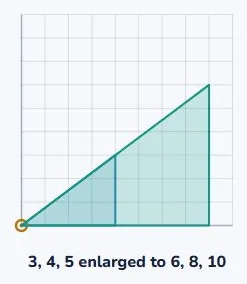
- Enlarge a right triangle from the corner with the angle.
- Every side doubles. The angle does not change.
- So the sides stay in the same proportion.
The ratios belong to the angle
- Divide one side by another in each triangle.
- The answers are identical every time.
- Sine, cosine and tangent are names for these ratios.
| Sides | opp ÷ hyp | adj ÷ hyp | opp ÷ adj |
|---|---|---|---|
| 3, 4, 5 | 3 ÷ 5 = 0.6 | 4 ÷ 5 = 0.8 | 3 ÷ 4 = 0.75 |
| 6, 8, 10 | 6 ÷ 10 = 0.6 | 8 ÷ 10 = 0.8 | 6 ÷ 8 = 0.75 |
| 9, 12, 15 | 9 ÷ 15 = 0.6 | 12 ÷ 15 = 0.8 | 9 ÷ 12 = 0.75 |
| Angle 36.9° | sin = 0.6 | cos = 0.8 | tan = 0.75 |
Try it: change the triangle
Label the sides from the angle
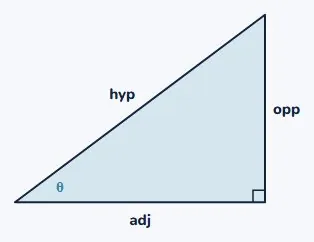
- Hypotenuse: opposite the right angle, the longest side.
- Opposite: across the triangle from θ.
- Adjacent: next to θ, and not the hypotenuse.
Move the angle, the labels move
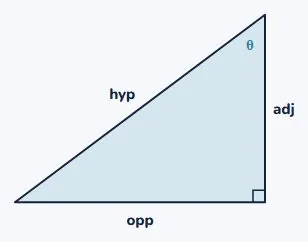
- Same triangle, now θ is at the top corner.
- The vertical side is next to θ now: adjacent.
- The hypotenuse never moves.
SOH CAH TOA picks the ratio
- Label the side you know and the side you want.
- The third side is not involved.
- The ratio that uses your two sides is the one.
| Rule | Ratio | Uses |
|---|---|---|
| SOH | sin θ = opp ÷ hyp | opp and hyp |
| CAH | cos θ = adj ÷ hyp | adj and hyp |
| TOA | tan θ = opp ÷ adj | opp and adj |
| To choose | label all three sides | drop the unused one |
Try it: SOH CAH TOA
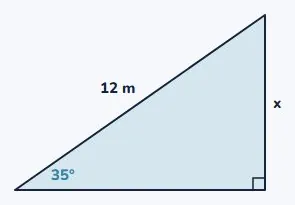
Finding a side: unknown on top
- x is opposite 35°, 12 m is the hyp: SOH.
- Sin 35° = x ÷ 12, so x = 12 × sin 35°.
- x = 6.88 m (3 s.f.)
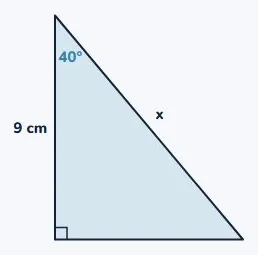
Finding a side: unknown on the bottom
- 9 cm is adjacent to 40°, x is the hyp: CAH.
- Cos 40° = 9 ÷ x, so x × cos 40° = 9.
- x = 9 ÷ cos 40° = 11.7 cm (3 s.f.)
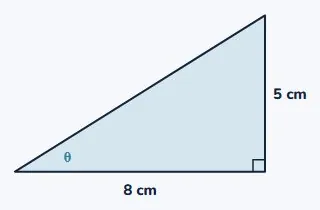
Finding an angle: go backwards
- 5 cm opposite, 8 cm adjacent: TOA.
- Tan θ = 5 ÷ 8 = 0.625
- Θ = tan⁻¹(0.625) = 32.0° (1 d.p.)
Triangle solver
Degree mode, and rounding
- Check the mode: sin 30° should give 0.5.
- Keep every digit until the last line.
- Round the answer, and say how you rounded.
| Setting | Test or rule | Why |
|---|---|---|
| Degree mode | sin 30° = 0.5 | check it first |
| Radian mode | sin 30 = −0.988 | wrong mode |
| Mid-working | keep every digit | round at the end |
| Lengths | 3 significant figures | with units |
| Angles | 1 decimal place | say you rounded |
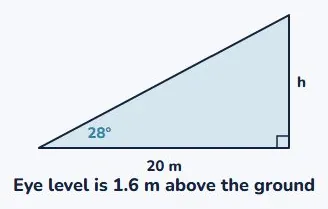
Angle of elevation: a tree
- 20 m from the tree, looking up 28° from eye level.
- Tan 28° = h ÷ 20, so h = 20 × tan 28° = 10.634… m
- Add eye height 1.6 m: the tree is 12.2 m (3 s.f.)
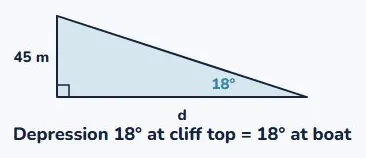
Angle of depression: a boat
- Looking down 18° from a 45 m cliff to a boat.
- Alternate angles: 18° at the boat too.
- d = 45 ÷ tan 18° = 138 m (3 s.f.)
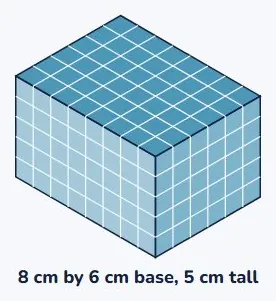
In 3D: Pythagoras on the base first
- A cuboid 8 cm by 6 cm, 5 cm tall.
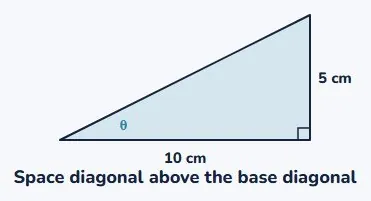
- The space diagonal sits above the base diagonal.
- Base diagonal = √(8² + 6²) = √100 = 10 cm
Then trigonometry in the upright triangle
- Height 5 cm opposite θ, base diagonal 10 cm adjacent.
- Tan θ = 5 ÷ 10 = 0.5
- Θ = tan⁻¹(0.5) = 26.6° (1 d.p.)
Try it: tree, cliff and box
What to take away
- Label from the angle, choose the ratio, then give the reason.
| Why ratios work | same angle, same side ratios |
| Label from the angle | opp faces it, hyp faces the right angle |
| Choose the ratio | the two sides involved pick SOH, CAH or TOA |
| Unknown on top | multiply: x = 12 × sin 35° |
| Unknown on bottom | divide: x = 9 ÷ cos 40° |
| Finding an angle | use sin⁻¹, cos⁻¹ or tan⁻¹ |
| Depression | equals the elevation from below |
Common mistakes
- cos 40° = 9 ÷ x, so x = 9 × cos 40° = 6.89 cmx is on the bottom, so x = 9 ÷ cos 40° = 11.7 cm; the hypotenuse must be longer than 9 cm.
- sin 30 = −0.988The calculator is in radian mode; switch to degrees, where sin 30° = 0.5, before any trig question.
- The tree's height is 20 × tan 28° = 10.6 m.That is only the height above eye level; add the 1.6 m eye height, so the tree is 12.2 m.
- With θ at the top corner, the vertical side is still the opposite.Labels depend on where θ is: the vertical side is now next to θ, so it is adjacent; only the hypotenuse never moves.
Your turn: eight questions
- Label each triangle first.
- Question 2 needs the alternate-angle reason.
- Question 4 needs Pythagoras before trigonometry.
A 6 m ladder makes 70° with the ground. How high does it reach?
A 30 m lighthouse sees a kayak at a 12° depression. How far out?
A ramp rises 1.2 m over 9 m across. Find its angle.
A box is 12 by 5 cm, 8 cm tall. Space diagonal angle to the base?
You know the side adjacent to θ and want the hypotenuse. Which ratio do you use?
In a right-angled triangle, the side opposite a 25° angle is 7 cm. Find the hypotenuse.
Mia has opposite 4 m and hypotenuse 10 m, and writes θ = tan⁻¹(4 ÷ 10). What is the correct angle?
Rangi stands 40 m from a flagpole with his eyes 1.5 m above the ground. He looks up 22° to the top. How tall is the pole?
Show answer
1. 5.64 m. The height is opposite the 70° angle and the ladder is the hypotenuse, so use sine: h = 6 × sin 70° = 5.638. 2. 141 m. The angle of elevation from the kayak is also 12° (alternate angles). tan 12° = 30 ÷ d, so d = 30 ÷ tan 12° = 141.1. 3. 7.6°. Opposite 1.2 and adjacent 9, so tan θ = 1.2 ÷ 9 and θ = tan⁻¹(1.2 ÷ 9) = 7.59…° ≈ 7.6°. 4. 31.6°. Base diagonal by Pythagoras: √(12² + 5²) = 13 cm. Then tan θ = 8 ÷ 13, so θ = tan⁻¹(8 ÷ 13) = 31.6°. 5. cos θ = adj ÷ hyp. CAH is the ratio that uses the adjacent side and the hypotenuse; the opposite side is not involved. 6. 16.6 cm (3 s.f.). Opposite and hypotenuse: SOH. sin 25° = 7 ÷ x, so x = 7 ÷ sin 25° = 16.56… ≈ 16.6 cm. 7. 23.6° (1 d.p.). Opposite and hypotenuse need SOH, not TOA: θ = sin⁻¹(4 ÷ 10) = 23.57…° ≈ 23.6°. 8. 17.7 m (3 s.f.). tan 22° = h ÷ 40, so h = 40 × tan 22° = 16.16… m above eye level, then add 1.5 m: 17.66… ≈ 17.7 m.
The answers
- 5.64 m, using sine: 6 × sin 70°.
- 141 m, using tan: 30 ÷ tan 12°.
- 7.6°, using tan⁻¹(1.2 ÷ 9).
- 31.6°: base diagonal 13 cm, then tan⁻¹(8 ÷ 13).
Sample question: Achieved
A wheelchair ramp is 6.5 m long and rises 0.8 m. Find the angle the ramp makes with the ground, to 2 decimal places.
Hint
The ramp is the hypotenuse and the rise is opposite the angle, so use sine, then inverse sine.
Answer
7.07°
Step by step
- Draw a right-angled triangle: the ground, the upright rise, and the ramp as the sloping side.
- Label from the angle θ at the ground. The ramp, 6.5 m, is opposite the right angle, so it is the hypotenuse. The rise, 0.8 m, is opposite θ.
- Opposite and hypotenuse: that is SOH, so sin θ = opposite ÷ hypotenuse.
- sin θ = 0.8 ÷ 6.5 = 0.1230…
- To get an angle back from a ratio, use inverse sine: θ = sin⁻¹(0.1230…) = 7.0697…°
- Round to 2 decimal places: θ = 7.07°. Make sure the calculator is in degree mode.
- Check: 6.5 × sin 7.07° ≈ 0.80 m, the rise we were given.
Full working
- sin θ = 0.8 ÷ 6.5opposite and hypotenuse: SOH
- θ = sin⁻¹(0.1230…)inverse sine
- θ = 7.07°
Sample questions: Merit
A flagpole stands on the flat roof of a building. From a point on level ground 40 m from the building, the angle of elevation to the top of the flagpole is 52°, and to the bottom of the flagpole (the roof edge) is 47°. Find the height of the flagpole, to 2 decimal places.
Hint
There are two right-angled triangles sharing the 40 m ground side. Find each height with tan, then subtract.
Answer
8.30 m
Step by step
- The flagpole's height is not in a triangle of its own. But it is the difference between two heights that are.
- Both triangles have the 40 m ground distance as the side adjacent to the angle, and a height opposite it.
- Opposite and adjacent: TOA, so height = 40 × tan(angle).
- To the top of the flagpole: 40 × tan 52° = 51.197… m.
- To the roof: 40 × tan 47° = 42.894… m.
- Flagpole = 51.197… − 42.894… = 8.302… m.
- Round only at the end: 8.30 m. Rounding each height to the nearest metre first would give 51 − 43 = 8 m, which loses accuracy.
- Check it is sensible: the angles differ by only 5°, so a short pole of about 8 m on a tall building fits.
Full working
- top: 40 × tan 52° = 51.197…TOA
- roof: 40 × tan 47° = 42.894…TOA
- 51.197… − 42.894… = 8.302…difference of heights
- 8.30 m
A room is a cuboid 5 m long, 4 m wide and 3 m high. A string runs from one bottom corner to the opposite top corner. Find the angle the string makes with the floor, to 1 decimal place.
Hint
First find the floor diagonal with Pythagoras. Then the string, the floor diagonal and the 3 m height make an upright right-angled triangle.
Answer
25.1°
Step by step
- The angle with the floor is the angle between the string and the line directly below it on the floor. That line is the floor diagonal.
- Floor diagonal: the length and width meet at a right angle, so f² = 5² + 4² = 25 + 16 = 41. f = √41 = 6.403… m.
- Now the upright triangle: the floor diagonal along the bottom, the 3 m height straight up at the far corner, and the string as the hypotenuse.
- Label from the angle θ at the floor: the height 3 m is opposite, and the floor diagonal √41 is adjacent.
- Opposite and adjacent: TOA. tan θ = 3 ÷ √41 = 0.4685…
- θ = tan⁻¹(0.4685…) = 25.1° to 1 decimal place.
- The classic mistake is to use the 5 m length as the adjacent side. The string is not above that edge, it is above the diagonal.
- Check: the angle is fairly small, which fits a room that is much longer than it is tall.
Full working
- f² = 5² + 4² = 41, f = √41floor diagonal
- tan θ = 3 ÷ √41opposite 3, adjacent √41
- θ = tan⁻¹(0.4685…)
- θ = 25.1°
Sample questions: Excellence
From point A on level ground, the angle of elevation to the top of a tower is 30°. From point B, 50 m closer to the tower in a straight line, the angle of elevation is 45°. Find the height of the tower, to 3 significant figures.
Hint
Let h be the height and d the distance from B to the tower. Write one tan equation for each point, then solve them together.
Answer
68.3 m
Step by step
- Neither triangle has two known sides, so one triangle alone is not enough. Use both and link them with letters.
- Let h be the tower's height and d the distance from B to the base of the tower. Then A is d + 50 from the base.
- From B: tan 45° = h ÷ d. tan 45° = 1, so h = d.
- From A: tan 30° = h ÷ (d + 50), so h = (d + 50) × tan 30°.
- Replace d with h, because they are equal: h = (h + 50) × tan 30°.
- tan 30° = 0.5773… Expand: h = 0.5773…h + 28.867…
- Gather the h terms: h − 0.5773…h = 28.867…, so 0.4226…h = 28.867…
- Divide: h = 28.867… ÷ 0.4226… = 68.30… m.
- To 3 significant figures, the tower is 68.3 m tall.
- Check: from B, d = 68.3, so tan⁻¹(68.3 ÷ 68.3) = 45°. From A, tan⁻¹(68.3 ÷ 118.3) = 30.0°. Both agree.
- Keep every digit of tan 30° until the end. Using 0.58 gives about 69.0 m, which is wrong in the third figure.
Full working
- h = d tan 45° = dfrom B
- h = (d + 50) tan 30°from A
- h = (h + 50) × 0.5773…d = h
- h(1 − 0.5773…) = 28.867…gather h terms
- h = 28.867… ÷ 0.4226… = 68.30…
- h ≈ 68.3 m
In any right-angled triangle, label the sides o (opposite θ), a (adjacent to θ) and h (hypotenuse). Prove that (sin θ)² + (cos θ)² = 1. Hence, if sin θ = 0.6 and θ is an acute angle, find cos θ and tan θ exactly, without finding θ.
Hint
Write sin θ and cos θ as fractions of the sides, add their squares, and use Pythagoras on the top.
Answer
sin²θ + cos²θ = o² + a²h² = h²h² = 1; cos θ = 0.8 and tan θ = 0.75
Step by step
- A proof must work for every right-angled triangle, so use the letters o, a and h, not numbers.
- From SOH and CAH: sin θ = oh and cos θ = ah.
- Square and add: (sin θ)² + (cos θ)² = o²h² + a²h² = o² + a²h².
- Pythagoras says the two shorter sides squared add to the hypotenuse squared: o² + a² = h².
- So the fraction is h²h² = 1. That holds for every right-angled triangle, so (sin θ)² + (cos θ)² = 1.
- Hence: sin θ = 0.6, so (cos θ)² = 1 − 0.6² = 1 − 0.36 = 0.64.
- cos θ = √0.64 = 0.8. θ is acute, so cos θ is positive (it is a length divided by a length).
- tan θ = oa. Divide top and bottom by h: tan θ = (oh) ÷ (ah) = sin θ ÷ cos θ = 0.6 ÷ 0.8 = 0.75.
- This is a 3, 4, 5 triangle in disguise: sin θ = 35, cos θ = 45 and tan θ = 34.
- Check with a calculator: θ = sin⁻¹(0.6) = 36.87°, and cos 36.87° = 0.800, tan 36.87° = 0.750.
Full working
- sin θ = oh, cos θ = ahSOH, CAH
- o²h² + a²h² = o² + a²h²add the squares
- = h²h² = 1Pythagoras: o² + a² = h²
- (cos θ)² = 1 − 0.36 = 0.64, cos θ = 0.8hence, θ acute
- tan θ = 0.6 ÷ 0.8 = 0.75tan θ = sin θ ÷ cos θ
- cos θ = 0.8, tan θ = 0.75
Challenge
A ferry leaves port and sails 20 km on a bearing of 060°. It then turns and sails 15 km on a bearing of 150°. How far is it from port, and on what bearing must it sail to go straight back? Give the bearing to 1 decimal place.
Hint
Work out the angle between the two legs of the trip first. Bearings 060° and 150° differ by 90°.
Answer
25 km, on a bearing of 276.9°
Step by step
- The two legs are on bearings 060° and 150°, which differ by 90°, so the turn makes a right angle. The trip and the way home form a right-angled triangle.
- Distance home: √(20² + 15²) = √625 = 25 km.
- At the port, the angle between the first leg and the line to the ferry is θ, with tan θ = 15 ÷ 20 = 0.75, so θ = 36.87°.
- The ferry turned clockwise, so from the port it is on a bearing of 060° + 36.87° = 096.87°.
- To go back it sails the opposite way: 096.87° + 180° = 276.87°, so 276.9°.
Full working
- 150° − 060° = 90°the legs meet at a right angle
- d = √(20² + 15²) = 25Pythagoras
- tan θ = 15 ÷ 20, θ = 36.87°angle at the port
- 060° + 36.87° = 096.87°bearing of the ferry from port
- 096.87° + 180° = 276.87°back-bearing
- 25 km on a bearing of 276.9°
A regular pentagon has sides of 10 cm. Find its area to 1 decimal place.
Hint
Join the centre to each corner to make 5 equal isosceles triangles. Cut one in half to get a right-angled triangle with a 36° angle at the centre.
Answer
172.0 cm²
Step by step
- Joining the centre to each corner splits the pentagon into 5 equal isosceles triangles.
- The angles at the centre add to 360°, so each is 360° ÷ 5 = 72°.
- Cut one triangle in half from the centre to the middle of a side. That line meets the side at 90°, so you get a right-angled triangle with 36° at the centre and 5 cm opposite it.
- The height h is adjacent to 36°: tan 36° = 5 ÷ h, so h = 5 ÷ tan 36° = 6.8819… cm.
- One triangle: ½ × 10 × 6.8819… = 34.409… cm². Five of them: 172.047… ≈ 172.0 cm².
Full working
- 360° ÷ 5 = 72°, half is 36°angle at the centre
- tan 36° = 5 ÷ hTOA, h adjacent
- h = 5 ÷ tan 36° = 6.8819…unknown on the bottom
- ½ × 10 × 6.8819… = 34.409…one triangle
- 5 × 34.409… = 172.047…five triangles
- 172.0 cm²
A radio mast stands on flat ground. From point A, due south of the mast, the angle of elevation of the top is 40°. From point B, 100 m due west of A, the angle of elevation of the top is 30°. Find the height of the mast to 3 significant figures.
Hint
Call the height h. Write the distances from A and from B to the foot of the mast in terms of h. The foot, A and B make a right-angled triangle on the ground.
Answer
79.6 m
Step by step
- Let the foot of the mast be F and the height be h. From A: tan 40° = h ÷ FA, so FA = h ÷ tan 40°. From B: FB = h ÷ tan 30°.
- A is due south of F and B is due west of A, so angle FAB is 90°. Pythagoras on the ground: FB² = FA² + 100².
- Substitute: h² ÷ tan² 30° = h² ÷ tan² 40° + 10 000.
- 1 ÷ tan² 30° = 3 and 1 ÷ tan² 40° = 1.4202…, so h² × (3 − 1.4202…) = 10 000.
- h² = 10 000 ÷ 1.5797… = 6330.2…, so h = 79.56… ≈ 79.6 m.
- Check: FA = 94.82 m and FB = 137.81 m, and √(94.82² + 100²) = 137.81.
Full working
- FA = h ÷ tan 40°, FB = h ÷ tan 30°elevation from A and B
- FB² = FA² + 100²right angle at A on the ground
- h² × (1 ÷ tan² 30° − 1 ÷ tan² 40°) = 10 000substitute and collect
- h² × 1.5797… = 10 0003 − 1.4202…
- h = 79.56…square root
- 79.6 m
Where science uses this
Practise this
Report a mistake
More in AS 91947
 Expanding, index laws and algebraic fractions8 min
 Factorising quadratics, HCF and difference of squares8 min
 Algebraic proof: even, odd and consecutive numbers8 min
 Solving linear equations and inequations8 min
 Solving quadratic equations by factorising8 min
 Simultaneous equations: elimination and substitution8 min
 Straight-line graphs, gradient and rate of change8 min
 Optimal solutions: break-even and maximum area7 min
 Pythagoras' theorem in 2D and 3D explained7 minTrigonometry: SOH CAH TOA, elevation and 3D7 min
 Similar shapes: scale factors, area and volume7 min
 Surface area of pyramids, cones and spheres7 min
 Volume of cones, pyramids, spheres and composite solids7 min
 Expressions: 7 exam questions solved step by step11 min
 Factorising: 7 exam questions solved step by step10 min
 Generalising: 7 exam questions solved step by step10 min
 Equations and inequations: 7 exam questions solved11 min
 Quadratic equations: 7 exam questions solved step by step11 min
 Simultaneous equations: 7 exam questions solved step by step12 min
 Straight-line graphs: 7 exam questions solved step by step11 min
 Optimal solutions: 7 exam questions solved step by step11 min
 Pythagoras: 7 exam questions solved step by step11 min
 Trigonometry: 7 exam questions solved step by step10 min
 Similar shapes: 7 exam questions solved step by step10 min
 Surface area: 7 exam questions solved step by step11 min
 Volume: 7 exam questions solved step by step10 min
Is your child on track?
Take the free placement test