Pythagoras: 7 exam questions solved step by step
What this lesson covers
- In a right-angled triangle, the square on the hypotenuse equals the sum of the squares on the other two sides.
- A 3D length is found by using Pythagoras' theorem twice, in two right-angled triangles that share a side.
Pythagoras: a² + b² = c²
- Find the right angle.
- The hypotenuse c is opposite it: the longest side.
- Finding c: add the squares, then square root.
- Finding a shorter side: subtract the squares.
- Keep it exact; round only at the end.
Question 1 · Achieved
- A right-angled triangle has shorter
- Sides 5 cm and 9 cm.
- Find the hypotenuse c, to 1 dp.
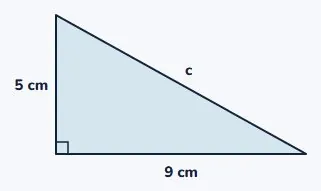
Q1: find the hypotenuse
- c is opposite the 90°.
- Add the squares.
- c² = 5² + 9²Pythagoras
- c² = 25 + 81 = 106
- c = √106square root
- √106 = 10.2956…calculator
- c ≈ 10.3 cm1 dp
- 10.3 > 9 and 10.3 > 5
Try it: find the hypotenuse
Question 2 · Achieved
- A right-angled triangle has
- Hypotenuse 12 cm and a side of 8 cm.
- Find the other side a, to 1 dp.
- Careful: 12 cm is the longest side.
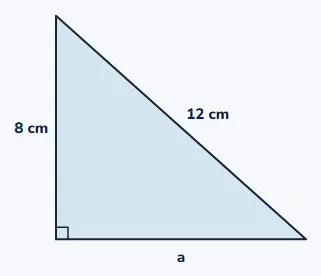
Q2: find a shorter side
- A is a shorter side.
- So subtract.
- a² + 8² = 12²Pythagoras
- a² = 12² − 8²−8² both sides
- a² = 144 − 64 = 80
- a = √80
- √80 = 8.9442…calculator
- a ≈ 8.9 cm1 dp
- 144 + 64 = 208, √208 ≈ 14.4
- 14.4 > 12: impossiblelonger than c
- 8.9 < 12
Question 3 · Merit, in context
- A 4.5 m ladder leans on a wall.
- Its foot is 1.2 m from the wall.
- How high up the wall does it reach?
- Give your answer to 2 dp.
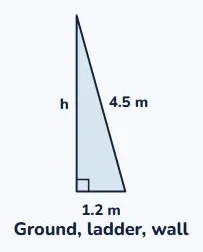
Q3: the ladder
- Ladder is the hypotenuse.
- Subtract, then root.
- h² + 1.2² = 4.5²Pythagoras
- h² = 4.5² − 1.2²−1.2² both sides
- h² = 20.25 − 1.44 = 18.81
- h = √18.81
- √18.81 = 4.3370…calculator
- h ≈ 4.34 m2 dp
- 4.34 < 4.5shorter than ladder
- It reaches about 4.34 m up
Question 4 · Merit, in context
- A builder marks out a deck corner.
- Sides 2.4 m and 3.2 m, diagonal 4.1 m.
- Is the corner a right angle? Explain.
Q4: is it a right angle?
- Use the converse.
- Compare, then explain.
- 2.4² + 3.2² = 5.76 + 10.24
- = 16
- 4.1² = 16.81longest side
- 16 ≠ 16.81
- Not a right anglesquares do not match
- For 90°: diagonal = √16 = 4 m
Question 5 · Merit, in context
- A kayak paddles 1.2 km due east,
- Then 500 m due north.
- How far is it from its start, in m?
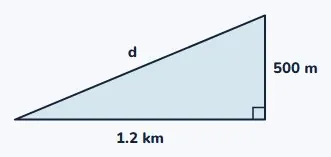
Q5: the kayak
- East, then north: 90°.
- Same units first.
- √(1.2² + 500²) ≈ 500mixed units
- 1.2 km = 1200 m× 1000
- d² = 1200² + 500²Pythagoras
- d² = 1 440 000 + 250 000
- = 1 690 000
- d = √1 690 000 = 1300
- 1300 m from the start
- 1.2² + 0.5² = 1.69 = 1.3²in km
Try it: distance as Pythagoras
Question 6 · Excellence
- A box is 80 cm by 50 cm by 30 cm.
- Will a 1 m fishing rod fit inside,
- Lying straight? Explain.
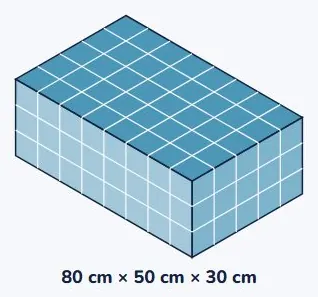
Q6: two triangles
- Longest: space diagonal.
- Floor first, keep exact.
- f² = 80² + 50²floor triangle
- f² = 6400 + 2500 = 8900
- f = √8900keep exact
- Triangle 2: sides f, 30, d
- d² = f² + 30²height at 90° to floor
- d² = 8900 + 900 = 9800
Q6: does the rod fit?
- Round only at the end.
- Compare in one unit.
- d² = 9800
- d = √9800
- √9800 = 98.9949…calculator
- d ≈ 98.99 cm2 dp
- 1 m = 100 cm
- 98.99 cm < 100 cm
- No, the 1 m rod will not fit
Question 7 · Excellence, in context
- A tent is a square-based pyramid.
- Its base is 6 m by 6 m.
- Each sloping edge is 5 m long.
- How tall is the centre pole? (2 dp)
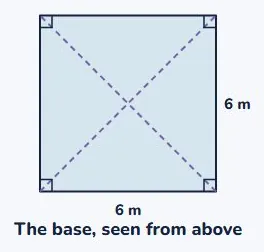
Q7: centre to corner first
- Pole meets base at 90°.
- Base triangle first.
- k = centre to a corner
- k² = 3² + 3²half of 6 each way
- k² = 9 + 9 = 18
- k = √18keep exact
- Triangle 2: pole h, k, edge 5
- h² + k² = 5²edge is hypotenuse
- h² + 18 = 25k² = 18
Q7: the height of the pole
- Subtract, then root.
- Round at the end.
- h² + 18 = 25
- h² = 25 − 18 = 7−18 both sides
- h = √7
- √7 = 2.6457…calculator
- h ≈ 2.65 m2 dp
- 2.65 < 5shorter than edge
- The pole is about 2.65 m tall
Try it: name Sam's slip
Common mistakes
- 12² + 8² = 208, so a = √208 ≈ 14.4 cm12 cm is the hypotenuse, so subtract: a² = 144 − 64 = 80, a ≈ 8.9 cm; a shorter side cannot be longer than c.
- √(1.2² + 500²) ≈ 500 mChange to the same units first: √(1200² + 500²) = 1300 m.
- 2.4² + 3.2² is close to 4.1², so the corner is a right angle.2.4² + 3.2² = 16 but 4.1² = 16.81; they are not equal, so it is not a right angle (the diagonal should be 4 m).
The method that solved all seven
- Right angle, hypotenuse, square, root, then round.
| Step | How |
|---|---|
| Right angle | find it before anything else |
| Hypotenuse | opposite 90°, the longest |
| Short side | subtract, never add |
| Same units | convert before you square |
| Converse | squares match: a right angle |
| 3D lengths | two triangles, keep it exact |
| Rounding | only at the end, with units |
Challenge
Tama stands somewhere inside a rectangular paddock ABCD (the corner posts go round in that order, so A and C are opposite corners). He is 40 m from post A, 70 m from post B and 80 m from post C. (a) Show that for any point P inside a rectangle ABCD, PA² + PC² = PB² + PD². (b) Hence find how far Tama is from post D, to 1 decimal place. (c) Explain why the three distances he knows are not enough to work out the size of the paddock.
Hint
Let the paddock be a m by b m, and let Tama be x m from side AD and y m from side AB. Each distance to a post is the hypotenuse of a right-angled triangle with sides made from x, y, a − x and b − y.
Answer
(a) Both sums equal x² + y² + (a − x)² + (b − y)². (b) √3100 ≈ 55.7 m. (c) There are four unknowns (the length, the width and Tama's two distances from the sides) but only three equations, so different paddocks fit the same three distances.
Step by step
- Put A at the bottom left, B at the bottom right, C at the top right and D at the top left.
- Tama is x m in from side AD and y m up from side AB, so each distance to a post comes from Pythagoras.
- PA² and PC² together use the same four squares as PB² and PD² together, so the sums are equal.
- Put in 40, 70 and 80 and solve for PD.
- For (c), count the unknowns and the equations.
Full working
- PA² = x² + y²across x, up y
- PB² = (a − x)² + y²
- PC² = (a − x)² + (b − y)²
- PD² = x² + (b − y)²
- PA² + PC² = x² + y² + (a − x)² + (b − y)² = PB² + PD²same four squares
- 40² + 80² = 70² + PD²A, C opposite; B, D opposite
- PD² = 1600 + 6400 − 4900 = 3100
- PD = √3100 ≈ 55.7 m
Two vertical poles stand on flat ground 12 m apart. One is 4 m tall and the other is 8 m tall. A stake is put in the ground between them so that the wires from the stake to the two tops are the same length. How far from the shorter pole is the stake, and how long is each wire, exactly and to 2 decimal places?
Hint
Let the stake be x m from the short pole, so it is 12 − x from the tall one. Write each wire length squared with Pythagoras and set them equal.
Answer
8 m from the shorter pole; each wire is √80 ≈ 8.94 m
Step by step
- Each wire is the hypotenuse of a right-angled triangle made by a pole and the ground.
- Short wire: x² + 4². Tall wire: (12 − x)² + 8².
- Set them equal and expand: the x² terms cancel, leaving a linear equation.
- 24x = 192 gives x = 8, so the stake is 4 m from the tall pole.
- Both wires are √(64 + 16) = √80 ≈ 8.94 m.
Full working
- x² + 4² = (12 − x)² + 8²equal wires
- x² + 16 = 144 − 24x + x² + 64expand
- 24x = 192−x², +24x, −16
- x = 8÷ 24
- short: 8² + 4² = 80; tall: 4² + 8² = 80check
- √80 = 8.944…calculator
- 8 m from the short pole, wires √80 ≈ 8.94 m
A wooden block is a cuboid 6 cm by 3 cm by 2 cm. A flat cut slices off one corner, passing through the three corners next to it. (a) Find the three sides of the triangular cut face exactly. (b) Is that triangle right-angled? (c) Show that a corner cut like this on any cuboid can never give a right-angled triangle.
Hint
Each side of the cut is a diagonal of one face. For (c), call the edges a, b and c and compare the sum of any two squared sides with the third.
Answer
(a) √45, √40 and √13 cm (b) No: 40 + 13 = 53, not 45 (c) any two squared sides add to more than the third
Step by step
- Each side of the cut face is a face diagonal, found from two edges of the block.
- The squared sides are 6² + 3² = 45, 6² + 2² = 40 and 3² + 2² = 13.
- For a right angle, the two smaller squares would add to 45, but 40 + 13 = 53.
- For edges a, b and c, the squared sides are a² + b², a² + c² and b² + c².
- Any two of them add to the third plus twice a square, for example (a² + b²) + (a² + c²) = (b² + c²) + 2a², which is always bigger.
- So the converse of Pythagoras never holds, and the triangle is never right-angled.
Full working
- 6² + 3² = 45, 6² + 2² = 40, 3² + 2² = 13face diagonals squared
- sides √45, √40, √13exact
- 40 + 13 = 53 ≠ 45converse test
- (a² + b²) + (a² + c²) = (b² + c²) + 2a²general edges a, b, c
- 2a² > 0, so the sum is more than b² + c²same for each pair
- (a) √45, √40, √13 cm (b) no (c) never right-angled
Practise this
Report a mistake
More in AS 91947
 Expanding, index laws and algebraic fractions8 min
 Factorising quadratics, HCF and difference of squares8 min
 Algebraic proof: even, odd and consecutive numbers8 min
 Solving linear equations and inequations8 min
 Solving quadratic equations by factorising8 min
 Simultaneous equations: elimination and substitution8 min
 Straight-line graphs, gradient and rate of change8 min
 Optimal solutions: break-even and maximum area7 min
 Pythagoras' theorem in 2D and 3D explained7 min
 Trigonometry: SOH CAH TOA, elevation and 3D7 min
 Similar shapes: scale factors, area and volume7 min
 Surface area of pyramids, cones and spheres7 min
 Volume of cones, pyramids, spheres and composite solids7 min
 Expressions: 7 exam questions solved step by step11 min
 Factorising: 7 exam questions solved step by step10 min
 Generalising: 7 exam questions solved step by step10 min
 Equations and inequations: 7 exam questions solved11 min
 Quadratic equations: 7 exam questions solved step by step11 min
 Simultaneous equations: 7 exam questions solved step by step12 min
 Straight-line graphs: 7 exam questions solved step by step11 min
 Optimal solutions: 7 exam questions solved step by step11 minPythagoras: 7 exam questions solved step by step11 min
 Trigonometry: 7 exam questions solved step by step10 min
 Similar shapes: 7 exam questions solved step by step10 min
 Surface area: 7 exam questions solved step by step11 min
 Volume: 7 exam questions solved step by step10 min
Is your child on track?
Take the free placement test