Factorising quadratics, HCF and difference of squares
What this lesson covers
- Factorising is expanding in reverse, and every factorisation can be checked by expanding it back.
- Taking out the highest common factor first makes every later step simpler.
Factorising is expanding in reverse
- Year 10: common factors, and x squared plus b x plus c.
- Every factorisation can be checked by expanding it back.
- This lesson adds four new kinds, with a reason for each step.
| Direction | Start | Gives |
|---|---|---|
| Expanding | 3(2x + 5) | 6x + 15 |
| Factorising | 6x + 15 | 3(2x + 5) |
| Factorising | x² + 7x + 12 | (x + 3)(x + 4) |
| The check | expand it back | same as you started |
A highest common factor with letters
- The number part first: the HCF of 6 and 9 is 3.
- Then each letter, at its lowest power: x and y.
- Divide each term by 3xy to see what is left inside.
| Part | Compare | Take out |
|---|---|---|
| 6x²y − 9xy² | numbers: 6 and 9 | HCF 3 |
| Letter x | x² and x | lowest power: x |
| Letter y | y and y² | lowest power: y |
| Take out 3xy | divide each term | 3xy(2x − 3y) |
| Check | 3xy × 2x, 3xy × 3y | 6x²y − 9xy² |
Common is not the same as highest
- Taking out 2x is correct, but not finished.
- The bracket still has a common factor of 2.
- Fully factorised: 4x, bracket, 3x plus 2.
| Step | Working | Result |
|---|---|---|
| 12x² + 8x | take out 2x | 2x(6x + 4) |
| Look inside | 6x + 4 shares 2 | not finished |
| Take out 4x | the highest | 4x(3x + 2) |
| Check | expands to 12x² + 8x | 3x + 2 is done |
Read the signs before you search
- c positive: both numbers share the sign of b.
- c negative: one number is positive, one negative.
- The one larger in size takes the sign of b.
| Signs | The two numbers | Example |
|---|---|---|
| c positive, b positive | both numbers + | x² + 7x + 12 |
| c positive, b negative | both numbers − | x² − 9x + 20 |
| c negative, b negative | larger size − | x² − 5x − 14 |
| c negative, b positive | larger size + | x² + 2x − 8 |
Try it: read the signs
When b and c are both negative
- Multiply to minus 14, add to minus 5.
- Opposite signs, and the one larger in size is negative.
- Minus 7 and 2. Then expand back to check.
| Step | Reasoning | Result |
|---|---|---|
| x² − 5x − 14 | need × −14, + −5 | |
| c negative | opposite signs | larger size negative |
| Try 7 and 2 | −7 × 2 = −14 | −7 + 2 = −5 |
| So | (x − 7)(x + 2) | |
| Check | x² + 2x − 7x − 14 | x² − 5x − 14 |
A difference of two squares
- Two terms, both perfect squares, with a minus between.
- 4x squared is 2x all squared. 25 is 5 squared.
- Plus in one bracket, minus in the other. The middle cancels.
| Question | Answer | Note |
|---|---|---|
| 4x² − 25 | is 4x² a square? | yes, (2x)² |
| Is 25 a square? | yes, 5² | and a minus between |
| So | (2x + 5)(2x − 5) | |
| Check | 4x² − 10x + 10x − 25 | middle cancels |
Squares hiding behind a common factor
- 2 and 18 are not squares, so take the 2 out first.
- Inside is x squared minus 9: a difference of two squares.
- x² + 9, a sum of two squares, does not factorise into brackets.
| Step | Working | Note |
|---|---|---|
| 2x² − 18 | 2 and 18 not squares | look for HCF |
| Take out 2 | 2(x² − 9) | |
| Inside | x² − 3² | two squares |
| So | 2(x + 3)(x − 3) | |
| But x² + 9 | a sum, not a difference | does not factorise |
When a is not 1: the ac method
- Multiply a by c: 2 times 3 is 6.
- Find two numbers: multiply to 6, add to 7. So 6 and 1.
- Split the middle term, then group in pairs.
| Step | Working | Gives |
|---|---|---|
| 2x² + 7x + 3 | a × c = 2 × 3 | 6 |
| Need × 6, + 7 | 6 and 1 | |
| Split the 7x | 2x² + 6x + x + 3 | |
| Group in pairs | 2x(x + 3) + 1(x + 3) | |
| Common bracket | (2x + 1)(x + 3) |
Try it: find the pair, fill the box
The ac method with negatives
- A times c is 3 times minus 8: minus 24.
- Minus 12 and 2 multiply to minus 24 and add to minus 10.
- Split, group, take out the common bracket, check.
| Step | Working | Gives |
|---|---|---|
| 3x² − 10x − 8 | a × c = 3 × −8 | −24 |
| Need × −24, + −10 | −12 and 2 | |
| Split the −10x | 3x² − 12x + 2x − 8 | |
| Group in pairs | 3x(x − 4) + 2(x − 4) | |
| Check | (3x + 2)(x − 4) | expands back |
Why multiply a by c?
- Expand two brackets and look at the two middle pieces.
- They always multiply to first coefficient times last.
- So the numbers you want must multiply to ac.
| Look at | Working | Gives |
|---|---|---|
| (2x + 1)(x + 3) | middle pieces | 6x and 1x |
| Multiply them | 6 × 1 | 6 |
| First times last | 2 × 3 | 6 |
| Always | middle pair | multiplies to ac |
Graphing calculator
Which method? Ask in this order
- Always look for a common factor first.
- Then count the terms, and look at the number in front.
- And finish every one by expanding back.
| Ask | Then | |
|---|---|---|
| 1 | Common factor? | always take it out first |
| 2 | Two squares, a minus? | difference of squares |
| 3 | Three terms, a = 1? | product and sum |
| 4 | Three terms, a ≠ 1? | ac method |
| 5 | Finished? | expand back to check |
The order in action
- Three terms and a is 2, so it looks like the ac method.
- But step one first: every term shares a 2.
- Take it out, and what is left has a equal to 1.
| Step | Working | Gives |
|---|---|---|
| 2x² − 8x − 24 | common factor 2 | 2(x² − 4x − 12) |
| Inside: a = 1 | need × −12, + −4 | −6 and 2 |
| So | 2(x − 6)(x + 2) | |
| Check | expands to 2x² − 8x − 24 | matches |
Try it: the factors are the roots
When the factors are lengths
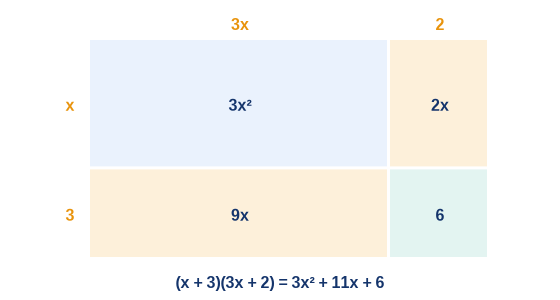
- A rectangular garden plot. Area is length times width.
- Factorise the area and one factor is the known width.
- Test with x equals 4: both give 98 square metres.
| Know | Working | Gives |
|---|---|---|
| Area 3x² + 11x + 6 | width x + 3 | length? |
| ac = 18 | need × 18, + 11 | 9 and 2 |
| Split and group | 3x(x + 3) + 2(x + 3) | |
| So | (3x + 2)(x + 3) | length 3x + 2 |
| Test x = 4 | area 98 | 14 × 7 = 98 |
What to take away
- Seven lines. The first and last are the same idea.
| Factorising | is expanding in reverse |
| HCF first | number, then lowest powers |
| c negative | opposite signs in the brackets |
| Square minus square | (a + b)(a − b) |
| a not 1 | find × ac, + b, then split |
| Which method? | HCF, then count the terms |
| Always | expand back to check |
Common mistakes
- 12x² + 8x = 2x(6x + 4)That is not fully factorised, because 6x + 4 still shares 2; take out the highest common factor: 4x(3x + 2).
- x² − 5x − 14 = (x + 7)(x − 2)The number larger in size takes the sign of b: −7 × 2 = −14 and −7 + 2 = −5, so (x − 7)(x + 2).
- x² + 9 = (x + 3)(x − 3)(x + 3)(x − 3) expands to x² − 9; a sum of two squares does not factorise into brackets.
- 2x² + 7x + 3: two numbers that multiply to 3 and add to 7When a is not 1, multiply a by c first: × 6 and + 7 gives 6 and 1, so split, group and get (2x + 1)(x + 3).
Your turn: eight questions
- Write all eight out, with reasons.
- Questions 1 and 3 say fully: check the HCF.
- Question 4 has a front number of 2.
Factorise 8a²b + 12ab² fully.
Factorise x² − 3x − 18.
Factorise 3x² − 75 fully.
Factorise 2x² − 5x − 3.
Which expression factorises to (x − 4)(x + 9)?
Mere writes 18x² − 12x = 6(3x² − 2x). What is the full factorisation?
Which of these cannot be factorised into two brackets?
A rectangle has area 6x² + 7x − 20 square metres and width 2x + 5 metres. What is its perimeter?
Show answer
1. 4ab(2a + 3b). The HCF of 8 and 12 is 4, and the lowest powers are a and b. Check: 4ab × 2a = 8a²b and 4ab × 3b = 12ab². 2. (x − 6)(x + 3). The numbers multiply to −18 and add to −3, so they have opposite signs and the one larger in size is negative. 3. 3(x + 5)(x − 5). Take out 3 first, leaving x² − 25, a difference of two squares. 4. (2x + 1)(x − 3). ac is −6, and −6 and 1 add to −5. Split: 2x² − 6x + x − 3 = 2x(x − 3) + 1(x − 3). 5. x² + 5x − 36. Expanding back: x² + 9x − 4x − 36, and −4 + 9 = 5 while −4 × 9 = −36. 6. 6x(3x − 2). Her bracket still shares a factor of x, so the HCF is 6x: the HCF of 18 and 12 is 6, and the lowest power of x is x. 7. x² + 25. It is a sum of two squares, not a difference. x² − 25 = (x + 5)(x − 5), 4x² − 1 = (2x + 1)(2x − 1) and x² − 10x + 25 = (x − 5)². 8. 10x + 2 metres. By the ac method 6x² + 7x − 20 = (3x − 4)(2x + 5), so the length is 3x − 4 and the perimeter is 2(3x − 4 + 2x + 5) = 10x + 2.
The answers
- 1. 4ab(2a + 3b)
- 2. (x − 6)(x + 3)
- 3. 3(x + 5)(x − 5)
- 4. (2x + 1)(x − 3)
Sample question: Achieved
Factorise fully 3x² − 12x − 36.
Hint
Take out the highest common factor first, then factorise the quadratic left in the bracket.
Answer
3(x − 6)(x + 2)
Step by step
- Always look for a common factor first. 3, 12 and 36 are all multiples of 3.
- Take out the 3: 3x² − 12x − 36 = 3(x² − 4x − 12).
- Now factorise x² − 4x − 12. Find two numbers that multiply to −12 and add to −4.
- The product is negative, so one number is positive and one is negative. The sum is negative, so the bigger one is negative.
- −6 and 2 work: −6 × 2 = −12 and −6 + 2 = −4.
- So x² − 4x − 12 = (x − 6)(x + 2), and the full answer is 3(x − 6)(x + 2).
- The classic mistake is to forget the 3 at the front. Fully means every factor is shown.
- Check by expanding back: (x − 6)(x + 2) = x² − 4x − 12, and 3 times that is 3x² − 12x − 36.
Full working
- 3(x² − 4x − 12)HCF is 3
- −6 × 2 = −12, −6 + 2 = −4multiply to c, add to b
- 3(x − 6)(x + 2)
Sample questions: Merit
Factorise 6x² + x − 12 and 12x² − 27. Hence simplify 6x² + x − 1212x² − 27.
Hint
The first needs the ac method. The second has a common factor of 3, and what is left is a difference of two squares.
Answer
(3x − 4)(2x + 3) and 3(2x − 3)(2x + 3); the fraction is 3x − 43(2x − 3)
Step by step
- 6x² + x − 12 has no common factor, and a = 6, so use the ac method.
- ac = 6 × −12 = −72. Find two numbers that multiply to −72 and add to 1 (the number in front of x): 9 and −8.
- Split the middle term: 6x² + 9x − 8x − 12.
- Group in pairs: 3x(2x + 3) − 4(2x + 3). Both pairs share (2x + 3), so take it out: (3x − 4)(2x + 3).
- 12x² − 27: 12 and 27 are not squares, so look for a common factor first. Both are multiples of 3: 3(4x² − 9).
- 4x² − 9 is (2x)² − 3², a difference of two squares, so it is (2x − 3)(2x + 3). Altogether 3(2x − 3)(2x + 3).
- Hence the fraction is (3x − 4)(2x + 3)3(2x − 3)(2x + 3).
- (2x + 3) is a whole factor of the top and the bottom, so it cancels: 3x − 43(2x − 3).
- Check with x = 1: the original is 6 + 1 − 1212 − 27 = −5−15 = 13. The answer is 3 − 43 × −1 = 13. They agree.
Full working
- ac = −72: 9 and −8multiply to −72, add to 1
- 6x² + 9x − 8x − 12 = 3x(2x + 3) − 4(2x + 3)split and group
- 6x² + x − 12 = (3x − 4)(2x + 3)
- 12x² − 27 = 3(4x² − 9) = 3(2x − 3)(2x + 3)HCF, then difference of two squares
- (3x − 4)(2x + 3)3(2x − 3)(2x + 3)cancel 2x + 3
- 3x − 43(2x − 3)
A rectangle has area 2x² + 7x − 15 square metres and width x + 5 metres. Find its length. Explain why x must be more than 1.5, and check your length using x = 4.
Hint
Area is length times width, so one factor of the area is the width. Factorise the area to find the other factor.
Answer
Length 2x − 3 metres; a length must be positive, so 2x − 3 > 0 gives x > 1.5
Step by step
- Area = length × width. So if you factorise the area, one factor should be the width, x + 5.
- Factorise 2x² + 7x − 15 with the ac method. ac = 2 × −15 = −30.
- Two numbers that multiply to −30 and add to 7: 10 and −3.
- Split: 2x² + 10x − 3x − 15. Group: 2x(x + 5) − 3(x + 5) = (2x − 3)(x + 5).
- One factor is x + 5, the width. So the length is the other factor: 2x − 3 metres.
- A length must be more than zero. 2x − 3 > 0 means 2x > 3, so x > 1.5. If x were 1.5 or less, the length would be zero or negative.
- The width x + 5 is positive whenever x > 1.5 too, so that adds no extra condition.
- Check with x = 4: the width is 9 m and the length is 2 × 4 − 3 = 5 m, so the area is 45 m².
- The area formula gives 2 × 16 + 7 × 4 − 15 = 32 + 28 − 15 = 45 m². They agree.
Full working
- ac = −30: 10 and −3multiply to −30, add to 7
- 2x(x + 5) − 3(x + 5) = (2x − 3)(x + 5)split and group
- length = 2x − 3the width x + 5 is one factor
- 2x − 3 > 0, so x > 1.5a length must be positive
- x = 4: 9 × 5 = 45 and 32 + 28 − 15 = 45check
- Length 2x − 3 metres, with x > 1.5
Sample questions: Excellence
Use factorising to work out 1003² − 997² without a calculator. Then prove that, for any two numbers that differ by 6, the difference of their squares is always 6 times their sum.
Hint
Both parts are a difference of two squares: a² − b² = (a − b)(a + b). For the proof, call the numbers a and a + 6.
Answer
1003² − 997² = 12 000; (a + 6)² − a² = 6(a + (a + 6))
Step by step
- a² − b² = (a − b)(a + b) is a difference of two squares. It turns a hard subtraction into an easy product.
- Here a = 1003 and b = 997. a − b = 6 and a + b = 2000.
- So 1003² − 997² = 6 × 2000 = 12 000. No big squares were needed.
- Now the proof. It must work for every pair, so use letters. Let the smaller number be a. The larger is a + 6.
- The difference of their squares is (a + 6)² − a².
- Use the same factorising: ((a + 6) − a)((a + 6) + a).
- The first bracket is 6. The second is a + 6 + a, which is exactly their sum.
- So (a + 6)² − a² = 6 × (their sum), for any number a. That proves it.
- Check by expanding instead: (a + 6)² − a² = a² + 12a + 36 − a² = 12a + 36, and 6(2a + 6) = 12a + 36. They agree.
- The first part is an example of the rule: 1003 and 997 differ by 6, their sum is 2000, and 6 × 2000 = 12 000.
Full working
- 1003² − 997² = (1003 − 997)(1003 + 997)difference of two squares
- = 6 × 2000 = 12 000
- (a + 6)² − a² = ((a + 6) − a)((a + 6) + a)numbers a and a + 6
- = 6(a + (a + 6))6 times their sum
- check: 12a + 36 = 6(2a + 6)expand both ways
- 12 000; the difference is always 6 × the sum
x² + bx − 12 can be factorised as (x + p)(x + q), where b, p and q are integers. Find every possible value of b, and explain how you know you have found them all.
Hint
p × q must be −12 and p + q must be b. List every pair of integers that multiplies to −12.
Answer
b = −11, −4, −1, 1, 4 or 11
Step by step
- Expand (x + p)(x + q) = x² + (p + q)x + pq. Match it with x² + bx − 12.
- So pq = −12 and b = p + q. Every integer pair that multiplies to −12 gives one value of b.
- To be sure of finding them all, go through the factor pairs of 12 in order: 1 and 12, 2 and 6, 3 and 4.
- The product is negative, so one number in each pair is negative. Each pair can have the minus on either number.
- 1 and −12 add to −11. −1 and 12 add to 11.
- 2 and −6 add to −4. −2 and 6 add to 4.
- 3 and −4 add to −1. −3 and 4 add to 1.
- 12 has no other factor pairs, so there are no other values. b = −11, −4, −1, 1, 4 or 11.
- Swapping p and q gives the same b, so it adds nothing new.
- Check one: b = 4 gives x² + 4x − 12 = (x + 6)(x − 2). Expand: x² − 2x + 6x − 12 = x² + 4x − 12.
Full working
- (x + p)(x + q) = x² + (p + q)x + pqexpand
- pq = −12, b = p + qmatch terms
- 1, −12 → −11 and −1, 12 → 11
- 2, −6 → −4 and −2, 6 → 4
- 3, −4 → −1 and −3, 4 → 112 has only three factor pairs
- b = ±1, ±4 or ±11
Area Model Algebra
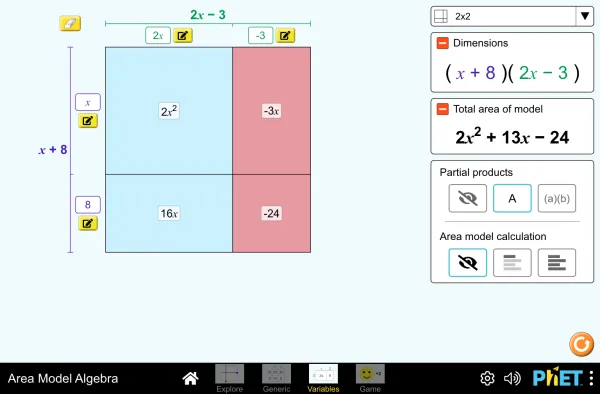
Full screen · PhET Interactive Simulations, University of Colorado Boulder, CC BY 4.0
Challenge
Factorise x⁴ − 13x² + 36 completely, into four brackets.
Hint
Treat x² as one thing. x⁴ is (x²)², so this is a quadratic in x². Factorise that, then look again at each bracket.
Answer
(x − 2)(x + 2)(x − 3)(x + 3)
Step by step
- x⁴ = (x²)², so think of x² as a single letter, say y. The expression is y² − 13y + 36.
- Two numbers that multiply to 36 and add to −13: −4 and −9. Both negative, because c is positive and b is negative.
- So y² − 13y + 36 = (y − 4)(y − 9), which is (x² − 4)(x² − 9).
- Each bracket is a difference of two squares: x² − 4 = (x − 2)(x + 2) and x² − 9 = (x − 3)(x + 3).
- Check with x = 1: 1 − 13 + 36 = 24, and (−1)(3)(−2)(4) = 24.
Full working
- y² − 13y + 36, with y = x²a quadratic in x²
- −4 × −9 = 36, −4 + −9 = −13multiply to c, add to b
- (x² − 4)(x² − 9)put x² back
- x² − 4 = (x − 2)(x + 2), x² − 9 = (x − 3)(x + 3)difference of two squares, twice
- (x − 2)(x + 2)(x − 3)(x + 3)
Without working out 2²⁰, use factorising to show that 2²⁰ − 1 is divisible by 3, 5, 11, 31 and 41.
Hint
2²⁰ = (2¹⁰)², so 2²⁰ − 1 is a difference of two squares. Do the same trick again with 2¹⁰ − 1.
Answer
2²⁰ − 1 = 31 × 33 × 1025 = 3 × 5² × 11 × 31 × 41, so it is divisible by all five
Step by step
- 2²⁰ = (2¹⁰)² and 1 = 1², so 2²⁰ − 1 = (2¹⁰ − 1)(2¹⁰ + 1).
- 2¹⁰ − 1 is a difference of two squares too: (2⁵ − 1)(2⁵ + 1) = 31 × 33.
- 2¹⁰ + 1 is a sum, so that trick does not work. But 2¹⁰ = 1024 is small, so 2¹⁰ + 1 = 1025 = 25 × 41.
- So 2²⁰ − 1 = 31 × 33 × 25 × 41 = 31 × 3 × 11 × 5 × 5 × 41.
- Each of 3, 5, 11, 31 and 41 appears as a factor, so each one divides 2²⁰ − 1.
Full working
- 2²⁰ − 1 = (2¹⁰ − 1)(2¹⁰ + 1)difference of two squares
- 2¹⁰ − 1 = (2⁵ − 1)(2⁵ + 1) = 31 × 33again
- 2¹⁰ + 1 = 1025 = 25 × 41a sum, so just factor the number
- 2²⁰ − 1 = 31 × 3 × 11 × 5² × 41put the pieces together
- divisible by 3, 5, 11, 31 and 41
Find every pair of positive whole numbers x and y with x² − y² = 45. Then explain why no whole numbers x and y have x² − y² = 46.
Hint
Factorise: (x − y)(x + y) = 45, so the two brackets are a factor pair of 45. For 46, add the two brackets: what do you notice about whether they are odd or even?
Answer
(x, y) = (23, 22), (9, 6) or (7, 2); 46 is impossible because (x − y)(x + y) is always odd or a multiple of 4
Step by step
- x² − y² = (x − y)(x + y). Both brackets are whole numbers, and x + y is the bigger, so they are a factor pair of 45.
- The pairs are 1 × 45, 3 × 15 and 5 × 9. Solve each: adding the brackets gives 2x, subtracting gives 2y.
- 1 and 45: x = 23, y = 22. 3 and 15: x = 9, y = 6. 5 and 9: x = 7, y = 2.
- For 46: the brackets add to (x − y) + (x + y) = 2x, which is even. So they are both even or both odd.
- Both odd: the product is odd. Both even: the product is 2a × 2b = 4ab, a multiple of 4.
- 46 is even but 46 ÷ 4 = 11.5, so it is neither. No whole numbers work.
Full working
- (x − y)(x + y) = 45difference of two squares
- 1 × 45: x = 23, y = 22x = (1 + 45) ÷ 2
- 3 × 15: x = 9, y = 6; 5 × 9: x = 7, y = 2the other factor pairs
- (x − y) + (x + y) = 2x, evenso same parity
- odd × odd is odd; 2a × 2b = 4abthe only two cases
- (23, 22), (9, 6), (7, 2); 46 is even but not a multiple of 4, so impossible
Practise this
Report a mistake
More in AS 91947
 Expanding, index laws and algebraic fractions8 minFactorising quadratics, HCF and difference of squares8 min
 Algebraic proof: even, odd and consecutive numbers8 min
 Solving linear equations and inequations8 min
 Solving quadratic equations by factorising8 min
 Simultaneous equations: elimination and substitution8 min
 Straight-line graphs, gradient and rate of change8 min
 Optimal solutions: break-even and maximum area7 min
 Pythagoras' theorem in 2D and 3D explained7 min
 Trigonometry: SOH CAH TOA, elevation and 3D7 min
 Similar shapes: scale factors, area and volume7 min
 Surface area of pyramids, cones and spheres7 min
 Volume of cones, pyramids, spheres and composite solids7 min
 Expressions: 7 exam questions solved step by step11 min
 Factorising: 7 exam questions solved step by step10 min
 Generalising: 7 exam questions solved step by step10 min
 Equations and inequations: 7 exam questions solved11 min
 Quadratic equations: 7 exam questions solved step by step11 min
 Simultaneous equations: 7 exam questions solved step by step12 min
 Straight-line graphs: 7 exam questions solved step by step11 min
 Optimal solutions: 7 exam questions solved step by step11 min
 Pythagoras: 7 exam questions solved step by step11 min
 Trigonometry: 7 exam questions solved step by step10 min
 Similar shapes: 7 exam questions solved step by step10 min
 Surface area: 7 exam questions solved step by step11 min
 Volume: 7 exam questions solved step by step10 min
Is your child on track?
Take the free placement test