Optimal solutions: break-even and maximum area
What this lesson covers
- The best option depends on the quantity being compared, so the comparison has to be set up before the choice is made.
- Where two cost rules cross is the point at which the better option changes.
Optimal means best at something
- Cheapest, largest and quickest are different questions.
- So name the measure before you compare anything.
- Then the optimal choice is the best by that measure.
| Situation | Measure | Best is |
|---|---|---|
| Hiring a kayak | total cost | the lowest |
| Fencing a garden | area enclosed | the largest |
| Getting to school | time taken | the shortest |
| So first | name the measure | then compare |
Two hire plans, as equations
- Each plan is a fixed fee plus a rate for every hour.
- The rate multiplies h. The fixed fee stands alone.
- P = 10 + 2h and Q = 4 + 3h.
| Plan | In words | Equation |
|---|---|---|
| Plan P | $10, then $2 an hour | P = 10 + 2h |
| Plan Q | $4, then $3 an hour | Q = 4 + 3h |
| h | hours of hire | whole hours |
| Fixed fee | the number on its own | rate goes with h |
Try a few hires first
- Short hires: Q wins, because its fee is small.
- Long hires: P wins, because its rate is small.
- So somewhere in between, the winner changes.
| Hire | Plan P | Plan Q |
|---|---|---|
| 2 hours | $14 | $10, Q wins |
| 4 hours | $18 | $16, Q wins |
| 8 hours | $26 | $28, P wins |
| Somewhere between | the two | are equal |
Try it: fit a parabola
The break-even point
- Break-even means the two costs are equal.
- Set P equal to Q and solve like any equation.
- h = 6, and both plans cost $22. Checked.
| Step | Working | Check |
|---|---|---|
| P = Q | 10 + 2h = 4 + 3h | |
| Take 2h off both | 10 = 4 + h | |
| Take 4 off both | h = 6 | |
| Check | P: 10 + 12 = 22 | Q: 4 + 18 = 22 |
Try it: the break-even point
Where the two plans cross
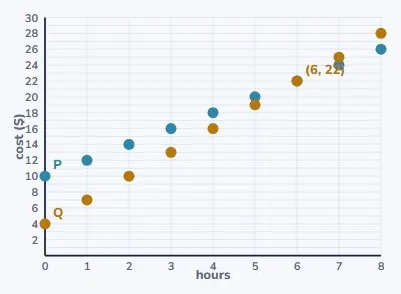
- Q starts lower but climbs faster.
- They meet at 6 hours and $22.
- After the crossing, P is the lower one.
When is Plan P cheaper?
- Cheaper means less than, so write P < Q.
- Solve it exactly as you solved the equation.
- h > 6. No negative multiplier, so no reversal.
| Step | Working | Result |
|---|---|---|
| P cheaper | 10 + 2h < 4 + 3h | |
| Take 2h off both | 10 < 4 + h | |
| Take 4 off both | 6 < h | so h > 6 |
| Check h = 7 | P $24, Q $25 | P cheaper |
Answer in hours, not in h
- Hire is charged in whole hours.
- So h > 6 means seven hours or more.
- Give all three cases, including the tie.
| Hire | Better plan | Because |
|---|---|---|
| 1 to 5 hours | Q is cheaper | h < 6 |
| Exactly 6 hours | same cost, $22 | h = 6 |
| 7 hours or more | P is cheaper | h > 6 |
| Whole hours | so h > 6 means | 7, 8, 9, ... |
Justifying the choice
- State the choice and the measure.
- Give the numbers that prove it.
- Say why, using the break-even point.
| Part | For a 3-hour hire |
|---|---|
| The choice | Plan Q, for 3 hours |
| The measure | it is the cheaper plan |
| The numbers | Q costs $13, P costs $16 |
| The reason | Q is cheaper for any hire under 6 hours |
A different measure: the most area
- 12 m of fence, with a wall along one side.
- The width x is fenced twice, so it uses 2x.
- Area is width times length: A = x(12 − 2x).
| Part | Reasoning | Expression |
|---|---|---|
| Fence | 12 m, wall on one side | |
| Width x | used twice | 2x |
| Length | what is left | 12 − 2x |
| Area | width × length | A = x(12 − 2x) |
Try some widths
- Too narrow is small. Too wide is small too.
- The areas rise, then fall in the same steps.
- That mirror pattern is the clue.
| Width | Length | Area |
|---|---|---|
| 1 m | 10 m | 10 m² |
| 2 m | 8 m | 16 m² |
| 3 m | 6 m | 18 m² |
| 4 m | 4 m | 16 m² |
| 5 m | 2 m | 10 m² |
Where the area is zero
- The model is already factorised.
- A product is zero when one factor is zero.
- So the zeros are x = 0 and x = 6.
| Case | Working | Meaning |
|---|---|---|
| A = 0 when | x = 0 | no width |
| or when | 12 − 2x = 0 | x = 6 |
| x = 6 | length is 0 | no garden |
| Zeros | 0 and 6 | the ends |
The maximum is halfway
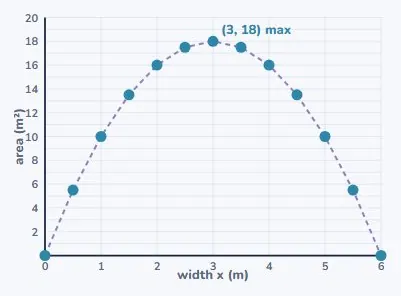
- A parabola is symmetric, and this one opens downward.
- Halfway between 0 and 6 is x = 3.
- A = 3 × 6 = 18 m². That is the maximum.
Try it: the biggest garden
Try it: make the case
Any length of fence
- Fence L metres: x(L − 2x), which opens downward.
- The zeros are 0 and L/2, so the middle is L/4.
- Maximum area: L²/8. With L = 12 it is 18.
| Step | Working | Result |
|---|---|---|
| Fence L | A = x(L − 2x) | |
| Zeros | x = 0 and x = L/2 | |
| Midpoint | x = L/4 | length L/2 |
| Maximum | (L/4)(L/2) | L²/8 |
| Check L = 12 | 144 ÷ 8 | 18, as before |
What to take away
- Seven lines, and every one starts by naming the measure.
| Optimal | best by a measure you name first |
| Two plans | write an equation for each |
| Break-even | set them equal and solve |
| Which is cheaper | an inequation, read in context |
| Whole numbers | h > 6 means 7 hours or more |
| Maximum of x(L − 2x) | halfway between the zeros |
| Justify | choice, measure, numbers, reason |
Common mistakes
- Plan P, $10 then $2 an hour: P = 10h + 2The rate multiplies h and the fixed fee stands alone, so P = 10 + 2h.
- P is cheaper when h > 6, so choose P for 6 hours or more.At exactly 6 hours both cost $22, and hire is in whole hours, so P is cheaper for 7 hours or more.
- 12 m of fence with a wall on one side: A = x(12 − x)The width x is fenced twice, so the length is 12 − 2x and A = x(12 − 2x).
- The maximum area is x = 3.x = 3 m is the width that gives the maximum; the maximum area itself is 3 × 6 = 18 m².
Your turn: eight questions
- Write each one out in full.
- Question 2 wants a whole number of guests.
- Question 4 has eight sides fenced, not three.
Hall P $120 + $5/guest, Q $40 + $9/guest. Equal cost when?
Use an inequation: for how many guests is Hall P cheaper?
A garden: A = x(16 − 2x) (x in metres). Find its maximum area.
20 m of fence goes round all 4 sides. Width for largest area?
A kayak shop charges $15 to start plus $8 an hour. Which equation gives the cost C for h hours?
A garden has area A = x(18 − 2x), with x in metres. For which widths x is the area zero?
Bike hire: Plan A is $20 + $4 an hour, Plan B is $8 + $6 an hour. Which plan is cheaper for a 4-hour ride?
With a wall on one side, A = x(L − 2x) has a maximum area of L²/8. What fence length L gives a maximum of 50 m²?
Show answer
1. 20 guests. 120 + 5n = 40 + 9n gives 80 = 4n, so n = 20, and both halls cost $220. 2. 21 guests or more. 120 + 5n < 40 + 9n gives 80 < 4n, so n > 20, and guests come in whole numbers. Check 21: P is $225, Q is $229. 3. 32 m². Expanded, A = −2x² + 16x; the x² term is negative, so the graph opens downward and its turning point is a maximum. The zeros are x = 0 and x = 8, the midpoint is x = 4, the length is 16 − 8 = 8, and 4 × 8 = 32. 4. 5 m. Width x leaves length 10 − x, so A = x(10 − x) with zeros 0 and 10. Halfway is 5, a 5 m square of 25 m², and widths 4 and 6 give only 24 m². 5. C = 15 + 8h. The rate $8 goes with h, and the fixed fee $15 stands alone. 6. x = 0 and x = 9. A product is zero when a factor is zero: x = 0, or 18 − 2x = 0, which gives x = 9. 7. Plan B, $32 against Plan A's $36. A costs 20 + 4 × 4 = 36 and B costs 8 + 6 × 4 = 32; B is cheaper for any ride under the 6-hour break-even. 8. L = 20 m. Solve L²/8 = 50: L² = 400, so L = √400 = 20.
The answers
- 20 guests, where both halls cost $220.
- 21 guests or more.
- Opens downward: 32 m², at a width of 4 m.
- A width of 5 m: a square of 25 m².
Sample question: Achieved
Gym A charges a $40 joining fee plus $15 a week. Gym B has no joining fee and charges $20 a week. After how many weeks do the two gyms cost the same, and what is that cost?
Hint
Write a cost rule for each gym in terms of the number of weeks w, then set them equal.
Answer
After 8 weeks, when both cost $160
Step by step
- Let w be the number of weeks.
- Gym A: a fixed 40 plus 15 for each week, so A = 40 + 15w.
- Gym B: just 20 for each week, so B = 20w.
- The same cost means A = B: 40 + 15w = 20w. This is the break-even point.
- Subtract 15w from both sides: 40 = 5w. Divide by 5: w = 8.
- Cost: 20 × 8 = $160. Check with Gym A: 40 + 15 × 8 = 40 + 120 = 160. Both agree.
- Before 8 weeks Gym B is cheaper (no joining fee). After 8 weeks Gym A is cheaper (lower weekly rate).
Full working
- A = 40 + 15w, B = 20ww = number of weeks
- 40 + 15w = 20wbreak-even: costs equal
- 40 = 5w, so w = 8subtract 15w, divide by 5
- 20 × 8 = 160 and 40 + 120 = 160check
- 8 weeks, $160
Sample questions: Merit
For a one-day hire, Company X charges $55 plus 20 cents per km, and Company Y charges $40 plus 35 cents per km. Use an inequation to find for which distances X is cheaper. Give the advice for every distance.
Hint
Work in dollars (20 cents is 0.20). Cheaper means less than, so solve X < Y.
Answer
X is cheaper for more than 100 km; they cost the same ($75) at 100 km; Y is cheaper for less than 100 km
Step by step
- Let d be the distance in km. Write both costs in dollars so the units match: 20 cents = $0.20.
- X = 55 + 0.20d and Y = 40 + 0.35d.
- X cheaper means X < Y: 55 + 0.20d < 40 + 0.35d.
- Subtract 0.20d from both sides, so the d term stays positive: 55 < 40 + 0.15d.
- Subtract 40: 15 < 0.15d. Divide by 0.15, a positive number, so no reversal: 100 < d.
- So X is cheaper for distances over 100 km.
- At exactly 100 km: X = 55 + 20 = 75 and Y = 40 + 35 = 75. They cost the same.
- Under 100 km, Y is cheaper, because its fixed charge is $15 less.
- Check one value each side. 50 km: X = 65, Y = 57.50, so Y wins. 200 km: X = 95, Y = 110, so X wins.
Full working
- X = 55 + 0.20d, Y = 40 + 0.35din dollars
- 55 + 0.20d < 40 + 0.35dX cheaper
- 15 < 0.15dsubtract 0.20d and 40
- d > 100divide by 0.15, no reversal
- at 100 km both cost 75break-even
- X cheaper over 100 km, same at 100 km, Y cheaper under 100 km
A farmer has 30 m of fence to make a rectangular pen against a long wall, so only three sides need fence. Let x be the width of each side that meets the wall. Write a model for the area A, and find the width that gives the largest area, and that area.
Hint
The two widths use 2x of the fence, and the rest is the length. The area model is a parabola, so its maximum is halfway between its zeros.
Answer
A = x(30 − 2x); the largest area is 112.5 m², with width 7.5 m and length 15 m
Step by step
- Name the measure first: we want the most area.
- The two sides that meet the wall each use x metres, so 2x of the fence. The side parallel to the wall gets the rest: 30 − 2x.
- Area = width × length, so A = x(30 − 2x).
- Expanded, A = 30x − 2x². The x² term is negative, so the graph is a parabola that opens downward. It has a highest point.
- Zeros: a product is zero when a factor is zero. x = 0, or 30 − 2x = 0, which gives x = 15.
- A parabola is symmetric, so the top is halfway between the zeros: x = (0 + 15) ÷ 2 = 7.5 m.
- Length = 30 − 2 × 7.5 = 15 m. Area = 7.5 × 15 = 112.5 m².
- Check nearby widths: x = 7 gives 7 × 16 = 112 and x = 8 gives 8 × 14 = 112. Both are less than 112.5.
- So the best pen is 7.5 m wide and 15 m long, with area 112.5 m². Notice the length is twice the width.
Full working
- length = 30 − 2xtwo widths are fenced
- A = x(30 − 2x)area = width × length
- zeros x = 0 and x = 15opens downward
- x = (0 + 15) ÷ 2 = 7.5symmetry
- A = 7.5 × 15 = 112.5 m²
- width 7.5 m, length 15 m, area 112.5 m²
Sample questions: Excellence
A rectangular paddock is fenced on all four sides and split into two pens by one extra fence parallel to the width. There is 60 m of fence in total. Let the width be w and the length be l. Find the dimensions that give the largest total area, and justify that it is the largest.
Hint
Count how many widths and lengths of fence there are, write l in terms of w, then use the symmetry of the area parabola.
Answer
Width 10 m and length 15 m, for a largest area of 150 m²
Step by step
- Name the measure: the most total area.
- Count the fence. There are two widths on the outside plus one dividing fence, also a width: 3w. There are two lengths: 2l.
- So 3w + 2l = 60. Rearrange for l: 2l = 60 − 3w, so l = 60 − 3w2.
- Area = w × l = w(60 − 3w)2. One variable now, so it can be optimised.
- The w² term is −3w² ÷ 2, which is negative, so the parabola opens downward and has a maximum.
- Zeros: w = 0, or 60 − 3w = 0, which gives w = 20.
- The maximum is halfway between the zeros, by symmetry: w = (0 + 20) ÷ 2 = 10 m.
- Then l = 60 − 302 = 15 m, and the area is 10 × 15 = 150 m².
- Justify: the parabola opens downward and is symmetric about w = 10, so no other width gives more. Check w = 9 and w = 11: both give 148.5 m², less than 150.
- Check the fence: 3 × 10 + 2 × 15 = 30 + 30 = 60 m. All of it is used.
- The classic mistake is to forget the dividing fence and use 2w + 2l = 60, which gives a square, not the best shape here.
Full working
- 3w + 2l = 60three widths, two lengths
- l = 60 − 3w2rearrange
- A = w(60 − 3w)2opens downward
- zeros w = 0 and w = 20, so w = 10symmetry
- l = 15, A = 150w = 9 or 11 gives 148.5
- 10 m by 15 m, 150 m²
A school concert expects 400 − 20p people to come when tickets cost p dollars. (a) Find the price that gives the most ticket money (revenue), and that revenue. (b) Each person also costs the school $5. Find the price that gives the most profit, and that profit. (c) Explain why the best price for profit is higher than the best price for revenue, and give one limitation of the model.
Hint
Revenue = price × people. Profit = (price − 5) × people. Write each as a product of two brackets, find the zeros, and go halfway.
Answer
(a) $10, revenue $2000 (b) $12.50, profit $1125 (c) each extra person now costs $5, so fewer, higher-paying people is better; one limitation: 400 − 20p is only a guess at how people react to price
Step by step
- Name the measure each time: (a) is the most revenue, (b) is the most profit. They are different questions.
- (a) Revenue = price × number of people = p(400 − 20p). It opens downward, because of the −20p² term.
- Zeros: p = 0, or 400 − 20p = 0, which gives p = 20. Halfway: p = 10, a price of $10.
- At p = 10, 400 − 200 = 200 people come, so revenue = 10 × 200 = $2000.
- (b) The school keeps p − 5 dollars from each person. Profit = (p − 5)(400 − 20p).
- Zeros: p = 5 (each ticket just covers its cost) and p = 20 (nobody comes). Halfway: p = (5 + 20) ÷ 2 = 12.5.
- At p = 12.50, 400 − 250 = 150 people come. Profit = 7.5 × 150 = $1125.
- Compare: at p = 10 the profit is only 5 × 200 = $1000. So 12.50 really is better for profit.
- (c) Why higher: every extra person now costs $5. Charging more means fewer people, so fewer costs. The zero at p = 5 moves the halfway point up.
- Limitation: the model 400 − 20p is a guess about how people react to price. Real numbers may not drop in a straight line, and the price should be a sensible amount like $12.50.
Full working
- R = p(400 − 20p)price × people
- zeros 0 and 20, so p = 10symmetry
- R = 10 × 200 = 2000
- P = (p − 5)(400 − 20p)profit per person × people
- zeros 5 and 20, so p = 12.5symmetry
- P = 7.5 × 150 = 1125at p = 10 only 1000
- (a) $10, 2000 (b) $12.50, 1125
Challenge
A kayak hire shed has three plans. Plan A: $5 per hour. Plan B: $12 fee plus $3 per hour. Plan C: $40 for the whole day. Hire is charged in whole hours. Give the cheapest plan for every hire length, and explain why the point where Plan A and Plan C cost the same does not matter.
Hint
Write a rule for each plan and find where each pair breaks even. Then check which plan is lowest between those points.
Answer
1 to 5 hours: Plan A; 6 hours: A and B tie at $30; 7 to 9 hours: Plan B; 10 hours or more: Plan C
Step by step
- Rules: A = 5h, B = 12 + 3h, C = 40.
- A = B when 5h = 12 + 3h, so h = 6 ($30 each). A is cheaper than B when h < 6.
- B = C when 12 + 3h = 40, so h = 283 = 9⅓. B is cheaper than C when h < 9⅓, which is 9 hours or fewer.
- A = C at h = 8, both $40. But at 8 hours B costs only $36, so neither A nor C is cheapest there. That crossing does not change the best choice.
- So: A for 1 to 5 hours, a tie at 6 hours, B for 7 to 9 hours (9 hours: $39 against $40), and C for 10 hours or more (10 hours: B is $42, C is $40).
Full working
- A = 5h, B = 12 + 3h, C = 40one rule per plan
- 5h = 12 + 3h, h = 6, cost $30A and B break even
- 12 + 3h = 40, h = 9⅓B and C break even
- 5h = 40, h = 8, but B = $36 thereA and C crossing, under B
- h = 9: B $39, C $40; h = 10: B $42, C $40whole hours either side
- A for 1 to 5 h, tie at 6 h, B for 7 to 9 h, C for 10 h or more
A farmer has 30 m of fence for a rectangular pen against a wall, so only three sides are fenced. The wall is only 12 m long, and the side along the wall must not be longer than the wall. Let x be the width of each fenced side that meets the wall. Find the dimensions with the largest area, and explain why the answer is not at the turning point.
Hint
Write A = x(30 − 2x) and find where the maximum would be without the wall limit. Then turn the 12 m limit into a condition on x.
Answer
Width 9 m and length 12 m, for an area of 108 m²
Step by step
- The length along the wall is 30 − 2x, so the area is A = x(30 − 2x).
- The zeros are x = 0 and x = 15, so the turning point is halfway, at x = 7.5. That would give a length of 15 m.
- But the length can be at most 12 m: 30 − 2x ≤ 12, so 2x ≥ 18 and x ≥ 9. The turning point x = 7.5 is not allowed.
- The parabola opens downward and x ≥ 9 is to the right of its top, so the area only gets smaller as x grows past 9.
- So the best allowed width is the smallest one, x = 9. The length is 30 − 18 = 12 m and the area is 9 × 12 = 108 m².
- Check a neighbour: x = 10 gives 10 × 10 = 100 m², which is less.
Full working
- A = x(30 − 2x)width x twice, length 30 − 2x
- zeros 0 and 15, top at x = 7.5halfway between the zeros
- 30 − 2x ≤ 12, so x ≥ 9the wall is 12 m
- x ≥ 9 is right of the top, so A fallsparabola opens down
- x = 9: 9 × 12 = 108smallest allowed width
- 9 m by 12 m, area 108 m²
A guided kayak trip has 20 people booked at $60 each. For every extra person who books, the price drops by $2 for everyone. Each person costs the company $14 in gear and food. (a) Write a model for the profit P when n extra people book. (b) Find the number of people that gives the most profit, and explain why two group sizes tie. (c) For how many people is the profit less than with the original 20?
Hint
Profit per person is the price take away $14. P = (number of people) × (profit per person). Find the zeros, then the middle. n must be a whole number.
Answer
(a) P = (20 + n)(46 − 2n) (b) 21 or 22 people, $924 profit either way (c) 24 people or more
Step by step
- With n extra people there are 20 + n people and the price is 60 − 2n. Each person makes 60 − 2n − 14 = 46 − 2n profit. So P = (20 + n)(46 − 2n).
- The zeros are n = −20 and n = 23, so the top of the parabola is halfway: n = (−20 + 23) ÷ 2 = 1.5.
- n must be whole. n = 1 and n = 2 are both 0.5 from the top, and a parabola is symmetric, so they give the same profit: 21 × 44 = 924 and 22 × 42 = 924.
- The original 20 people is n = 0, giving 20 × 46 = 920. By symmetry about 1.5, n = 3 also gives 920 (23 × 40).
- Past n = 3 the profit keeps falling: n = 4 gives 24 × 38 = 912. So 24 people or more makes less than the original $920.
Full working
- P = (20 + n)(60 − 2n − 14) = (20 + n)(46 − 2n)people × profit each
- zeros n = −20 and n = 23each bracket zero
- top at n = 1.5halfway between the zeros
- n = 1: 21 × 44 = 924; n = 2: 22 × 42 = 924equal, both 0.5 from the top
- n = 0 and n = 3 both give 920; n = 4 gives 912symmetry, then falling
- 21 or 22 people for $924; 24 people or more is less than with 20
Practise this
Report a mistake
More in AS 91947
 Expanding, index laws and algebraic fractions8 min
 Factorising quadratics, HCF and difference of squares8 min
 Algebraic proof: even, odd and consecutive numbers8 min
 Solving linear equations and inequations8 min
 Solving quadratic equations by factorising8 min
 Simultaneous equations: elimination and substitution8 min
 Straight-line graphs, gradient and rate of change8 minOptimal solutions: break-even and maximum area7 min
 Pythagoras' theorem in 2D and 3D explained7 min
 Trigonometry: SOH CAH TOA, elevation and 3D7 min
 Similar shapes: scale factors, area and volume7 min
 Surface area of pyramids, cones and spheres7 min
 Volume of cones, pyramids, spheres and composite solids7 min
 Expressions: 7 exam questions solved step by step11 min
 Factorising: 7 exam questions solved step by step10 min
 Generalising: 7 exam questions solved step by step10 min
 Equations and inequations: 7 exam questions solved11 min
 Quadratic equations: 7 exam questions solved step by step11 min
 Simultaneous equations: 7 exam questions solved step by step12 min
 Straight-line graphs: 7 exam questions solved step by step11 min
 Optimal solutions: 7 exam questions solved step by step11 min
 Pythagoras: 7 exam questions solved step by step11 min
 Trigonometry: 7 exam questions solved step by step10 min
 Similar shapes: 7 exam questions solved step by step10 min
 Surface area: 7 exam questions solved step by step11 min
 Volume: 7 exam questions solved step by step10 min
Is your child on track?
Take the free placement test