Volume of cones, pyramids, spheres and composite solids
What this lesson covers
- A pyramid or cone holds one third of the prism or cylinder with the same base and height.
- The volume of a composite solid is the sum or difference of the volumes of its parts.
Year 10 gave you the prism
- Last year: prisms, and a third for a pyramid.
- Now: cones, spheres and solids built from parts.
- And working back from a volume to a length.
| Where | What you do |
|---|---|
| Year 10: prisms | volume = base area × length |
| Year 10: pyramids | a third, stated but not explained |
| Level 1: cones and spheres | exact in π, then rounded |
| Level 1: composites | add or subtract the parts |
| Level 1: unknowns | work back from a volume |
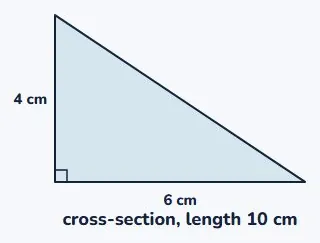
A prism is base area × height
- The base is a right triangle: ½ × 6 × 4 = 12 cm².
- The same triangle runs 10 cm through the prism.
- V = 12 × 10 = 120 cm³
Try it: base area × height
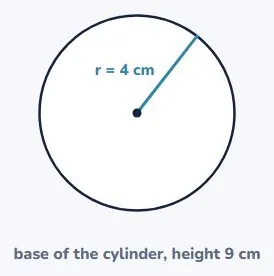
A cylinder is the same idea
- The base is a circle: π × 4² = 16π cm².
- Height 9 cm: V = 16π × 9 = 144π cm³
- Rounded to 1 d.p.: 452.4 cm³
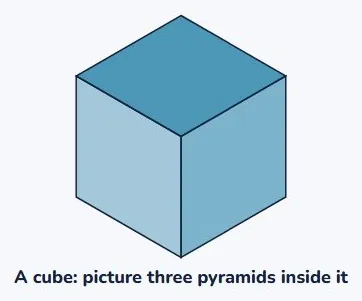
Why a pyramid is a third
- Three identical pyramids fill a cube exactly.
- Each has the cube’s base and the cube’s height.
- So each is ⅓ × base area × height.
A square-based pyramid
- Base 6 cm by 6 cm, vertical height 7 cm.
- Work out the prism it sits inside.
- Take a third: 84 cm³.
| Step | Working | Result |
|---|---|---|
| Base area | 6 × 6 | 36 cm² |
| Prism, same base | 36 × 7 | 252 cm³ |
| Pyramid is a third | 252 ÷ 3 | 84 cm³ |
Shapes and nets
Slant height is not the height
- The slant is the hypotenuse of this triangle.
- h² = 13² − 5² = 144
- h = 12 cm, the vertical height.
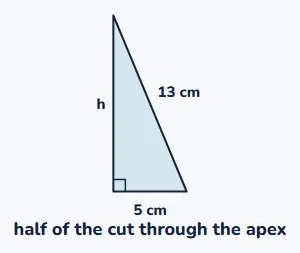
The cone is a third of its cylinder
- Use h = 12, never the slant of 13.
- A third of 300π is 100π cm³.
- Rounded to 1 d.p.: 314.2 cm³
| Step | Working | Result |
|---|---|---|
| Base area | π × 5² | 25π cm² |
| Cylinder, same base | 25π × 12 | 300π cm³ |
| Cone is a third | 300π ÷ 3 | 100π cm³ |
| Rounded | to 1 d.p. | 314.2 cm³ |
Try it: a third of the cylinder
A sphere: 4/3 πr³
- Only the radius is needed.
- 6³ = 216, and 4/3 × 216 = 288
- V = 288π, about 904.8 cm³
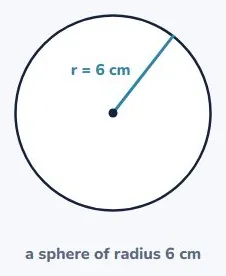
A hemisphere is half a sphere
- Given a diameter? Halve it before anything else.
- Work out the whole sphere, then halve it.
- Exact answer first, then round.
| Step | Working | Result |
|---|---|---|
| Diameter 10 cm | halve it first | r = 5 cm |
| Whole sphere | 4/3 × π × 125 | 500π/3 cm³ |
| Half of it | 500π/3 ÷ 2 | 250π/3 cm³ |
| Rounded | to 1 d.p. | 261.8 cm³ |
Composite: add the parts
- A silo: a cylinder with a hemisphere on top.
- Both have radius 3 m, and they do not overlap.
- So the volumes add: 90π m³.
| Part | Working | Volume |
|---|---|---|
| Cylinder | π × 3² × 8 | 72π m³ |
| Hemisphere | 2/3 × π × 3³ | 18π m³ |
| Add the parts | 72π + 18π | 90π m³ |
| Rounded | to 1 d.p. | 282.7 m³ |
Composite: subtract the hole
- A cone drilled out of a cylinder, same base and height.
- What is left is the cylinder minus the cone.
- 200π: two thirds of the cylinder remain.
| Part | Working | Volume |
|---|---|---|
| Cylinder | π × 5² × 12 | 300π cm³ |
| Cone taken out | a third of that | 100π cm³ |
| Subtract | 300π − 100π | 200π cm³ |
| Rounded | to 1 d.p. | 628.3 cm³ |
Try it: dodge the volume traps
Working back to a height
- A cone of radius 6 cm must hold 500 mL.
- Substitute what you know, then solve for h.
- Round up, or it holds less than 500 mL.
| Step | Working | Note |
|---|---|---|
| 500 mL | is 500 cm³ | 1 mL = 1 cm³ |
| Substitute r = 6 | 1/3 × π × 36 × h | = 12πh |
| Set equal | 12πh = 500 | |
| Divide by 12π | h = 13.26... | |
| Round up | h = 13.3 cm | 13.2 holds too little |
How many full cups?
- An urn: radius 10 cm, height 30 cm.
- Change to millilitres, then divide by one cup.
- Round down: only full cups count.
| Step | Working | Result |
|---|---|---|
| Urn | π × 10² × 30 | 3000π cm³ |
| In millilitres | 1 cm³ = 1 mL | 9424.8 mL |
| Cups of 300 mL | 9424.8 ÷ 300 | 31.4 |
| Round down | 31 full cups | the 32nd is not full |
What to take away
- Base area × height, a third for a point, and say why.
| Prism or cylinder | base area × height |
| Pyramid or cone | a third of the prism or cylinder |
| Slant height given | Pythagoras for the vertical height |
| Sphere | 4/3 πr³, and a hemisphere is half |
| Composite solid | add the parts, subtract the holes |
| Unknown dimension | set the formula equal, then solve |
| Rounding | exact in π first, then fit the context |
Common mistakes
- Cone, radius 5, slant height 13: V = ⅓ × π × 5² × 13Use the vertical height, h = √(13² − 5²) = 12, so V = ⅓ × π × 25 × 12 = 100π cm³.
- Cone, radius 5, height 12: V = π × 5² × 12 = 300π cm³That is the cylinder; a cone holds a third of it, so V = 300π ÷ 3 = 100π cm³.
- Hemisphere with diameter 10 cm: V = ⅔ × π × 10³Halve the diameter first: r = 5, so V = ⅔ × π × 125 = 250π/3 ≈ 261.8 cm³.
- Sphere of radius 6: V = 4 × π × 6² = 144π cm³4πr² is the surface area; the volume is 4/3 πr³ = 4/3 × π × 216 = 288π cm³.
Your turn: eight questions
- Write all eight out, with reasons.
- Watch for diameters and slant heights.
- Give an exact answer, then a rounded one with units.
A cylinder has diameter 12 cm and height 5 cm. Find its volume.
A cone has radius 6 cm and slant height 10 cm. Find its volume.
A hemisphere bowl has diameter 18 cm. How many mL does it hold?
Cone r 3, h 10 cm; a hemisphere, r 3 cm, on its base. Volume?
A cone and a cylinder have the same radius and the same height. The cylinder holds 600 mL. How much does the cone hold?
A pyramid has a rectangular base 8 cm by 5 cm and a volume of 120 cm³. Find its vertical height.
Mere finds the volume of a ball of diameter 8 cm as 4/3 × π × 8³. Find the correct volume.
A Canterbury farm needs a cylindrical tank, radius 1.5 m, to hold 25,000 L. Find the height, to 1 d.p., so it holds enough.
Show answer
1. 180π, about 565.5 cm³. The diameter is 12, so the radius is 6. Base area 36π, times the height 5. 2. 96π, about 301.6 cm³. The slant is the hypotenuse, so h² = 10² − 6² = 64 and h = 8. Then a third of 36π × 8. 3. 486π cm³, about 1526.8 mL. The radius is 9, so half of 4/3 × π × 729, and 1 cm³ is 1 mL. 4. 48π, about 150.8 cm³. The cone is a third of 9π × 10, which is 30π, the hemisphere is 2/3 × π × 27, which is 18π, and the parts are added. 5. 200 mL. A cone holds one third of the cylinder with the same base and height, and 600 ÷ 3 = 200. 6. 9 cm. The base area is 8 × 5 = 40 cm², so ⅓ × 40 × h = 120, which gives 40h = 360 and h = 9. 7. 256π/3, about 268.1 cm³. Mere used the diameter: the radius is 4, so V = 4/3 × π × 64 = 256π/3. 8. 3.6 m. 25,000 L is 25 m³, so π × 1.5² × h = 25 and h = 3.54 m; round up to 3.6 m, as 3.5 m holds too little.
The answers
- 180π, about 565.5 cm³
- h = 8, so 96π, about 301.6 cm³
- 486π cm³, about 1526.8 mL
- 30π + 18π = 48π, about 150.8 cm³
Sample question: Achieved
Find the volume of a cone with base radius 5 cm and vertical height 9 cm. Give the exact answer and the answer to 1 decimal place.
Hint
A cone is one third of the cylinder with the same base and height: V = 13 πr²h.
Answer
75π ≈ 235.6 cm³
Step by step
- A cone holds one third of the cylinder that has the same base and the same height. So V = 13 × base area × height.
- The base is a circle: π × 5² = 25π cm².
- The cylinder around it would hold 25π × 9 = 225π cm³.
- The cone is a third of that: 225π ÷ 3 = 75π cm³.
- To 1 decimal place: 75 × π = 235.6 cm³.
- The classic mistake is to forget the third, which gives 706.9 cm³, three times too big.
- Units: three lengths multiplied together, so cm³.
Full working
- base = π × 5² = 25πcircle
- V = 13 × 25π × 9a third of the cylinder
- = 75π
- 75π ≈ 235.6 cm³
Sample questions: Merit
A cone has a base diameter of 16 cm and a slant height of 17 cm. Find its volume, exactly and to 1 decimal place.
Hint
Halve the diameter to get the radius. The volume needs the vertical height, so find it with Pythagoras from the slant height.
Answer
320π ≈ 1005.3 cm³
Step by step
- Two traps here: a diameter instead of a radius, and a slant height instead of the vertical height.
- Radius = 16 ÷ 2 = 8 cm.
- The radius, the vertical height and the slant height make a right-angled triangle. The slant height, 17 cm, is the hypotenuse.
- h² = 17² − 8² = 289 − 64 = 225, so h = 15 cm.
- V = 13 πr²h = 13 × π × 64 × 15.
- 64 × 15 = 960, and a third of 960 is 320. So V = 320π cm³.
- To 1 decimal place: 1005.3 cm³.
- Using 17 as the height would give about 1139.4 cm³, which is too big. The vertical height is always shorter than the slant.
Full working
- r = 16 ÷ 2 = 8halve the diameter
- h² = 17² − 8² = 225, so h = 15slant height is the hypotenuse
- V = 13 × π × 64 × 15V = 13 πr²h
- = 320π
- 320π ≈ 1005.3 cm³
A wooden cube has edges of 10 cm. A hemisphere-shaped bowl of radius 4 cm is carved out of the middle of its top face. Find the volume of wood that is left, to 1 decimal place.
Hint
Wood left = cube minus the hole. A hemisphere is half of a sphere, 43 πr³.
Answer
1000 − 128π3 ≈ 866.0 cm³
Step by step
- This is a composite solid with a hole, so the volumes subtract: wood left = cube − hemisphere.
- Cube: 10 × 10 × 10 = 1000 cm³.
- A whole sphere of radius 4 is 43 × π × 4³ = 43 × π × 64 = 256π3.
- A hemisphere is half of that: 128π3 cm³, which is about 134.04 cm³.
- Wood left = 1000 − 128π3 = 865.96… cm³.
- To 1 decimal place: 866.0 cm³. Keep the exact form until the last step so you round only once.
- The bowl fits: it is 8 cm wide and 4 cm deep, inside a 10 cm cube, so the subtraction makes sense.
- Check: the hole is about 13% of the cube, so most of the wood is left. 866 out of 1000 fits that.
Full working
- cube = 10³ = 1000V = edge³
- hemisphere = ½ × 43 × π × 4³ = 128π3half a sphere
- 1000 − 128π3subtract the hole
- = 865.96…
- 866.0 cm³
Sample questions: Excellence
A metal sphere of radius 6 cm is melted down and recast as a cone with the same radius, 6 cm. (a) Find the height of the cone. (b) Prove that for any sphere of radius r recast as a cone of the same radius, the cone's height is always 4r. (c) Instead, the metal is recast as a cylinder of radius 4 cm. Find its height.
Hint
Melting does not change the volume, so set the two volume formulas equal and solve for the height.
Answer
(a) 24 cm (b) 13 πr²h = 43 πr³ gives h = 4r (c) 18 cm
Step by step
- Melting and recasting keeps the amount of metal, so the volume stays the same. That is the equation to use.
- (a) Sphere volume: 43 × π × 6³ = 43 × π × 216 = 288π cm³.
- Cone volume with radius 6: 13 × π × 36 × h = 12πh.
- Set them equal: 12πh = 288π. Divide both sides by 12π: h = 24 cm.
- (b) Use letters so it works for every size. Sphere: 43 πr³. Cone of the same radius: 13 πr²h.
- Set them equal: 13 πr²h = 43 πr³.
- Multiply both sides by 3: πr²h = 4πr³. Divide both sides by πr²: h = 4r.
- So the cone is always 4 times as tall as the sphere's radius. Check with (a): 4 × 6 = 24. It agrees.
- (c) Cylinder of radius 4: π × 4² × h = 16πh. Set equal to 288π: h = 288 ÷ 16 = 18 cm.
- Keeping π as a symbol means it cancels, so there is no rounding at all.
Full working
- sphere = 43 × π × 216 = 288πV = 43 πr³
- 12πh = 288π, so h = 24cone: 13 × π × 36 × h
- 13 πr²h = 43 πr³same volume, any r
- h = 4rmultiply by 3, divide by πr²
- 16πh = 288π, so h = 18cylinder radius 4
- (a) 24 cm (b) h = 4r (c) 18 cm
A farm water tank is a cylinder of radius 1.2 m and height 2 m, with a cone of the same radius and height 0.9 m underneath it. When full, how many litres does it hold? A household uses 180 litres a day and there is no rain. For how many full days will a full tank last? State one assumption you made.
Hint
Add the cylinder and the cone, convert cubic metres to litres (1 m³ = 1000 L), then divide by the daily use and think about rounding.
Answer
About 10 405 litres; 57 full days; assumes, for example, that the tank starts completely full
Step by step
- The tank is a composite solid with no overlap, so add the two volumes.
- Both parts have base area π × 1.2² = 1.44π m².
- Cylinder: 1.44π × 2 = 2.88π m³.
- Cone: 13 × 1.44π × 0.9 = 0.432π m³. Remember the third.
- Total: 2.88π + 0.432π = 3.312π = 10.404… m³.
- 1 m³ is 1000 litres, so the tank holds about 10 405 litres.
- Days: 10 405 ÷ 180 = 57.8…
- The question asks for full days. On day 58 the tank runs out partway through, so round down to 57.
- Check: 57 × 180 = 10 260 L, which fits. 58 × 180 = 10 440 L, which is more than the tank holds.
- Assumptions: the tank starts completely full, the water can all be drained (even from the cone), and use stays at exactly 180 L each day.
Full working
- base = π × 1.2² = 1.44πboth parts
- cylinder 1.44π × 2 = 2.88πV = base × height
- cone 13 × 1.44π × 0.9 = 0.432πV = 13 × base × height
- 3.312π = 10.404… m³ ≈ 10 405 L1 m³ = 1000 L
- 10 405 ÷ 180 = 57.8…round down: full days only
- 10 405 L; 57 full days
Challenge
Tennis balls of radius 3.3 cm are sold three to a cylindrical tin. The tin fits them exactly: its radius is the ball's radius, and its height is three diameters. (a) Show that, whatever the size of the ball, exactly one third of the tin is empty space. (b) Find the empty space in this tin, exactly and to 1 decimal place.
Hint
Write the tin's height in terms of r (three diameters is 6r), then write both volumes in terms of r and compare them.
Answer
(a) tin 6πr³, balls 4πr³, so the gap is 2πr³, one third (b) 71.874π ≈ 225.8 cm³
Step by step
- Use letters first so the result works for every ball size.
- The tin has radius r and height 3 × 2r = 6r, so its volume is πr² × 6r = 6πr³.
- Each ball is 43 πr³, so three balls are 3 × 43 πr³ = 4πr³.
- Empty space = 6πr³ − 4πr³ = 2πr³, and 2πr³ ÷ 6πr³ = 13, whatever r is.
- For r = 3.3: r³ = 35.937, so the gap is 2π × 35.937 = 71.874π ≈ 225.8 cm³.
Full working
- height = 3 × 2r = 6rthree diameters
- tin = πr² × 6r = 6πr³cylinder
- balls = 3 × 43 πr³ = 4πr³three spheres
- gap = 2πr³, and 2πr³ ÷ 6πr³ = 13true for any r
- r = 3.3: 2π × 35.937 = 71.874πr³ = 35.937
- (a) one third empty (b) 71.874π ≈ 225.8 cm³
A cylindrical glass has an inside radius of 4 cm and a height of 15 cm. It holds water to a depth of 10 cm. Solid steel balls of radius 3 cm are dropped in one at a time; they sink, and each one rests on top of the one before. (a) How much does the water rise for each ball that ends up fully under water? (b) Show that two balls can go in without spilling, and give the new depth. (c) A third ball is dropped in. How much water spills out?
Hint
A ball fully under water pushes up the water by its own volume, spread over the circle of the glass. For (c), notice where the third ball's centre sits compared with the rim.
Answer
(a) 2.25 cm (b) 14.5 cm deep, balls reach only 12 cm (c) 10π ≈ 31.4 cm³
Step by step
- One ball is 43 × π × 27 = 36π cm³. The water surface is a circle of area 16π cm², so the level rises 36π ÷ 16π = 2.25 cm.
- Two balls: 10 + 2 × 2.25 = 14.5 cm, below the 15 cm rim. The balls are 6 cm across and stack to 12 cm, so both are fully under water and the 2.25 cm rise is fair.
- A third ball would sit from 12 cm to 18 cm, so its centre is exactly at the 15 cm rim: only its lower half can be under water.
- Below the rim we would need water 160π, two whole balls 72π and half a ball 18π, a total of 250π cm³.
- The glass holds only 16π × 15 = 240π cm³, so 250π − 240π = 10π ≈ 31.4 cm³ spills out.
Full working
- ball = 43 × π × 3³ = 36πsphere
- rise = 36π ÷ 16π = 2.25 cmvolume ÷ base area of glass
- 10 + 2 × 2.25 = 14.5 cm, balls reach 12 cmtwo balls, both covered
- 160π + 72π + 18π = 250πwater + 2 balls + lower half of ball 3
- 250π − 16π × 15 = 250π − 240π = 10πglass full to the rim
- (a) 2.25 cm (b) 14.5 cm (c) 10π ≈ 31.4 cm³ spills
A paper water cup is a cone, point down, with a rim radius of 4 cm and a vertical height of 9 cm. (a) Water is poured in to a depth of 6 cm, two thirds of the way up. Show that the cup is less than one third full, and give the exact fraction. (b) To what depth must the water reach for the cup to be exactly half full? Give your answer to 2 decimal places.
Hint
The water itself is a smaller cone with the same shape: its radius is to its depth as 4 is to 9, so at depth d its radius is 4d9. For (b), set the water's volume equal to half the cup and solve for d.
Answer
(a) 827 of the cup (b) d = 9 × ∛(12) ≈ 7.14 cm
Step by step
- The full cup holds 13 × π × 4² × 9 = 48π cm³.
- The water is a similar cone. At depth 6 its radius is 4 × 69 = 83 cm.
- Water = 13 × π × (83)² × 6 = 128π9 cm³, and 128π9 ÷ 48π = 827, which is less than 927 = 13.
- In general the water at depth d has radius 4d9, so its volume is 13 × π × 16d²81 × d = 16πd³243.
- Half full means 16πd³243 = 24π, so d³ = 364.5 and d = ∛364.5 ≈ 7.14 cm, far above half the height, because a cone is narrow at the bottom.
Full working
- cup = 13 × π × 16 × 9 = 48πfull cone
- radius at depth 6 = 4 × 69 = 83similar cones
- water = 13 × π × 649 × 6 = 128π9smaller cone
- 128π9 ÷ 48π = 827 < 13fraction full
- 16πd³243 = 24π, so d³ = 364.5half of 48π
- (a) 827 (b) d = ∛364.5 ≈ 7.14 cm
Practise this
Report a mistake
More in AS 91947
 Expanding, index laws and algebraic fractions8 min
 Factorising quadratics, HCF and difference of squares8 min
 Algebraic proof: even, odd and consecutive numbers8 min
 Solving linear equations and inequations8 min
 Solving quadratic equations by factorising8 min
 Simultaneous equations: elimination and substitution8 min
 Straight-line graphs, gradient and rate of change8 min
 Optimal solutions: break-even and maximum area7 min
 Pythagoras' theorem in 2D and 3D explained7 min
 Trigonometry: SOH CAH TOA, elevation and 3D7 min
 Similar shapes: scale factors, area and volume7 min
 Surface area of pyramids, cones and spheres7 minVolume of cones, pyramids, spheres and composite solids7 min
 Expressions: 7 exam questions solved step by step11 min
 Factorising: 7 exam questions solved step by step10 min
 Generalising: 7 exam questions solved step by step10 min
 Equations and inequations: 7 exam questions solved11 min
 Quadratic equations: 7 exam questions solved step by step11 min
 Simultaneous equations: 7 exam questions solved step by step12 min
 Straight-line graphs: 7 exam questions solved step by step11 min
 Optimal solutions: 7 exam questions solved step by step11 min
 Pythagoras: 7 exam questions solved step by step11 min
 Trigonometry: 7 exam questions solved step by step10 min
 Similar shapes: 7 exam questions solved step by step10 min
 Surface area: 7 exam questions solved step by step11 min
 Volume: 7 exam questions solved step by step10 min
Is your child on track?
Take the free placement test