Optimal solutions: 7 exam questions solved step by step
What this lesson covers
- The best option depends on the quantity being compared, so the comparison has to be set up before the choice is made.
- Where two cost rules cross is the point at which the better option changes.
Finding the best option
- Say what best means: cheapest, or largest.
- Write a rule for each option.
- Same cost: set the rules equal and solve.
- One better: write and solve an inequation.
- Largest area or income: halfway between the zeros.
- Answer in words, with the numbers that prove it.
Question 1 · Achieved, in context
- Bike hire in Rotorua, for 3 hours.
- Company A: $15, plus $5 an hour.
- Company B: $25, plus $3 an hour.
- Which is cheaper? Justify it.
Q1: bike hire for 3 hours
- Measure: total cost.
- Fee + rate × hours.
- Let h = number of hours
- A = 15 + 5hfee + rate × hours
- B = 25 + 3h
- A = 15 + 5 × 3 = 30h = 3
- B = 25 + 3 × 3 = 34h = 3
- 30 < 34, a saving of $4
- Company A is cheaper, by $4
Question 2 · Achieved, in context
- A gym has two ways to pay.
- Plan P: $40 to join, then $8 a visit.
- Plan Q: $12 a visit, nothing to join.
- When do both cost the same?
Q2: the break-even point
- Same cost: set equal.
- Check in both rules.
- P = 40 + 8nn = number of visits
- Q = 12nno joining fee
- 40 + 8n = 12nP = Q
- 40 = 4n−8n both sides
- n = 10÷ 4
- P = 40 + 80 = 120
- Q = 12 × 10 = 120
- 10 visits, both cost $120
Try it: the break-even point
Question 3 · Merit, in context
- Bike hire: A = 15 + 5h, B = 25 + 3h
- Hire is charged in whole hours.
- For which hires is B cheaper?
- Answer in hours, not just in h.
Q3: when is B cheaper?
- Cheaper: less than.
- Whole hours only.
- 25 + 3h < 15 + 5hB < A
- 25 < 15 + 2h−3h both sides
- 10 < 2h−15 both sides
- 5 < h, so h > 5÷ 2, sign stays
- h = 5: A = 40, B = 40break-even
- h = 6: A = 45, B = 43B wins
- 6 hours or more: B is cheaper
Question 4 · Merit, in context
- A vege garden against a wall.
- 20 m of fence for the other 3 sides.
- Width x m, so A = x(20 − 2x).
- Find the largest possible area.
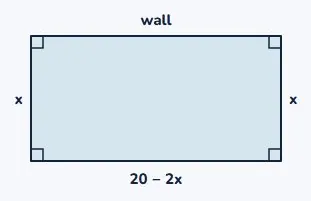
Q4: the largest garden
- Opens downward: a max.
- Max is halfway.
- length = 20 − 2xtwo widths use 2x
- A = x(20 − 2x) = −2x² + 20xx² negative: a max
- A = 0: x = 0 or 20 − 2x = 0
- zeros: x = 0 and x = 10
- x = (0 + 10) ÷ 2 = 5halfway
- length = 20 − 2 × 5 = 10
- A = 5 × 10 = 50
- x = 4 or 6: A = 48 < 50
- 50 m², 5 m wide by 10 m long
Try it: the largest garden
Question 5 · Merit, in context
- A school quiz night sells tickets.
- At $p each, it sells 200 − 10p.
- Income: R = p(200 − 10p) dollars.
- Which price gives the most income?
Q5: the best ticket price
- Measure: income.
- Halfway between zeros.
- R = −10p² + 200popens downward
- R = 0: p = 0 or 200 − 10p = 0
- zeros: p = 0 and p = 20
- p = (0 + 20) ÷ 2 = 10halfway
- tickets = 200 − 10 × 10 = 100
- R = 10 × 100 = 1000
- p = 9: 9 × 110 = 990
- p = 11: 11 × 90 = 990
- $10 a ticket, income $1000
Question 6 · Excellence
- Two sheep pens, side by side,
- Against a woolshed wall.
- 24 m of fence, one across the middle.
- Find the pens with the most area.
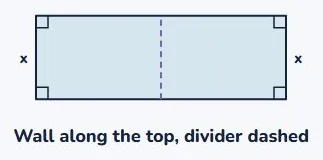
Q6: two pens, one fence
- The divider is a width.
- Then halfway again.
- Let x = width of the pens (m)
- length = 24 − 3x3 widths use 3x
- A = x(24 − 3x) = −3x² + 24xopens downward
- zeros: x = 0 and x = 824 − 3x = 0
- x = (0 + 8) ÷ 2 = 4halfway
- length = 24 − 3 × 4 = 12
- A = 4 × 12 = 48
- x = 3 or 5: A = 45 < 48
- 4 m by 12 m, 48 m² in total
Try it: best deal
Question 7 · Excellence
- C: $f fixed, plus $4 an hour.
- D: $7 an hour, no fixed fee.
- Show they break even at h = f/3.
- Find f for 4 hours; when is C cheaper?
Q7: break-even with a letter
- Same method, a letter.
- Solve for h.
- C = f + 4h
- D = 7h
- f + 4h = 7hC = D
- f = 3h−4h both sides
- h = f/3÷ 3
- h = 4: f = 3 × 4 = 12
- C = 12 + 16 = 28, D = 28
Q7: when is C cheaper?
- Cheaper: less than.
- Whole hours only.
- C = 12 + 4h, D = 7h
- 12 + 4h < 7hC < D
- 12 < 3h−4h both sides
- 4 < h, so h > 4÷ 3
- h = 5: C = 32, D = 35
- f = $12; C cheaper from 5 hours
Common mistakes
- Company A is cheaper.Justify with numbers: A costs 15 + 5 × 3 = $30 and B costs 25 + 3 × 3 = $34, so A is $4 cheaper.
- 15 + 5h > 25 + 3h gives h > 5, so the answer is h > 5.Hire is in whole hours, so answer in context: B is cheaper for hires of 6 hours or more.
- R = p(200 − 10p) is zero at p = 0 and p = 200, so the best price is $100.200 − 10p = 0 gives p = 20, so the best price is halfway, $10, for an income of $1000.
The method that solved all seven
- Name the measure, compare, and justify in words.
| Step | How |
|---|---|
| The measure | name what best means first |
| Two rules | fixed fee + rate × amount |
| Break-even | set the rules equal, solve |
| Better when | an inequation, then check |
| Whole units | h > 5 means 6 hours or more |
| Most area | halfway between the zeros |
| Justify it | choice, numbers and reason |
Challenge
Electrician A charges a call-out fee plus an hourly rate: a 2 hour job costs $190 and a 5 hour job costs $385. Electrician B charges $95 an hour with no call-out fee. Both charge in half hours. A customer saved exactly $15 by choosing the cheaper electrician. Find the two possible lengths of the job, and say who did the work in each case.
Hint
First find A's fee and rate from the two jobs. Then write A − B as a rule in h, and ask when it equals 15 or −15.
Answer
1.5 hours with B ($142.50 against $157.50), or 2.5 hours with A ($222.50 against $237.50)
Step by step
- From 2 hours to 5 hours, A's cost goes up by $195, so A's rate is $65 an hour.
- The fee is 190 − 2 × 65 = $60, so A = 60 + 65h and B = 95h.
- The difference A − B = 60 − 30h. They break even at 2 hours.
- A saving of $15 means the difference is 15 or −15: h = 1.5 (B cheaper) or h = 2.5 (A cheaper).
- Both are whole half hours, so both are possible.
Full working
- 3r = 385 − 190 = 195, r = 655 h job − 2 h job
- f = 190 − 2 × 65 = 60A's call-out fee
- A = 60 + 65h, B = 95hthe two rules
- A − B = 60 − 30hdifference
- 60 − 30h = 15 gives h = 1.5A dearer: B did it
- 60 − 30h = −15 gives h = 2.5B dearer: A did it
- h = 1.5: B $142.50, A $157.50; h = 2.5: A $222.50, B $237.50check
- 1.5 hours by B, or 2.5 hours by A
A rectangular garden is fenced against a house wall, so only three sides need fence. The front fence, parallel to the wall, costs $30 per metre. The two side fences cost $20 per metre. The budget is $1200. Find the dimensions that give the largest area, and that area.
Hint
The cost, not the length of fence, is fixed. Let x be each side length and write the front length in terms of x from the budget.
Answer
Sides 15 m and front 20 m, for a largest area of 300 m²
Step by step
- Two sides cost 2 × 20x = 40x dollars and the front y metres costs 30y dollars.
- The budget gives 40x + 30y = 1200, so y = 40 − 4x ÷ 3.
- Area A = x(40 − 4x ÷ 3): zero when x = 0 and when x = 30.
- The largest area is halfway, at x = 15, so the front is 40 − 20 = 20 m.
- Check either side: x = 12 and x = 18 both give 288 m², less than 300 m².
Full working
- 40x + 30y = 1200cost of three fences
- y = 40 − 4x ÷ 3front in terms of x
- A = x(40 − 4x ÷ 3)area
- zeros: x = 0 and x = 3040 − 4x ÷ 3 = 0
- x = (0 + 30) ÷ 2 = 15halfway
- y = 40 − 20 = 20, A = 15 × 20 = 300dimensions
- x = 12: 12 × 24 = 288; x = 18: 18 × 16 = 288both smaller
- 15 m sides, 20 m front, 300 m²
A food truck sells 300 kebabs a day at $12 each, and 240 a day at $14 each. Assume the number sold follows a straight-line rule in the price p. Each kebab costs $8 to make. (a) Write the number sold and the daily profit in terms of p. (b) Find the price that gives the most profit, and that profit. (c) Which other price gives the same profit as $13? Explain without working out its profit first.
Hint
Find the straight-line rule n = mp + c from the two data points. Profit is (profit per kebab) × (number sold). Where is profit zero?
Answer
(a) n = 660 − 30p, P = (p − 8)(660 − 30p) (b) $15, profit $1470 a day (c) $17, because the graph is symmetric about p = 15
Step by step
- Raising the price by $2 loses 60 sales, so sales fall by 30 for every $1: n = 660 − 30p.
- Profit per kebab is p − 8, so P = (p − 8)(660 − 30p).
- P = 0 when p = 8 (no profit per kebab) or p = 22 (no sales).
- The best price is halfway, p = 15: 210 kebabs at $7 profit each is $1470.
- The graph is symmetric about p = 15, and $13 is $2 below it, so $17 ($2 above) gives the same profit, $1350.
Full working
- m = (240 − 300) ÷ (14 − 12) = −30sales per $1
- n = 300 − 30(p − 12) = 660 − 30pstraight-line rule
- P = (p − 8)(660 − 30p)profit per kebab × number
- zeros: p = 8 and p = 22P = 0
- p = (8 + 22) ÷ 2 = 15halfway
- P = 7 × 210 = 1470best profit
- 15 − 2 = 13, 15 + 2 = 17symmetry
- P(13) = 5 × 270 = 1350, P(17) = 9 × 150 = 1350check
- (b) $15 for $1470 a day (c) $17
Practise this
Report a mistake
More in AS 91947
 Expanding, index laws and algebraic fractions8 min
 Factorising quadratics, HCF and difference of squares8 min
 Algebraic proof: even, odd and consecutive numbers8 min
 Solving linear equations and inequations8 min
 Solving quadratic equations by factorising8 min
 Simultaneous equations: elimination and substitution8 min
 Straight-line graphs, gradient and rate of change8 min
 Optimal solutions: break-even and maximum area7 min
 Pythagoras' theorem in 2D and 3D explained7 min
 Trigonometry: SOH CAH TOA, elevation and 3D7 min
 Similar shapes: scale factors, area and volume7 min
 Surface area of pyramids, cones and spheres7 min
 Volume of cones, pyramids, spheres and composite solids7 min
 Expressions: 7 exam questions solved step by step11 min
 Factorising: 7 exam questions solved step by step10 min
 Generalising: 7 exam questions solved step by step10 min
 Equations and inequations: 7 exam questions solved11 min
 Quadratic equations: 7 exam questions solved step by step11 min
 Simultaneous equations: 7 exam questions solved step by step12 min
 Straight-line graphs: 7 exam questions solved step by step11 minOptimal solutions: 7 exam questions solved step by step11 min
 Pythagoras: 7 exam questions solved step by step11 min
 Trigonometry: 7 exam questions solved step by step10 min
 Similar shapes: 7 exam questions solved step by step10 min
 Surface area: 7 exam questions solved step by step11 min
 Volume: 7 exam questions solved step by step10 min
Is your child on track?
Take the free placement test