Solving quadratic equations by factorising
What this lesson covers
- If two quantities multiply to zero, at least one of them is zero.
- A quadratic equation can have two, one or no real solutions, and the solutions are where its graph crosses the x-axis.
Year 10 gave you the brackets
- Last year the quadratic arrived already factorised.
- Now you rearrange it and factorise it yourself.
- And every step comes with its reason.
| Question | What it asks of you |
|---|---|
| Year 10: (x − 2)(x + 4) = 0 | already factorised, read it off |
| Level 1: x² = 5x + 14 | rearrange, factorise, then solve |
| Level 1: a context | form the equation yourself |
| Every step | says why it is allowed |
Why it has to equal zero
- If two numbers multiply to zero, one of them is zero.
- No other number works that way.
- Six is two times three, or one times six, or many others.
| Equation | Tells you | Because |
|---|---|---|
| a × b = 0 | a = 0 or b = 0 | only 0 does this |
| (x − 3)(x + 5) = 0 | x = 3 or x = −5 | set each bracket to 0 |
| (x − 1)(x − 2) = 6 | no conclusion | many pairs make 6 |
| So first | get 0 on one side |
Rearrange to zero first
- Subtract five x and fourteen from both sides.
- Factorise: minus seven and two.
- Null factor law, then check both answers.
| Step | Working | Why |
|---|---|---|
| Start | x² = 5x + 14 | |
| Subtract 5x and 14 | x² − 5x − 14 = 0 | same to both sides |
| Factorise | (x − 7)(x + 2) = 0 | × −14, + −5 |
| Null factor law | x = 7 or x = −2 | one bracket is 0 |
| Check | 49 = 35 + 14 | 4 = −10 + 14 |
Do not divide by x
- Dividing both sides by x gives x equals three.
- But x might be zero, and you cannot divide by zero.
- Rearrange and factorise instead: two solutions.
| Method | Working | Result |
|---|---|---|
| Divide by x | x² ÷ x = 3x ÷ x | x = 3 only |
| But x could be 0 | you cannot divide by 0 | x = 0 is lost |
| Rearrange instead | x² − 3x = 0 | |
| Common factor | x(x − 3) = 0 | x = 0 or x = 3 |
When the number in front is not 1
- Multiply a by c: two times minus three is minus six.
- Find two numbers: times to minus six, add to five.
- Split the middle, group in pairs, take out the bracket.
| Step | Working | Note |
|---|---|---|
| 2x² + 5x − 3 = 0 | a is 2, so use ac | ac = −6 |
| Need × −6, + 5 | 6 and −1 | |
| Split the middle | 2x² + 6x − x − 3 | |
| Group in pairs | 2x(x + 3) − 1(x + 3) | |
| Common bracket | (2x − 1)(x + 3) = 0 |
Solving each bracket
- Two x minus one is zero, so x is a half.
- x plus three is zero, so x is minus three.
- Both check back to zero.
| Bracket | Set to 0 | Solution |
|---|---|---|
| 2x − 1 = 0 | 2x = 1 | x = 1/2 |
| x + 3 = 0 | x = −3 | |
| Check x = 1/2 | 0.5 + 2.5 − 3 | = 0 |
| Check x = −3 | 18 − 15 − 3 | = 0 |
A repeated root
- Minus three and minus three: times to nine, add to minus six.
- So it is x minus three, squared.
- Both brackets give the same answer. One solution.
| Step | Working | Note |
|---|---|---|
| x² − 6x + 9 = 0 | need × 9, + −6 | |
| −3 and −3 | multiply to 9, add to −6 | |
| Factorise | (x − 3)(x − 3) = 0 | a perfect square |
| Both brackets | give x = 3 | one solution |
The solutions are on the graph
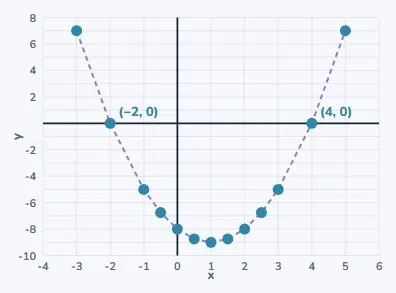
- On the x-axis, y is zero.
- So solving equals zero asks where the graph meets the axis.
- It crosses at minus two and four.
Try it: two, one or no solutions
Two, one or no real solutions
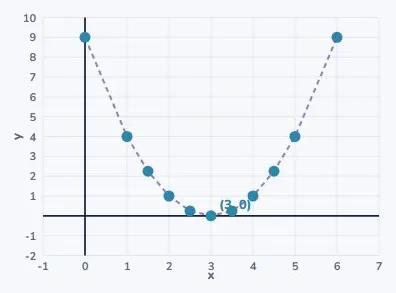
- A repeated root: the graph just touches the axis.
- Here it touches once, at three.
- A graph that never reaches the axis has no real solutions.
Forming the equation from words
- Name the unknown: the width is w metres.
- The length is three more, so w plus three.
- Length times width is forty. Rearrange to zero.
| Words | Algebra | Note |
|---|---|---|
| Width | w metres | the unknown |
| Length is 3 more | w + 3 | |
| Area is 40 m² | w(w + 3) = 40 | length × width |
| Expand, subtract 40 | w² + 3w − 40 = 0 | now it is = 0 |
Solve it, then reject what cannot be
- Eight and minus five: times to minus forty, add to three.
- w is five, or w is minus eight.
- A width cannot be negative, so minus eight is rejected.
| Step | Working | Reason |
|---|---|---|
| Factorise | (w + 8)(w − 5) = 0 | × −40, + 3 |
| Null factor law | w = −8 or w = 5 | |
| Reject w = −8 | a width cannot be negative | |
| Answer | 5 m wide, 8 m long | check: 5 × 8 = 40 |
Try it: get it to zero
Writing it up as reasoning
- Say what the letter stands for, with units.
- Give the reason beside each step.
- Finish with an answer to the question that was asked.
| Line | What you write |
|---|---|
| Define the unknown | let w be the width in metres |
| Form the equation | w(w + 3) = 40, because area is length × width |
| Give each reason | rearranged to 0, then the null factor law |
| Reject with a reason | w = −8 is impossible: a width is positive |
| Answer the question | the rectangle is 5 m wide and 8 m long |
Graphing calculator
What to take away
- Get it to zero, factorise, and say why at every step.
| Null factor law | only works when one side is 0 |
| Rearrange first | everything on one side, 0 on the other |
| Never divide by x | you lose the solution x = 0 |
| When a is not 1 | split the middle using ac |
| A repeated root | one solution, the graph touches the axis |
| The solutions | are the x-intercepts of the graph |
| In a context | reject what cannot happen, and say why |
Common mistakes
- x² = 3x, so divide both sides by x: x = 3Dividing by x loses x = 0; rearrange to x² − 3x = 0, so x(x − 3) = 0 and x = 0 or x = 3.
- (x − 7)(x + 2) = 0, so x = −7 or x = 2Set each bracket to zero: x − 7 = 0 gives x = 7, and x + 2 = 0 gives x = −2.
- (x − 1)(x − 2) = 6, so x − 1 = 6 or x − 2 = 6The null factor law only works when the product is 0; expand and rearrange to x² − 3x − 4 = 0 first.
- w(w + 3) = 40, so w = −8 or w = 5.Reject w = −8 because a width cannot be negative, then answer the question: 5 m wide and 8 m long.
Your turn: eight questions
- Write all eight out, with reasons.
- Question 1 is not equal to zero yet.
- Question 3 has a solution to reject. Say why.
Solve x² = 4x + 21.
Solve 2x² + x − 6 = 0.
A garden is 2 m longer than wide. Area 48 m². Find its width.
How many times does y = x² + 10x + 25 meet the x-axis? Why?
Solve x² = 6x.
Solve 4x² − 9 = 0.
A quadratic graph crosses the x-axis at x = −4 and x = 1. Which equation has these two solutions?
A 10 cm by 8 cm photo gets a border x cm wide on every side. Photo and border together cover 168 cm². Find x.
Show answer
1. x = 7 or x = −3. Rearrange to x² − 4x − 21 = 0, which factorises to (x − 7)(x + 3) = 0, then use the null factor law. 2. x = 3/2 or x = −2. ac = −12, so split the middle with 4 and −3: 2x(x + 2) − 3(x + 2) = (2x − 3)(x + 2) = 0. 3. The width is 6 m. w(w + 2) = 48 gives w² + 2w − 48 = 0, so (w + 8)(w − 6) = 0 and w = 6 or −8. Reject −8 because a width cannot be negative. 4. Once, at x = −5. It factorises to (x + 5)², a repeated root, so the graph touches the x-axis at one point instead of crossing it twice. 5. x = 0 or x = 6. Do not divide by x: rearrange to x² − 6x = 0, so x(x − 6) = 0, then use the null factor law. 6. x = 3/2 or x = −3/2. It is a difference of two squares: (2x + 3)(2x − 3) = 0, so 2x = 3 or 2x = −3. 7. x² + 3x − 4 = 0. x = −4 comes from the bracket (x + 4) and x = 1 from (x − 1), and (x + 4)(x − 1) = x² + 3x − 4. 8. x = 2 cm. (10 + 2x)(8 + 2x) = 168 gives 4x² + 36x − 88 = 0, so x² + 9x − 22 = 0 and (x + 11)(x − 2) = 0. Reject −11: a width cannot be negative.
The answers
- x = 7 or x = −3.
- x = 3/2 or x = −2.
- Width 6 m. Reject −8: a width cannot be negative.
- Once, at x = −5. It is (x + 5)², a repeated root.
Sample question: Achieved
Solve x² − 2x = 15.
Hint
Make one side zero first, then factorise and use the null factor law.
Answer
x = 5 or x = −3
Step by step
- The null factor law only works when a product equals zero. Right now the right side is 15, so move it.
- Subtract 15 from both sides: x² − 2x − 15 = 0.
- Factorise: find two numbers that multiply to −15 and add to −2. They are −5 and 3.
- So (x − 5)(x + 3) = 0.
- If two things multiply to zero, one of them must be zero. So x − 5 = 0 or x + 3 = 0.
- That gives x = 5 or x = −3.
- The classic mistake is to factorise x² − 2x = 15 as x(x − 2) = 15 and guess. 15 can be made from many products, so that does not work.
- Check: 5² − 2 × 5 = 25 − 10 = 15. (−3)² − 2 × (−3) = 9 + 6 = 15. Both work.
Full working
- x² − 2x − 15 = 0subtract 15 to get zero
- (x − 5)(x + 3) = 0−5 × 3 = −15, −5 + 3 = −2
- x − 5 = 0 or x + 3 = 0null factor law
- x = 5 or x = −3
Sample questions: Merit
Solve (x + 1)(x − 3) = 2x − 6. Explain why dividing both sides by (x − 3) would be a mistake.
Hint
Expand the left side, move everything to one side so it equals zero, then factorise.
Answer
x = 1 or x = 3; dividing by x − 3 loses the answer x = 3
Step by step
- The left side is factorised, but the right side is not zero. So the null factor law cannot be used yet.
- Expand the left: (x + 1)(x − 3) = x² − 3x + x − 3 = x² − 2x − 3.
- So x² − 2x − 3 = 2x − 6. Subtract 2x and add 6 to both sides: x² − 4x + 3 = 0.
- Factorise: two numbers that multiply to 3 and add to −4 are −1 and −3. So (x − 1)(x − 3) = 0.
- Null factor law: x − 1 = 0 or x − 3 = 0, so x = 1 or x = 3.
- Why not divide? 2x − 6 = 2(x − 3), so it is tempting to divide both sides by x − 3 and get x + 1 = 2, so x = 1.
- But when x = 3, x − 3 is zero, and you cannot divide by zero. Dividing throws away the answer x = 3.
- Check x = 1: (2)(−2) = −4 and 2 − 6 = −4. Check x = 3: (4)(0) = 0 and 6 − 6 = 0. Both work.
Full working
- x² − 2x − 3 = 2x − 6expand
- x² − 4x + 3 = 0subtract 2x, add 6
- (x − 1)(x − 3) = 0−1 × −3 = 3, −1 + −3 = −4
- x = 1 or x = 3null factor law
- dividing by x − 3 loses x = 3it is zero there
- x = 1 or x = 3
The sides of a right-angled triangle are x, x + 7 and x + 8 centimetres. Form a quadratic equation, solve it, and find the three sides.
Hint
The longest side, x + 8, is the hypotenuse. Use Pythagoras, then rearrange to zero.
Answer
x = 5, so the sides are 5 cm, 12 cm and 13 cm (x = −3 is rejected)
Step by step
- In a right-angled triangle, the hypotenuse is the longest side. Here that is x + 8.
- Pythagoras: x² + (x + 7)² = (x + 8)².
- Expand each square as two brackets: (x + 7)² = x² + 14x + 49 and (x + 8)² = x² + 16x + 64.
- So x² + x² + 14x + 49 = x² + 16x + 64, which is 2x² + 14x + 49 = x² + 16x + 64.
- Move everything to the left: x² − 2x − 15 = 0.
- Factorise: −5 and 3 multiply to −15 and add to −2. So (x − 5)(x + 3) = 0, and x = 5 or x = −3.
- A length cannot be negative, so x = −3 is rejected. Always say why you reject an answer.
- x = 5 gives sides 5, 12 and 13 cm.
- Check: 5² + 12² = 25 + 144 = 169 = 13². It is right-angled.
Full working
- x² + (x + 7)² = (x + 8)²x + 8 is the hypotenuse
- 2x² + 14x + 49 = x² + 16x + 64expand
- x² − 2x − 15 = 0rearrange to zero
- (x − 5)(x + 3) = 0, so x = 5 or −3
- reject x = −3a length cannot be negative
- 5 cm, 12 cm and 13 cm
Sample questions: Excellence
For the equation x² − kx + 36 = 0: (a) find the values of k that give exactly one solution, and the solution in each case. (b) Explain what the graph of y = x² − kx + 36 looks like for those values of k. (c) Solve the equation when k = 13.
Hint
One solution means a repeated root, so the quadratic must be a perfect square, (x − a)². Expand that and match it.
Answer
(a) k = 12 gives x = 6; k = −12 gives x = −6 (b) the graph just touches the x-axis at that point (c) x = 4 or x = 9
Step by step
- A quadratic has exactly one solution when it is a repeated root. That happens when it factorises as a perfect square, (x − a)² = 0.
- Expand: (x − a)² = x² − 2ax + a². Match it with x² − kx + 36.
- The numbers must match: a² = 36, so a = 6 or a = −6.
- The x terms must match: k = 2a. So a = 6 gives k = 12, and a = −6 gives k = −12.
- k = 12: x² − 12x + 36 = (x − 6)² = 0, so the only solution is x = 6.
- k = −12: x² + 12x + 36 = (x + 6)² = 0, so the only solution is x = −6.
- (b) The solutions are where the graph meets the x-axis. One repeated solution means the graph just touches the axis once and turns back up, at x = 6 or at x = −6.
- (c) k = 13: x² − 13x + 36 = 0. Two numbers that multiply to 36 and add to −13: −4 and −9.
- (x − 4)(x − 9) = 0, so x = 4 or x = 9. Two solutions: this graph crosses the axis twice.
- Check (a): 6² − 12 × 6 + 36 = 36 − 72 + 36 = 0. Check (c): 4² − 13 × 4 + 36 = 16 − 52 + 36 = 0, and 81 − 117 + 36 = 0.
Full working
- (x − a)² = x² − 2ax + a²a repeated root is a perfect square
- a² = 36, so a = ±6match the numbers
- k = 2a = ±12match the x terms
- (x − 6)² = 0 gives x = 6; (x + 6)² = 0 gives x = −6
- k = 13: (x − 4)(x − 9) = 0, so x = 4 or 9
- k = 12, x = 6; k = −12, x = −6; graph touches the axis; k = 13 gives x = 4 or 9
A rectangular lawn is 12 m by 8 m. A path of the same width w metres is laid all the way around it. The lawn and path together cover 165 m². Form a quadratic equation and find the width of the path.
Hint
The path adds w to each end, so the outside length is 12 + 2w and the outside width is 8 + 2w. Multiply, set equal to 165, and rearrange to zero.
Answer
The path is 1.5 m wide
Step by step
- Draw it. The path goes round all four sides, so it adds w at both ends of each side.
- Outside length: 12 + 2w. Outside width: 8 + 2w. Using 12 + w is the classic mistake.
- Area of lawn plus path: (12 + 2w)(8 + 2w) = 165.
- Expand: 96 + 24w + 16w + 4w² = 165, so 4w² + 40w + 96 = 165.
- Subtract 165 to get zero: 4w² + 40w − 69 = 0.
- There is no common factor and a = 4, so use the ac method. ac = 4 × −69 = −276.
- Two numbers that multiply to −276 and add to 40: 46 and −6.
- Split and group: 4w² + 46w − 6w − 69 = 2w(2w + 23) − 3(2w + 23) = (2w − 3)(2w + 23).
- Null factor law: 2w − 3 = 0 gives w = 1.5. 2w + 23 = 0 gives w = −11.5.
- A width cannot be negative, so reject w = −11.5. The path is 1.5 m wide.
- Check: the outside is 15 m by 11 m, and 15 × 11 = 165 m².
Full working
- (12 + 2w)(8 + 2w) = 165path on both sides
- 4w² + 40w − 69 = 0expand, subtract 165
- ac = −276: 46 and −6multiply to −276, add to 40
- (2w − 3)(2w + 23) = 0split and group
- w = 1.5 or −11.5reject the negative width
- w = 1.5 m
Graphing Quadratics
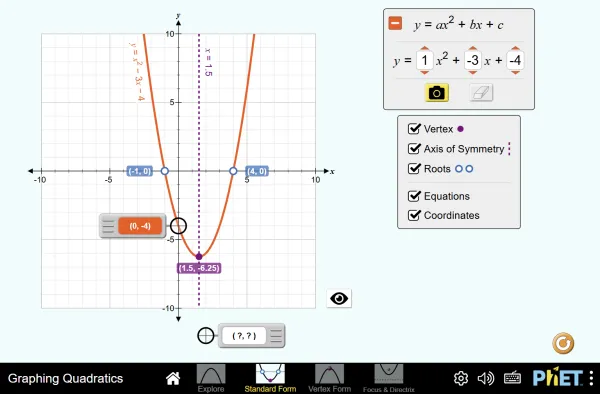
Full screen · PhET Interactive Simulations, University of Colorado Boulder, CC BY 4.0
Challenge
A sheet of card is 20 cm by 14 cm. A square of side x cm is cut from each corner and the sides are folded up to make an open tray. The base of the tray has an area of 72 cm². Form a quadratic equation, solve it, and find the volume of the tray. Explain why one of the solutions must be rejected even though it is positive.
Hint
Cutting a square from both ends of a side takes 2x off it, so the base is (20 − 2x) by (14 − 2x). After solving, test each answer in both of those lengths.
Answer
x = 4, so the tray is 12 cm by 6 cm by 4 cm and its volume is 288 cm³; x = 13 is rejected because 14 − 2 × 13 = −12 is not a length
Step by step
- The squares come off both ends of each side, so the base is (20 − 2x) cm long and (14 − 2x) cm wide.
- Base area: (20 − 2x)(14 − 2x) = 72. Expand: 280 − 40x − 28x + 4x² = 72, so 4x² − 68x + 208 = 0.
- Divide every term by the common factor 4: x² − 17x + 52 = 0. Two numbers that multiply to 52 and add to −17 are −4 and −13.
- (x − 4)(x − 13) = 0, so x = 4 or x = 13 by the null factor law.
- x = 13 is positive, but the width would be 14 − 26 = −12 cm, and you cannot cut 13 cm squares from both ends of a 14 cm side. Reject it.
- x = 4 gives a base 12 cm by 6 cm (area 72 cm²) and a height of 4 cm, so the volume is 12 × 6 × 4 = 288 cm³.
Full working
- (20 − 2x)(14 − 2x) = 72base length × base width
- 4x² − 68x + 208 = 0expand, subtract 72
- x² − 17x + 52 = 0divide by 4
- (x − 4)(x − 13) = 0, so x = 4 or 13−4 × −13 = 52, −4 + −13 = −17
- reject x = 1314 − 26 = −12, a width cannot be negative
- x = 4: 12 × 6 × 4 = 288length × width × height
- x = 4 cm, volume 288 cm³
A rectangular sign has a perimeter of 34 cm and a diagonal of 13 cm. Form a quadratic equation in one unknown, solve it, and find the area of the sign. Your equation has two solutions: explain why the question still has only one answer.
Hint
Call one side x. Half the perimeter is 17, so the other side is 17 − x. The diagonal makes a right-angled triangle with the two sides.
Answer
x = 5 or x = 12; both give the same 5 cm by 12 cm rectangle, so the area is 60 cm²
Step by step
- Length plus width is half the perimeter, 17 cm. So if one side is x, the other is 17 − x.
- The diagonal is the hypotenuse of a right-angled triangle: x² + (17 − x)² = 13².
- Expand: x² + 289 − 34x + x² = 169, so 2x² − 34x + 120 = 0. Divide by 2: x² − 17x + 60 = 0.
- −5 and −12 multiply to 60 and add to −17, so (x − 5)(x − 12) = 0 and x = 5 or x = 12.
- x = 5 makes the other side 12; x = 12 makes the other side 5. It is the same rectangle turned round, so there is only one answer.
- The area is 5 × 12 = 60 cm². Check: 2(5 + 12) = 34 and 5² + 12² = 169 = 13².
Full working
- sides x and 17 − xhalf of 34
- x² + (17 − x)² = 169Pythagoras with the diagonal
- 2x² − 34x + 120 = 0expand, subtract 169
- x² − 17x + 60 = 0divide by 2
- (x − 5)(x − 12) = 0, so x = 5 or 12null factor law
- both give 5 cm by 12 cmthe two sides swap
- area = 5 × 12 = 60 cm²
Solve (x² − 3x)² − 14(x² − 3x) + 40 = 0. Explain why this equation has more solutions than an ordinary quadratic, and check one of your answers.
Hint
The same bracket, x² − 3x, appears twice. Call it u. Then the equation is an ordinary quadratic in u.
Answer
x = −2, −1, 4 or 5
Step by step
- Let u = x² − 3x. The equation becomes u² − 14u + 40 = 0, a quadratic in u.
- −4 and −10 multiply to 40 and add to −14, so (u − 4)(u − 10) = 0 and u = 4 or u = 10.
- Put x back in. u = 4: x² − 3x − 4 = 0, so (x − 4)(x + 1) = 0 and x = 4 or x = −1.
- u = 10: x² − 3x − 10 = 0, so (x − 5)(x + 2) = 0 and x = 5 or x = −2.
- Each of the two values of u gives its own quadratic in x with two solutions, so there are four solutions in all. If you expanded fully, the highest power would be x⁴, not x².
- Check x = 5: x² − 3x = 25 − 15 = 10, and 10² − 14 × 10 + 40 = 100 − 140 + 40 = 0.
Full working
- u = x² − 3xthe repeated bracket
- u² − 14u + 40 = 0a quadratic in u
- (u − 4)(u − 10) = 0, so u = 4 or 10null factor law
- x² − 3x − 4 = 0: (x − 4)(x + 1) = 0u = 4
- x² − 3x − 10 = 0: (x − 5)(x + 2) = 0u = 10
- check x = 5: 100 − 140 + 40 = 0u = 10
- x = −2, −1, 4 or 5
Practise this
Report a mistake
More in AS 91947
 Expanding, index laws and algebraic fractions8 min
 Factorising quadratics, HCF and difference of squares8 min
 Algebraic proof: even, odd and consecutive numbers8 min
 Solving linear equations and inequations8 minSolving quadratic equations by factorising8 min
 Simultaneous equations: elimination and substitution8 min
 Straight-line graphs, gradient and rate of change8 min
 Optimal solutions: break-even and maximum area7 min
 Pythagoras' theorem in 2D and 3D explained7 min
 Trigonometry: SOH CAH TOA, elevation and 3D7 min
 Similar shapes: scale factors, area and volume7 min
 Surface area of pyramids, cones and spheres7 min
 Volume of cones, pyramids, spheres and composite solids7 min
 Expressions: 7 exam questions solved step by step11 min
 Factorising: 7 exam questions solved step by step10 min
 Generalising: 7 exam questions solved step by step10 min
 Equations and inequations: 7 exam questions solved11 min
 Quadratic equations: 7 exam questions solved step by step11 min
 Simultaneous equations: 7 exam questions solved step by step12 min
 Straight-line graphs: 7 exam questions solved step by step11 min
 Optimal solutions: 7 exam questions solved step by step11 min
 Pythagoras: 7 exam questions solved step by step11 min
 Trigonometry: 7 exam questions solved step by step10 min
 Similar shapes: 7 exam questions solved step by step10 min
 Surface area: 7 exam questions solved step by step11 min
 Volume: 7 exam questions solved step by step10 min
Is your child on track?
Take the free placement test