Simultaneous equations: 7 exam questions solved step by step
What this lesson covers
- Two equations in two unknowns are solved by the pair of values that makes both true at once.
- Graphically, that pair is the point where the two lines cross.
Solving two equations together
- Label the equations (1) and (2).
- Remove one letter: eliminate or substitute.
- Solve for the letter left, then find the other.
- Check the pair in both original equations.
Question 1 · Achieved
- Solve 2x + y = 11 (1)
- And 3x − y = 9 (2)
Q1: 2x + y = 11, 3x − y = 9
- Opposite signs: add.
- Check in both equations.
- +y and −y: opposite signs
- 5x = 20(1) + (2)
- x = 4÷ 5
- 2 × 4 + y = 11x = 4 into (1)
- 8 + y = 11, y = 3
- (1): 8 + 3 = 11
- (2): 12 − 3 = 9
- x = 4, y = 3
Question 2 · Achieved
- Solve y = 3x − 2 (1)
- And 2x + y = 13 (2)
Q2: y = 3x − 2, 2x + y = 13
- y is given: substitute.
- Use brackets.
- 2x + (3x − 2) = 13replace y in (2)
- 5x − 2 = 13collect x terms
- 5x = 15+2 both sides
- x = 3÷ 5
- y = 3 × 3 − 2 = 7x = 3 into (1)
- (1): 7 = 9 − 2
- (2): 6 + 7 = 13
- x = 3, y = 7
Try it: one of the two lines
Question 3 · Merit
- Solve 3x + 4y = 18 (1)
- And 2x − 3y = −5 (2)
- Careful with the negative.
Q3: make the x terms match
- Multiply both equations.
- Minus a negative is plus.
- 6x + 8y = 36(1) × 2
- 6x − 9y = −15(2) × 3
- 6x − 6x = 0(1) − (2): x goes
- 8y − (−9y) = 17yminus a negative
- 36 − (−15) = 51
- 17y = 51
- y = 3÷ 17
Q3: find x, check both
- Back into equation (1).
- Check both equations.
- y = 3
- 3x + 4 × 3 = 18y = 3 into (1)
- 3x + 12 = 18
- 3x = 6−12 both sides
- x = 2÷ 3
- (1): 6 + 12 = 18
- (2): 4 − 9 = −5
- x = 2, y = 3
Question 4 · Merit
- The lines y = 2x + 1 and x + y = 7
- Find where they cross, using algebra.
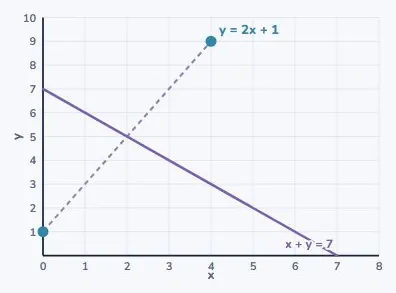
Q4: where the lines cross
- Crossing = fits both.
- y is given: substitute.
- x + (2x + 1) = 7replace y
- 3x + 1 = 7collect x terms
- 3x = 6−1 both sides
- x = 2÷ 3
- y = 2 × 2 + 1 = 5x = 2 into y = 2x + 1
- 2 + 5 = 7
- they cross at (2, 5)
Try it: where the lines cross
Question 5 · Merit, in context
- Hāngī tickets: adults $15, children $8.
- 120 tickets sold, $1450 taken.
- How many of each were sold?
Q5: hāngī tickets
- Define the letters.
- Answer in words.
- a = adult, c = child tickets
- a + c = 120counts tickets
- 15a + 8c = 1450counts dollars
- 8a + 8c = 960first × 8
- 7a = 490, a = 70money − that, ÷ 7
- 70 + c = 120, c = 50
- 70 + 50 = 120
- 1050 + 400 = 1450
- 70 adult, 50 child tickets
Question 6 · Excellence, in context
- Kayak hire: a fixed fee + an hourly rate.
- 2 hours costs $50. 5 hours costs $95.
- How many hours can you hire for $140?
Q6: find the fee and the rate
- Stage 1: fee and rate.
- Same sign: subtract.
- f = fee ($), r = rate ($ per h)
- f + 2r = 502 hours (1)
- f + 5r = 955 hours (2)
- 3r = 45(2) − (1)
- r = 15÷ 3
- f + 30 = 50, f = 20
- (2): 20 + 75 = 95
- $20 fee, $15 per hour
Q6: hours for $140
- Stage 2: use the rule.
- Do not forget the fee.
- $20 fee, $15 per hour
- 140 ÷ 15 ≈ 9.3forgets the $20 fee
- C = 15h + 20cost of h hours
- 15h + 20 = 140C = 140
- 15h = 120−20 both sides
- h = 8÷ 15
- 15 × 8 + 20 = 140
- 8 hours of kayak hire
Question 7 · Excellence
- 3x + y = 5k (1), k a constant
- x − y = 3k (2)
- Solve for x and y in terms of k.
- If x = 6, find k and the point.
Q7: solve in terms of k
- k is just a number.
- Add: the y terms cancel.
- 4x = 8k(1) + (2)
- x = 2k÷ 4
- 2k − y = 3kx = 2k into (2)
- −y = k, y = −k−2k both sides
- (1): 6k − k = 5k
- (2): 2k − (−k) = 3k
- x = 2k, y = −k
Q7: the lines meet at x = 6
- Use x = 2k.
- Check with k = 3.
- x = 2k, y = −k
- 2k = 6x = 6
- k = 3÷ 2
- y = −3y = −k
- (1): 18 − 3 = 15 = 5 × 3
- (2): 6 − (−3) = 9 = 3 × 3
- k = 3, point (6, −3)
Try it: solve by picture
Common mistakes
- Subtract (2) from (1) to remove y: −x = 2, so x = −2The y terms are +y and −y, so add the equations: 5x = 20, x = 4, then y = 3.
- $140 ÷ $15 an hour ≈ 9.3 hoursTake off the $20 fixed fee first: (140 − 20) ÷ 15 = 8 hours.
- x = 4, so that is the answer.Find the other letter and check both: x = 4, y = 3 fits 2(4) + 3 = 11 and 3(4) − 3 = 9.
The method that solved all seven
- Label, match, eliminate, check both, and answer in words.
| Step | How |
|---|---|
| Label | number them (1) and (2) |
| Match | multiply every term |
| Eliminate | add if opposite, else subtract |
| Substitute | when one gives y already |
| Back-sub | find the other letter |
| Check | in both original equations |
| Context | answer in words, with units |
Challenge
A jet boat on the Shotover River travels 24 km downstream in 40 minutes. Going back upstream, it covers 30 km in 1 hour 15 minutes. (a) Find the boat's speed in still water and the speed of the current. (b) How long would a raft, drifting with the current, take to go the 24 km?
Hint
Downstream the current helps: boat + current. Upstream it slows the boat: boat − current. Change the times to hours first.
Answer
(a) Boat 30 km per hour, current 6 km per hour (b) 4 hours
Step by step
- 40 minutes is 23 of an hour, so downstream speed = 24 ÷ 23 = 36 km per hour.
- 1 hour 15 minutes is 1.25 hours, so upstream speed = 30 ÷ 1.25 = 24 km per hour.
- So b + c = 36 and b − c = 24.
- Add: 2b = 60, b = 30; then c = 6.
- A raft moves at the current's speed: 24 ÷ 6 = 4 hours.
Full working
- 24 ÷ 23 = 36downstream speed
- 30 ÷ 1.25 = 24upstream speed
- b + c = 36 (1), b − c = 24 (2)two equations
- 2b = 60, b = 30(1) + (2)
- c = 36 − 30 = 6into (1)
- 24 ÷ 6 = 4raft time
- (a) 30 and 6 km per hour (b) 4 hours
A jar holds only 20c and 50c coins, worth $20.30 in total. If the number of 20c coins and the number of 50c coins were swapped, the jar would be worth $4.20 more. How many of each coin are in the jar?
Hint
Work in cents. Write both totals as equations, then try adding them and subtracting them instead of the usual elimination.
Answer
39 twenty-cent coins and 25 fifty-cent coins
Step by step
- Let a be the number of 20c coins and b the number of 50c coins.
- Now: 20a + 50b = 2030. Swapped: 50a + 20b = 2030 + 420 = 2450.
- Adding gives 70(a + b) = 4480, so there are 64 coins.
- Subtracting gives 30(a − b) = 420, so a − b = 14.
- So a = 39 and b = 25.
Full working
- 20a + 50b = 2030 (1)value now, in cents
- 50a + 20b = 2450 (2)swapped, 420c more
- 70a + 70b = 4480, a + b = 64(1) + (2), ÷ 70
- 30a − 30b = 420, a − b = 14(2) − (1), ÷ 30
- 2a = 78, a = 39, b = 25add the two results
- 780 + 1250 = 2030; 1950 + 500 = 2450check
- 39 twenty-cent and 25 fifty-cent coins
The curve y = ax² + b passes through the points (1, 5) and (3, 21). (a) Find a and b. (b) Find the points where the curve meets the line y = 4x + 3.
Hint
Put each point into the rule to get two simultaneous equations in a and b. For (b), set the two rules for y equal; you get a quadratic.
Answer
(a) a = 2, b = 3 (b) (0, 3) and (2, 11)
Step by step
- Each point fits the rule: a + b = 5 and 9a + b = 21.
- Subtract: 8a = 16, so a = 2 and b = 3.
- Where they meet, both rules give the same y: 2x² + 3 = 4x + 3.
- This is a quadratic: 2x² − 4x = 0, so 2x(x − 2) = 0.
- x = 0 or x = 2, giving the points (0, 3) and (2, 11).
Full working
- a + b = 5 (1)point (1, 5)
- 9a + b = 21 (2)point (3, 21)
- 8a = 16, a = 2(2) − (1)
- b = 5 − 2 = 3into (1)
- 2x² + 3 = 4x + 3same y
- 2x² − 4x = 0, 2x(x − 2) = 0factorise
- x = 0: y = 3; x = 2: y = 11both rules agree
- (a) a = 2, b = 3 (b) (0, 3) and (2, 11)
Practise this
Report a mistake
More in AS 91947
 Expanding, index laws and algebraic fractions8 min
 Factorising quadratics, HCF and difference of squares8 min
 Algebraic proof: even, odd and consecutive numbers8 min
 Solving linear equations and inequations8 min
 Solving quadratic equations by factorising8 min
 Simultaneous equations: elimination and substitution8 min
 Straight-line graphs, gradient and rate of change8 min
 Optimal solutions: break-even and maximum area7 min
 Pythagoras' theorem in 2D and 3D explained7 min
 Trigonometry: SOH CAH TOA, elevation and 3D7 min
 Similar shapes: scale factors, area and volume7 min
 Surface area of pyramids, cones and spheres7 min
 Volume of cones, pyramids, spheres and composite solids7 min
 Expressions: 7 exam questions solved step by step11 min
 Factorising: 7 exam questions solved step by step10 min
 Generalising: 7 exam questions solved step by step10 min
 Equations and inequations: 7 exam questions solved11 min
 Quadratic equations: 7 exam questions solved step by step11 minSimultaneous equations: 7 exam questions solved step by step12 min
 Straight-line graphs: 7 exam questions solved step by step11 min
 Optimal solutions: 7 exam questions solved step by step11 min
 Pythagoras: 7 exam questions solved step by step11 min
 Trigonometry: 7 exam questions solved step by step10 min
 Similar shapes: 7 exam questions solved step by step10 min
 Surface area: 7 exam questions solved step by step11 min
 Volume: 7 exam questions solved step by step10 min
Is your child on track?
Take the free placement test