Straight-line graphs: 7 exam questions solved step by step
What this lesson covers
- A pattern, a table, an equation and a graph can all describe the same relationship.
- The gradient of a straight-line graph is its rate of change: how much y changes for each one unit of x.
A straight line is two numbers: m and c
- Gradient m = rise ÷ run: the change in y per 1 of x.
- Intercept c: the value of y when x = 0.
- Write the line as y = mx + c.
- In context, say what m and c mean, with units.
Question 1 · Achieved
- Find the rule for the number of tiles, T.
- How many tiles in pattern 20?
| Pattern, n | Tiles, T |
|---|---|
| 1 | 5 |
| 2 | 9 |
| 3 | 13 |
| 4 | 17 |
Q1: the tile rule
- Difference = gradient.
- Step back for c.
- 9 − 5 = 4, 13 − 9 = 4constant difference
- T = 4n + cgradient 4
- 5 − 4 = 1step back to n = 0
- T = 4n + 1
- n = 4: 4 × 4 + 1 = 17
- n = 20: 4 × 20 + 1 = 81
- 81 tiles in pattern 20
Try it: the tile rule
Question 2 · Achieved
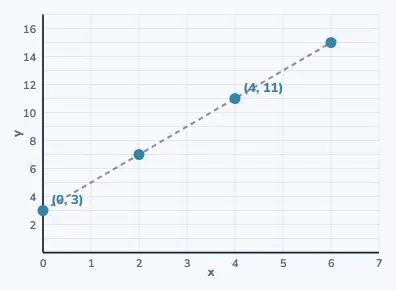
- The line passes through (0, 3) and (4, 11).
- Find its equation.
Q2: the equation of a line
- c: where it crosses.
- m: rise ÷ run.
- c = 3crosses the y-axis at 3
- rise = 11 − 3 = 8
- run = 4 − 0 = 4
- m = 8 ÷ 4 = 2rise ÷ run
- y = 2x + 3y = mx + c
- x = 4: 2 × 4 + 3 = 11
Question 3 · Merit
- Find the equation of the line.
- Careful: look at how x changes.
| x | y |
|---|---|
| 1 | 7 |
| 3 | 13 |
| 5 | 19 |
| 7 | 25 |
Q3: x goes up in twos
- The run is 2, not 1.
- Use a point for c.
- m = 6x went up 2, not 1
- y up 6 when x up 2
- m = 6 ÷ 2 = 3rise ÷ run
- y = 3x + c
- 7 = 3 × 1 + cuse (1, 7)
- c = 4−3 both sides
- y = 3x + 4
- x = 7: 3 × 7 + 4 = 25
Question 4 · Merit
- Tiles in pattern n: T = 5n + 3
- Which pattern uses 98 tiles?
- Could a pattern use exactly 120?
Q4: the rule run backwards
- Set the rule equal.
- n must be whole.
- 5n + 3 = 98T = 98
- 5n = 95−3 both sides
- n = 19÷ 5
- 5 × 19 + 3 = 98
- 5n + 3 = 120T = 120
- 5n = 117−3 both sides
- n = 23.4n must be whole
- pattern 19; no pattern uses 120
Question 5 · Merit, in context
- A candle burns down steadily.
- After 2 h: 18 cm tall. After 5 h: 12 cm.
- Find the rate of change, with units.
- Find h after t hours. What is c?
Q5: the rate of change
- Time across, height up.
- Units: cm per hour.
- (2, 18) and (5, 12)
- rise = 12 − 18 = −6height goes down
- run = 5 − 2 = 3hours
- m = −6 ÷ 3 = −2rise ÷ run
- m = −2 cm per houry units per x unit
- burns down 2 cm every hour
Q5: the equation and c
- Use a point for c.
- c is the start value.
- m = −2 cm per hour
- h = −2t + c
- 18 = −2 × 2 + cuse (2, 18)
- 18 = −4 + c
- c = 22+4 both sides
- h = 22 − 2t
- t = 5: 22 − 2 × 5 = 12
- t = 0: h = 22the intercept
- 22 cm tall when it was lit
Try it: rate and intercept
Question 6 · Excellence, in context
- Tables in one long row for a hui.
- Each seats 3 per long side, 1 per end.
- Explain why n tables seat S = 6n + 2.
- How many tables seat 100 people?
Q6: explain the rule
- Explain each part.
- Inner ends are lost.
- 3 + 3 = 6 side seats a table
- n tables: 6n side seats
- + 2 seats, one at each end
- S = 6n + 2
- n = 1: 6 + 2 = 8
- n = 3: 18 + 2 = 20
Q6: tables for 100 people
- Round up, not off.
- Check both choices.
- S = 6n + 2
- 6n + 2 = 100S = 100
- 6n = 98−2 both sides
- n = 16.33…÷ 6
- 16 tables: 96 + 2 = 982 people short
- 17 tables: 102 + 2 = 104
- 17 tables (4 spare seats)
Question 7 · Excellence, in context
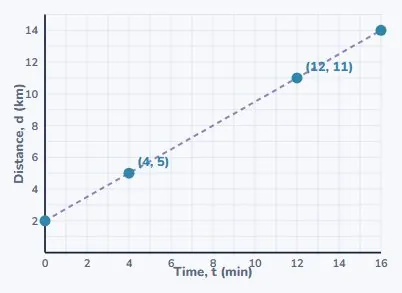
- A train: d km from Britomart, t min on.
- Find the speed in km/min and km/h.
- What does the intercept mean?
- When is it 20 km from Britomart?
Q7: the speed and the rule
- Units: km per minute.
- × 60 for km per hour.
- rise = 11 − 5 = 6 km
- run = 12 − 4 = 8 min
- m = 6 ÷ 8 = 0.75rise ÷ run
- 0.75 km per minute
- 0.75 × 60 = 45 km/h60 minutes in an hour
- d = 0.75t + c
- 5 = 0.75 × 4 + cuse (4, 5)
- 5 = 3 + c, c = 2
- d = 0.75t + 2
Q7: the intercept and 20 km
- c: the value at t = 0.
- Set d = 20 and solve.
- d = 0.75t + 2
- t = 0: d = 2the intercept
- 2 km out when timing began
- 0.75t + 2 = 20d = 20
- 0.75t = 18−2 both sides
- t = 18 ÷ 0.75 = 24
- 0.75 × 24 + 2 = 20
- 24 minutes after timing began
Try it: rules in context
Common mistakes
- y went up 6, so the gradient is 6.Gradient is rise ÷ run: if x went up 2 while y went up 6, the gradient is 6 ÷ 2 = 3.
- The candle's rate of change is 2.Give the sign and the units: the height goes down, so the rate is −2 cm per hour.
- 5n + 3 = 120 gives n = 23.4, so pattern 23 uses 120 tiles.Pattern numbers are whole, so n = 23.4 means no pattern uses exactly 120 tiles.
- 6n + 2 = 100 gives n = 16.3, so 16 tables.16 tables seat only 6 × 16 + 2 = 98 people, so round up: 17 tables are needed for 100.
What solved all seven
- Rise over run, the value at zero, and what it means.
| Step | How |
|---|---|
| Gradient | rise ÷ run, any two points |
| Pattern | difference is m; c is term 0 |
| x jumps | divide the rise by the run |
| Intercept | y when x = 0, or use a point |
| Units | y units per one x unit |
| Reverse | set the rule equal, then solve |
| Context | meaning, units and rounding |
Challenge
A straight line crosses the y-axis at 18 and goes down to cross the positive x-axis. Together with the two axes it makes a triangle of area 40.5 square units. Find the equation of the line, and show that the point (1, 14) is on it.
Hint
The triangle has a right angle at the origin, with base along the x-axis and height 18. Find where the line crosses the x-axis first, then use rise ÷ run.
Answer
y = −4x + 18 (it crosses the x-axis at 4.5); at x = 1, y = −4 + 18 = 14, so (1, 14) is on it
Step by step
- The triangle has height 18 (up the y-axis) and its base is the distance to where the line crosses the x-axis.
- ½ × base × 18 = 40.5, so the base is 4.5. The line crosses the x-axis at (4.5, 0).
- From (0, 18) to (4.5, 0), the rise is −18 and the run is 4.5, so the gradient is −4.
- So y = −4x + 18. Substituting x = 1 gives 14, so (1, 14) is on the line.
Full working
- ½ × b × 18 = 40.5area of the triangle
- 9b = 40.5, so b = 4.5x-intercept at (4.5, 0)
- m = (0 − 18) ÷ (4.5 − 0) = −4rise ÷ run
- y = −4x + 18y = mx + c, c = 18
- x = 1: −4 + 18 = 14(1, 14) is on the line
- y = −4x + 18
Rāwiri makes a row of n hexagons from matches, where neighbouring hexagons share a side, and a separate row of n squares in the same way. (a) Find a rule for the number of matches in each row, and explain each number in your rules. (b) Show that the total number of matches is always 2 more than a multiple of 8. (c) He has 200 matches. What is the largest n he can make both rows with, and how many matches are left?
Hint
The first hexagon needs 6 matches. Each extra hexagon shares one side with the one before it, so how many new matches does it need?
Answer
(a) Hexagons H = 5n + 1, squares S = 3n + 1. (b) H + S = 8n + 2. (c) n = 24, using 194 matches with 6 left over.
Step by step
- Each hexagon adds 5 new matches (one side is shared), plus 1 extra match to close off the first hexagon: H = 5n + 1.
- In the same way each square adds 3 matches, plus 1 to close the first one: S = 3n + 1.
- Together: 5n + 1 + 3n + 1 = 8n + 2, which is a multiple of 8 plus 2. So 200, which is 8 × 25, can never be used exactly.
- 8n + 2 ≤ 200 gives n ≤ 24.75, and n must be whole, so round down to 24.
- With n = 24 he uses 8 × 24 + 2 = 194 matches, leaving 6.
Full working
- n = 1, 2, 3 hexagons: 6, 11, 16up 5 each time
- H = 5n + 15 per hexagon, 1 to start
- n = 1, 2, 3 squares: 4, 7, 10, so S = 3n + 1up 3 each time
- H + S = 8n + 2collect like terms
- 8n + 2 ≤ 200at most 200 matches
- 8n ≤ 198, n ≤ 24.75round down: whole rows
- n = 24: 121 + 73 = 194check: 5 × 24 + 1 and 3 × 24 + 1
- n = 24, using 194 matches, 6 left over
Two tanks at a farm are connected by a pump. Tank P is being drained at a steady rate: 4 minutes after the pump starts it holds 1260 L, and after 10 minutes it holds 900 L. Tank Q is being filled at a steady rate: after 6 minutes it holds 240 L, and after 9 minutes 360 L. (a) Write a rule for the volume in each tank, t minutes after the pump starts, and say what each gradient and intercept means. (b) When do the tanks hold the same amount? (c) When does Q hold exactly twice as much as P? Give the time in minutes and seconds.
Hint
Find each gradient as rise ÷ run, then step back to t = 0 for the intercept. For (c), write 'Q = 2 × P' as an equation and solve.
Answer
(a) P = 1500 − 60t (starts with 1500 L, loses 60 L per minute); Q = 40t (starts empty, gains 40 L per minute). (b) At 15 minutes, both 600 L. (c) At 18 min 45 s, when P holds 375 L and Q holds 750 L.
Step by step
- For P, the volume falls 360 L in 6 minutes, so the gradient is −60 L per minute. Stepping back 4 minutes from 1260 L gives 1500 L at the start.
- For Q, the volume rises 120 L in 3 minutes, so 40 L per minute. Stepping back 6 minutes from 240 L gives 0, so Q starts empty.
- Same amount: 1500 − 60t = 40t gives 100t = 1500, so t = 15, and both hold 600 L.
- Twice as much: 40t = 2(1500 − 60t). Expand and collect: 160t = 3000, so t = 18.75 minutes.
- 0.75 of a minute is 45 seconds. Check: P = 1500 − 1125 = 375 L and Q = 750 L, which is twice 375.
Full working
- m = (900 − 1260) ÷ (10 − 4) = −60P, L per minute
- 1260 = −60 × 4 + c, so c = 1500P = 1500 − 60t
- m = (360 − 240) ÷ (9 − 6) = 40, c = 240 − 240 = 0Q = 40t
- 1500 − 60t = 40t, so 100t = 1500, t = 15same amount
- Q = 40 × 15 = 600 = 1500 − 900check
- 40t = 2(1500 − 60t) = 3000 − 120tQ is twice P
- 160t = 3000, t = 18.75+120t both sides, ÷ 160
- 0.75 × 60 = 45 s; P = 375 L, Q = 750 Lcheck
- (b) 15 min, 600 L each; (c) 18 min 45 s
Practise this
Report a mistake
More in AS 91947
 Expanding, index laws and algebraic fractions8 min
 Factorising quadratics, HCF and difference of squares8 min
 Algebraic proof: even, odd and consecutive numbers8 min
 Solving linear equations and inequations8 min
 Solving quadratic equations by factorising8 min
 Simultaneous equations: elimination and substitution8 min
 Straight-line graphs, gradient and rate of change8 min
 Optimal solutions: break-even and maximum area7 min
 Pythagoras' theorem in 2D and 3D explained7 min
 Trigonometry: SOH CAH TOA, elevation and 3D7 min
 Similar shapes: scale factors, area and volume7 min
 Surface area of pyramids, cones and spheres7 min
 Volume of cones, pyramids, spheres and composite solids7 min
 Expressions: 7 exam questions solved step by step11 min
 Factorising: 7 exam questions solved step by step10 min
 Generalising: 7 exam questions solved step by step10 min
 Equations and inequations: 7 exam questions solved11 min
 Quadratic equations: 7 exam questions solved step by step11 min
 Simultaneous equations: 7 exam questions solved step by step12 minStraight-line graphs: 7 exam questions solved step by step11 min
 Optimal solutions: 7 exam questions solved step by step11 min
 Pythagoras: 7 exam questions solved step by step11 min
 Trigonometry: 7 exam questions solved step by step10 min
 Similar shapes: 7 exam questions solved step by step10 min
 Surface area: 7 exam questions solved step by step11 min
 Volume: 7 exam questions solved step by step10 min
Is your child on track?
Take the free placement test