Motion, vectors and projectiles
What this lesson covers
- The four equations of constant acceleration link d, vi, vf, a and t; choose the one that leaves out the quantity you are not given and not asked for.
- In free fall every object accelerates downwards at 9.8 m s⁻², whatever its mass, if air resistance is ignored.
- A velocity can be split into components (v cos θ and v sin θ), and perpendicular vectors add with Pythagoras and tan.
- A velocity relative to the ground is the vector sum of the velocity relative to the moving air or water and the velocity of that air or water.
- A projectile keeps a constant horizontal velocity while its vertical velocity changes at 9.8 m s⁻² downwards; time links the two.
Four equations for constant acceleration
- Motion in a straight line with constant acceleration has five quantities: displacement d (m), initial velocity vi and final velocity vf (m s⁻¹), acceleration a (m s⁻²) and time t (s).
- Each equation leaves one of the five out, so list the three you know and the one you want, then choose the equation without the fifth.
- Pick a positive direction and keep to it: anything in the opposite direction is negative, so a car slowing down while moving forwards has a negative acceleration.
- Change units first (km h⁻¹ to m s⁻¹ means divide by 3.6, ms to s means divide by 1000), and round only the final answer, to the significant figures of the data.
| Equation | Leaves out |
|---|---|
| vf = vi + at | d |
| d = vi t + ½at² | vf |
| d = ½(vi + vf)t | a |
| vf² = vi² + 2ad | t |
Example: a car braking to a stop
- A car travelling at 15.0 m s⁻¹ brakes with a constant deceleration of 6.00 m s⁻² until it stops.
- Find the stopping distance and the time it takes to stop.
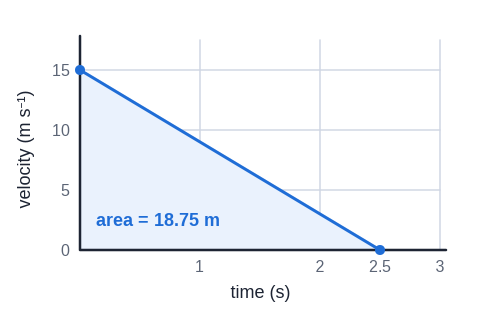
- vi = 15.0 m s⁻¹, vf = 0, a = −6.00 m s⁻²forwards is positive, so the deceleration is negative
- vf² = vi² + 2ad, so 0 = 15.0² + 2 × (−6.00) × dt is not given, so use the equation without t
- d = 225 ÷ 12.0 = 18.75 mrearrange: 12.0d = 225
- vf = vi + at, so 0 = 15.0 − 6.00t, t = 15.0 ÷ 6.00 = 2.50 s
- d = ½(vi + vf)t = ½ × (15.0 + 0) × 2.50 = 18.75 ma different equation gives the same distance
- stopping distance 18.8 m, stopping time 2.50 s
Motion lab
Free fall
- An object in free fall has only its weight acting on it, so it accelerates downwards at g = 9.8 m s⁻², the value NZQA's Level 2 papers give.
- Mass does not matter: a heavier object has a bigger weight, but it also needs a bigger force to accelerate it, and a = F ÷ m comes out at 9.8 m s⁻² for both.
- Taking up as positive, a = −9.8 m s⁻² the whole time: on the way up, at the top and on the way down.
- At the highest point of a throw straight up, the velocity is zero for an instant, but the acceleration is still 9.8 m s⁻² downwards.
Example: a stone dropped from a bridge
- A stone is dropped from rest from a bridge 20.0 m above a river. Ignore air resistance.
- Find how long it takes to reach the water and how fast it is going when it gets there.
- vi = 0, d = 20.0 m, a = 9.8 m s⁻²here down is positive, so d and a are both positive
- d = vi t + ½at², so 20.0 = 0 + ½ × 9.8 × t²
- t² = 20.0 ÷ 4.9 = 4.082 s², t = 2.020 s
- vf = vi + at = 0 + 9.8 × 2.020 = 19.80 m s⁻¹
- vf² = 2ad = 2 × 9.8 × 20.0 = 392 m² s⁻², vf = 19.80 m s⁻¹the equation without t agrees
- t = 2.02 s, vf = 19.8 m s⁻¹ downwards
Vectors, components and relative velocity
- A vector has a size and a direction (displacement, velocity, acceleration, force, momentum); a scalar has only a size (distance, speed, time, mass, energy).
- Any vector v at an angle θ to the horizontal splits into a horizontal component v cos θ and a vertical component v sin θ.
- Two perpendicular vectors add like the sides of a right-angled triangle: the size is √(x² + y²), and the angle comes from tan θ = opposite ÷ adjacent.
- Relative velocity: a boat's velocity over the ground is its velocity through the water plus the water's velocity, added as vectors.
- In a straight line this is just adding or subtracting: two cars at 100 km h⁻¹ and 90 km h⁻¹ in the same direction close at 10 km h⁻¹, but head-on they close at 190 km h⁻¹.
Example: a kayak crossing a river
- A kayaker paddles at 4.00 m s⁻¹ through the water, pointing straight across a river 60.0 m wide. The current flows at 3.00 m s⁻¹ downstream.
- Find the kayak's velocity over the ground, the time to cross and how far downstream it lands.
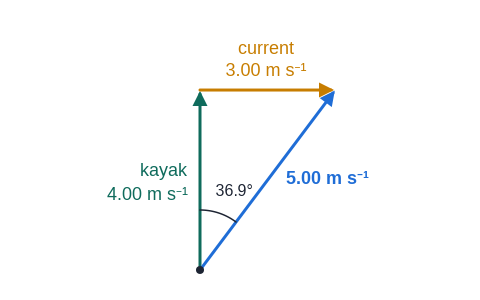
- v = √(4.00² + 3.00²) = √25.0 = 5.00 m s⁻¹the two velocities are at right angles
- tan θ = 3.00 ÷ 4.00, θ = 36.9° downstream from straight across
- t = 60.0 m ÷ 4.00 m s⁻¹ = 15.0 sonly the across component gets it over the river
- downstream = 3.00 m s⁻¹ × 15.0 s = 45.0 m
- path length = 5.00 × 15.0 = 75.0 m, and √(60.0² + 45.0²) = 75.0 m
- 5.00 m s⁻¹ at 36.9° downstream, 15.0 s, 45.0 m downstream
Projectile motion: two motions at once
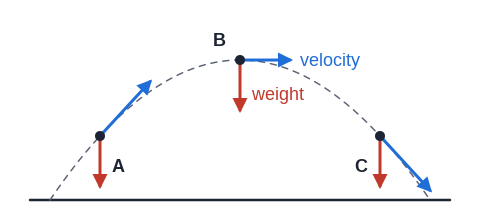
- Once a ball is thrown, the only force on it (ignoring air resistance) is its weight, straight down, the same size at every point.
- There is no horizontal force, so the horizontal velocity stays constant: d = vt sideways.
- Vertically it is free fall: the vertical velocity changes by 9.8 m s⁻² downwards, slowing on the way up, zero at the top, speeding up on the way down.
- The two motions are independent, and time is the only thing they share, so find t from one direction and use it in the other.
- The velocity always points along the path, while the force always points down; the path is a parabola.
Try it: launch a projectile
Example: thrown horizontally from a cliff
- A ball is thrown horizontally at 12.0 m s⁻¹ from the top of a cliff 19.6 m high.
- Find the time in the air, how far from the foot of the cliff it lands, and its velocity just before it lands.
- vertical: vi = 0, d = 19.6 m, a = 9.8 m s⁻²thrown horizontally, so no vertical velocity to start
- 19.6 = ½ × 9.8 × t², t² = 4.00 s², t = 2.00 s
- horizontal: d = vt = 12.0 × 2.00 = 24.0 mhorizontal velocity is constant
- vertical vf = 9.8 × 2.00 = 19.6 m s⁻¹ downwards
- v = √(12.0² + 19.6²) = √528.2 = 23.0 m s⁻¹, tan θ = 19.6 ÷ 12.0, θ = 58.5° below horizontal
- 2.00 s, 24.0 m from the cliff, 23.0 m s⁻¹ at 58.5° below the horizontal
Example: a ball kicked from the ground
- A ball is kicked from flat ground at 18.0 m s⁻¹ at 40.0° above the horizontal. Ignore air resistance.
- Find the components of its velocity, its time in the air, its range and its greatest height.
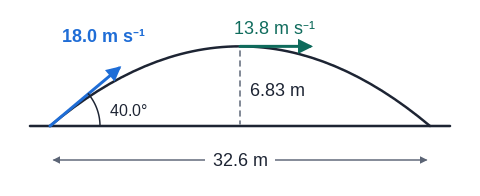
- vx = 18.0 cos 40.0° = 13.79 m s⁻¹, vy = 18.0 sin 40.0° = 11.57 m s⁻¹
- to the top: vf = vi + at, 0 = 11.57 − 9.8t, t = 1.181 svertical velocity is zero at the top
- time in the air = 2 × 1.181 = 2.361 sthe path is symmetrical when it lands at the height it started
- range = vx t = 13.79 × 2.361 = 32.56 m
- height: 0 = 11.57² − 2 × 9.8 × d, d = 133.9 ÷ 19.6 = 6.83 m
- d = vi t + ½at² = 11.57 × 1.181 − 4.9 × 1.181² = 13.66 − 6.83 = 6.83 m
- vx = 13.8 m s⁻¹, vy = 11.6 m s⁻¹, 2.36 s, range 32.6 m, height 6.83 m
Try it: split the motion
What Achieved, Merit and Excellence look like
- Achieved gives a correct fact or a one-step calculation; Merit gives the reason or finishes a two-step calculation; Excellence links every idea, cause to effect, for this context.
- Name the force, say what it does to each component, and finish with a sentence that answers the question asked.
| Grade | A model answer |
|---|---|
| Achieved | They land at the same time, but P lands further from the bench. |
| Merit | They land together because both start with no vertical velocity and both accelerate down at 9.8 m s⁻², so they take the same time to fall the same height. |
| Excellence | The only force on each ball is its weight, acting down, so each has a vertical acceleration of 9.8 m s⁻². Both start with zero vertical velocity and fall the same height, so by d = ½at² they take the same time. P's horizontal velocity has no effect on its vertical motion; with no horizontal force it stays at 3.0 m s⁻¹, so P lands 3.0t metres out while Q lands at the foot of the bench. |
Common mistakes
- At the top of its path the ball has stopped, so its acceleration is zero there.Only the vertical velocity is zero at the top; the weight still acts, so the acceleration is 9.8 m s⁻² downwards all the way.
- Time to reach the posts = 45.0 m ÷ 25.0 m s⁻¹, using the launch speed.Horizontal distance uses the horizontal component: t = 45.0 ÷ (25.0 cos θ).
- A ball thrown up at 14.7 m s⁻¹: vf² = 14.7² + 2 × 9.8 × d, so d comes out negative.With up as positive, a = −9.8 m s⁻², so 0 = 14.7² − 2 × 9.8 × d and d = 11.0 m.
- The heavier ball has more weight, so it falls faster and lands sooner.Without air resistance every object accelerates at 9.8 m s⁻², because the bigger weight has a bigger mass to move.
Measure your reaction time with a falling ruler
You need: a 30 cm ruler, a helper, paper and a pen, a calculator
- Your helper holds the ruler vertically by the 30 cm end, with the 0 cm mark level with the gap between your open thumb and finger.
- Without warning, the helper lets go and you pinch the ruler as fast as you can; read the mark at the top of your thumb, which is the distance d it fell.
- Do it 5 times, average d in metres, and find your reaction time from d = ½at²: t = √(2d ÷ 9.8), so 0.20 m gives √(0.0408) = 0.20 s.
- Repeat with your other hand, or while someone talks to you, and compare.
- Look for: the ruler starts from rest and speeds up as it falls, so doubling the distance does not double the time; a 0.80 m drop would take only twice as long as a 0.20 m drop.
Safety: Keep your face well away from the ruler's path and hold it only between finger and thumb, because a dropped or flicked ruler can hit an eye.
Your turn
A cyclist speeds up uniformly from 2.0 m s⁻¹ to 8.0 m s⁻¹ in 4.0 s. What is her acceleration?
How far does she travel in those 4.0 s?
A ball is thrown straight up at 14.7 m s⁻¹. How high does it rise?
A rock rolls horizontally off a cliff 44.1 m high at 5.00 m s⁻¹. How far from the foot of the cliff does it land?
A plane heads north at 70.0 m s⁻¹ through air that is moving east at 24.0 m s⁻¹. What is its velocity over the ground?
Show answer
1. a = (vf − vi) ÷ t = (8.0 − 2.0) ÷ 4.0 = 1.5 m s⁻². 2. d = ½(vi + vf)t = ½ × (2.0 + 8.0) × 4.0 = 20 m. 3. Up is positive: 0 = 14.7² + 2 × (−9.8) × d, so d = 216.09 ÷ 19.6 = 11.0 m. 4. Vertically 44.1 = ½ × 9.8 × t², so t² = 9.00 s² and t = 3.00 s; horizontally d = 5.00 × 3.00 = 15.0 m. 5. v = √(70.0² + 24.0²) = √5476 = 74.0 m s⁻¹; tan θ = 24.0 ÷ 70.0, θ = 18.9°, so 74.0 m s⁻¹ at 18.9° east of north.
Exam-style question: the driving range
- At a golf driving range, Tama hits a ball from the ground at 30.0 m s⁻¹ at 25.0° above the horizontal. A safety fence 3.00 m high stands 60.0 m away on level ground. Ignore air resistance and use g = 9.8 m s⁻².
Describe the force on the ball during its flight and what it does to the horizontal and vertical parts of its velocity.
Calculate the horizontal and vertical components of the ball's initial velocity.
By calculating, decide whether the ball clears the fence.
Explain why the ball's speed is smallest at the top of its path, but not zero.
Show answer
1. Only the weight acts, straight down. There is no horizontal force, so the horizontal velocity stays the same; the vertical velocity decreases on the way up, is zero at the top and increases on the way down, changing at 9.8 m s⁻² (Achieved for one correct statement, Merit for linking the force to each component). 2. vx = 30.0 cos 25.0° = 27.19 m s⁻¹, about 27.2 m s⁻¹; vy = 30.0 sin 25.0° = 12.68 m s⁻¹, about 12.7 m s⁻¹ (Achieved for either). 3. Time to travel 60.0 m across: t = 60.0 ÷ 27.19 = 2.2068 s (keep the unrounded value in the calculator). Height then: d = vi t + ½at² = 12.68 × 2.2068 − 4.9 × 2.2068² = 27.98 − 23.86 = 4.12 m. Check it is still in the air: time of flight = 2 × 12.68 ÷ 9.8 = 2.59 s, longer than 2.21 s. So the ball is 4.12 m up when it reaches the fence and clears the 3.00 m fence (Merit for the method with one slip, Excellence for the correct height and a concluding sentence). 4. The speed combines both components. At the top the vertical component has fallen to zero, so the speed is just the horizontal component, its smallest value; that component stays at 27.2 m s⁻¹ because no horizontal force acts, so the speed is never zero (Excellence links both components to the forces).
Projectile Motion
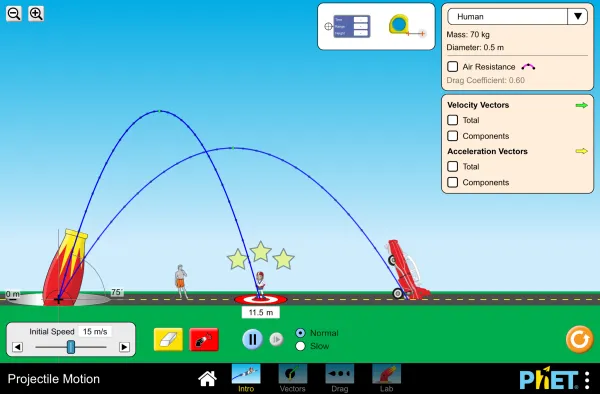
Full screen · PhET Interactive Simulations, University of Colorado Boulder, CC BY 4.0
Recap
- List d, vi, vf, a and t, then use the equation without the one you do not need.
- Choose a positive direction; with up positive, g is −9.8 m s⁻².
- Split velocities into v cos θ and v sin θ, and add perpendicular vectors with Pythagoras and tan.
- Projectiles: horizontal velocity constant, vertical acceleration 9.8 m s⁻² down, time shared.
- Round only at the end, and give every answer a unit (and a direction for a vector).
| Formula | Use it for |
|---|---|
| vf = vi + at | velocity after a time |
| d = vi t + ½at² | distance when vf is unknown |
| d = ½(vi + vf)t | distance when a is unknown |
| vf² = vi² + 2ad | anything without t |
| vx = v cos θ, vy = v sin θ | components of a velocity |
Challenge
A delivery drone flies at 10.0 m s⁻¹ through the air. It must fly to a farmhouse 1.20 km due north of its base while a steady wind blows towards the east at 6.0 m s⁻¹. (a) In what direction must the drone point so that it travels straight north over the ground? (b) How long does the trip take? (c) It then flies straight back south in the same wind. Show that the round trip takes 60 s longer than it would on a calm day.
Hint
Draw the vector triangle the other way round from the kayak example: this time the ground velocity (due north) is one side, and the 10.0 m s⁻¹ through the air is the longest side.
Answer
(a) 36.9° west of north (b) 150 s (c) 300 s against 240 s
Step by step
- The drone's velocity through the air plus the wind's velocity must add to a velocity pointing due north.
- So the drone must point partly west to cancel the 6.0 m s⁻¹ wind: its west component must be 6.0 m s⁻¹.
- Its 10.0 m s⁻¹ is the hypotenuse, so sin θ = 6.0 ÷ 10.0 gives the angle west of north, and Pythagoras gives the northward ground speed.
- Only 8.0 m s⁻¹ is left for going north, so the trip takes 1200 ÷ 8.0 seconds. Coming back it must point west of south, with the same 8.0 m s⁻¹ ground speed.
- On a calm day all 10.0 m s⁻¹ goes along the route, so the round trip is shorter.
Full working
- sin θ = 6.0 ÷ 10.0 = 0.60, θ = 36.9° west of northwest component cancels the wind
- ground speed = √(10.0² − 6.0²) = √64 = 8.0 m s⁻¹ norththe other side of the right-angled triangle
- t = 1200 ÷ 8.0 = 150 s1.20 km = 1200 m
- back: 150 s again, round trip = 300 ssame triangle, pointing 36.9° west of south
- calm day: 2 × 1200 ÷ 10.0 = 240 sno wind to cancel
- 300 − 240 = 60 sthe extra time
- (a) 36.9° west of north (b) 150 s (c) 300 s, which is 60 s longer than 240 s
From the top of a sea cliff 49.0 m high, a stone is thrown at 24.5 m s⁻¹ at an angle θ above the horizontal, where sin θ = 0.600 (θ is about 36.9°). It lands in the sea below. Ignore air resistance. (a) How long is it in the air? (b) How far from the foot of the cliff does it land? (c) Find its speed when it hits the water, by two different methods.
Hint
You can avoid solving a quadratic: split the flight into the rise to the top, then a fall from rest through the total height above the sea. Energy gives a second way to find the final speed.
Answer
(a) 5.00 s (b) 98.0 m (c) 39.5 m s⁻¹
Step by step
- Split the launch velocity into components: cos θ = 0.800, so vx = 19.6 m s⁻¹ and vy = 14.7 m s⁻¹ up.
- Rising: the vertical velocity falls to zero in 1.50 s, and the stone rises 11.025 m above the cliff top.
- Falling: it drops from rest through 11.025 + 49.0 = 60.025 m, which takes 3.50 s, so the total time is 5.00 s.
- The horizontal velocity stays 19.6 m s⁻¹ for all 5.00 s, which gives the distance from the cliff.
- For the speed, combine the final vertical velocity with the unchanged horizontal velocity, or use energy: the mass cancels in ½mv² = ½mu² + mgh.
Full working
- vx = 24.5 × 0.800 = 19.6 m s⁻¹, vy = 24.5 × 0.600 = 14.7 m s⁻¹cos θ = √(1 − 0.600²) = 0.800
- 0 = 14.7 − 9.8t, t = 1.50 s; height gained = 14.7² ÷ (2 × 9.8) = 11.025 mup to the top
- 60.025 = ½ × 9.8 × t², t² = 12.25, t = 3.50 sfrom rest at the top down to the sea
- total time = 1.50 + 3.50 = 5.00 s(a)
- x = 19.6 × 5.00 = 98.0 m(b), horizontal velocity constant
- vy = 14.7 − 9.8 × 5.00 = −34.3 m s⁻¹, v = √(19.6² + 34.3²) = √1560.65 = 39.5 m s⁻¹method 1, components
- v² = 24.5² + 2 × 9.8 × 49.0 = 600.25 + 960.4 = 1560.65, v = 39.5 m s⁻¹method 2, energy, the same answer
- (a) 5.00 s (b) 98.0 m (c) 39.5 m s⁻¹
A netball shooter releases the ball 2.15 m above the court, 4.00 m (measured horizontally) from the centre of the ring, which is 3.05 m above the court. Her coach wants the ball to drop into the centre of the ring moving at exactly 45° below the horizontal. Ignore air resistance. Find the speed and angle at which she must release the ball, and the greatest height the ball reaches above the court.
Hint
Call the constant horizontal velocity u. At 45° the downward vertical velocity at the ring equals u. Write the time of flight in terms of u, then use d = ½(vi + vf)t for the vertical motion.
Answer
7.05 m s⁻¹ at 55.4° above the horizontal; greatest height 3.87 m
Step by step
- Let the horizontal velocity be u. The time to cover 4.00 m is t = 4.00 ÷ u.
- At the ring the ball moves at 45° downwards, so its vertical velocity there is −u (up is positive).
- The vertical velocity changes by 9.8t, so at release it was −u + 9.8t = −u + 39.2 ÷ u.
- The ball rises 3.05 − 2.15 = 0.90 m overall. Using d = ½(vi + vf)t, the equation simplifies to u² = 16, so u = 4.00 m s⁻¹ and t = 1.00 s.
- Then the launch vertical velocity is 5.80 m s⁻¹; combine the components for the speed and angle, and use vf² = vi² + 2ad for the top of the path.
Full working
- t = 4.00 ÷ u, vy at ring = −uhorizontal velocity constant; 45° means equal components
- vy at release = −u + 9.8 × (4.00 ÷ u) = −u + 39.2 ÷ uvf = vi + at, with a = −9.8
- 0.90 = ½ × (−u + 39.2 ÷ u − u) × (4.00 ÷ u) = −4.00 + 78.4 ÷ u²d = ½(vi + vf)t
- 78.4 ÷ u² = 4.90, u² = 16.0, u = 4.00 m s⁻¹, t = 1.00 ssolve
- vy = −4.00 + 39.2 ÷ 4.00 = 5.80 m s⁻¹check: 5.80 × 1.00 − 4.9 × 1.00² = 0.90 m
- v = √(4.00² + 5.80²) = √49.64 = 7.05 m s⁻¹, tan θ = 5.80 ÷ 4.00, θ = 55.4°speed and angle
- height gained = 5.80² ÷ (2 × 9.8) = 1.72 m, 2.15 + 1.72 = 3.87 mtop of the path
- 7.05 m s⁻¹ at 55.4° above the horizontal; greatest height 3.87 m
The maths behind it
Report a mistake
How is NCEA Level 2 maths going?
See the NCEA Level 2 maths guide