Percentages, fractions of amounts, and proportion
What this lesson covers
- Multiplying a whole number by a fraction and finding that fraction of that whole number have the same result.
- Percentages are decimal fractions with denominators of 100; they are represented using the percent symbol %.
40% of a number is 28
- What is the number?
- Most people try to guess and check.
- There is a picture that just tells you.
First, a fraction of an amount
- Divide by the bottom, multiply by the top.
- That order, every time.
- It works even when the fraction is top-heavy.
| Question | Step | Working |
|---|---|---|
| 5/3 of 186 | divide by the bottom | 186 ÷ 3 = 62 |
| multiply by the top | 62 × 5 = 310 | |
| Answer | bigger than 186 | 310 |
5/3 of 186 is bigger than 186
- Five thirds is more than one whole.
- So taking five thirds of something grows it.
- 310, not something smaller.
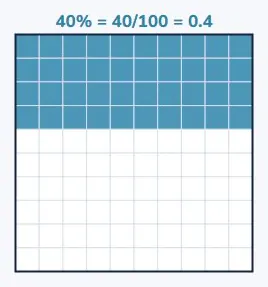
A percentage is hundredths
- 40% means 40 out of every 100.
- Which is the fraction 40/100, or 0.4.
- So percentages are fractions with a fixed bottom.
The ones you can do in your head
- 50% is half. 25% is half of that.
- 10% is a shift of one column.
- And 5% is half of 10%.
| Percentage | How | Same as |
|---|---|---|
| 50% | halve it | ÷ 2 |
| 25% | halve it twice | ÷ 4 |
| 10% | shift one column right | ÷ 10 |
| 5% | half of 10% | ÷ 20 |
| 1% | shift two columns right | ÷ 100 |
Find 10% first, then scale it
- 10% is the easiest one to get.
- Every other percentage is built from it.
- 30% is three lots. 5% is half a lot.
| Percentage | How | Same as |
|---|---|---|
| 50% | halve it | ÷ 2 |
| 25% | halve it twice | ÷ 4 |
| 10% | shift one column right | ÷ 10 |
| 5% | half of 10% | ÷ 20 |
| 1% | shift two columns right | ÷ 100 |
15% of 60
- 10% of 60 is 6.
- 5% is half of that, so 3.
- 6 + 3 = 9.
| Step | Working | Answer |
|---|---|---|
| 10% of 60 | 60 ÷ 10 | 6 |
| 5% of 60 | half of 6 | 3 |
| 15% | 6 + 3 | 9 |
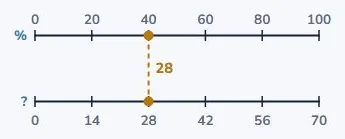
Two scales, side by side
- Percentages on top, the real amount below.
- Both start at zero and end together.
- Every tick lines up with its partner.
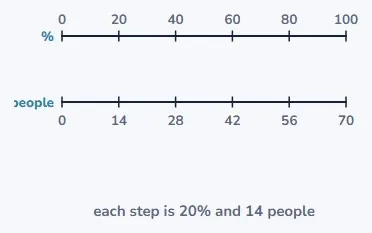
Try it: two scales side by side
Reading it downwards: 40% of 70
- Find 40% on the top scale.
- Look straight down.
- 28.
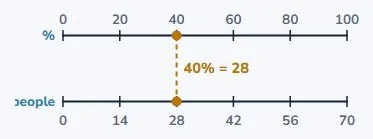
The same thing in numbers
- 10% of 70 is 7.
- 40% is four lots of 7.
- 28.
| Step | Working | Answer |
|---|---|---|
| 10% of 70 | 70 ÷ 10 | 7 |
| 40% | 4 lots of 7 | 28 |
Now upwards: 40% is 28
- Same picture, different end known.
- 28 sits at the 40% tick.
- Read along to 100%: the whole is 70.
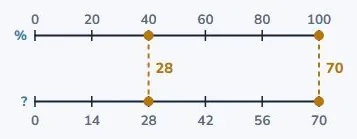
In numbers, through 10%
- If 40% is 28, then 10% is 28 ÷ 4 = 7.
- 100% is ten lots of 10%.
- 7 × 10 = 70.
| Step | Working | Answer |
|---|---|---|
| 40% is | 28 | |
| 10% is | 28 ÷ 4 | 7 |
| 100% is | 7 × 10 | 70 |
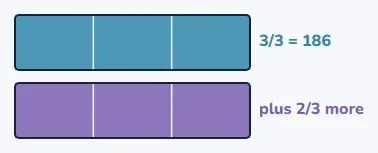
5/4 of a set is 85. How big is the set?
- Five quarters is 85, so one quarter is 17.
- The whole set is four quarters.
- 17 × 4 = 68.
| Step | Working | Answer |
|---|---|---|
| 5/4 of the set is | 85 | |
| So 1/4 is | 85 ÷ 5 | 17 |
| And 4/4 is | 17 × 4 | 68 |
Why 68 is smaller than 85
- Five quarters is MORE than the whole set.
- So the whole set has to be less than 85.
- If your answer came out bigger, check it.
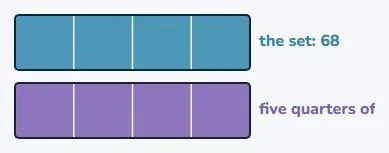
Try it: part and whole on one bar
3 red for every 2 blue
- Not 3 red and 2 blue in total.
- A repeating group: 3 red with 2 blue, over and over.
- So count the groups.
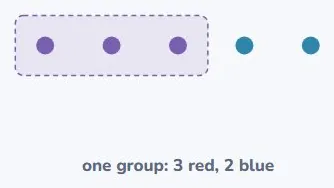
12 red. How many blue?
- 12 red is 12 ÷ 3 = 4 groups.
- Each group has 2 blue.
- 2 × 4 = 8 blue.
| Step | Working | Answer |
|---|---|---|
| For every | 3 red | 2 blue |
| 12 red is | 12 ÷ 3 = 4 groups | |
| So blue is | 2 × 4 | 8 |
Common mistakes
- 40% of a number is 28, so the number is 40% of 28, which is 11.2.28 is the 40% part; get to 10% (28 ÷ 4 = 7), then to 100% (7 × 10 = 70).
- 5/4 of a set is 85, so the set is 85 ÷ 4 × 5 = 106.25.85 is five quarters, so one quarter is 85 ÷ 5 = 17 and the set is 17 × 4 = 68, less than 85.
- 3 red for every 2 blue, and there are 12 red, so there are 12 − 1 = 11 blue.Count groups: 12 red is 12 ÷ 3 = 4 groups, and each group has 2 blue, so there are 8 blue.
- 15% of 60 is 60 ÷ 15 = 4.Build it from 10%: 10% of 60 is 6, 5% is 3, so 15% is 9.
Your turn: eight questions
- Try all eight.
- On question 3, find 10% before anything else.
- On question 4, count the groups.
Find 3/8 of 96.
Find 35% of 80.
60% of a number is 48. What is the number?
5 apples for every 3 oranges. With 20 apples, how many oranges?
Which fraction is the same as 40%?
2/3 of a class is 18 students. How many students are in the whole class?
Ana's kōwhai seedling was 120 cm tall. It is now 5/4 of that height. How tall is it now?
Kai mixes 2 cups of juice for every 5 cups of water. He makes 21 cups of punch in total. How many cups of juice is that?
Show answer
1. 36. 96 ÷ 8 = 12, then 12 × 3 = 36. 2. 28. 10% is 8, so 30% is 24; 5% is 4; 24 + 4 = 28. 3. 80. If 60% is 48 then 10% is 8, so 100% is 80. 4. 12. 20 apples is 4 groups of 5, so oranges are 3 × 4 = 12. 5. 2/5. 40% is 40/100, and 40 and 100 share a 20, so it simplifies to 2/5. 6. 27. Two thirds is 18, so one third is 18 ÷ 2 = 9, and the whole class is three thirds: 9 × 3 = 27. 7. 150 cm. Divide by the bottom and multiply by the top: 120 ÷ 4 = 30, then 30 × 5 = 150. Five quarters is more than a whole, so it grew. 8. 6 cups. Each group is 2 + 5 = 7 cups, so 21 cups is 21 ÷ 7 = 3 groups, and juice is 2 × 3 = 6.
The answers
- 3/8 of 96 is 36. 35% of 80 is 28.
- 60% is 48, so 10% is 8 and the number is 80.
- 20 apples is 4 groups, so 12 oranges.
| Answer | |
|---|---|
| 1 | 36 |
| 2 | 28 |
| 3 | 80 |
| 4 | 12 |
Proportion Playground
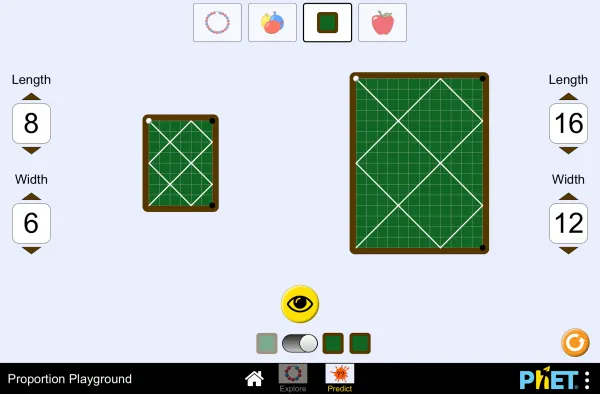
Full screen · PhET Interactive Simulations, University of Colorado Boulder, CC BY 4.0
What to take away
- Find 10% first; everything else is built from it.
- Going backwards, get to 10%, then up to 100%.
- The double number line reads in both directions.
| Remember | |
|---|---|
| A fraction of an amount | divide by the bottom, times the top |
| 10% first | then scale it to any percentage |
| Going backwards | get to 1% or 10%, then up to 100% |
| Double number line | works in both directions |
| Ratios | count the groups, then scale |
Challenge
Aroha spends 38 of her money on a book. Then she spends 40% of the money she has left on lunch. She now has $27. How much did she start with, and how much did the book and the lunch cost? Ben says she spent 38 + 40% = 77.5% of her money. What percentage did she really spend?
Hint
The 40% is a percentage of what was left after the book, not of the starting amount. What fraction of the starting money is left after the book, and what part of that is left after lunch?
Answer
She started with $72. The book cost $27 and the lunch cost $18. She really spent 62.5% of her money, not 77.5%.
Step by step
- After the book, 58 of her money is left.
- Lunch takes 40% of that, so 60% of it is left, and that 60% is the $27.
- If 60% is $27, then 10% is $4.50 and 100% is $45. So $45 was left after the book.
- $45 is 58 of her money, so 18 is $9 and all of it is $72.
- The book cost 38 of $72 = $27, and lunch cost $45 − $27 = $18.
- She spent $27 + $18 = $45 out of $72, which is 58, or 62.5%. Ben added 40% of a smaller amount as if it were 40% of the whole.
Full working
- 60% of the rest = $27lunch took 40%, so 60% is left
- 10% = 27 ÷ 6 = $4.50, 100% = $45money left after the book
- 58 of start = $45, so 18 = $9 and start = $7238 went on the book
- book: 72 ÷ 8 × 3 = $27; lunch: 45 − 27 = $1840% of 45 is 18
- 27 + 18 = 45 spent, 4572 = 58 = 62.5%not 77.5%
- start $72; book $27; lunch $18; she spent 62.5%
In a school kapa haka group there are 3 girls for every 2 boys. Then 6 more boys join, and no one leaves. Now there are 5 girls for every 4 boys. How many girls and how many boys were in the group at the start?
Hint
The number of girls never changes, so it must fit both ratios: it is a multiple of 3 and also a multiple of 5. Make a table of possible numbers of girls and test each one.
Answer
45 girls and 30 boys at the start (36 boys after the 6 join)
Step by step
- The girls do not change, so their number is a multiple of both 3 and 5, so a multiple of 15.
- Try 15 girls: 5 groups of 3, so 10 boys at first. Afterwards 3 groups of 5, so 12 boys. Only 2 joined, not 6.
- Each extra 15 girls adds 2 more to the number who joined: 15 gives 2, 30 gives 4, 45 gives 6.
- With 45 girls: 15 groups of 3, so 30 boys at first. Afterwards 9 groups of 5, so 36 boys.
- 36 − 30 = 6, which matches.
Full working
- girls are a multiple of 15they fit 3 : 2 and 5 : 4
- 15 girls: 10 boys before, 12 after2 joined
- 30 girls: 20 boys before, 24 after4 joined
- 45 girls: 45 ÷ 3 × 2 = 30 before, 45 ÷ 5 × 4 = 36 after6 joined
- 45 : 36 = 5 : 4both divide by 9
- 45 girls and 30 boys at the start
At a Hamilton school, 45% of the students sing in the choir, and 23 of the choir are girls. There are 60 girls in the choir. Of the students who are not in the choir, 40% are boys. What percentage of the whole school are boys?
Hint
Work backwards one step at a time: from the choir girls to the whole choir, then from the choir (45%) to 10%, then to the whole school.
Answer
37% of the school are boys (74 out of 200)
Step by step
- 60 is 23 of the choir, so 13 is 30 and the whole choir is 90. That leaves 30 choir boys.
- 90 is 45% of the school. 5% is 90 ÷ 9 = 10, so 10% is 20 and 100% is 200 students.
- Students not in the choir: 200 − 90 = 110.
- 40% of 110: 10% is 11, so 40% is 44 boys.
- Total boys: 30 + 44 = 74 out of 200, which is 37 out of 100, so 37%.
Full working
- 60 ÷ 2 × 3 = 90 in the choir60 is 23 of the choir
- 90 − 60 = 30 choir boysthe other 13
- 45% = 90, so 5% = 10 and 100% = 20045 ÷ 5 = 9 lots of 5%
- 200 − 90 = 110 not in choir; 40% of 110 = 4410% of 110 is 11
- 30 + 44 = 74 boys; 74200 = 37100divide top and bottom by 2
- 37%
Where science uses this
Practise this
Report a mistake
More in Number
 Powers of 10 and expanded form6 min
 Primes, factors, HCF and LCM7 min
 Integers, and adding below zero6 min
 Order of operations, rounding and remainders7 min
 Fractions, decimals and percentages7 min
 Multiplying and dividing fractions and decimals6 minPercentages, fractions of amounts, and proportion6 min
 Money, cash rounding and discounts6 min
Is your child on track?
Take the free placement test