Integers, and adding below zero
What this lesson covers
- The number system extends infinitely, including into negative numbers, and can be represented with a number line.
- Integers are all the whole numbers, including positive whole numbers, negative whole numbers, and zero.
- Every number has an additive inverse, and their sum is zero (e.g. −5 and 5 are additive inverses; −5 + 5 = 0 and 5 + −5 = 0).
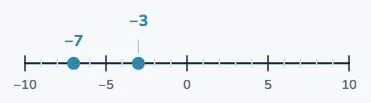
Which is bigger: −7 or −3?
- Most people say −7, because 7 is bigger than 3.
- −3 is bigger.
- One picture makes that obvious and keeps it obvious.
What an integer is
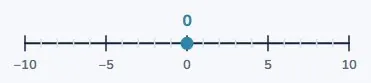
- All the whole numbers, going both ways.
- Negatives, zero, and positives.
- No halves, no fractions, no decimals.
| Number | An integer? |
|---|---|
| −7 | yes, a negative whole number |
| 0 | yes, zero is an integer |
| 12 | yes, a positive whole number |
| 2.5 | no, not a whole number |
| 3/4 | no, not a whole number |
The line runs both ways forever
- Zero is not the end of the line. It is the middle.
- Numbers keep going left, as far as you like.
- And further left always means smaller.
So −7 is smaller than −3
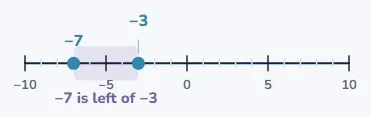
- −7 sits further left than −3.
- Further left, smaller. Same rule as always.
- There is no separate rule for negatives.
Put five numbers in order
- −7, 3, −1, 0, −10.
- Find each one on the line, then read left to right.
- −10, −7, −1, 0, 3.
| Number | Where | |
|---|---|---|
| −10 | furthest left | smallest |
| −7 | left of −1 | |
| −1 | just left of 0 | |
| 0 | the middle | |
| 3 | furthest right | largest |
Every number has a partner
- −5 and 5 are the same distance from zero.
- Add them and you land back on zero.
- That partner is called the additive inverse.
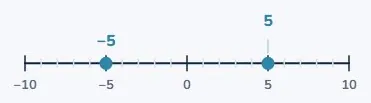
Their sum is always zero
- Start at −5 and add 5. You reach 0.
- It works the other way round too.
- Zero is its own partner.
| Pair | Adds to |
|---|---|
| −5 and 5 | −5 + 5 = 0 |
| 12 and −12 | 12 + −12 = 0 |
| 0 and 0 | 0 + 0 = 0 |
The only rule you need
- Adding moves you right along the line.
- Subtracting moves you left.
- It makes no difference where you start.
| Operation | On the line |
|---|---|
| Adding | move right |
| Subtracting | move left |
| Where you start | makes no difference |
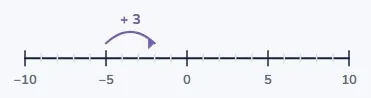
−5 + 3
- Stand on −5.
- Adding, so move 3 to the right.
- You land on −2.
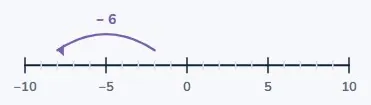
−2 − 6
- Stand on −2.
- Subtracting, so move 6 to the left.
- You land on −8.
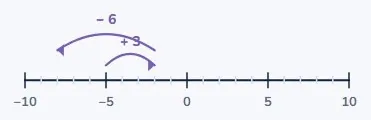
Two jumps in a row
- −5 + 3 − 6.
- Right 3 to −2, then left 6.
- −8. Each jump starts where the last one landed.
Try it: jump along the line
Crossing zero changes nothing
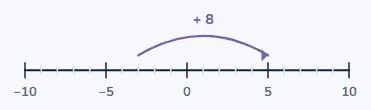
- Start at −3 and add 8. Move 8 right.
- You pass through zero on the way.
- Land on 5. No special rule for the crossing.
The line stood on its end
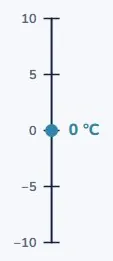
- A thermometer is a number line turned upright.
- Adding is now up. Subtracting is down.
- Same rule, turned a quarter turn.
A frosty morning
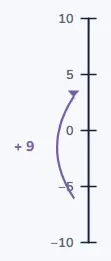
- Overnight it dropped to −6 °C.
- By midday it had risen 9 degrees.
- −6 + 9 = 3 °C.
Reading it back
- It went up 9, but it only reached 3.
- Six of those degrees were spent getting to zero.
- Then three more above it.
| Step | Value |
|---|---|
| Overnight low | −6 °C |
| Rose by | 9 degrees |
| By midday | 3 °C |
An account in the red
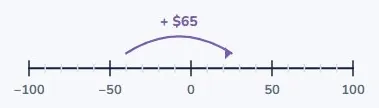
- A balance of −$40 means owing $40.
- $65 goes in. Move 65 to the right.
- The balance is now $25.
Why it is not $65
- The first $40 cleared what was owed.
- Only the rest is actually yours.
- $65 − $40 = $25.
| Step | Value |
|---|---|
| Balance | −$40 (overdrawn) |
| Paid in | $65 |
| New balance | $25 |
Common mistakes
- −7 is bigger than −3 because 7 is bigger than 3.−7 is further left on the number line, and further left is always smaller, so −7 < −3.
- −4 − 7 = 3.Start at −4 and move 7 further left to land on −11; subtracting always moves left.
- It was −6 °C and rose 9 degrees, so it is now 15 °C.Start at −6 and move up 9: six degrees reach zero, three more give 3 °C.
- −5 + 3 = −8.Adding moves right, so from −5 move 3 right to −2.
Your turn: eight questions
- Try all eight.
- Draw the line for questions 3 and 4.
- It is faster than trying to hold it in your head.
Put in order, smallest first: −7, 3, −1, 0, −10
What is the additive inverse of −12?
Work out −4 − 7.
An account is −$85. A deposit of $130 goes in. What now?
Which statement is true?
Ana says −6 − 4 = −2 because 6 − 4 = 2. What is the correct answer?
Work out −3 + 8 − 9.
At Lake Tekapo it is −5 °C at 6 am and 8 °C by 2 pm. How many degrees did the temperature rise?
Show answer
1. −10, −7, −1, 0, 3. Furthest left first. 2. 12, because −12 + 12 = 0. 3. −11. Start at −4 and move 7 further left. 4. $45. Start at −85 and move 130 right, crossing zero at 85. 5. −9 < −4. −9 sits further left on the number line than −4, and further left is smaller. 6. −10. Start at −6 and subtract 4, so move 4 further left: −6 − 4 = −10. 7. −4. Start at −3, move 8 right to 5, then 9 left to −4. 8. 13 degrees. 5 degrees up to zero, then 8 more above it: 8 − −5 = 5 + 8 = 13.
The answers
- −10, −7, −1, 0, 3. And the inverse of −12 is 12.
- −4 − 7 is −11: start at −4, move 7 further left.
- −85 + 130 is $45; it crosses zero at 85.
| Answer | |
|---|---|
| 1 | −10, −7, −1, 0, 3 |
| 2 | 12, because −12 + 12 = 0 |
| 3 | −11 |
| 4 | $45 |
Number Line: Operations
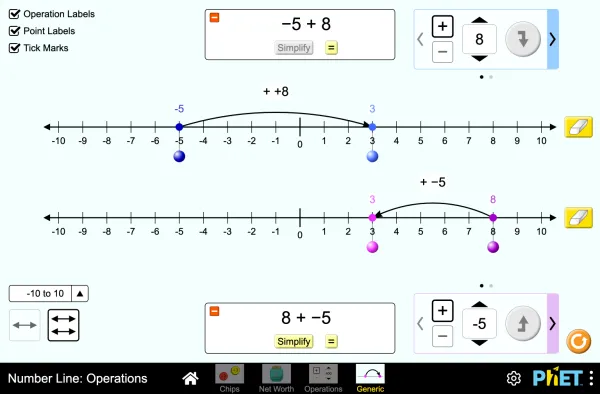
Full screen · PhET Interactive Simulations, University of Colorado Boulder, CC BY 4.0
What to take away
- Further left is smaller. That is why −7 < −3.
- Adding moves right, subtracting moves left, always.
- Every number has a partner that brings you back to zero.
| Remember | |
|---|---|
| Integers | whole numbers, negative, zero and positive |
| Further left | is always smaller, so −7 < −3 |
| Adding | moves right, wherever you start |
| Subtracting | moves left, wherever you start |
| Additive inverse | the partner that brings you back to 0 |
Challenge
Mere's bank charges a $5 fee at the end of any day on which her balance is below zero, after that day's payment has gone through. From Monday to Friday she has exactly one payment each day: Monday −$60, Tuesday +$25, Wednesday −$40, Thursday +$90, Friday −$30. After Friday's fee (if any), her balance is −$15. What was her balance on Monday morning, and how much did she pay in fees that week?
Hint
Work backwards from Friday night. If the balance at the end of a day is below zero, was a fee charged that day? Undo the fee first, then undo the payment.
Answer
$20 on Monday morning; $20 in fees (four $5 fees)
Step by step
- A fee only takes the balance further below zero, so if a day ends below zero there was a fee that day, and if it ends at zero or above there was none.
- Friday ends at −$15, so undo the fee: −$15 + $5 = −$10. Undo the −$30 payment by moving 30 right: $20 on Friday morning.
- Thursday ended at $20, so no fee. Undo +$90 by moving 90 left: −$70.
- Wednesday ended at −$70: undo the fee to −$65, then undo −$40 to −$25. Tuesday ended at −$25: undo the fee to −$20, then undo +$25 to −$45.
- Monday ended at −$45: undo the fee to −$40, then undo −$60 to $20. Fees were charged on Monday, Tuesday, Wednesday and Friday: 4 × $5 = $20.
Full working
- Friday: −15 + 5 = −10, then −10 + 30 = 20fee then payment undone
- Thursday: 20 is not below zero, no fee; 20 − 90 = −70undo +90
- Wednesday: −70 + 5 = −65, then −65 + 40 = −25undo fee and −40
- Tuesday: −25 + 5 = −20, then −20 − 25 = −45undo fee and +25
- Monday: −45 + 5 = −40, then −40 + 60 = 20undo fee and −60
- check: 20 − 60 = −40 → −45, + 25 = −20 → −25, − 40 = −65 → −70, + 90 = 20, − 30 = −10 → −15forwards
- Monday morning $20; fees $20
Kiri stands on 0 on a number line. She jumps 1 to the right, then 2 to the left, then 3 to the right, then 4 to the left, and so on, each jump one longer than the last and in the opposite direction, until she has made 100 jumps. Where does she finish? How many times does she pass over 0? Which integers from −50 to 50 does she land on, and how many times does she land on each one?
Hint
Write down where she is after each of the first six jumps and look for a pattern in the even-numbered and the odd-numbered jumps.
Answer
She finishes on −50. She passes over 0 99 times. She lands on every integer from −50 to 50 except 0, each exactly once.
Step by step
- After jumps 1 to 6 she is on 1, −1, 2, −2, 3, −3.
- Each pair of jumps (right then left) moves her one step further left overall. So after an even-numbered jump she is on minus half the jump number (after jump 6 she is on −3), and after an odd-numbered jump she is on half of one more than the jump number (after jump 7 she is on 4).
- After jump 100 (the 50th pair) she is on −50. After jump 99 she was on 50.
- Jump 1 goes from 0 to 1 without passing over 0. Every jump after that goes from a positive number to a negative one or back, so jumps 2 to 100 each pass over 0: that is 99 times.
- Her landing spots are 1, −1, 2, −2, ..., 50, −50: every integer from −50 to 50 except 0, and each one only once.
Full working
- 0 + 1 = 1, 1 − 2 = −1, −1 + 3 = 2, 2 − 4 = −2, −2 + 5 = 3, 3 − 6 = −3first six jumps
- each pair: +1 − 2 = −1, +3 − 4 = −1, +5 − 6 = −1, and so onright then left
- after 100 jumps: 50 pairs × (−1) = −50finishing point
- after 99 jumps: −49 + 99 = 50furthest right
- jumps 2 to 100 change sign each time: 100 − 1 = 99passes over 0
- finishes on −50; passes 0 99 times; lands once on each of ±1, ±2, ..., ±50, never on 0
Put the integers −4, −3, −2, −1, 0, 1, 2, 3, 4 into a 3 by 3 grid, one in each square, so that every row, every column and both diagonals add to the same total. Explain why that total must be 0 and why the middle square must be 0. Then give one grid that works.
Hint
Add all nine numbers using additive inverses. For the middle square, add up the four lines that pass through the middle: the middle number is counted four times and every other number once.
Answer
The total is 0 and the middle is 0. One grid: top row 3, −4, 1; middle row −2, 0, 2; bottom row −1, 4, −3.
Step by step
- The nine numbers pair up into additive inverses, −4 and 4, −3 and 3, −2 and 2, −1 and 1, plus 0, so they add to 0.
- The three rows use every number once and all have the same total, so 3 × total = 0, and the total is 0.
- The middle row, middle column and two diagonals all pass through the middle square. Together they use the middle number four times and each other number once.
- Those four lines add to 4 × 0 = 0. That equals (all nine numbers) + 3 × middle = 0 + 3 × middle, so the middle is 0.
- With 0 in the middle, each line through the middle needs a pair of inverses at its two ends. Putting 4 and −4 in the middle of the top and bottom rows and filling the corners to suit gives the grid above.
Full working
- (−4 + 4) + (−3 + 3) + (−2 + 2) + (−1 + 1) + 0 = 0additive inverses
- 3 × total = 0, so total = 0three rows use every number once
- 4 lines through the middle: 4 × 0 = 0each line totals 0
- 0 = (sum of all nine) + 3 × middle = 0 + 3 × middlemiddle counted 4 times
- middle = 0divide by 3
- rows: 3 − 4 + 1 = 0, −2 + 0 + 2 = 0, −1 + 4 − 3 = 0check rows
- columns: 3 − 2 − 1 = 0, −4 + 0 + 4 = 0, 1 + 2 − 3 = 0; diagonals: 3 + 0 − 3 = 0, 1 + 0 − 1 = 0check the rest
- total 0, middle 0; rows 3, −4, 1; −2, 0, 2; −1, 4, −3
Where science uses this
Practise this
Report a mistake
More in Number
 Powers of 10 and expanded form6 min
 Primes, factors, HCF and LCM7 minIntegers, and adding below zero6 min
 Order of operations, rounding and remainders7 min
 Fractions, decimals and percentages7 min
 Multiplying and dividing fractions and decimals6 min
 Percentages, fractions of amounts, and proportion6 min
 Money, cash rounding and discounts6 min
Is your child on track?
Take the free placement test