The particle model: solids, liquids, gases and changes of state
What this lesson covers
- All matter is made of tiny particles, too small to see even with a microscope
- How particles are arranged, spaced and moving in a solid, a liquid and a gas
- Why attractions between particles hold solids and liquids together
- Using the particle model to explain the properties of each state
- Melting, freezing, evaporation, condensation, sublimation and deposition
- How adding or removing thermal energy causes a change of state
- Everyday problems that changes of state can cause
Everything is made of particles
- Matter is anything that has mass and takes up space: rocks, water, air, your body.
- All matter is made of particles that are far too small to see, even with the best school microscope.
- A single drop of water holds more particles than there are grains of sand on every beach in New Zealand.
- Scientists use the particle model: we picture each particle as a tiny ball, and use that picture to explain how materials behave.
- The model is a simplified picture, not a photograph, but it explains a lot.
Solids, liquids and gases
- Most matter around us is a solid, a liquid or a gas. These are the three states of matter.
- In a solid the particles are packed tightly in a fixed pattern. They cannot swap places; they only vibrate on the spot.
- In a liquid the particles are still close together, touching their neighbours, but they are jumbled and can slide past each other.
- In a gas the particles are far apart and move quickly in straight lines in every direction until they hit something.
| State | Arrangement | Spacing | Movement |
|---|---|---|---|
| Solid | Regular pattern | Very close, touching | Vibrate in place |
| Liquid | Random | Close, touching | Slide past each other |
| Gas | Random | Far apart | Move fast in all directions |
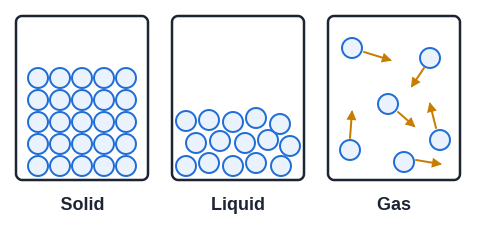
Try it: solid, liquid and gas particles
What holds particles together
- Particles pull on each other with attractive forces, a bit like very weak magnets.
- In solids these attractions are strong enough to lock particles in place.
- In liquids the particles are still held close by attraction, but they have enough energy to keep sliding around.
- In gases the particles are so far apart and moving so fast that the attraction between them is very weak.
The model explains the properties
- A solid keeps its own shape and volume because its particles are locked in place.
- A liquid flows and takes the shape of its container, because its particles can slide, but its volume stays the same because they stay close.
- A gas spreads out to fill any container, because its particles fly apart.
- A gas can be squashed (compressed) because there are big empty spaces between its particles. Solids and liquids hardly squash at all, because their particles are already touching.
| Property | Solid | Liquid | Gas |
|---|---|---|---|
| Fixed shape? | Yes | No | No |
| Fixed volume? | Yes | Yes | No |
| Can it flow? | No | Yes | Yes |
| Easy to squash? | No | No | Yes |
Example: squashing air and water
- Tama fills one syringe with air and another with water, blocks the ends with his fingers and pushes each plunger.
- The air syringe plunger moves in a long way. The water syringe plunger hardly moves. Explain this with the particle model.
- Air is a gas: its particles are far apartlots of empty space
- Pushing moves the air particles closer togetherthe space shrinks
- Water is a liquid: its particles are already touchingalmost no space to remove
- Gas particles have space between them to squash into; liquid particles do not
Six changes of state
- A substance can change from one state to another. The particles stay the same; only their arrangement and movement change.
- Melting is solid to liquid, and freezing is liquid to solid.
- Evaporation is liquid to gas, and condensation is gas to liquid.
- Sublimation is solid straight to gas, skipping the liquid. Deposition is gas straight to solid.
- Frost on a car windscreen on a cold Canterbury morning forms by deposition: water vapour in the air turns straight into ice crystals.
| Change | From | To | Everyday example |
|---|---|---|---|
| Melting | Solid | Liquid | An ice block dripping on a summer day |
| Freezing | Liquid | Solid | Ice cube trays in the freezer |
| Evaporation | Liquid | Gas | Washing drying on the line |
| Condensation | Gas | Liquid | A bathroom mirror fogging up |
| Sublimation | Solid | Gas | Dry ice giving off a cold mist |
| Deposition | Gas | Solid | Frost forming on a windscreen |
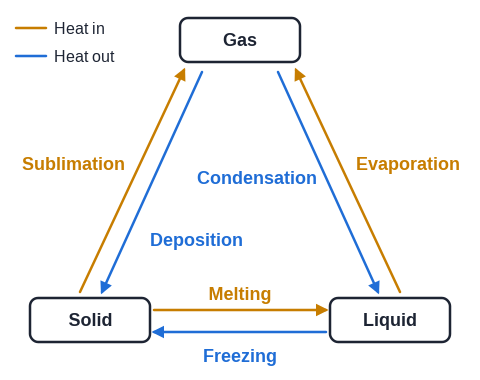
Try it: name the change of state
Thermal energy drives the change
- Changes of state happen when thermal energy (heat) is added to a substance or taken away from it.
- Adding thermal energy makes particles move faster. In a solid they vibrate harder until they break out of their fixed pattern: the solid melts.
- Add more and liquid particles move fast enough to escape the attractions completely: the liquid evaporates.
- Taking thermal energy away slows the particles down, so the attractions pull them closer together again: a gas condenses and a liquid freezes.
- While a substance is changing state, its temperature stays steady, because the energy goes into separating the particles instead of speeding them up.
Example: a class heats crushed ice
- A Year 7 class at a Hamilton school put crushed ice from a freezer in a beaker, warmed it gently on a hot plate, stirred it and read the thermometer every minute.
- Use their results to say when the ice was melting, and why the temperature did what it did.
| Time (min) | 0 | 1 | 2 | 3 | 4 | 5 | 6 | 7 | 8 | 9 |
|---|---|---|---|---|---|---|---|---|---|---|
| Temperature (°C) | −6 | −2 | 0 | 0 | 0 | 0 | 3 | 8 | 13 | 18 |
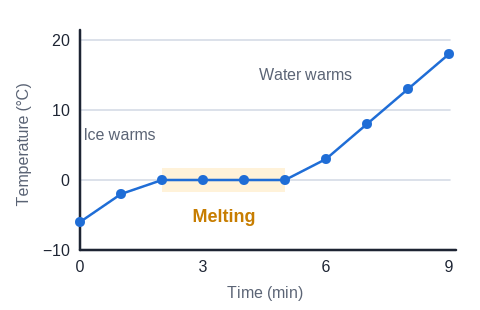
- 0 to 2 min: −6 °C up to 0 °Cthe solid ice warms up
- 2 to 5 min: steady at 0 °Cenergy is breaking the solid pattern
- After 5 min: rising againall liquid now, so the water warms
- Melting from about 2 to 5 minutes, at 0 °C
Try it: heat ice until it boils
When changes of state cause problems
- A full glass bottle of water left in the freezer can crack, because water takes up more room as it freezes.
- On cold mornings, water on roads such as the Desert Road can freeze into a thin, clear layer of ice that drivers cannot see, so cars skid.
- In winter, water vapour from cooking, showers and breathing condenses on cold windows. If it is not wiped or aired out, it feeds mould, which is bad for health.
- Water pipes outside can freeze and burst on frosty nights, so some people wrap them in insulation.
Planning a melting experiment
- A good question to test: does the temperature of the water around an ice cube change how fast it melts?
- The variable you change on purpose (independent variable) is the water temperature.
- The variable you measure (dependent variable) is the time for the ice cube to melt.
- Everything else stays the same to make the test fair: the same size of ice cube, the same amount of water and the same kind of cup.
- Repeat each test at least three times and work out an average, so one odd result does not mislead you.
Common mistakes
- When ice melts, the particles themselves melt and get softer.The particles do not change at all; they just move faster and leave their fixed pattern.
- There is air between the particles in a gas.Between gas particles there is empty space; air is itself made of particles.
- The drops on the outside of a cold drink leaked through the glass.They are water vapour from the air that condensed on the cold glass.
- Condensation happens when something is heated.Condensation happens when a gas loses thermal energy and cools into a liquid.
Does warmer water melt ice faster?
You need: 3 ice cubes of the same size, 3 identical cups, cold tap water, hot tap water, a measuring jug, a timer or phone
- Fill one cup with 200 mL of cold tap water, one with 200 mL of hot tap water, and one with 100 mL of each mixed together.
- Drop one ice cube into each cup at the same moment and start the timer.
- Stir each cup gently with a spoon every 30 seconds, the same way each time.
- Write down the time when each ice cube has completely disappeared.
- Look for the pattern: the ice in the warmest water should melt first, because that water passes thermal energy to the ice fastest.
Safety: Hot tap water can scald, so ask an adult to run it, carry the cups slowly and keep them away from the edge of the bench.
Your turn
Which state of matter has particles touching each other but able to slide past one another?
Name the change of state when a puddle dries up on a sunny day.
Naphthalene mothballs slowly get smaller in a wardrobe without ever becoming liquid. Which change of state is this?
Why does a gas fill its whole container while a liquid sits at the bottom?
A class heats wax. Its temperature stays at 55 °C for 4 minutes while it turns to liquid. What is happening during those 4 minutes?
Show answer
1. A liquid. 2. Evaporation (liquid to gas). 3. Sublimation (solid straight to gas). 4. Gas particles have only weak attractions and move fast in all directions, so they spread out; liquid particles are held close together by attraction. 5. The wax is melting: the thermal energy is breaking the particles out of their fixed pattern instead of raising the temperature.
States of Matter: Basics
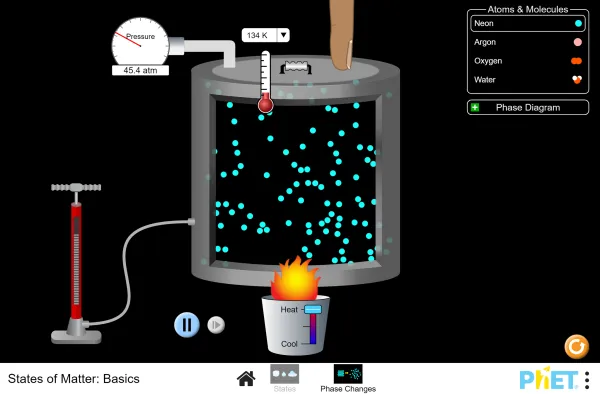
Full screen · PhET Interactive Simulations, University of Colorado Boulder, CC BY 4.0
Recap
- All matter is made of particles too small to see, and the particle model pictures them as tiny balls.
- Solids have particles fixed in a pattern, liquids have close particles that slide, and gases have particles far apart moving fast.
- Attractions hold particles together; they are strong in solids and liquids and very weak in gases.
- The six changes of state are melting, freezing, evaporation, condensation, sublimation and deposition.
- Adding thermal energy speeds particles up and can change a solid to a liquid to a gas; removing it does the reverse.
- Changes of state explain everyday problems like burst bottles, icy roads and wet windows.
Challenge
A class melts some stearic acid (a white waxy solid) in a test tube, then takes it out of the hot water and reads its temperature every minute as it cools in the air. Results, from 0 to 9 minutes: 85, 79, 74, 70, 69, 69, 69, 69, 66, 61 °C. Give the state of the stearic acid at 2 minutes, from 4 to 7 minutes, and at 9 minutes, and its melting point. The test tube keeps losing heat to the air the whole time, so explain with the particle model why the temperature stops falling for a while.
Hint
A flat part on a heating graph means a change of state. On a cooling graph it is the reverse change. When particles are pulled back into a fixed pattern by their attractions, is energy taken in or given out?
Answer
Liquid at 2 minutes; freezing (liquid and solid together) from 4 to 7 minutes; solid at 9 minutes. Melting point 69 °C. While it freezes, the attractions pull the particles into a fixed pattern, and that gives out energy which makes up for the heat lost to the air, so the temperature stays at 69 °C until all of it is solid.
Step by step
- From 0 to 3 minutes the temperature falls steadily: it is a liquid cooling, so at 2 minutes (74 °C) it is liquid.
- From 4 to 7 minutes the temperature stays at 69 °C: it is freezing, so liquid and solid are both present.
- After 7 minutes it falls again: it is all solid now, so at 9 minutes (61 °C) it is solid.
- A substance freezes and melts at the same temperature, so the melting point is 69 °C.
- As it freezes, particles slow enough for their attractions to lock them into a fixed pattern. Locking in gives out energy.
- That energy balances the heat escaping to the air, so the particles' average speed, and so the temperature, stays the same until no liquid is left.
Full working
- 0 to 3 min: 85 → 70 °Cliquid cooling
- 2 min: 74 °Cliquid
- 4 to 7 min: steady at 69 °Cfreezing, liquid and solid together
- 8 to 9 min: 66 → 61 °Csolid cooling
- Freezing point = melting point = 69 °Csame temperature both ways
- Attractions lock particles in place and give out energybalances heat lost to the air
- Liquid at 2 min, freezing from 4 to 7 min, solid at 9 min; melting point 69 °C
Water boils at 100 °C, yet a puddle dries up on a 15 °C day in Ōtautahi Christchurch. And after a swim you feel cold standing in the wind, even on a warm day, until you dry off. Use the particle model to explain both. Your explanation must say why evaporation makes the water left behind cooler.
Hint
Temperature is about the average speed of the particles, but not every particle moves at the average speed. Which particles at the surface could escape? What happens to the average when the fastest ones leave?
Answer
Even at 15 °C some water particles at the surface move fast enough to break free of the attractions and escape as a gas, so the puddle evaporates slowly. The particles that escape are the fastest ones, so the average speed of those left behind drops, which means the water cools. On your skin, that cooling water takes heat from your body, and wind carries the water vapour away so evaporation keeps going quickly.
Step by step
- At any temperature, the particles in a liquid move at a range of speeds. Temperature tells you only the average.
- A few particles at the surface are fast enough to break free of the attractions and escape into the air. That is evaporation, and it happens below the boiling point.
- The particles that escape are the fastest ones, so the ones left behind are slower on average. Slower on average means a lower temperature.
- Water on your skin cools as it evaporates, and heat flows from your warmer skin into it, so you lose body heat and feel cold.
- Wind carries the escaped water vapour away, so fewer particles come back to the surface, and evaporation and cooling keep going faster.
Full working
- Liquid particles have a range of speedstemperature is the average
- Fastest surface particles escapeevaporation below 100 °C
- Fastest particles leave, so the average speed fallsthe remaining water cools
- Heat flows from skin into the cooler wateryou lose body heat
- Wind removes the vapourevaporation keeps going quickly
- The fastest particles escape, so the water left behind is cooler; on skin this draws heat from your body
When 1 mL of liquid water boils at 100 °C, it becomes about 1600 mL of steam. In the liquid the particles are touching. Estimate roughly how many times further apart, centre to centre, the particles are in steam than in liquid water. Then use your answer to explain why steam can be squashed easily but water hardly at all.
Hint
Imagine each particle sitting alone in its own little cube of space. If every side of the cubes became 2 times longer, the volume would become 2 × 2 × 2 = 8 times bigger. Which number k makes k × k × k about 1600?
Answer
About 12 times further apart (11 × 11 × 11 = 1331 and 12 × 12 × 12 = 1728, so between 11 and 12, closer to 12). Steam is mostly empty space, so its particles can be pushed much closer together; in water they are already touching, so there is almost no space left to remove.
Step by step
- Boiling does not change the number of particles, only the space they have, so each particle now has about 1600 times as much space.
- Picture each particle in its own cube of space. Making the side k times longer makes the volume k × k × k times bigger.
- We need k × k × k to be about 1600. 10 × 10 × 10 = 1000 is too small, 11 × 11 × 11 = 1331 is too small, and 12 × 12 × 12 = 1728 is a bit too big.
- So the particles are about 12 times further apart in steam than in the liquid.
- Particles about 12 diameters apart leave lots of empty space, so pushing on steam moves them closer. In liquid water the particles already touch, so pushing hardly changes the volume.
Full working
- Same particles, 1600 times the volumeboiling only spreads them out
- Volume grows by side × side × sidea cube of space for each particle
- 10 × 10 × 10 = 1000too small
- 11 × 11 × 11 = 1331still too small
- 12 × 12 × 12 = 1728just over 1600
- Spacing grows by between 11 and 12 timesabout 12
- About 12 times further apart, so steam is mostly empty space and can be squashed; water cannot
The maths behind it
Report a mistake
How is Year 7 maths going?
See the Year 7 maths guide