Expansion, density, and why ice floats
What this lesson covers
- Heating makes particles move faster and push further apart
- Why materials expand when heated and contract when cooled
- Why most substances are denser as a solid than as a liquid
- Why water is different: ice is less dense than liquid water, so it floats
- In a change of state the particles move and rearrange, but the particles themselves stay the same
- Mass stays the same when a substance changes state
- Using particle diagrams to explain what you see in an experiment
Heating speeds particles up
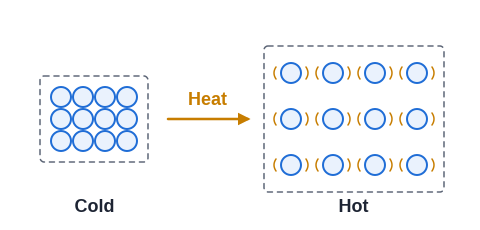
- When a substance gains thermal energy, its particles move faster: solid particles vibrate harder, and liquid and gas particles rush around more quickly.
- Faster particles bump into each other harder and push their neighbours further away.
- If they gain enough energy they can overcome the attractions holding them together, and the substance changes state.
- When a substance cools, the reverse happens: particles slow down and the attractions pull them closer.
Expansion and contraction
- Because hot particles push each other further apart, most materials get bigger when they are heated. This is called expansion.
- When they cool, the particles move closer again and the material shrinks. This is contraction.
- There are the same number of particles before and after; they just take up more or less room.
- Engineers plan for it. Long road bridges have expansion joints, small gaps that close up on hot days, and power lines are hung with some slack because they sag more in summer.
- A tight metal jar lid can be loosened under hot tap water, because the metal lid expands more than the glass jar.
Density: how tightly packed
- Density tells you how much mass is packed into a certain volume. A brick is denser than a sponge of the same size.
- Density = mass ÷ volume, often in grams per millilitre (g/mL) or grams per cubic centimetre (g/cm³).
- Something less dense than a liquid floats in it; something denser sinks.
- For most substances the particles are packed most tightly in the solid, so the solid is denser than its liquid.
- Drop a lump of solid candle wax into melted wax and it sinks to the bottom. Solid iron sinks in molten iron in the same way.
Water breaks the rule
- Water is an unusual substance: it expands when it freezes.
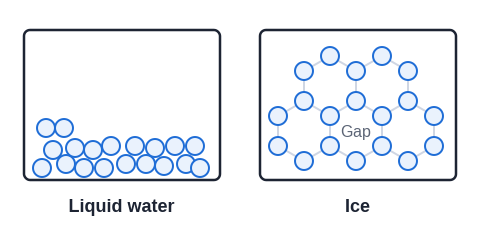
- As water freezes, its particles lock into a regular, open pattern with gaps in it, so they end up further apart than in liquid water.
- The same mass now takes up more space, so ice is less dense than liquid water, and it floats.
- This matters for life. A pond in Central Otago in winter freezes from the top down, and the floating ice acts like a lid that helps keep the water underneath from freezing, so fish and insects survive.
- It also explains the burst bottle in the freezer: the ice needs more room than the water did.
Try it: why ice floats
Example: a class freezes 500 g of water
- A Year 7 class poured 500 mL of water (mass 500 g) into a soft plastic container, marked the level, and froze it overnight.
- The next day the ice had a volume of about 545 mL and a mass of 500 g. Find the increase in volume, and the density before and after.
- 545 mL − 500 mL = 45 mL biggerthe ice takes more space
- 45 ÷ 500 × 100 = 9% increaseas a percentage of the start
- Water: 500 g ÷ 500 mL = 1.0 g/mLdensity = mass ÷ volume
- Ice: 500 g ÷ 545 mL ≈ 0.92 g/mLsame mass, more volume
- Volume up 45 mL (9%); density falls from 1.0 to about 0.92 g/mL, so ice floats
What changes, and what does not
- Melting, freezing, evaporating and condensing are physical changes: no new substance is made.
- They are reversible. Melted ice can be frozen again, and steam can condense back into water.
- In these changes the particles move to new positions and the gaps between them change.
- The particles themselves do not get bigger, smaller, change shape or turn into a different kind of particle. A water particle in ice is the same as one in steam.
| In a change of state | Changes? |
|---|---|
| How the particles are arranged | Yes |
| The distance between particles | Yes |
| How fast the particles move | Yes |
| The size of each particle | No |
| The kind of particle | No |
| The number of particles | No |
Try it: what changes?
Mass is conserved
- Because the number and kind of particles stay the same, the mass stays the same when a substance changes state.
- This is called conservation of mass: no mass is made or destroyed.
- A puddle that dries up seems to lose its water, but the particles have only spread out into the air as water vapour. Their mass is now in the air.
- To test conservation of mass, use a sealed container so no particles can escape or get in.
Example: weighing ice as it melts
- Mia puts ice cubes in a jar, screws the lid on tightly and finds the mass is 250 g. An hour later the ice has melted and the scales still read 250 g.
- Her friend repeats it but the second reading is 252 g. Drops of water have formed on the outside of the cold jar. Explain both results.
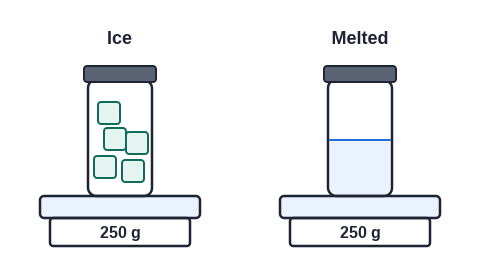
- Mia: 250 g before and 250 g aftersealed, so no particles left or arrived
- Ice to water only rearranges the particlessame number, same kind
- Friend: 252 g − 250 g = 2 g extrawater vapour from the air condensed on the jar
- Mass is conserved; the 2 g came from outside, so dry the jar before weighing
Example: explaining with particles
- In class, a balloon is stretched over the neck of an empty plastic bottle. When the bottle stands in a bowl of hot tap water, the balloon slowly inflates. In iced water it is sucked into the bottle.
- Use the particle model to explain what you see.
- Hot water heats the air in the bottlethermal energy goes in
- Air particles move faster and spread further apartthe gas expands
- There is no room in the bottle, so the expanding air pushes into the balloonthe balloon inflates
- In iced water the particles slow and move closer, so the air contracts and the balloon is pulled in
Common mistakes
- Things expand when heated because the particles themselves get bigger.The particles stay the same size; they move faster and spread further apart.
- Ice floats because it has air bubbles trapped in it.Even clear ice floats, because its particles are held in an open pattern that makes it less dense than water.
- When water evaporates, its mass is destroyed.The particles spread into the air as water vapour, so the mass is still there, just in the air.
- Ice has a bigger volume than the water it came from, so it must have more mass.The mass stays the same; the same particles just take up more room, so the density goes down.
Freeze it, weigh it, melt it
You need: a small plastic container or plastic cup, water, a marker pen, kitchen scales, cling film, space in the freezer
- Pour water into the plastic container until it is about two thirds full, and mark the water level on the outside with the marker.
- Cover it loosely with cling film, weigh it on the kitchen scales and write down the mass.
- Freeze it overnight, then look at the ice level against your mark and weigh it again.
- Leave it on the bench until all the ice has melted, wipe the outside dry, and weigh it a third time.
- Look for the pattern: the ice sits above the mark because water expands as it freezes, the melted water returns to the mark, and the mass stays the same all the way through.
Safety: Use plastic, never glass, in the freezer, and do not seal the lid tightly, because freezing water expands and can crack its container.
Your turn
Why do railway lines have small gaps between sections of track?
A solid block of chocolate sinks when dropped into melted chocolate. What does that tell you about the density of solid chocolate?
A 200 g ice block melts in a sealed bag. What is the mass of the water afterwards?
A student says that when water boils, its particles grow bigger to make steam. Correct the student.
Why does a can of fizzy drink left in the freezer sometimes burst?
Show answer
1. The steel expands on hot days, and the gaps give it room so the track does not buckle. 2. Solid chocolate is denser than liquid chocolate, like most substances. 3. 200 g, because mass is conserved in a change of state. 4. The particles stay the same size; they move much faster and spread far apart. 5. Most of the drink is water, which expands as it freezes, so the ice needs more room than the can has.
States of Matter: Basics
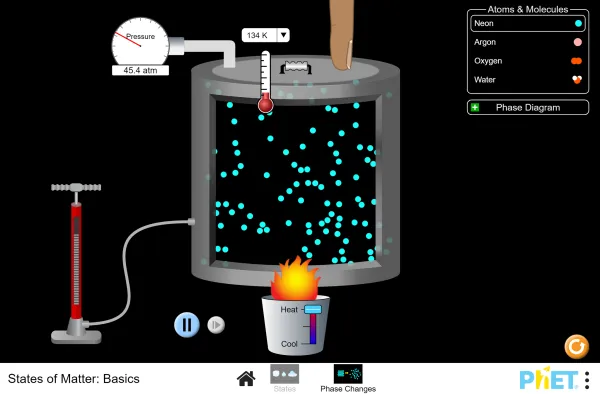
Full screen · PhET Interactive Simulations, University of Colorado Boulder, CC BY 4.0
Recap
- Heating makes particles move faster and push apart, so most materials expand when heated and contract when cooled.
- Density is mass divided by volume; less dense things float.
- Most substances are denser as a solid than as a liquid.
- Water is different: ice forms an open pattern, expands and is less dense than water, so it floats.
- Changes of state are reversible and only change the arrangement and spacing of particles, not the particles themselves.
- Mass is conserved in a change of state.
Challenge
A steel road bridge in Canterbury is 250 m long. For every 1 °C its temperature rises, each metre of steel gets 0.012 mm longer. Over a year the steel ranges from −2 °C on a frosty winter night to 38 °C in summer sun. The bridge has one expansion joint at each end, and the two gaps share the expansion equally. (a) How much longer is the bridge at 38 °C than at −2 °C? (b) The engineers want both gaps to be just closed at 38 °C. How wide should each gap be when the builders fit the joints on a 15 °C day? (c) How wide will each gap be on the coldest night?
Hint
First find how much the whole bridge grows for each 1 °C. Then work backwards from 38 °C: the gaps on the 15 °C day must swallow all the growth between 15 °C and 38 °C.
Answer
(a) 120 mm longer. (b) Each gap should be 34.5 mm wide (69 mm shared between two joints). (c) Each gap will be 60 mm wide.
Step by step
- The whole bridge grows 250 × 0.012 = 3 mm for every 1 °C.
- From −2 °C to 38 °C is a rise of 40 °C, so the bridge grows 120 mm.
- From 15 °C to 38 °C is a rise of 23 °C, so the bridge still has 69 mm to grow after the joints are fitted.
- That 69 mm must fit into the two gaps, so each gap is 34.5 mm on the 15 °C day.
- On the coldest night the bridge is 120 mm shorter than when the gaps are closed, so each gap is 60 mm.
Full working
- 250 × 0.012 = 3 mm per °Cgrowth of the whole bridge for each 1 °C
- 38 − (−2) = 40 °Cfull temperature range
- 3 × 40 = 120 mm(a) total change in length
- 38 − 15 = 23 °C, and 3 × 23 = 69 mmgrowth still to come after fitting
- 69 ÷ 2 = 34.5 mm(b) shared between two gaps
- 120 ÷ 2 = 60 mm(c) gaps when the bridge is shortest
- (a) 120 mm, (b) 34.5 mm each, (c) 60 mm each
Two mystery substances, X and Y, are tested in a lab. For each one, a solid block 5 cm × 4 cm × 2 cm is weighed, then some of the substance is melted and 50 mL of the liquid is weighed. Substance X: the block has a mass of 36.8 g and the 50 mL of liquid has a mass of 50 g. Substance Y: the block has a mass of 36 g and the 50 mL of liquid has a mass of 40 g. (a) Find the density of each substance as a solid and as a liquid. (b) Which solid would float in its own liquid? Which substance could be water? (c) Each whole block is melted with no loss. What volume of liquid does each block make? (d) Use the particle model to explain why the two substances change volume in opposite ways when they melt.
Hint
Find the volume of the block first. For (c), the mass does not change when a substance melts, so divide the mass of the block by the density of the liquid.
Answer
(a) X: solid 0.92 g per cm³, liquid 1.0 g per mL. Y: solid 0.9 g per cm³, liquid 0.8 g per mL. (b) Solid X floats in liquid X, so X could be water; solid Y sinks in liquid Y. (c) X makes 36.8 mL (it shrinks by 3.2 cm³, 8%); Y makes 45 mL (it grows by 5 cm³). (d) In solid X the particles are held in an open pattern with gaps, and melting lets them pack closer, so the volume goes down; in solid Y the particles are packed most tightly, and melting lets them move further apart, so the volume goes up.
Step by step
- The block's volume is 5 × 4 × 2 = 40 cm³, and 1 cm³ is the same as 1 mL.
- Density is mass ÷ volume, for the solid and for the liquid.
- X is less dense as a solid than as a liquid, which is the unusual behaviour of water, so solid X floats.
- Y behaves like most substances: the solid is denser and sinks in its own liquid.
- Melting keeps the mass the same, so the new volume is the block's mass ÷ the liquid's density.
- The particles do not change size; only the gaps between them change.
Full working
- 5 × 4 × 2 = 40 cm³volume of each block
- X solid: 36.8 ÷ 40 = 0.92 g per cm³; X liquid: 50 ÷ 50 = 1.0 g per mLdensity = mass ÷ volume
- Y solid: 36 ÷ 40 = 0.9 g per cm³; Y liquid: 40 ÷ 50 = 0.8 g per mLsame method
- 0.92 < 1.0 so solid X floats; 0.9 > 0.8 so solid Y sinksless dense floats
- X: 36.8 g ÷ 1.0 g per mL = 36.8 mL, which is 3.2 cm³ less than 40mass is conserved
- Y: 36 g ÷ 0.8 g per mL = 45 mL, which is 5 cm³ more than 40mass is conserved
- Solid X floats and X could be water; X shrinks to 36.8 mL on melting, Y grows to 45 mL
Water is densest at 4 °C. Here are its densities in g per mL: at 10 °C, 0.9997; at 4 °C, 1.0000; at 2 °C, 0.9999; at 0 °C (liquid), 0.9998; ice at 0 °C, 0.917. A pond in Central Otago starts autumn at 10 °C all the way down, and the air above it gets colder every night. (a) Use the data to explain what happens to the cooled surface water while the pond is above 4 °C. (b) Explain what changes once the whole pond has reached 4 °C and the surface keeps cooling, and why the ice forms at the top. (c) By midwinter the ice is 15 cm thick. How deep was the layer of liquid water that froze to make it? (d) Why does the water at the bottom of a deep pond stay close to 4 °C all winter, so fish can survive there?
Hint
Denser water sinks below less dense water, just as a denser object sinks. Compare each new temperature with the water underneath it. For (c), a column of ice and the water it came from have the same mass.
Answer
(a) Surface water cooled towards 4 °C becomes denser than the warmer water below, so it sinks and warmer water rises to be cooled, until the whole pond is 4 °C. (b) Below 4 °C the surface water becomes less dense than the 4 °C water under it, so it stays on top, cools to 0 °C and freezes there; ice (0.917) is less dense still, so it floats. (c) About 13.8 cm of water. (d) The densest water, at 4 °C, collects at the bottom and nothing colder sinks down to replace it, while the floating ice acts like a lid that slows further heat loss.
Step by step
- Above 4 °C, cooling makes water denser, so cold surface water sinks and mixes the pond.
- This keeps going until all the water is at 4 °C, the densest it can be.
- Cooling below 4 °C makes the surface water less dense, so it floats on the 4 °C water instead of sinking.
- Only that top layer reaches 0 °C, so ice forms at the surface, and ice is even less dense, so it stays there.
- Ice and the water it came from have the same mass, so the depth of water is 15 cm × 0.917 ÷ 0.9998.
- The bottom is filled with 4 °C water and is cut off from the cold air by the ice and the colder water above.
Full working
- 10 °C: 0.9997, 4 °C: 1.0000cooling to 4 °C makes water denser
- Denser cooled water sinks; warmer water rises to the surfacethe pond mixes
- Whole pond at 4 °C, density 1.0000the densest water
- 2 °C: 0.9999 and 0 °C: 0.9998 are less than 1.0000colder water now stays on top
- Ice 0.917 < 0.9998ice floats on the surface
- Mass of ice per cm² = 15 × 0.917 = 13.755 gsame mass as the water it came from
- Water depth = 13.755 ÷ 0.9998 ≈ 13.8 cmdensity of liquid water at 0 °C
- About 13.8 cm of water froze; the bottom stays near 4 °C because the densest water sinks and the ice lid slows heat loss
The maths behind it
Report a mistake
How is Year 7 maths going?
See the Year 7 maths guide