Temperature, thermal energy and choosing insulators
What this lesson covers
- Kinetic energy is the energy anything has because it is moving
- Temperature tells you how fast, on average, the particles are moving
- Thermal energy, and why it is not the same as temperature
- Heat moves by conduction, convection and radiation
- How conduction passes energy from particle to particle
- Conductors, insulators and thermal conductivity
- Running a fair test and choosing insulating materials
Moving things have kinetic energy
- Kinetic energy is the energy an object has because it is moving.
- A rolling netball, a flying kererū and a gust of wind all have kinetic energy. The faster something moves, the more kinetic energy it has.
- Particles are always moving, so they have kinetic energy too, even in something that looks perfectly still, like a rock.
What temperature measures
- Temperature tells you how hot or cold something is. We measure it with a thermometer, in degrees Celsius (°C).
- In particle terms, temperature measures the average kinetic energy of the particles: how fast they are moving on average.
- In a hot cup of tea the particles move fast on average. In a glass of iced water they move more slowly.
- It is an average because not every particle moves at the same speed; some are faster and some slower.
Try it: heat the particles
Thermal energy is not temperature
- Thermal energy is the total energy of all the particles in something, from their movement and the pulls between them.
- Temperature depends on how fast the particles move on average. Thermal energy also depends on how many particles there are.
- A warm bath at 40 °C holds far more thermal energy than a cup of tea at 80 °C, because the bath has so many more particles.
- Heat is thermal energy on the move. It always flows from a hotter object to a colder one, never the other way on its own.
Three ways heat moves
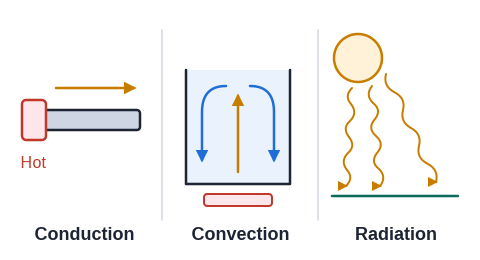
- Conduction: heat passes through a material from particle to particle. This is how the handle of a metal spoon in hot soup warms up.
- Convection: in a liquid or gas, the warmer part rises and the cooler part sinks, carrying heat with it in a loop. This is how a heater warms a whole room.
- Radiation: heat travels as invisible rays that need no material at all. This is how the Sun warms you across empty space, and why you feel the heat of a fire on your face.
Try it: conduction, convection or radiation?
Conduction close up
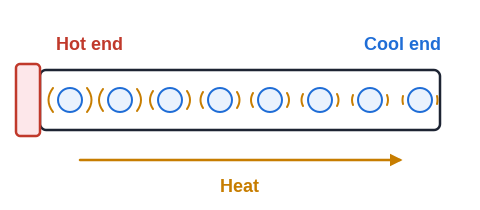
- Heat one end of a solid and the particles there vibrate harder.
- They bump into their neighbours and make them vibrate harder too, and so on along the material.
- The particles stay in place; only the energy is passed along. The material itself does not move.
- Metals conduct heat especially well. Materials with particles far apart, like gases, conduct heat very badly.
Conductors and insulators
- Thermal conductivity describes how well a material passes heat along by conduction.
- A material with high thermal conductivity is a good conductor: heat moves through it quickly. Metals such as copper, aluminium and steel are good conductors.
- A material with low thermal conductivity is an insulator: heat moves through it slowly. Wood, plastic, wool and still air are insulators.
- Many of the best insulators work by trapping lots of still air, which is a very poor conductor: think of wool, foam, feathers and bubble wrap.
- This is why a metal bench feels colder than a wooden one at the same temperature: the metal carries heat away from your hand much faster.
| Material | Conducts heat | Good for |
|---|---|---|
| Copper | Very well | Bottoms of pots |
| Steel | Well | Barbecue plates, pots |
| Glass | Poorly | Windows (better as double glazing) |
| Wood | Poorly | Spoon and pot handles |
| Wool | Very poorly | Jerseys, ceiling insulation |
| Polystyrene foam | Very poorly | Chilly bins, cups for hot drinks |
Try it: conductor or insulator?
Planning a fair test
- Question: which material keeps a can of hot water warm for longest?
- Change one thing only, the independent variable: the material wrapped around the can.
- Measure one thing, the dependent variable: how much the temperature drops in 20 minutes.
- Keep everything else the same (the controlled variables): the same cans, the same volume of water, the same starting temperature, the same thickness of wrapping, and the same place on the bench.
- Include a can with no wrapping to compare against, and repeat the test to check the results.
Example: which wrap insulates best?
- A Year 7 class in Dunedin filled four identical cans with 300 mL of hot tap water at 50 °C. They wrapped three in one layer of a different material and left one bare, then read the temperature after 20 minutes.
- Use their results to rank the materials as insulators.
| Can | Start (°C) | After 20 min (°C) | Drop (°C) |
|---|---|---|---|
| No wrap | 50 | 36 | 14 |
| Cotton T-shirt | 50 | 40 | 10 |
| Wool jersey | 50 | 43 | 7 |
| Bubble wrap | 50 | 44 | 6 |
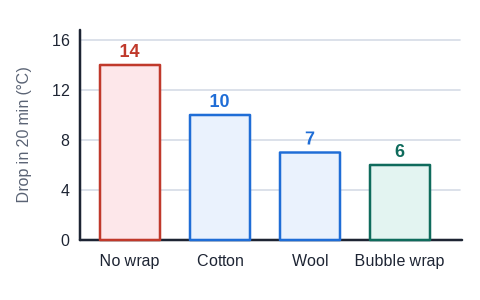
- Drop = start − after, e.g. 50 − 36 = 14 °Cfor each can
- Smallest drop = least heat lostbest insulator
- Bubble wrap 6, wool 7, cotton 10, no wrap 14in order
- Best insulator: bubble wrap, then wool, then cotton
- Wool and bubble wrap are close, so repeat the test before deciding
Choosing materials for the job
- Food: a chilly bin has foam walls so heat from a hot beach day gets in slowly and the food stays cold.
- Shelter: wool or fibreglass batts in ceilings and walls, and double glazing with a layer of air between two panes, slow heat loss from New Zealand homes in winter.
- Clothing: layers of merino or fleece trap still air next to your body, and a wetsuit traps a thin layer of water against your skin that your body warms.
- Sometimes you want a conductor instead: a pot base should be metal so heat from the element reaches the food quickly.
Example: designing a pot
- A designer is choosing materials for a cooking pot: one for the base and one for the handle. The choices are copper, wood and steel.
- Choose a material for each part and give a reason.
- Base: needs to pass heat to the food quicklyhigh thermal conductivity
- Handle: needs to stay cool enough to holdlow thermal conductivity
- Base: copper (or steel); handle: wood
Common mistakes
- A metal bench feels colder because metal is colder than wood.Both are the same temperature; metal is a better conductor, so it draws heat from your hand faster.
- A jersey makes heat to keep you warm.A jersey makes no heat; it is an insulator that slows the loss of your own body heat.
- Temperature and thermal energy are the same thing.Temperature is the average particle energy; thermal energy is the total, so a big cool bath can hold more than a small hot cup.
- Cold flows into your hands from a cold drink can.Heat flows out of your hands into the can; heat always moves from hotter to colder.
The ice cube race
You need: 3 ice cubes of the same size, a metal baking tray or pot lid, a wooden chopping board, a plastic plate, a timer or phone
- Leave the tray, board and plate on the bench for 10 minutes so they are all at room temperature, then touch each one and note which feels coldest.
- Put one ice cube on each surface at the same moment and start the timer.
- Every 2 minutes, write down how much of each ice cube is left.
- Note which ice cube melts first and which lasts longest.
- Look for the pattern: the ice on the metal melts fastest, because metal conducts heat from the room into the ice quickly, even though the metal felt coldest.
Safety: Wipe up the meltwater straight away so nobody slips on a wet floor, and ask an adult before using the baking tray.
Your turn
Which has more kinetic energy: a car at 30 km/h or the same car at 60 km/h?
Name the way heat travels from the Sun to Earth.
Why are saucepan handles often made of plastic or wood?
In a class test, a can wrapped in foil dropped 12 °C and one wrapped in felt dropped 5 °C. Which material is the better insulator?
Why does a puffer jacket keep you warm even though it is very light?
Show answer
1. The car at 60 km/h, because it is moving faster. 2. Radiation, which needs no material to travel through. 3. They have low thermal conductivity, so the handle stays cool enough to hold. 4. Felt, because its can lost the least heat (5 °C compared with 12 °C). 5. Its filling traps a lot of still air, which is a very poor conductor, so body heat escapes slowly.
Energy Forms and Changes
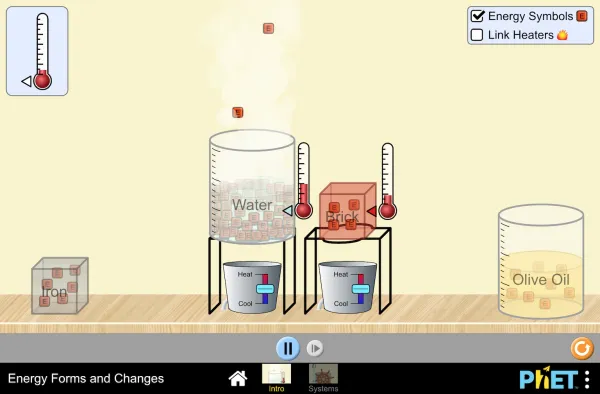
Full screen · PhET Interactive Simulations, University of Colorado Boulder, CC BY 4.0
Recap
- Kinetic energy is the energy of motion; faster means more.
- Temperature measures the average kinetic energy of the particles; thermal energy is the total energy of all of them.
- Heat flows from hot to cold by conduction, convection and radiation.
- In conduction, vibrating particles pass energy to their neighbours, but the material itself does not move.
- Good conductors such as metals have high thermal conductivity; insulators such as wool, foam and still air have low thermal conductivity.
- A fair test changes one variable, measures one, and keeps the rest the same.
Challenge
A park in Napier has a steel bench and a wooden bench side by side in the same shade. Your hand is at about 33 °C. Which bench feels colder at 6 am, when both are 8 °C? Which feels hotter at 3 pm, when both are 45 °C? How do they feel at a moment when both are exactly 33 °C? Explain all three with one idea.
Hint
Your hand does not feel the temperature of the bench. It feels how fast heat is flowing into or out of your hand. Which way does heat flow at each time, and which material moves it faster?
Answer
At 8 °C the steel feels colder; at 45 °C the steel feels hotter; at 33 °C they feel the same (neither warm nor cold). Steel is the better conductor, so it moves heat into or out of your hand faster, and at 33 °C no heat flows either way.
Step by step
- Heat always flows from the hotter object to the colder one, and your skin senses how fast that happens.
- At 8 °C both benches are colder than your hand, so heat flows out of your hand. Steel conducts it away much faster than wood, so the steel feels colder.
- At 45 °C both benches are hotter than your hand, so heat flows into your hand. Steel conducts it in faster, so the steel feels hotter.
- At 33 °C the benches and your hand are the same temperature, so no heat flows either way, and both feel the same.
- The one idea: a good conductor makes the difference between it and your skin feel bigger, in either direction.
Full working
- 8 °C < 33 °Cheat flows out of the hand
- Steel conducts faster than woodso steel feels colder
- 45 °C > 33 °Cheat flows into the hand
- Steel conducts faster than woodso steel feels hotter
- 33 °C = 33 °Cno heat flow, so no difference
- Morning: steel colder; afternoon: steel hotter; at 33 °C they feel the same
Mere pours 200 mL of water at 80 °C into a bowl that already holds 600 mL of water at 20 °C, and stirs. Ignoring any heat lost to the bowl or the air, what temperature does the mixture end up at? Her thermometer actually reads a little lower than this. Give a reason why, and say which water had more thermal energy to start with, the hot or the cold.
Hint
The heat the hot water gives out is exactly what the cold water takes in. There is 3 times as much cold water, so for every 1 degree the cold water rises, how many degrees must the hot water fall?
Answer
35 °C. The real reading is lower because some heat flows into the bowl and the air. The 600 mL of cold water had more thermal energy than the 200 mL of hot water.
Step by step
- Heat flows from the hot water to the cold water until both are at the same temperature.
- Each millilitre of water needs the same heat to change by 1 degree, and there is 3 times as much cold water.
- So the hot water must fall 3 degrees for every 1 degree the cold water rises.
- The gap from 20 °C to 80 °C is 60 degrees. Split it 3 to 1: the hot water falls 45 degrees and the cold water rises 15 degrees, meeting at 35 °C.
- In real life some heat also warms the bowl and escapes to the air, so the mixture ends a little below 35 °C.
- Thermal energy is the total energy of all the moving particles, not the temperature. The cold water has 3 times as many particles, and each one moves only a little slower than in the hot water, so altogether it holds more thermal energy, even though it is cooler.
Full working
- Heat lost by hot water = heat gained by cold waterenergy is passed, not made
- 600 ÷ 200 = 3three times as much cold water
- Hot falls 3 degrees for each 1 degree cold risessplit the gap 3 to 1
- 80 − 20 = 60 degreesthe gap
- 60 ÷ 4 = 15one share
- Cold: 20 + 15 = 35 °C; hot: 80 − 45 = 35 °Cthey meet
- Check: 200 × 45 = 9000 and 600 × 15 = 9000equal heat, measured in mL × degrees
- 35 °C (the real reading is lower because of heat lost to the bowl and air)
A vacuum flask keeps soup hot for hours. It has two thin glass walls with the air pumped out of the gap between them, both walls are coated with shiny silver on the side facing the gap, and the top is closed with a plastic stopper. For each of the three ways heat moves, say which feature stops or slows it, and explain why. Then explain why the soup still cools down slowly in the end.
Hint
Conduction and convection both need particles to carry heat. What is in the gap? Radiation needs no particles at all, so the gap cannot stop it on its own: what do shiny surfaces do to rays?
Answer
Conduction: the vacuum has almost no particles to pass heat along, and the stopper is a plastic insulator. Convection: no air in the gap means no warm currents can form there, and the stopper stops hot air rising out of the top. Radiation: it can cross a vacuum, so the shiny silver walls reflect it back towards the soup. The soup still cools because some heat is conducted through the glass where the two walls join at the neck, and through the stopper, and the silver does not reflect every ray.
Step by step
- Conduction passes heat from particle to particle. With the air pumped out, the gap has almost no particles, so almost no heat is conducted across it.
- Convection needs a liquid or gas that can move in a loop. The empty gap has none, and the stopper stops warm air and steam escaping from the top.
- Radiation travels as rays that need no material, so a vacuum cannot stop it. The shiny silver surfaces reflect most of the rays back towards the soup.
- The stopper is plastic, a poor conductor, so little heat is conducted out through the top.
- No flask is perfect: the two glass walls must join at the neck, the stopper still conducts a little, and the silver reflects most but not all rays, so heat leaks out slowly.
Full working
- Vacuum gap: almost no particlesblocks conduction across the gap
- Vacuum gap: no gas to circulateblocks convection in the gap
- Stopperstops hot air rising out (convection), and plastic is an insulator (conduction)
- Silver wallsreflect radiation, which can cross a vacuum
- Weak spots: glass joined at the neck, the stopper, imperfect reflectionslow leaks
- Each way is blocked, but heat still leaks slowly through the neck, the stopper and by radiation
The maths behind it
Report a mistake
How is Year 7 maths going?
See the Year 7 maths guide