Speed: measuring it, calculating it and graphing it
What this lesson covers
- Speed tells you how fast something is moving
- Speed is the distance covered in each unit of time: speed = distance ÷ time
- Speed units, metres per second (m/s) and kilometres per hour (km/h), and converting between them
- Constant speed, changing speed, and average speed
- Measuring distance and time accurately, and why repeats make results more reliable
- Showing motion on a distance-time graph
- Faster objects have more kinetic energy
What speed means
- Speed tells you how fast something is moving: how much distance it covers in a certain amount of time.
- A speed of 3 metres per second means the object travels 3 metres every second.
- To compare how fast two things move, you compare their speeds, not just the distances or the times on their own.
- A snail and a sprinter can both travel 100 m. What makes them different is how long it takes.
Speed = distance ÷ time
- To calculate speed, divide the distance travelled by the time taken.
- If distance is in metres (m) and time in seconds (s), the speed is in metres per second (m/s).
- If distance is in kilometres (km) and time in hours (h), the speed is in kilometres per hour (km/h). Road signs in New Zealand use km/h.
- You can rearrange it: distance = speed × time, and time = distance ÷ speed.
| To find | Use |
|---|---|
| Speed | distance ÷ time |
| Distance | speed × time |
| Time | distance ÷ speed |
Example: who is faster?
- Aroha runs 100 m in 16 s. Ben runs 60 m in 10 s. Who is faster?
- Aroha: 100 m ÷ 16 s = 6.25 m/sspeed = distance ÷ time
- Ben: 60 m ÷ 10 s = 6 m/ssame method
- 6.25 m/s is more than 6 m/scompare the speeds
- Aroha is faster, by 0.25 m/s
Switching between m/s and km/h
- There are 1000 metres in a kilometre and 3600 seconds in an hour.
- So 1 m/s is 3600 m in an hour, which is 3.6 km/h.
- To change m/s into km/h, multiply by 3.6. To change km/h into m/s, divide by 3.6.
- A school zone limit of 30 km/h is 30 ÷ 3.6 ≈ 8.3 m/s: a car covers more than 8 metres every second, even when it is going slowly.
Example: a bike ride in km/h and m/s
- Sione cycles 18 km along a rail trail in 1.5 hours. Find his average speed in km/h and in m/s.
- 18 km ÷ 1.5 h = 12 km/hspeed = distance ÷ time
- 12 ÷ 3.6 ≈ 3.3 m/skm/h to m/s: divide by 3.6
- 12 km/h, about 3.3 m/s
Steady speed, changing speed, average speed
- An object moving at a constant (steady) speed covers the same distance every second.
- Most real motion changes speed: a bus speeds up, slows at stops and waits at lights.
- Average speed is the total distance divided by the total time. It treats the whole trip as if it were done at one steady speed.
- Sione's 12 km/h is an average: on hills he was slower, and on the flat he was faster.
Measuring speed well
- Measure distance with a tape measure or trundle wheel, in metres.
- Measure time with a stopwatch. A person takes about a fifth of a second to react when starting and stopping it, so very short times have big errors.
- Use a longer distance so the reaction-time error is a smaller part of the total.
- Repeat each measurement at least three times and take the mean (average). If one result is very different from the others, check it, and leave it out if it was a mistake.
- Results are reliable when repeats give similar values, and accurate when they are close to the true value.
Example: timing a rolling ball
- A Year 7 class in Nelson timed a ball rolling 5 m across the hall floor, three times each by two methods.
- Find the average time and the speed, and say which method was more reliable.
| Method | Trial 1 (s) | Trial 2 (s) | Trial 3 (s) |
|---|---|---|---|
| Stopwatch, one timer | 2.2 | 2.9 | 2.6 |
| Phone filming, counting frames | 2.5 | 2.5 | 2.6 |
- Stopwatch mean: (2.2 + 2.9 + 2.6) ÷ 3 = 2.57 sadd, divide by 3
- Filming mean: (2.5 + 2.5 + 2.6) ÷ 3 = 2.53 ssame
- Speed ≈ 5 m ÷ 2.53 s ≈ 2.0 m/sspeed = distance ÷ time
- About 2.0 m/s; filming was more reliable because its three times agree closely
Try it: race, convert, time it
Distance-time graphs
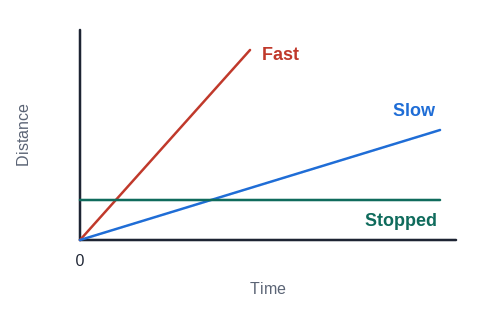
- A distance-time graph shows how far an object has gone (up the side) at each time (along the bottom).
- A straight sloping line means a constant speed. The steeper the line, the faster the object.
- A flat line means the distance is not changing: the object has stopped.
- A curved line means the speed is changing.
Try it: read the line
Example: reading a walk to school
- Riya walks to a crossing, waits for the lights, then walks on. Her friend records her distance every 10 seconds.
- Find her speed in each part of the trip, and her average speed overall.
| Time (s) | 0 | 10 | 20 | 30 | 40 |
|---|---|---|---|---|---|
| Distance (m) | 0 | 15 | 30 | 30 | 50 |
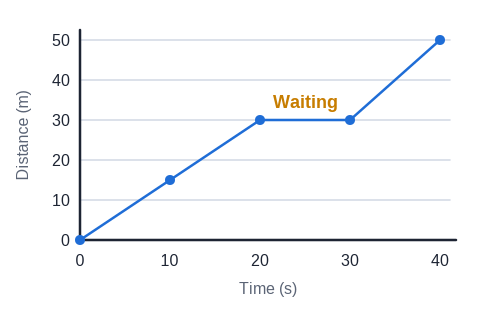
- 0 to 20 s: 30 m ÷ 20 s = 1.5 m/ssteady slope
- 20 to 30 s: 0 m ÷ 10 s = 0 m/sflat line: waiting
- 30 to 40 s: 20 m ÷ 10 s = 2 m/ssteeper slope: faster
- Average: 50 m ÷ 40 s = 1.25 m/s
Try it: build a distance-time graph
Speed and kinetic energy
- Every moving object has kinetic energy, the energy of motion.
- The faster an object moves, the more kinetic energy it has. A heavier object at the same speed also has more.
- Kinetic energy grows quickly with speed: doubling the speed gives four times the kinetic energy.
- That is why a car crash at 50 km/h does far more damage than one at 30 km/h, and why school zones have lower limits.
Common mistakes
- Speed = time ÷ distance, so 100 m in 20 s is 0.2 m/s.Speed is distance ÷ time: 100 m ÷ 20 s = 5 m/s.
- A flat line on a distance-time graph means moving at a steady speed.A flat line means the distance is not changing, so the object is stopped; a steady speed is a straight sloping line.
- Dividing 3 km by 20 minutes gives a speed of 0.15 km/h.Change the time to hours first: 20 min = 1/3 h, so 3 km ÷ 1/3 h = 9 km/h.
- If I measure once very carefully, I do not need repeats.Repeats show whether results agree and let you take a mean, which reduces the effect of reaction-time errors.
How fast do you walk?
You need: a tape measure, 2 markers such as shoes or chalk, a stopwatch or phone timer, a helper, paper and pencil
- Measure 20 m along a footpath, driveway or hallway and mark the start and finish.
- Start walking well before the start line, so you are already at your normal pace when you cross it.
- Your helper starts the timer as you pass the start and stops it at the finish. Do this three times.
- Find the mean of your three times, then divide 20 m by it to get your walking speed in m/s.
- Look for the pattern: your three times should be close; try again walking fast and compare the speeds.
Safety: Walk on a footpath or at home, never on a road or driveway where a car could be moving, and ask an adult before you start.
Your turn
A tūī flies 120 m in 8 s. What is its speed?
Convert 5 m/s into km/h.
A ferry travels at 30 km/h for 2 hours. How far does it go?
On a distance-time graph, line A is steeper than line B. Which object is faster?
Three timings of a falling ball are 0.6 s, 0.9 s and 0.6 s. Why should the class be careful about trusting these?
Show answer
1. 120 ÷ 8 = 15 m/s. 2. 5 × 3.6 = 18 km/h. 3. 30 × 2 = 60 km. 4. A, because a steeper line means more distance in each second. 5. The times are very short and do not agree, so reaction time causes large errors; drop from higher or film it.
Forces and Motion: Basics
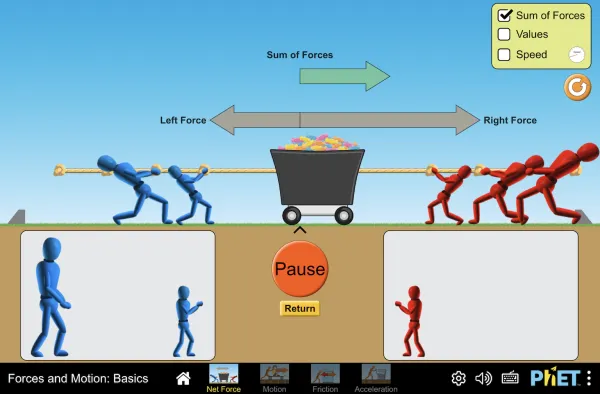
Full screen · PhET Interactive Simulations, University of Colorado Boulder, CC BY 4.0
Recap
- Speed is distance travelled per unit of time: speed = distance ÷ time.
- Units are usually m/s or km/h; multiply by 3.6 to go from m/s to km/h.
- Speed can be constant or changing; average speed is total distance ÷ total time.
- Repeat measurements and take the mean; longer distances reduce reaction-time error.
- On a distance-time graph, steeper means faster and flat means stopped.
- Faster objects have more kinetic energy.
Challenge
A driver needs 1.5 s to react before her foot reaches the brake, and the car keeps its speed during that time. Once the brakes are on, a car on a dry road needs 5 m to stop from 30 km per hour, and 14 m to stop from 50 km per hour (realistic figures for an ordinary car). A child runs onto the road 20 m in front of the car. (a) Find the total stopping distance at 30 km per hour and at 50 km per hour. (b) At which speed does the car stop before reaching the child? At the other speed, is the driver even braking when the car reaches the child? (c) Show that the braking distance grows by about the same factor as the kinetic energy when the speed rises from 30 to 50 km per hour.
Hint
Change each speed to metres per second (divide by 3.6) and multiply by the reaction time. For (c), the kinetic energy grows with speed × speed, so compare 50 × 50 with 30 × 30.
Answer
(a) 17.5 m at 30 km per hour; about 34.8 m at 50 km per hour. (b) At 30 km per hour the car stops 2.5 m short of the child. At 50 km per hour the car travels about 20.8 m before braking even starts, so it reaches the child at full speed. (c) Kinetic energy grows by 2500 ÷ 900 ≈ 2.8 times, and the braking distance grows by 14 ÷ 5 = 2.8 times.
Step by step
- Convert both speeds to metres per second so they match the reaction time in seconds.
- Reaction distance is speed × reaction time.
- Stopping distance is reaction distance plus braking distance.
- Compare each stopping distance with the 20 m gap.
- Kinetic energy grows with the square of the speed; the brakes have to remove all of it, so braking distance grows in the same way.
Full working
- 30 ÷ 3.6 ≈ 8.33 m per s; 50 ÷ 3.6 ≈ 13.9 m per skm per hour to m per s
- 8.33 × 1.5 = 12.5 m; 13.9 × 1.5 ≈ 20.8 mreaction distances
- 12.5 + 5 = 17.5 m; 20.8 + 14 = 34.8 m(a) stopping distances
- 20 − 17.5 = 2.5 m spare; 20.8 m > 20 m(b) compare with the gap
- (50 × 50) ÷ (30 × 30) = 2500 ÷ 900 ≈ 2.8kinetic energy factor
- 14 ÷ 5 = 2.8braking distance factor
- Stops 2.5 m short at 30 km per hour; at 50 km per hour it hits the child before braking; both factors are about 2.8
Tama cycles 6 km to his friend's house into a headwind at 12 km per hour, then cycles straight back with the wind behind him at 18 km per hour. (a) His friend says his average speed for the round trip must be 15 km per hour. Find the real average speed and explain why it is not 15. (b) On another day the wind is the same and Tama rides out at 12 km per hour again. How fast must he ride home to average 16 km per hour for the whole trip? (c) Could any return speed make his average 24 km per hour? Explain.
Hint
Average speed is total distance ÷ total time, so find how long each half of the trip takes. For (b) and (c), work backwards: what total time does the target average allow, and how much of it has he already used?
Answer
(a) 14.4 km per hour. He spends longer riding at the slow speed (30 min) than at the fast speed (20 min), so the average is pulled towards 12. (b) 24 km per hour. (c) No. To average 24 km per hour over 12 km he would need to finish in 30 minutes, but the ride out alone takes 30 minutes, so he would need to get home in no time at all.
Step by step
- Find the time for each half: time = distance ÷ speed.
- Add the times and divide the total distance (12 km) by the total time.
- The slow half takes longer, so it counts for more of the trip.
- For a 16 km per hour average, the whole 12 km must take 12 ÷ 16 = 0.75 h, which leaves 0.25 h for the ride home.
- For 24 km per hour, the whole trip must take 0.5 h, and the ride out has already used all of it.
Full working
- Out: 6 ÷ 12 = 0.5 h (30 min)time = distance ÷ speed
- Back: 6 ÷ 18 = 13 h (20 min)same
- Total time = 30 + 20 = 50 min = 56 hadd the times
- 12 ÷ 56 = 14.4 km per hour(a) total distance ÷ total time
- 12 ÷ 16 = 0.75 h, and 0.75 − 0.5 = 0.25 h left(b) time allowed for the ride home
- 6 ÷ 0.25 = 24 km per hourspeed needed home
- 12 ÷ 24 = 0.5 h, and 0.5 − 0.5 = 0 h left(c) impossible
- (a) 14.4 km per hour, (b) 24 km per hour, (c) no
Riya's home and her school are 900 m apart along one straight footpath. Riya leaves home walking towards school at a steady 1.5 m per s. One minute later, her brother leaves school and walks towards home along the same path at a steady 1.2 m per s. (a) How far apart are they when her brother sets off? (b) How long after Riya leaves home do they meet, and how far from home are they? (c) Describe the two lines you would draw on one distance-time graph, with distance measured from home, and what the point where they cross shows.
Hint
Once both are walking towards each other, the gap between them shrinks by both of their speeds added together every second.
Answer
(a) 810 m. (b) They meet 360 s (6 minutes) after Riya leaves, 540 m from home. (c) Riya's line starts at 0 m at 0 s and slopes up steadily. Her brother's line is flat at 900 m for the first 60 s, then slopes down steadily, less steeply than Riya's slopes up. The lines cross at 360 s and 540 m, which is when and where they meet.
Step by step
- In the first 60 s only Riya is moving, so she closes part of the gap alone.
- After that both walk towards each other, so the gap shrinks by 1.5 + 1.2 = 2.7 m every second.
- Divide the remaining gap by 2.7 to find how long until they meet.
- Add the first minute back on, then use Riya's speed to find where they meet.
- Check with her brother: in 300 s he walks 360 m, and 900 − 360 = 540 m.
Full working
- 1.5 × 60 = 90 mRiya's distance in the first minute
- 900 − 90 = 810 m(a) gap when her brother starts
- 1.5 + 1.2 = 2.7 m per sgap closes this much each second
- 810 ÷ 2.7 = 300 stime with both walking
- 60 + 300 = 360 s = 6 min(b) time after Riya leaves
- 1.5 × 360 = 540 m from homeRiya's distance
- Check: 1.2 × 300 = 360 m, and 900 − 360 = 540 mbrother's position matches
- They meet 6 minutes after Riya leaves, 540 m from home
The maths behind it
Report a mistake
How is Year 7 maths going?
See the Year 7 maths guide