Metric units, and formulae run backwards
What this lesson covers
- Area is a two-dimensional measure, so its units are squared (e.g. cm²).
- Volume is a three-dimensional measure, so its units are cubed (e.g. cm³).
- Formulae represent the relationship between measurements and can be used to determine unknown measurements from known measurements.
- Shapes can be decomposed or recomposed to help find their measurements (e.g. their perimeters, areas, and volumes).
Area 48. One side is 8. What is the other?
- You know the formula: area is length times width.
- But you have the answer and want one of the inputs.
- Formulae run both ways, and this is how.
Three base measures
- The metre for length.
- The gram for mass.
- The litre for how much a container holds.
| Unit | Measures | Short |
|---|---|---|
| metre | length | m |
| gram | mass | g |
| litre | capacity | L |
Prefixes resize them
- Kilo means a thousand of them.
- Centi means a hundredth.
- Milli means a thousandth.
| Prefix | Means | Example |
|---|---|---|
| kilo– | 1000 of them | 1 km = 1000 m |
| centi– | one hundredth | 100 cm = 1 m |
| milli– | one thousandth | 1000 mm = 1 m |
Picking a sensible one
- A pencil in kilometres is a silly number.
- So is a road trip in millimetres.
- Choose the unit that gives a number you can say.
| Measuring | Use | Looks like |
|---|---|---|
| A pencil | centimetres | 18 cm |
| A rugby field | metres | 100 m |
| Wellington to Auckland | kilometres | 640 km |
| A grain of rice | millimetres | 6 mm |
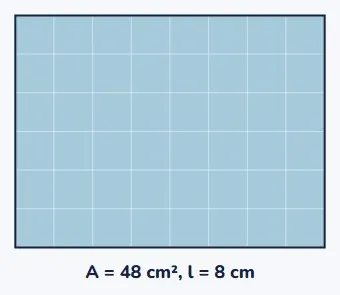
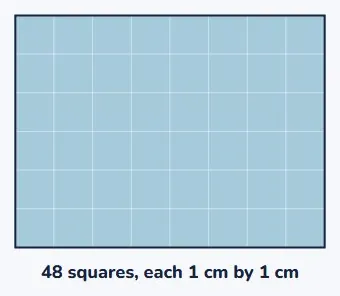
What cm² actually says
- It is not a decoration meaning "this is an area".
- It says centimetres times centimetres.
- The little 2 counts the directions.
Try it: what cm² really counts
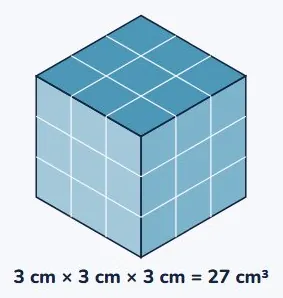
And cm³ counts three
- Length, width and height.
- Three directions multiplied, so a little 3.
- Each unit is a cube 1 cm on every edge.
One, two or three directions
- Length has one. Area has two. Volume has three.
- The exponent tells you which you are looking at.
- An area answered in cm is simply wrong.
| Measure | Units | Because |
|---|---|---|
| Length | cm | one direction |
| Area | cm² | cm × cm |
| Volume | cm³ | cm × cm × cm |
The perimeter formulae
- A square has four equal sides, so P = 4l.
- A rectangle has two of each, so P = 2(l + w).
- Both just add up the way round.
| Shape | Perimeter |
|---|---|
| Square | P = 4l |
| Rectangle | P = 2(l + w) |
A square has perimeter 36. Find a side.
- P = 4l, and P is 36. So 36 = 4l.
- Divide both sides by 4.
- l = 9 cm.
| Step | Working | Answer |
|---|---|---|
| Formula | P = 4l | |
| Known | 36 = 4l | |
| Divide both by 4 | l = 9 | 9 cm |
That was an equation
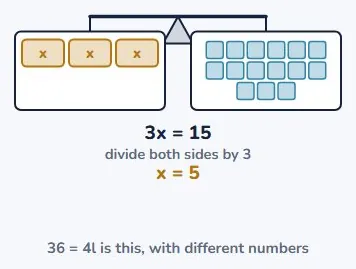
- 36 = 4l is exactly like 3x = 15.
- Divide both sides. Same rule as the balance.
- Nothing new to learn here at all.
Perimeter 30, one side 9
- 30 = 2(9 + w). Divide both sides by 2.
- 15 = 9 + w. Take 9 off both sides.
- w = 6 cm.
| Step | Working | Answer |
|---|---|---|
| Formula | P = 2(l + w) | |
| Known | 30 = 2(9 + w) | |
| Divide both by 2 | 15 = 9 + w | |
| Take 9 off both | w = 6 | 6 cm |
Back to the opening question
- A = lw, so 48 = 8 × w.
- Divide both sides by 8.
- w = 6 cm.
| Step | Working | Answer |
|---|---|---|
| Formula | A = lw | |
| Known | 48 = 8 × w | |
| Divide both by 8 | w = 6 | 6 cm |
Where the triangle formula comes from
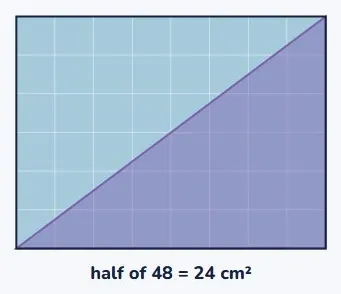
- A triangle is exactly half its rectangle.
- So A = bh, then halved.
- A = bh ÷ 2.
Try it: half a rectangle
Area 24, height 6. Find the base.
- 24 = b × 6 ÷ 2. Multiply both sides by 2.
- 48 = 6b. Divide both sides by 6.
- b = 8 cm.
| Step | Working | Answer |
|---|---|---|
| Formula | A = bh ÷ 2 | |
| Known | 24 = b × 6 ÷ 2 | |
| Times both by 2 | 48 = 6b | |
| Divide both by 6 | b = 8 | 8 cm |
Try it: run the formula backwards
Shapes that are not rectangles
- An L-shape has no formula of its own.
- But it is made of rectangles.
- Cut it up, do each piece, add them.
| Method | Working | |
|---|---|---|
| Split it | 4 × 7 = 28 | plus 6 × 3 = 18 |
| Total | 46 cm² |
The other way: subtract the bite
- Treat it as a full 10 by 7 rectangle: 70.
- Then take off the missing 6 by 4 corner: 24.
- 70 − 24 = 46 cm². The same answer.
| Method | Working | |
|---|---|---|
| Split it | 4 × 7 = 28 | plus 6 × 3 = 18 |
| Total | 46 cm² | |
| Or subtract | 10 × 7 = 70 | minus 6 × 4 = 24 |
| Total | 46 cm² |
Two methods agreeing is the check
- There is no single right way to cut it up.
- So do it twice, differently.
- If they match, you are almost certainly right.
| Method | Answer |
|---|---|
| Split into two | 46 cm² |
| Subtract the bite | 46 cm² |
Common mistakes
- The L-shape's area is 46 cm.Area multiplies two lengths, cm × cm, so the unit must be cm²; an area in cm is wrong.
- Triangle area 24, height 6, so the base is 24 ÷ 6 = 4 cm.A = bh ÷ 2, so double first: 48 = 6b, giving b = 8 cm.
- Rectangle perimeter 30, one side 9, so the other side is 30 − 9 = 21 cm.P = 2(l + w) counts each side twice: 30 = 2(9 + w), so 15 = 9 + w and w = 6 cm.
- 2.5 km is 250 m.Kilo means a thousand, so 2.5 km = 2.5 × 1000 = 2500 m.
Your turn: eight questions
- Try all eight.
- Write each one as an equation first.
- Then solve it the way you would in algebra.
A square has perimeter 52 cm. How long is each side?
A rectangle has area 72 cm² and width 6 cm. Find its length.
A triangle has area 30 cm² and base 10 cm. Find its height.
Convert 2.5 km to metres.
Which unit is right for the area of a netball court?
A drink bottle holds 750 mL. How many litres is that?
A rectangular garden in Napier has perimeter 40 m and length 12 m. Find its width.
An L-shape is a 10 m by 8 m rectangle with a 4 m by 3 m corner cut out. What is its area?
Show answer
1. 13 cm. 52 = 4l, so divide both sides by 4. 2. 12 cm. 72 = 6 × l, so divide both sides by 6. 3. 6 cm. 30 = 10h ÷ 2, so 60 = 10h, so h = 6. 4. 2500 m. Kilo means a thousand, so multiply by 1000. 5. m². Area has two directions, metres times metres, so it is measured in m², not m or m³. 6. 0.75 L. Milli means a thousandth, so divide by 1000: 750 ÷ 1000 = 0.75. 7. 8 m. 40 = 2(12 + w), so divide both sides by 2 to get 20 = 12 + w, then take 12 off both sides. 8. 68 m². The full rectangle is 10 × 8 = 80, the missing corner is 4 × 3 = 12, and 80 − 12 = 68 m².
The answers
- 52 ÷ 4 = 13 cm. And 72 ÷ 6 = 12 cm.
- For the triangle, double first: 60 = 10h, so h = 6 cm.
- 2.5 km is 2500 m.
| Answer | |
|---|---|
| 1 | 13 cm |
| 2 | 12 cm |
| 3 | 6 cm |
| 4 | 2500 m |
What to take away
- Cm² means cm × cm. The exponent counts directions.
- A formula runs backwards as well as forwards.
- Backwards is just solving an equation.
| Remember | |
|---|---|
| cm² | means cm × cm; it is not decoration |
| A formula | works forwards and backwards |
| Backwards | is just solving an equation |
| Compound shapes | split them, or subtract a bite |
| Two methods agreeing | is your check |
Challenge
A box measures 0.12 m by 90 mm by 6 cm on the inside. How many sugar cubes with 1.5 cm edges fit in it exactly? Tama then wants to fill the same box with dice that have 2 cm edges. He divides the box's volume by the volume of one die and says 81 will fit. Explain why he is wrong, and find how many really fit.
Hint
Change every length to centimetres first. Then count how many cubes fit along each edge, rather than dividing volumes.
Answer
192 sugar cubes fit exactly. Only 72 dice fit, not 81: along the 9 cm edge only 4 dice fit (4.5 is not possible), so 0.5 cm of space is wasted.
Step by step
- In centimetres the box is 12 cm by 9 cm by 6 cm, so its volume is 648 cm³.
- Along the edges: 12 ÷ 1.5 = 8, 9 ÷ 1.5 = 6, 6 ÷ 1.5 = 4 sugar cubes, so 8 × 6 × 4 = 192.
- Check: one sugar cube is 1.5 × 1.5 × 1.5 = 3.375 cm³, and 648 ÷ 3.375 = 192 too, because they fit with no gaps.
- A die is 2 × 2 × 2 = 8 cm³, and 648 ÷ 8 = 81, but that pretends dice can be cut up.
- Along the edges: 12 ÷ 2 = 6, only 4 along the 9 cm edge, and 6 ÷ 2 = 3, so 6 × 4 × 3 = 72.
Full working
- 0.12 m = 12 cm, 90 mm = 9 cmsame units
- 12 × 9 × 6 = 648 cm³volume of the box
- 8 × 6 × 4 = 192sugar cubes along each edge
- 648 ÷ 3.375 = 192check by volume
- 648 ÷ 8 = 81Tama's answer
- 9 ÷ 2 = 4.5, so only 4 dicewhole dice only
- 6 × 4 × 3 = 72dice that really fit
- 192 sugar cubes; 72 dice, not 81
Rectangle ABCD has AB = 12 cm and AD = 8 cm, with side DC opposite AB. Point P is somewhere on DC, and the lines PA and PB cut the rectangle into three triangles. Triangle APD has area 18 cm². How long is DP, and what is the area of triangle BPC? Explain why triangle ABP always has the same area, wherever P is on DC.
Hint
Each of the three triangles has a height of 8 cm. Use A = bh ÷ 2 backwards for triangle APD.
Answer
DP = 4.5 cm and triangle BPC has area 30 cm². Triangle ABP always has base AB = 12 cm and height 8 cm, so its area is always 48 cm², half the rectangle.
Step by step
- Triangle APD has a right angle at D, base DP and height AD = 8 cm.
- 18 = DP × 8 ÷ 2, so 36 = 8 × DP and DP = 4.5 cm.
- Then PC = 12 − 4.5 = 7.5 cm, and triangle BPC has area 7.5 × 8 ÷ 2 = 30 cm².
- Triangle ABP has base AB = 12 cm. Its height is the distance from P to AB, which is 8 cm wherever P is on DC.
- So its area is 12 × 8 ÷ 2 = 48 cm², half of the 96 cm² rectangle. Check: 18 + 30 + 48 = 96.
Full working
- 18 = DP × 8 ÷ 2A = bh ÷ 2 for APD
- 36 = 8 × DP, DP = 4.5 cmdouble, then divide by 8
- PC = 12 − 4.5 = 7.5 cmrest of DC
- 7.5 × 8 ÷ 2 = 30 cm²area of BPC
- 12 × 8 ÷ 2 = 48 cm²area of ABP, any P
- 18 + 30 + 48 = 96 = 12 × 8check
- DP = 4.5 cm; BPC is 30 cm²; ABP is always 48 cm²
An L-shaped garden is made by taking a 3 m by 4 m rectangle out of one corner of a bigger rectangle. The L-shaped garden has a perimeter of 46 m and an area of 108 m². What are the length and width of the bigger rectangle?
Hint
Compare the perimeter of the L with the perimeter of the full rectangle. Push the two inside edges of the L out to the edge: does the distance round change?
Answer
The bigger rectangle is 15 m by 8 m.
Step by step
- Cutting a rectangle from a corner does not change the perimeter: the two new inside edges are exactly as long as the two pieces of outside edge that were removed.
- So the big rectangle also has perimeter 46 m, and its length plus width is 46 ÷ 2 = 23 m.
- Its area is the L plus the bite: 108 + 3 × 4 = 120 m².
- Look for two numbers that add to 23 and multiply to 120: 15 and 8.
- Check: 2 × (15 + 8) = 46, and 15 × 8 − 12 = 108.
Full working
- perimeter of L = perimeter of big rectanglecorner cut-out
- 2(l + w) = 46, so l + w = 23divide by 2
- lw = 108 + 12 = 120add the bite back
- 15 + 8 = 23 and 15 × 8 = 120try pairs
- check 2 × 23 = 46, 120 − 12 = 108true
- 15 m by 8 m
Where science uses this
Practise this
Report a mistake
More in Measurement
Is your child on track?
Take the free placement test