Patterns, rules and the coordinate plane
What this lesson covers
- Algebra has its own specialised notation to express relationships and operations concisely, including 3b in place of b + b + b.
- A coordinate plane extends to 4 quadrants that meet at the origin (0, 0).
- Linear patterns have a constant increase or decrease, can be described by the rule t = a × n + d, and can be graphed as a straight line on a coordinate plane.
What is the 50th number in this pattern?
- 3, 5, 7, 9, 11...
- You could keep going. It would take a while.
- Or you could find the rule and jump straight there.
| Position n | Value t |
|---|---|
| 1 | 3 |
| 2 | 5 |
| 3 | 7 |
| 4 | 9 |
| 5 | 11 |
Put it in a table first
- Position on the left, value on the right.
- Position is called n. Value is called t.
- Now the pattern is easier to interrogate.
| Position n | Value t |
|---|---|
| 1 | 3 |
| 2 | 5 |
| 3 | 7 |
| 4 | 9 |
| 5 | 11 |
Try it: find the rule
Find the step
- How much does it go up each time?
- Every single gap is 2.
- That constant step is what makes it linear.
| From | Step |
|---|---|
| 3 to 5 | + 2 |
| 5 to 7 | + 2 |
| 7 to 9 | + 2 |
| 9 to 11 | + 2 |
The shape of the rule
- Every linear pattern fits t = a × n + d.
- A is the step.
- d is the bit that shifts it up or down.
| Part | What it is |
|---|---|
| n | the position |
| a | the step |
| d | the starting adjustment |
| t | the value you get |
a is the easy one
- The step is 2, so a is 2.
- So far the rule is t = 2n + something.
- Now for the something.
| From | Step |
|---|---|
| 3 to 5 | + 2 |
| 5 to 7 | + 2 |
| 7 to 9 | + 2 |
| 9 to 11 | + 2 |
Go back one more step
- Position 1 holds 3. What would position 0 hold?
- One step back: 3 − 2 = 1.
- That is d. The rule is t = 2n + 1.
| Step | Working | Result |
|---|---|---|
| The step | is 2 | so a = 2 |
| Go back to n = 0 | 3 − 2 | so d = 1 |
| The rule | t = 2n + 1 |
Test it before you trust it
- n = 1 gives 2 × 1 + 1 = 3. Correct.
- n = 5 gives 2 × 5 + 1 = 11. Correct.
- Two checks is enough to be confident.
| Position | Working | Value |
|---|---|---|
| n = 1 | 2 × 1 + 1 | 3 |
| n = 3 | 2 × 3 + 1 | 7 |
| n = 5 | 2 × 5 + 1 | 11 |
So the 50th number is...
- n = 50, so 2 × 50 + 1.
- 101.
- No counting. That is what a rule is for.
| Position | Working | Value |
|---|---|---|
| n = 1 | 2 × 1 + 1 | 3 |
| n = 3 | 2 × 3 + 1 | 7 |
| n = 5 | 2 × 5 + 1 | 11 |
| n = 50 | 2 × 50 + 1 | 101 |
Algebra writes things short
- b + b + b is written 3b.
- 3 × b is also 3b; the times sign is dropped.
- And b × b is b².
| Long | Short | |
|---|---|---|
| b + b + b | written as | 3b |
| 3 × b | written as | 3b |
| a × b | written as | ab |
| b × b | written as | b² |
Why drop the times sign
- Because × looks far too much like the letter x.
- 3 × x + 2 is a nightmare to read.
- 3x + 2 is not.
| With the sign | Without |
|---|---|
| 3 × x + 2 | 3x + 2 |
| a × b × c | abc |
Like terms
- Terms with the same letter can be added together.
- 3a + a + a is 5a: five lots of a.
- Different letters cannot join.
| Expression | Why | Simplifies to |
|---|---|---|
| 3a + a + a | all a terms | 5a |
| 3b − 2b | all b terms | b |
4x + 3y + 2x
- The x terms go together: 4x + 2x = 6x.
- 3y has nothing to join.
- 6x + 3y. That is as simple as it gets.
| Expression | Why | Simplifies to |
|---|---|---|
| 3a + a + a | all a terms | 5a |
| 3b − 2b | all b terms | b |
| 4x + 3y + 2x | x with x only | 6x + 3y |
| 2a + 3a² | different powers | cannot join |
Try it: collect like terms
Rearranging a formula
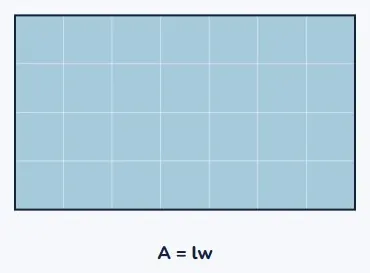
- A = lw gives the area from length and width.
- What if you know the area and want the width?
- Same balance rule as last lesson.
Making w the subject
- w is being multiplied by l.
- So divide both sides by l.
- w = A ÷ l.
| Step | Working | Result |
|---|---|---|
| A = lw | l is multiplying w | |
| Divide both by l | A ÷ l = w | |
| So | w = A ÷ l |
The plane goes four ways
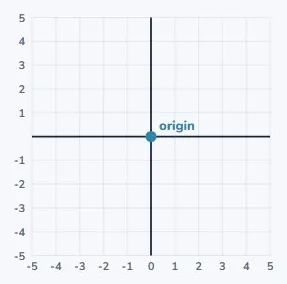
- You have used the top-right corner for years.
- The axes carry on the other way too.
- Four regions, meeting at the origin, (0, 0).
Which quadrant is which
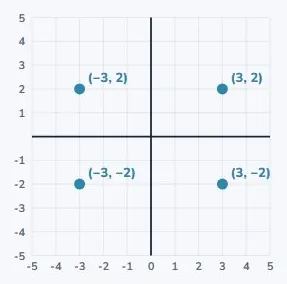
- The signs of the two numbers tell you.
- Both positive is the first, top right.
- Then anticlockwise from there.
Try it: all four quadrants
The four, in order
- First: both positive.
- Second: x negative, y positive.
- Third: both negative. Fourth: x positive, y negative.
| Quadrant | Signs | Example |
|---|---|---|
| First | x positive, y positive | (3, 2) |
| Second | x negative, y positive | (−3, 2) |
| Third | x negative, y negative | (−3, −2) |
| Fourth | x positive, y negative | (3, −2) |
Now plot the pattern
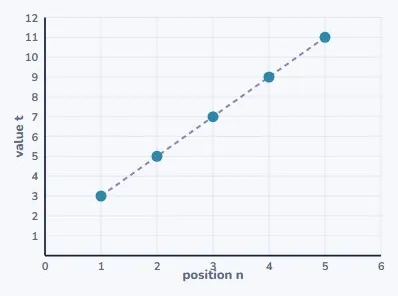
- Position across, value up. (1, 3), (2, 5), (3, 7)...
- Join them.
- A straight line, which is why it is called linear.
Four views of one thing
- The pattern, the table, the rule, the line.
- The step of 2 is in all four of them.
- It is the gap, the a, and how steep the line is.
| View | Where the 2 shows up |
|---|---|
| The numbers | each gap is 2 |
| The table | each row goes up 2 |
| The rule | t = 2n + 1 |
| The graph | up 2 for every 1 across |
Common mistakes
- 3, 5, 7, 9 goes up by 2, so the rule is t = n + 2.The step is the number in front of n, so a = 2. Position 0 would hold 1, so t = 2n + 1. Check: n = 1 gives 3.
- 4x + 3y = 7xyOnly like terms join. 4x and 3y have different letters, so 4x + 3y cannot be simplified.
- A = lw, so w = A × l.w is being multiplied by l, so divide both sides by l: w = A ÷ l.
- (−2, 3) is in the fourth quadrant.x is negative (left) and y is positive (up), so (−2, 3) is in the second quadrant, top left.
Your turn: eight questions
- Try all eight.
- On question 2, find the step first, then go back to zero.
- On question 4, look at the signs.
Simplify 5a + 3a − 2a.
A pattern goes 4, 7, 10, 13. What is the rule?
Make l the subject of A = lw.
Which quadrant is (−2, 3) in?
Write 3 × b × b in algebra's short form.
Simplify 7x + 2y − 3x + y.
A pattern goes 6, 11, 16, 21. What is the 30th number in the pattern?
A linear pattern's graph goes up 3 for every 1 across, and its value at n = 0 is 2. What is its rule?
Show answer
1. 6a. All three are a terms: 5 + 3 − 2 = 6. 2. t = 3n + 1. The step is 3, and going back one step from 4 gives 1 at position zero. 3. l = A ÷ w. Divide both sides by w. 4. The second quadrant: x is negative and y is positive, so it is top left. 5. 3b². The times signs are dropped, and b × b is written b², so it is 3b². 6. 4x + 3y. The x terms give 7x − 3x = 4x, and the y terms give 2y + y = 3y; x and y cannot join. 7. 151. The step is 5 and going back from 6 gives 1, so the rule is t = 5n + 1, and 5 × 30 + 1 = 151. 8. t = 3n + 2. The step of 3 is the number in front of n, and the value at position zero, 2, is d.
The answers
- 5a + 3a − 2a is 6a. And the rule is t = 3n + 1.
- l = A ÷ w. Divide both sides by w.
- (−2, 3) is the second quadrant, top left.
| Answer | |
|---|---|
| 1 | 6a |
| 2 | t = 3n + 1 |
| 3 | l = A ÷ w |
| 4 | second quadrant |
Function Builder
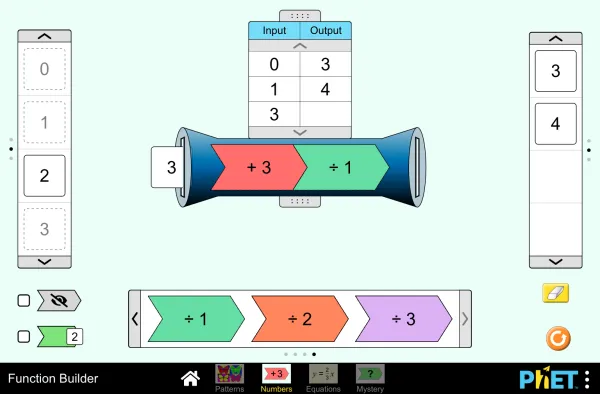
Full screen · PhET Interactive Simulations, University of Colorado Boulder, CC BY 4.0
What to take away
- The step is the number in front of n.
- d is what would sit at position zero.
- Only terms with the same letter can be collected.
| Remember | |
|---|---|
| A linear pattern | goes up by the same amount each time |
| That step | is the number in front of n |
| d | is what would sit at position zero |
| Like terms | same letter, same power; only those join |
| Four quadrants | the signs of x and y tell you which |
Challenge
Pattern A goes 7, 11, 15, 19, ... and Pattern B goes 100, 97, 94, 91, ... Find a rule t = a × n + d for each pattern. At which position n is Pattern A's value bigger than Pattern B's for the first time, and what are the two values there?
Hint
Pattern B goes down, so its step is negative. Once you have both rules, try a position near the middle and adjust.
Answer
A: t = 4n + 3. B: t = 103 − 3n. A first beats B at position 15, where A is 63 and B is 58.
Step by step
- Pattern A goes up 4 each time, and one step back from 7 is 3, so t = 4n + 3.
- Pattern B goes down 3 each time, and one step back from 100 is 103, so t = 103 − 3n.
- Each position, A gains 4 and B loses 3, so the gap closes by 7 each step.
- At position 1 B is ahead by 93, so after about 93 ÷ 7 ≈ 13.3 more steps A overtakes.
- Check position 14: A is 59, B is 61, so B is still ahead. At position 15, A is 63 and B is 58.
Full working
- A: step 4, 7 − 4 = 3so t = 4n + 3
- B: step −3, 100 + 3 = 103so t = 103 − 3n
- n = 14: A = 4 × 14 + 3 = 59, B = 103 − 42 = 61B still bigger
- n = 15: A = 4 × 15 + 3 = 63, B = 103 − 45 = 58A bigger
- position 15: A is 63, B is 58
Hemi plots a linear pattern as points (n, t), with the position n across and the value t up. Position 3 has value 5 and position 7 has value −7. Find the rule. Which position holds the first negative value? Hemi then draws the straight line through his points and extends it in both directions. Which quadrants does the line pass through, and why can it never enter the remaining quadrant?
Hint
From position 3 to position 7 is 4 steps. How much did the value change altogether? For the last part, think about what t is when n is negative.
Answer
The rule is t = 14 − 3n (or t = −3n + 14). The first negative value is at position 5 (it is −1). The line passes through the first, second and fourth quadrants. It never enters the third, because when n is negative, t = 14 − 3n is bigger than 14, so it is never negative.
Step by step
- From n = 3 to n = 7 is 4 steps, and the value falls from 5 to −7, which is 12. So each step is −3.
- Go back from position 3 to position 0: 5 + 3 + 3 + 3 = 14. So the rule is t = 14 − 3n.
- Position 4 gives 2 and position 5 gives −1, so position 5 is the first negative.
- For positive n the line starts above the axis (first quadrant) and then drops below it (fourth quadrant).
- For negative n, taking away 3 times a negative number adds on, so t is more than 14: always positive, which is the second quadrant and never the third.
Full working
- −7 − 5 = −12 over 4 stepschange in value
- −12 ÷ 4 = −3the step a
- 5 + 3 × 3 = 14value at n = 0, so d = 14
- t = 14 − 3nthe rule; check n = 7: 14 − 21 = −7
- n = 4: 14 − 12 = 2; n = 5: 14 − 15 = −1first negative at n = 5
- n = −1: 14 + 3 = 17; n = −2: 14 + 6 = 20negative n gives t above 14
- first, second and fourth quadrants; never the third
In a number wall, each brick is the sum of the two bricks directly below it. The bottom row has four bricks: x, 3, 2x, 5 (in that order). Write each brick in the next three rows using x, collecting like terms. The top brick is 70: find x. Now, keeping the same four bottom numbers but putting them in any order you like, what is the largest the top brick can be?
Hint
Build the wall with letters first. For the last part, label the bottom bricks a, b, c, d and work out the top brick in terms of them: which bottom bricks count more than once?
Answer
Rows: x + 3, 2x + 3, 2x + 5; then 3x + 6, 4x + 8; top 7x + 14. So x = 8 and the bottom bricks are 8, 3, 16 and 5. The largest possible top is 80 (for example with the order 3, 16, 8, 5).
Step by step
- Add neighbours and collect like terms: the second row is x + 3, 2x + 3 and 2x + 5.
- The third row is 3x + 6 and 4x + 8, so the top is 7x + 14.
- 7x + 14 = 70 gives 7x = 56, so x = 8, and the bottom numbers are 8, 3, 16, 5.
- With bottom bricks a, b, c, d the top works out as a + 3b + 3c + d, so the two middle bricks count three times.
- Put the two biggest numbers, 16 and 8, in the middle: 3 × 24 + 3 + 5 = 80.
Full working
- x + 3, 3 + 2x, 2x + 5second row
- (x + 3) + (2x + 3) = 3x + 6; (2x + 3) + (2x + 5) = 4x + 8third row
- (3x + 6) + (4x + 8) = 7x + 14top brick
- 7x + 14 = 70, so 7x = 56, x = 8solve
- bricks 8, 3, 16, 5; check 7 × 8 + 14 = 70true
- top = a + 3b + 3c + dgeneral wall
- 3 × (16 + 8) + 3 + 5 = 72 + 8 = 80biggest in the middle
- x = 8; largest top is 80
Practise this
Report a mistake
More in Algebra
Is your child on track?
Take the free placement test