Solving equations with a balance
What this lesson covers
- A variable can be used to represent an unknown number, often in formulae, or a quantity that can vary or change.
- The solution to an equation satisfies that equation.
- Equations can be rearranged using inverse operations (e.g. addition and subtraction, multiplication and division).
- Solutions to equations can be checked using substitution.
- Equations can be solved through trial and error, but this can be an inefficient method.
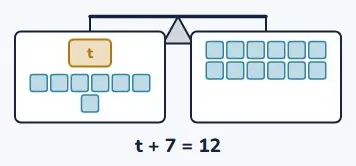
A number, plus 7, makes 12
- You already know the number is 5.
- Now write it the way algebra writes it.
- t + 7 = 12.
What the letter is doing
- Sometimes it is one unknown number waiting to be found.
- Sometimes it is a quantity that changes.
- And 3b is just shorthand for 3 × b.
| Written | The letter is | Meaning |
|---|---|---|
| t + 7 = 12 | one unknown number | t is 5, and only 5 |
| A = lw | a formula | l and w can be anything |
| 3b | shorthand | means 3 × b |
What the equals sign really says
- Not "here comes the answer".
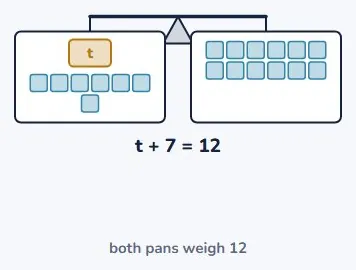
- It says these two sides weigh the same.
- An equation is a balance that is level.
The solution is the value that fits
- Put 5 in place of t and both sides come to 12.
- Put 4 in and the left side is only 11.
- Only 5 keeps it level.
| Try t = | Left side | Balanced? |
|---|---|---|
| 4 | 11 | no |
| 5 | 12 | yes |
| 6 | 13 | no |
You could just guess
- On t + 7 = 12 that works fine.
- On 5s + 3 = 18 it is slower.
- And on harder ones it stops working entirely.
| Equation | Guess | Gets |
|---|---|---|
| t + 7 = 12 | try 4 | 11, too small |
| try 5 | 12, got it | |
| 5s + 3 = 18 | try 4 | 23, too big |
| try 2 | 13, too small | |
| try 3 | 18, eventually |
The one move that always works
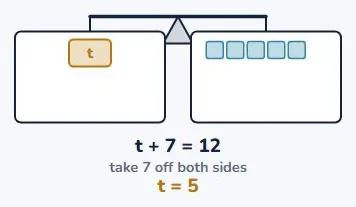
- Take something off one pan and it tips.
- Take the same off both and it stays level.
- That is the whole method.
Which move to make
- Whatever is happening to the letter, undo it.
- Adding is undone by subtracting.
- Multiplying is undone by dividing.
| Operation | Its inverse | |
|---|---|---|
| + | undone by | − |
| − | undone by | + |
| × | undone by | ÷ |
| ÷ | undone by | × |
t + 7 = 12
- 7 is being added, so subtract 7.
- From both sides, so it stays level.
- t = 5.
| Step | Equation | Why |
|---|---|---|
| Start | t + 7 = 12 | |
| Take 7 off both | t = 5 | inverse of + 7 |
| Check | 5 + 7 = 12 | true |
Always check
- Put your answer back into the original.
- 5 + 7 = 12. True.
- Thirty seconds, and it catches nearly everything.
| Step | Equation | Why |
|---|---|---|
| Start | t + 7 = 12 | |
| Take 7 off both | t = 5 | inverse of + 7 |
| Check | 5 + 7 = 12 | true |
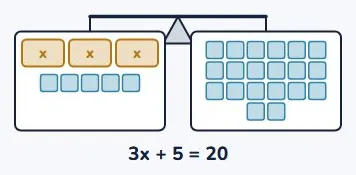
Now two things at once: 3x + 5 = 20
- Three x blocks and five ones on the left.
- Twenty ones on the right.
- Still level. Still the same rule.
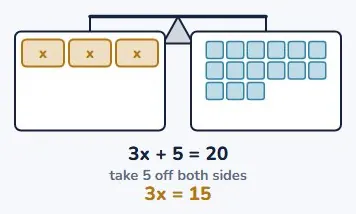
Take the 5 off both sides
- Five ones go from the left. Five from the right.
- Left has three x blocks. Right has fifteen.
- 3x = 15.
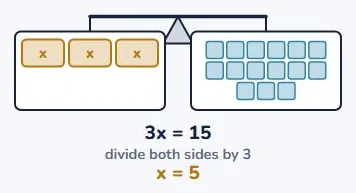
Now divide both sides by 3
- Three blocks weigh fifteen.
- So one block weighs five.
- x = 5.
Try it: do the same to both sides
Why the 5 came off first
- To build 3x + 5 you multiply, then add.
- To undo it you go backwards: subtract, then divide.
- Same steps, reverse order.
| Direction | First | Then |
|---|---|---|
| To build 3x + 5 | multiply by 3 | then add 5 |
| To undo it | subtract 5 | then divide by 3 |
| Which is | the same steps | backwards |
Written out without the picture
- 3x + 5 = 20.
- Subtract 5: 3x = 15. Divide by 3: x = 5.
- Check: 3 × 5 + 5 = 20. True.
| Step | Equation | Why |
|---|---|---|
| Start | 3x + 5 = 20 | |
| Take 5 off both | 3x = 15 | undo the adding |
| Divide both by 3 | x = 5 | undo the multiplying |
| Check | 3 × 5 + 5 = 20 | true |
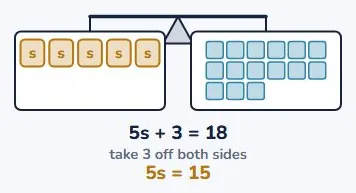
5s + 3 = 18
- The one guessing struggled with.
- Subtract 3: 5s = 15. Divide by 5: s = 3.
- Check: 5 × 3 + 3 = 18. True.
Substitution: the other direction
- Sometimes you are told the letter and asked for the value.
- Just put the number in and work it out.
- Order of operations still applies.
| Expression | Becomes | Value |
|---|---|---|
| 3w + 5, w = 4 | 3 × 4 + 5 | 17 |
| A = lw, l = 7, w = 4 | 7 × 4 | 28 |
| s², s = 6 | 6 × 6 | 36 |
Try it: what is the letter doing?
Is this sentence true?
- Work out both sides separately.
- Then compare them.
- The sign has to be right, not just close.
| Sentence | Both sides | True? |
|---|---|---|
| 0.8 × 12 ≤ 8 + 2 | 9.6 ≤ 10 | true |
| 7 × 6 > 40 + 3 | 42 > 43 | false |
| 100 ÷ 4 = 5² | 25 = 25 | true |
Common mistakes
- t + 7 = 12, so t = 19.Subtracting undoes + 7, so t = 12 − 7 = 5. Check: 5 + 7 = 12.
- 4m − 3 = 21, so 4m = 18.The 3 is being taken away, so add 3 to both sides: 4m = 24, then m = 6.
- 3x + 5 = 20: divide by 3 first, so x + 5 = 20 ÷ 3.Undo in reverse order: subtract 5 first to get 3x = 15, then divide by 3, so x = 5.
- If w = 4, then 3w + 5 = 34 + 5 = 39.3w means 3 × w, not the digits 3 and 4 side by side: 3 × 4 + 5 = 17.
Your turn: eight questions
- Try all eight.
- Question 2 has a subtraction, so add to undo it.
- Check every answer by putting it back in.
Solve t + 9 = 17.
Solve 4m − 3 = 21.
If w = 4, what is 3w + 5?
True or false: 0.8 × 12 ≤ 8 + 2
Solve x ÷ 5 = 8.
Find the value of 2a + 3b when a = 5 and b = 4.
Which number sentence is true: 45 ÷ 5 < 2 × 5, 6 × 7 > 40 + 3, 3² = 3 × 2, or 20 − 8 ≤ 2 × 5?
Tane thinks of a number, multiplies it by 4, then adds 7. He gets 35. What was his number?
Show answer
1. t = 8. Take 9 off both sides. Check: 8 + 9 = 17. 2. m = 6. Add 3 to both sides to get 4m = 24, then divide by 4. Check: 4 × 6 − 3 = 21. 3. 17. Multiply first: 3 × 4 = 12, then add 5. 4. True. 0.8 × 12 = 9.6, and 8 + 2 = 10, and 9.6 is less than 10. 5. x = 40. x is being divided by 5, so multiply both sides by 5: 8 × 5 = 40. Check: 40 ÷ 5 = 8. 6. 22. Multiply first: 2 × 5 = 10 and 3 × 4 = 12, then add: 10 + 12 = 22. 7. 45 ÷ 5 < 2 × 5, because 9 < 10. The others are false: 42 > 43, 9 = 6 and 12 ≤ 10 are all wrong. 8. 7. The equation is 4n + 7 = 35; subtract 7 to get 4n = 28, then divide by 4. Check: 4 × 7 + 7 = 35.
The answers
- t = 8. And m = 6: add 3, then divide by 4.
- 3w + 5 with w = 4 is 17.
- 9.6 is less than 10, so the last one is true.
| Answer | |
|---|---|
| 1 | t = 8 |
| 2 | m = 6 |
| 3 | 17 |
| 4 | true: 9.6 ≤ 10 |
Equality Explorer
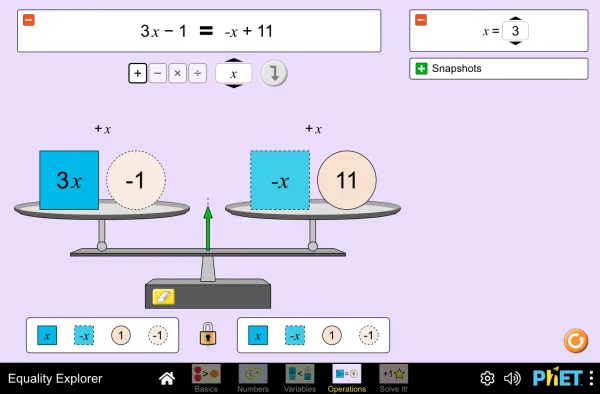
Full screen · PhET Interactive Simulations, University of Colorado Boulder, CC BY 4.0
What to take away
- An equation is two sides that weigh the same.
- Whatever you do, do it to both sides.
- Undo two steps in reverse order, then check.
| Remember | |
|---|---|
| An equation | two sides that weigh the same |
| Whatever you do | do it to both sides |
| Inverse operations | + undoes −, × undoes ÷ |
| Two steps | undo them in reverse order |
| Always check | put your answer back in |
Challenge
Mr Ngata says: "Think of a number, multiply it by 3, then add 8." Ana mixes up the order: she adds 8 first, then multiplies by 3, and gets 57. (a) What was Ana's starting number? (b) What answer should she have got? (c) Explain why, whatever the starting number, doing it Ana's way always gives an answer exactly 16 more than the right way.
Hint
Undo Ana's steps in reverse order. For (c), call the starting number n and write both ways as expressions. In Ana's way, what happens to the 8?
Answer
(a) 11. (b) 41. (c) Ana's way gives 3n + 24 and the right way gives 3n + 8; the 8 was tripled, so the difference is always 24 − 8 = 16.
Step by step
- Ana did (n + 8) × 3 = 57. Undo the last step first: divide by 3 to get n + 8 = 19.
- Then subtract 8: n = 11.
- The right way: 3 × 11 + 8 = 41.
- In Ana's way the 8 is added before tripling, so it gets tripled too: three lots of n and three lots of 8, which is 3n + 24.
- The right way gives 3n + 8. Both have 3n, so Ana's is always 24 − 8 = 16 more.
Full working
- (n + 8) × 3 = 57Ana's order
- n + 8 = 19divide both sides by 3
- n = 11subtract 8 from both sides
- 3 × 11 + 8 = 41the right order; check: 57 − 41 = 16
- (n + 8) × 3 = 3n + 24Ana's way: the 8 is tripled too
- (3n + 24) − (3n + 8) = 16always the same difference
- (a) 11, (b) 41, (c) always 16 more
On one balance, 3 identical cubes and a 5 g weight on the left are level with 1 cube and a 29 g weight on the right. On a second balance, 2 of those cubes and 1 sphere on the left are level with 4 identical spheres and a 6 g weight on the right. How many spheres would balance 5 cubes?
Hint
On each balance, take the same thing off both pans until only one kind of shape is left on one side. Start with the first balance: what can you take off both pans?
Answer
10 spheres.
Step by step
- First balance: take 1 cube off both pans. Then 2 cubes and 5 g balance 29 g.
- Take 5 g off both pans: 2 cubes weigh 24 g, so one cube weighs 12 g.
- Second balance: the 2 cubes weigh 24 g, so 24 g and 1 sphere balance 4 spheres and 6 g.
- Take 1 sphere and 6 g off both pans: 18 g balances 3 spheres, so one sphere weighs 6 g.
- 5 cubes weigh 60 g, and 60 ÷ 6 = 10 spheres.
Full working
- 3c + 5 = c + 29first balance
- 2c + 5 = 29take 1 cube off both pans
- 2c = 24, c = 12subtract 5, then divide by 2
- 24 + s = 4s + 6second balance, cubes are 12 g each
- 18 = 3s, s = 6take s and 6 off both pans, then divide by 3
- 5 × 12 ÷ 6 = 105 cubes weigh 60 g
- 10 spheres
Ms Rivers writes □ × n + 7 = 43 on the board. Each student picks a whole number from 1 to 20 to put in the box, then solves for n. (a) For how many of the 20 choices is n a whole number, and what do all those values of n add up to? (b) She wants to change the 43 to a different number, bigger than 7, so that every choice from 1 to 6 gives a whole-number n. What is the smallest number she could use?
Hint
Subtract 7 from both sides first. Then □ × n must equal that number, so □ has to divide it exactly.
Answer
(a) 8 choices (1, 2, 3, 4, 6, 9, 12, 18), and the values of n add to 90. (b) 67.
Step by step
- Subtract 7 from both sides: □ × n = 36. So n = 36 ÷ □, which is a whole number only when □ divides 36 exactly.
- The numbers from 1 to 20 that divide 36 are 1, 2, 3, 4, 6, 9, 12 and 18: 8 choices. (36 itself is too big.)
- The matching values of n are 36, 18, 12, 9, 6, 4, 3 and 2, which add to 90.
- For (b), the right side minus 7 must be divisible by 1, 2, 3, 4, 5 and 6, and bigger than 0.
- The smallest such number is 60 (it must be a multiple of 4, 3 and 5), so the right side is 60 + 7 = 67.
Full working
- □ × n = 43 − 7 = 36subtract 7 from both sides
- □ = 1, 2, 3, 4, 6, 9, 12, 18the numbers from 1 to 20 that divide 36
- n = 36, 18, 12, 9, 6, 4, 3, 2n = 36 ÷ □
- 36 + 18 + 12 + 9 + 6 + 4 + 3 + 2 = 90sum of the values of n
- smallest common multiple of 1 to 6 is 60needs 4, 3 and 5 as factors
- 60 + 7 = 67add the 7 back
- (a) 8 choices, n adds to 90; (b) 67
Practise this
Report a mistake
More in Algebra
Is your child on track?
Take the free placement test