Money, cash rounding and discounts
What this lesson covers
- Solutions to problems involving New Zealand currency are rounded to two decimal places.
- Cash payments in New Zealand are rounded up or down to the nearest 10 cents.
The same shopping, two different prices
- A basket comes to $23.47.
- Pay by card and it is $23.47.
- Pay in cash and it is $23.50. Both are correct.
| How you pay | What it costs |
|---|---|
| On the shelf | $23.47 |
| Paid by card | $23.47 |
| Paid in cash | $23.50 |
Because of the coins we have
- New Zealand dropped 1c and 2c coins in 1990.
- And the 5c coin in 2006.
- The smallest coin now is 10 cents.
| Coin | Status |
|---|---|
| 10c, 20c, 50c | in circulation |
| $1, $2 | in circulation |
| 5c | withdrawn in 2006 |
| 1c, 2c | withdrawn in 1990 |
So a cash total has to fit the coins
- You cannot hand over 7 cents. There is no coin.
- So cash totals round to the nearest 10 cents.
- Card payments do not; they take the exact cent.
| How you pay | What it costs |
|---|---|
| On the shelf | $23.47 |
| Paid by card | $23.47 |
| Paid in cash | $23.50 |
Try it: change a percentage
Which ten cents is nearer?
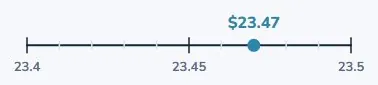
- $23.47 sits between $23.40 and $23.50.
- It is closer to $23.50.
- So that is what you pay.
The quick way to decide
- Look at the last digit: the cents.
- 1, 2, 3 or 4 rounds down.
- 6, 7, 8 or 9 rounds up.
| Total | To the | You pay |
|---|---|---|
| $23.42 | nearest 10c | $23.40 |
| $23.44 | nearest 10c | $23.40 |
| $23.47 | nearest 10c | $23.50 |
| $23.49 | nearest 10c | $23.50 |
Money always has two decimal places
- Write $8.50, never $8.5.
- And $12.00, not just $12.
- The second place is cents, even when it is zero.
| Wrong | Right |
|---|---|
| $8.5 | $8.50 |
| $12 | $12.00 |
| $0.9 | $0.90 |
Working out a total
- Add the exact prices first.
- $8.95 + $6.40 + $8.12 = $23.47.
- Round only at the very end, and only for cash.
| Item | Price |
|---|---|
| Bread | $8.95 |
| Milk | $6.40 |
| Apples | $8.12 |
| Total | $23.47 |
Round once, at the end
- Do not round each item as you go.
- Three small roundings can drift a few cents.
- One rounding on the total is the rule.
| Method | Gets |
|---|---|
| Round each item | $9.00 + $6.40 + $8.10 = $23.50 |
| Round the total | $23.47 → $23.50 |
| Here | the same, but not always |
Change from $50
- The cash total is $23.50.
- Count up: 50c to $24, then $6 to $30.
- Then $20 to $50. Change is $26.50.
| Step | Add | Running |
|---|---|---|
| Cash total | $23.50 | |
| To $24 | + 50c | |
| To $30 | + $6 | |
| To $50 | + $20 | |
| Change | 50c + $6 + $20 | $26.50 |
Why count up instead of subtract
- Subtracting $23.50 from $50 needs borrowing.
- Counting up needs none.
- It is also how a shopkeeper hands it to you.
| Step | Add | Running |
|---|---|---|
| Cash total | $23.50 | |
| To $24 | + 50c | |
| To $30 | + $6 | |
| To $50 | + $20 | |
| Change | 50c + $6 + $20 | $26.50 |
Try it: count up to give change
Now a sale: 20% off
- A jacket is $45. The sign says 20% off.
- 20% off means 20% is taken away.
- So work out 20%, then subtract it.
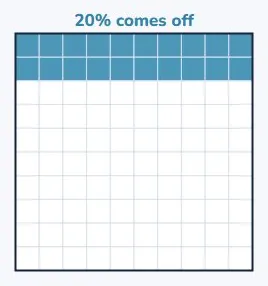
20% off $45
- 10% of $45 is $4.50.
- 20% is two lots: $9.00.
- $45 − $9 = $36.00.
| Step | Working | Answer |
|---|---|---|
| 10% of $45 | $45 ÷ 10 | $4.50 |
| 20% is | two lots | $9.00 |
| Sale price | $45 − $9 | $36.00 |
The mistake to avoid
- $9 is the discount, not the price.
- Nobody sells a $45 jacket for $9.
- Always ask: does the answer look like a price?
| Number | What it is |
|---|---|
| $9.00 | how much you save |
| $36.00 | what you pay |
The one-step way
- If 20% comes off, you pay the other 80%.
- So find 80% and stop.
- 30% off means pay 70%. 15% off means pay 85%.
| Step | Working | Answer |
|---|---|---|
| 20% off | means you pay | 80% |
| 80% of $45 | 10% is $4.50, × 8 | $36.00 |
| Same answer | one step instead of two |
30% off $90, both ways
- Long way: 10% is $9, so 30% is $27. $90 − $27 = $63.
- Short way: pay 70%. That is seven lots of $9.
- $63 either way.
| Method | Working | Answer |
|---|---|---|
| Discount then subtract | $90 − $27 | $63 |
| Pay 70% | $9 × 7 | $63 |
Common mistakes
- 20% off $45 is $9.$9 is the discount, not the price; take it off to get $45 − $9 = $36.00.
- Paying by card, $23.47 rounds to $23.50.Only cash rounds to the nearest 10 cents; a card pays the exact $23.47.
- I rounded each item for cash first: $8.95 → $9.00, $6.40, $8.12 → $8.10, total $23.50.Add the exact prices first and round once at the end, because rounding every item can drift the total by a few cents.
- The change is $1.5.Money always has two decimal places, so write $1.50.
Your turn: eight questions
- Try all eight.
- Question 4 needs the rounding before the change.
- Do it in that order or the answer is out by 4 cents.
A total is $17.63. What do you pay in cash?
A jacket is $90 with 30% off. What is the sale price?
You pay for a $12.80 item with $20. What is the change?
A cash total is $8.86, paid with $10. What is the change?
A shopping total is $34.68 and it is paid by card. How much is charged?
Which shop total is paid as $12.30 in cash?
Shoes are $60 with 25% off. Mia says she will pay $15. What should she actually pay?
Tui buys three muesli bars at $2.34 each and pays in cash. How much does she pay?
Show answer
1. $17.60. The 3 rounds down. 2. $63. 10% is $9, so 30% is $27, and $90 − $27 = $63. Or 70% of $90 straight off. 3. $7.20. No rounding needed: $12.80 is already a multiple of 10 cents. 4. $1.10. The total rounds up to $8.90 first, then $10 − $8.90. 5. $34.68. Card payments take the exact cent; only cash is rounded to the nearest 10 cents. 6. $12.33. The last digit is 3, so it rounds down to $12.30; $12.37 and $12.43 round to $12.40, and $12.23 rounds to $12.20. 7. $45. 25% of $60 is $15, but that is the discount; she pays the other 75%, which is $60 − $15 = $45. 8. $7.00. The exact total is 3 × $2.34 = $7.02, and rounding once at the end gives $7.00 in cash.
The answers
- $17.63 rounds down to $17.60.
- 30% off $90 is $63. And $20 − $12.80 is $7.20.
- $8.86 rounds to $8.90, so the change is $1.10.
| Answer | |
|---|---|
| 1 | $17.60 |
| 2 | $63.00 |
| 3 | $7.20 |
| 4 | $1.10 |
What to take away
- Cash rounds to the nearest 10 cents. Card does not.
- Round once, on the total, at the very end.
- 30% off means pay 70%: one step, not two.
| Remember | |
|---|---|
| Money | always two decimal places |
| Cash | rounded to the nearest 10 cents |
| Card | charged to the exact cent |
| Change | count up from the total |
| 30% off | means you pay 70% |
Challenge
Every price in a Napier clothing shop ends in 99 cents, such as $24.99 or $139.99. In a 30% off sale, sale prices are worked out to the nearest cent. In New Zealand, cash totals are rounded to the nearest 10 cents. Wiremu buys one jacket, pays in cash with a $100 note and gets $37.00 change. His friend says the jacket must have cost $90.00 before the sale, because 70% of $90 is $63. Why can his friend not be right? What was the jacket's price before the sale, and how much would Wiremu have paid by card?
Hint
Wiremu paid $63.00 in cash, but that is a rounded amount. Which card prices round to $63.00 in cash, and which original prices give a sale price in that range?
Answer
$90.00 cannot be a price in this shop. The jacket was $89.99 before the sale; by card Wiremu would have paid $62.99.
Step by step
- Every price ends in 99 cents, so $90.00 is impossible.
- Wiremu paid $100 − $37 = $63.00 in cash. That is the sale price rounded to the nearest 10 cents, so the exact sale price was somewhere from $62.96 to $63.04.
- In a 30% off sale you pay 70%, so the original price was close to $63 ÷ 0.7 = $90. Prices ending in 99 near $90 are $88.99, $89.99 and $90.99.
- 70% of $88.99 is about $62.29 and 70% of $90.99 is about $63.69, both too far away. 70% of $89.99 is $62.993, which is $62.99 to the nearest cent.
- $62.99 rounds to $63.00 for cash, which matches. By card he would pay the exact $62.99.
Full working
- $100 − $37.00 = $63.00cash paid
- exact sale price from $62.96 to $63.04these round to $63.00
- 30% off means pay 70%one-step discount
- 0.7 × $88.99 = $62.293 → $62.29rounds to $62.30, no
- 0.7 × $89.99 = $62.993 → $62.99rounds to $63.00, yes
- 0.7 × $90.99 = $63.693 → $63.69rounds to $63.70, no
- original $89.99; card price $62.99
A juice box costs $1.44 at a school canteen, and everyone pays in cash. In New Zealand, cash totals are rounded to the nearest 10 cents. On a trip day, a teacher could buy one juice box for each child in her class in a single payment. Instead, each child buys their own juice box with a separate cash payment. What is the smallest class size for which the children pay at least $1.00 less altogether than the teacher would have paid? Is there any class size for which the children pay more altogether than the teacher would?
Hint
Each child pays $1.40. Compare that with the teacher's total for a few class sizes, and notice what happens to the gap: each juice box adds 4 cents to it before the teacher's single rounding.
Answer
24 children. No: the children never pay more than the teacher would.
Step by step
- Each child's $1.44 rounds down to $1.40, so each child saves 4 cents on the shelf price.
- The teacher pays the exact total for n juice boxes, 1.44 × n, rounded once to the nearest 10 cents. That rounding moves it by at most 4 cents.
- So the gap is about 4 cents per child, give or take up to 4 cents from the teacher's rounding.
- With 23 children the teacher pays $33.12 → $33.10 and the children pay 23 × $1.40 = $32.20: a gap of 90 cents.
- With 24 children the teacher pays $34.56 → $34.60 and the children pay $33.60: a gap of exactly $1.00. So 24 is the smallest.
- The children save 4 cents each and the teacher's rounding can take off at most 4 cents in total, so the children never pay more.
Full working
- child pays $1.44 → $1.404 rounds down
- teacher with 22: 22 × $1.44 = $31.68 → $31.70children 22 × $1.40 = $30.80, gap 90c
- teacher with 23: 23 × $1.44 = $33.12 → $33.10children $32.20, gap 90c
- teacher with 24: 24 × $1.44 = $34.56 → $34.60children $33.60, gap $1.00
- gap = 4 cents × children, then the teacher's rounding of at most 4 centsso it never goes below 0
- smallest class size: 24; the children never pay more
A shop offers two deals, and you may use only one. Deal A: at the till your items are put into groups of three (you choose the groups), and the cheapest item in each group is free. Deal B: 20% off the whole bill, worked out to the nearest cent. In New Zealand, cash totals are rounded to the nearest 10 cents. Hana buys six items priced $38.45, $31.20, $27.95, $16.80, $12.35 and $9.99, and pays in cash with $120. Which deal, with which groups, makes her bill smallest, and how much change does she get? How much more would Deal B cost her in cash? Explain why no other grouping in Deal A can do better.
Hint
In Deal A one group has to contain the $9.99 item, so that group's free item is fixed. What is the dearest that the other group's cheapest item can be?
Answer
Deal A with groups {$38.45, $31.20, $27.95} and {$16.80, $12.35, $9.99}: she pays $98.80 and gets $21.20 change. Deal B would cost $109.40 in cash, $10.60 more.
Step by step
- The six prices add to $136.74.
- In Deal A, whichever group holds the $9.99 item gets it free. The other group's free item is its cheapest, and the best that can be is $27.95, by putting the three dearest items together.
- So the best saving is $27.95 + $9.99 = $37.94, and Hana pays $136.74 − $37.94 = $98.80. That is already a multiple of 10 cents, so her change from $120 is $21.20.
- Deal B: she pays 80% of $136.74, which is $109.392, so $109.39 to the nearest cent and $109.40 in cash.
- Deal B costs $109.40 − $98.80 = $10.60 more. A careless grouping in Deal A, such as putting $38.45 with $12.35 and $9.99, frees only $9.99 + $16.80 and costs $109.95, worse than Deal B.
Full working
- 38.45 + 31.20 + 27.95 + 16.80 + 12.35 + 9.99 = 136.74total before deals
- group 1: 38.45, 31.20, 27.95; free 27.95three dearest together
- group 2: 16.80, 12.35, 9.99; free 9.99the $9.99 is always free
- 136.74 − 27.95 − 9.99 = 98.80Deal A, already to 10 cents
- 120.00 − 98.80 = 21.20count up: 20c to 99, $1 to 100, $20 to 120
- 0.8 × 136.74 = 109.392 → 109.39 → 109.40Deal B, nearest cent then cash
- 109.40 − 98.80 = 10.60how much more Deal B costs
- Deal A, pays $98.80, change $21.20; Deal B costs $10.60 more
Practise this
Report a mistake
More in Number
 Powers of 10 and expanded form6 min
 Primes, factors, HCF and LCM7 min
 Integers, and adding below zero6 min
 Order of operations, rounding and remainders7 min
 Fractions, decimals and percentages7 min
 Multiplying and dividing fractions and decimals6 min
 Percentages, fractions of amounts, and proportion6 minMoney, cash rounding and discounts6 min
Is your child on track?
Take the free placement test