Powers of 10 and expanded form
What this lesson covers
- In our number system each place value is a power of 10, and this continues infinitely.
- Repeated multiplication can be expressed using exponent notation with positive exponents.
- An exponent means 'raising to the power of' (e.g. 5² is 5 raised to the power of 2 or 5 to the second power).
- Expanded form uses powers of 10 to indicate place value.
Ten to the power of four is not forty
- It is a very easy mistake to make.
- The little 4 is not something to multiply by.
- It is a count.
| Written | Means |
|---|---|
| 10⁴ | 10 × 10 × 10 × 10 |
| not | 10 × 4 |
What the exponent counts
- The big number is the base: the one being multiplied.
- The small raised number is the exponent.
- It says how many of the base to multiply together.
| Short | Long | Value |
|---|---|---|
| 2³ | 2 × 2 × 2 | 8 |
Try it: change the base and the power
How to say it out loud
- 2³ is "two to the power of three", or "two cubed".
- 5² is "five squared": the power of two.
- Those words come from area and volume.
| Short | Long | Value |
|---|---|---|
| 2³ | 2 × 2 × 2 | 8 |
| 5² | 5 × 5 | 25 |
Any base at all
- The base does not have to be small.
- 3⁴ is four threes multiplied: 81.
- Not 3 × 4 = 12. Nowhere near it.
| Short | Long | Value |
|---|---|---|
| 2³ | 2 × 2 × 2 | 8 |
| 5² | 5 × 5 | 25 |
| 3⁴ | 3 × 3 × 3 × 3 | 81 |
| 10³ | 10 × 10 × 10 | 1000 |
Ten is the useful one
- Multiply tens together and something tidy happens.
- 10 × 10 × 10 is 1000.
- Three tens multiplied. Three zeros. Count them.
| Short | Long | Value |
|---|---|---|
| 10³ | 10 × 10 × 10 | 1000 |
The powers of ten
- The exponent and the number of zeros are the same.
- That is only true for base ten.
- 3⁴ is 81; no zeros anywhere.
| Power | Value | Column |
|---|---|---|
| 10¹ | 10 | tens |
| 10² | 100 | hundreds |
| 10³ | 1000 | thousands |
| 10⁴ | 10,000 | ten thousands |
| 10⁵ | 100,000 | hundred thousands |
| 10⁶ | 1,000,000 | millions |
Every column is a power of ten
- Look at the third column of that table.
- Ones, tens, hundreds, thousands: the place value chart.
- It was powers of ten the whole time.
| Power | Value | Column |
|---|---|---|
| 10¹ | 10 | tens |
| 10² | 100 | hundreds |
| 10³ | 1000 | thousands |
| 10⁴ | 10,000 | ten thousands |
| 10⁵ | 100,000 | hundred thousands |
| 10⁶ | 1,000,000 | millions |
So what is the ones column?
- Come down the table: 1000, then 100, then 10.
- Each step divides by ten, and the exponent drops by one.
- One more step: 10⁰ is 1.
| Power | Value | Column |
|---|---|---|
| 10⁰ | 1 | ones |
| 10¹ | 10 | tens |
| 10² | 100 | hundreds |
| 10³ | 1000 | thousands |
| 10⁴ | 10,000 | ten thousands |
| 10⁵ | 100,000 | hundred thousands |
| 10⁶ | 1,000,000 | millions |
And it never stops
- Millions is 10⁶. Billions is 10⁹.
- There is no biggest column.
- Every one of them is ten times the one before.
| Power | Value | Column |
|---|---|---|
| 10⁴ | 10,000 | ten thousands |
| 10⁵ | 100,000 | hundred thousands |
| 10⁶ | 1,000,000 | millions |
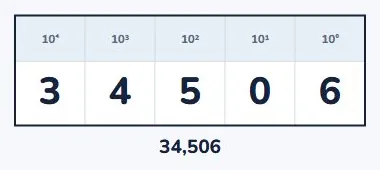
A number in its columns
- Thirty-four thousand, five hundred and six.
- Each digit sits in a column.
- Nothing changed except what we call the columns.
You already know expanded form
- Saying the number aloud names the columns.
- "Thirty-four thousand" is 3 ten-thousands and 4 thousands.
- Expanded form writes exactly that down.
| Way of writing it | 34,506 |
|---|---|
| In words | thirty-four thousand, five hundred and six |
| Plain sum | 30,000 + 4,000 + 500 + 0 + 6 |
| With powers | 3 × 10⁴ + 4 × 10³ + 5 × 10² + 0 × 10¹ + 6 × 10⁰ |
The column with nothing in it
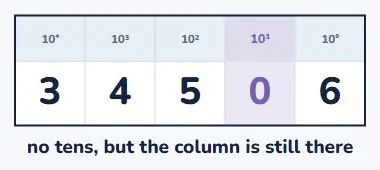
- 34,506 has no tens.
- It still has a tens column.
- Write 0 × 10¹, or the columns after it shift.
Write 60,208 in expanded form
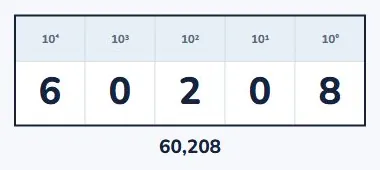
- Sixty thousand, two hundred and eight.
- Ten-thousands 6, thousands 0, hundreds 2, tens 0, ones 8.
- 6 × 10⁴ + 0 × 10³ + 2 × 10² + 0 × 10¹ + 8 × 10⁰.
Try it: expanded form
Check it by adding up
- 6 × 10,000 is 60,000.
- 2 × 100 is 200. 8 × 1 is 8.
- 60,000 + 200 + 8 = 60,208. It matches.
| Term | Value |
|---|---|
| 6 × 10⁴ | 60,000 |
| 0 × 10³ | 0 |
| 2 × 10² | 200 |
| 0 × 10¹ | 0 |
| 8 × 10⁰ | 8 |
| Total | 60,208 |
Comparing with powers
- 9,999 has four digits. 10⁴ has five.
- More columns means bigger, always.
- So 9,999 is less than 10⁴, by one.
| Number | Digits | Which |
|---|---|---|
| 9,999 | four digits | smaller |
| 10⁴ = 10,000 | five digits | bigger |
Put these in order
- 10³, 998, 10⁴, 9,999.
- Turn the powers into numbers first: 1000 and 10,000.
- 998, then 10³, then 9,999, then 10⁴.
| In order | Value |
|---|---|
| 998 | 998 |
| 10³ | 1,000 |
| 9,999 | 9,999 |
| 10⁴ | 10,000 |
The mistake to watch for
- 5² is not 10. It is 5 × 5, which is 25.
- 10⁴ is not 40. It is 10,000.
- The exponent counts. It never multiplies.
| Looks like | Actually |
|---|---|
| 5² = 10 | 5² = 25 |
| 10⁴ = 40 | 10⁴ = 10,000 |
Try it: powers, order and columns
Common mistakes
- 10⁴ = 40 and 5² = 10.The exponent counts how many times the base is multiplied: 10⁴ = 10 × 10 × 10 × 10 = 10,000 and 5² = 5 × 5 = 25.
- 34,506 = 3 × 10⁴ + 4 × 10³ + 5 × 10² + 6 × 10¹.34,506 has no tens, so write 0 × 10¹ and put the 6 in the ones: 6 × 10⁰; otherwise the 6 shifts and becomes 60.
- 10⁰ = 0, because there are no tens.Each step down the powers divides by 10, so 10¹ = 10 and 10⁰ = 1, the ones column.
- 3⁴ has four zeros, like 10⁴, so it is 30,000.Exponent equals the number of zeros only for base 10; 3⁴ = 3 × 3 × 3 × 3 = 81.
Your turn: eight questions
- Try all eight.
- Question 4 runs the process backwards.
- Watch the columns on that one.
Write 2⁵ as a multiplication, then work it out.
Which is bigger: 9,999 or 10⁴?
Write 40,703 in expanded form using powers of 10.
What number is 5 × 10³ + 2 × 10¹ + 9 × 10⁰?
What is the value of 4³?
New Zealand's population is about 5 × 10⁶. About how many people is that?
In 6,382,000, what is the 3 worth, written using a power of 10?
Put in order, smallest first: 10⁵, 99,999, 10³, 10,001.
Show answer
1. 2 × 2 × 2 × 2 × 2 = 32. 2. 10⁴ = 10,000, which is bigger than 9,999 by one. 3. 4 × 10⁴ + 0 × 10³ + 7 × 10² + 0 × 10¹ + 3 × 10⁰. 4. 5000 + 20 + 9 = 5029. Note the empty hundreds column. 5. 64. The exponent counts the fours: 4 × 4 × 4 = 64. 6. 5,000,000. 10⁶ is 1,000,000 (six zeros), and 5 × 1,000,000 = 5,000,000. 7. 3 × 10⁵. The 6 is in the millions (10⁶) column, so the 3 is in the hundred thousands column, 10⁵: 300,000. 8. 10³, 10,001, 99,999, 10⁵. Turn the powers into numbers first: 10³ is 1,000 and 10⁵ is 100,000, which has the most digits.
The answers
- 2⁵ = 32. And 10⁴ is bigger than 9,999.
- 40,703 is 4 × 10⁴ + 0 × 10³ + 7 × 10² + 0 × 10¹ + 3 × 10⁰.
- The last one is 5029: no hundreds column.
| Answer | |
|---|---|
| 1 | 2 × 2 × 2 × 2 × 2 = 32 |
| 2 | 10⁴ = 10,000, bigger by one |
| 3 | 4 × 10⁴ + 0 × 10³ + 7 × 10² + 0 × 10¹ + 3 × 10⁰ |
| 4 | 5000 + 20 + 9 = 5029 |
What to take away
- An exponent counts factors; it does not multiply.
- Every place value column is a power of ten.
- Expanded form is the number said aloud, written in symbols.
| Remember | |
|---|---|
| An exponent | counts how many are multiplied |
| 10⁴ | 10 × 10 × 10 × 10 = 10,000 |
| Every column | is a power of 10 |
| 10⁰ | is 1: the ones column |
| Expanded form | is the number said aloud, in symbols |
Challenge
Tipene writes a number as 4 × 10⁵ + 15 × 10⁴ + 23 × 10² + 48 × 10⁰. His teacher says this is not proper expanded form, because every number in front of a power of 10 should be a single digit from 0 to 9. What is Tipene's number? Write it in proper expanded form, with every power of 10 from 10⁵ down to 10⁰.
Hint
Work out each part as an ordinary number and add them. Or regroup: 15 ten-thousands is 1 hundred-thousand and 5 ten-thousands.
Answer
552,348 = 5 × 10⁵ + 5 × 10⁴ + 2 × 10³ + 3 × 10² + 4 × 10¹ + 8 × 10⁰
Step by step
- Turn each part into an ordinary number: 400,000, then 15 × 10,000 = 150,000, then 23 × 100 = 2,300, then 48 × 1 = 48.
- Add them: 400,000 + 150,000 + 2,300 + 48 = 552,348.
- Now read the digits of 552,348 column by column: 5 hundred-thousands, 5 ten-thousands, 2 thousands, 3 hundreds, 4 tens, 8 ones.
- Each group of ten in one column became one in the next column up, just like carrying in addition.
- Every column gets a term, and none is empty here.
Full working
- 4 × 10⁵ = 400,00010⁵ = 100,000
- 15 × 10⁴ = 150,00010⁴ = 10,000
- 23 × 10² = 2,30010² = 100
- 48 × 10⁰ = 4810⁰ = 1
- 400,000 + 150,000 + 2,300 + 48 = 552,348add the parts
- 552,348 = 5 × 10⁵ + 5 × 10⁴ + 2 × 10³ + 3 × 10² + 4 × 10¹ + 8 × 10⁰
Put these six numbers in order from smallest to largest: 2¹⁰, 3⁶, 4⁵, 5⁴, 9³, 10³. Two pairs of them are exactly equal. Find both pairs, and explain why each pair is equal by writing them out as repeated multiplication, without working out their values.
Hint
4 is 2 × 2 and 9 is 3 × 3. Write 4⁵ as five 4s multiplied, then replace each 4.
Answer
5⁴ (625) < 3⁶ = 9³ (729) < 10³ (1000) < 2¹⁰ = 4⁵ (1024)
Step by step
- Work out each value: 2¹⁰ = 1024, 3⁶ = 729, 4⁵ = 1024, 5⁴ = 625, 9³ = 729, 10³ = 1000.
- So the order is 5⁴, then 3⁶ and 9³ together, then 10³, then 2¹⁰ and 4⁵ together.
- 4⁵ is 4 × 4 × 4 × 4 × 4. Each 4 is 2 × 2, so that is ten 2s multiplied, which is 2¹⁰.
- 9³ is 9 × 9 × 9. Each 9 is 3 × 3, so that is six 3s multiplied, which is 3⁶.
- Notice 2¹⁰ = 1024 is just bigger than 10³ = 1000, even though its base is much smaller: the exponent counts factors, and ten factors make up for a small base.
Full working
- 5⁴ = 5 × 5 × 5 × 5 = 625smallest
- 3⁶ = 3 × 3 × 3 × 3 × 3 × 3 = 7299³ = 9 × 9 × 9 = 729
- 10³ = 1000three zeros
- 2¹⁰ = 1024ten 2s multiplied
- 4⁵ = (2 × 2) × (2 × 2) × (2 × 2) × (2 × 2) × (2 × 2) = 2¹⁰ten 2s
- 9³ = (3 × 3) × (3 × 3) × (3 × 3) = 3⁶six 3s
- 5⁴ < 3⁶ = 9³ < 10³ < 2¹⁰ = 4⁵
Without a calculator, find how many digits each of these numbers has when written out in full: 2¹⁰ × 5⁷ and 2⁷ × 5¹⁰. Then write each one in expanded form using powers of 10, leaving out the columns that are zero.
Hint
2 × 5 = 10. Pair up as many 2s with 5s as you can, and see what is left over.
Answer
2¹⁰ × 5⁷ = 80,000,000 = 8 × 10⁷, which has 8 digits. 2⁷ × 5¹⁰ = 1,250,000,000 = 1 × 10⁹ + 2 × 10⁸ + 5 × 10⁷, which has 10 digits.
Step by step
- Each 2 times a 5 makes 10, so pair the 2s with the 5s.
- 2¹⁰ × 5⁷ has seven pairs, which make 10⁷, and three 2s are left over: 2³ = 8. So it is 8 × 10⁷ = 80,000,000.
- 8 × 10⁷ is an 8 followed by seven zeros, so it has 8 digits.
- 2⁷ × 5¹⁰ also has seven pairs, making 10⁷, but now three 5s are left over: 5³ = 125. So it is 125 × 10⁷ = 1,250,000,000.
- That is 1 × 10⁹ + 2 × 10⁸ + 5 × 10⁷, with 10 digits. Swapping the exponents does not give the same number: leftover 5s are worth more than leftover 2s.
Full working
- 2¹⁰ × 5⁷ = 2³ × (2 × 5)⁷pair seven 2s with seven 5s
- = 8 × 10⁷ = 80,000,0002³ = 8, eight digits
- 2⁷ × 5¹⁰ = 5³ × (2 × 5)⁷pair seven 2s with seven 5s
- = 125 × 10⁷ = 1,250,000,0005³ = 125, ten digits
- 125 × 10⁷ = 1 × 10⁹ + 2 × 10⁸ + 5 × 10⁷100 × 10⁷ + 20 × 10⁷ + 5 × 10⁷
- 8 digits (8 × 10⁷) and 10 digits (1 × 10⁹ + 2 × 10⁸ + 5 × 10⁷)
Practise this
Report a mistake
More in Number
Powers of 10 and expanded form6 min Primes, factors, HCF and LCM7 min
 Integers, and adding below zero6 min
 Order of operations, rounding and remainders7 min
 Fractions, decimals and percentages7 min
 Multiplying and dividing fractions and decimals6 min
 Percentages, fractions of amounts, and proportion6 min
 Money, cash rounding and discounts6 min
Is your child on track?
Take the free placement test