Order of operations, rounding and remainders
What this lesson covers
- Rounding, estimation, and using benchmarks support comparing numbers and checking whether findings are reasonable.
- Division can result in a remainder expressed as a whole number, fraction, or decimal.
- In expressions that have more than one operation, the order of operations is important.
- A mnemonic, such as GEMA: grouped, exponents, multiplicative (× and ÷), and additive (+ and −) can be used to remember the order.
Is 3 + 4 × 5 equal to 35 or 23?
- Work left to right and you get 35.
- The answer is 23.
- And every calculator in the world agrees.
| Method | Working | Gets |
|---|---|---|
| Left to right | 3 + 4 = 7, then 7 × 5 | 35 |
| GEMA | 4 × 5 = 20, then 3 + 20 | 23 |
Why there has to be a rule
- Two people, one expression, two answers.
- That cannot be allowed to happen in maths.
- So everybody agrees on one order.
| Method | Working | Gets |
|---|---|---|
| Left to right | 3 + 4 = 7, then 7 × 5 | 35 |
| GEMA | 4 × 5 = 20, then 3 + 20 | 23 |
GEMA
- Grouped. Exponents. Multiplicative. Additive.
- Four steps, always in that order.
- The last two are pairs, not single operations.
| Means | |
|---|---|
| G | Grouped: brackets first |
| E | Exponents: powers next |
| M | Multiplicative: × and ÷, left to right |
| A | Additive: + and −, left to right |
G: anything in brackets
- Brackets say "do me first, whatever I am".
- They are how you override the rest of the rule.
- (3 + 4) × 5 really is 35.
| Expression | Answer |
|---|---|
| 3 + 4 × 5 | 23 |
| (3 + 4) × 5 | 35 |
E: powers next
- An exponent is repeated multiplication.
- So it happens before ordinary multiplying.
- 2 × 3² is 2 × 9, which is 18. Not 6² = 36.
| Expression | Working | Answer |
|---|---|---|
| 2 × 3² | 2 × 9 | 18 |
| (2 × 3)² | 6² | 36 |
M: × and ÷ share a step
- They do not take turns. They are one category.
- Work through them left to right.
- 12 ÷ 3 × 2 is 4 × 2 = 8, not 12 ÷ 6.
| Expression | Working | Answer |
|---|---|---|
| 12 ÷ 3 × 2 | left to right | 8 |
| all ÷ first | 12 ÷ 6 | 2 (wrong) |
A: + and − share a step too
- Same arrangement. One category, left to right.
- This is where the old rhymes go wrong.
- BEDMAS puts S before A. That is not the rule.
| Means | |
|---|---|
| G | Grouped: brackets first |
| E | Exponents: powers next |
| M | Multiplicative: × and ÷, left to right |
| A | Additive: + and −, left to right |
20 − 3 × 4 + 2
- Multiplicative first: 3 × 4 = 12.
- Now 20 − 12 + 2, left to right.
- 20 − 12 = 8, then 8 + 2 = 10.
| Step | Expression | Why |
|---|---|---|
| Start | 20 − 3 × 4 + 2 | |
| Multiplicative | 20 − 12 + 2 | 3 × 4 = 12 |
| Additive, left to right | 8 + 2 | 20 − 12 = 8 |
| Answer | 10 |
(2 + 3)² × 2
- Grouped first: 2 + 3 = 5.
- Exponent next: 5² = 25.
- Then multiply: 25 × 2 = 50.
| Step | Expression | Why |
|---|---|---|
| Start | (2 + 3)² × 2 | |
| Grouped | 5² × 2 | 2 + 3 = 5 |
| Exponents | 25 × 2 | 5² = 25 |
| Answer | 50 |
Try it: one step at a time
How would you know if you got it wrong?
- Both wrong answers looked perfectly fine.
- You need something to compare against.
- That is what estimating is for.
| Method | Working | Gets |
|---|---|---|
| Left to right | 3 + 4 = 7, then 7 × 5 | 35 |
| GEMA | 4 × 5 = 20, then 3 + 20 | 23 |
Rounding a whole number
- Find the column you are rounding to.
- Look at the digit just to its right.
- 5 or more rounds up. Less than 5 stays.
| Number | To the | Becomes |
|---|---|---|
| 47,382 | nearest ten | 47,380 |
| 47,382 | nearest hundred | 47,400 |
| 47,382 | nearest thousand | 47,000 |
| 47,382 | nearest ten thousand | 50,000 |
Try it: which way does it round?
Watch the ten thousands one
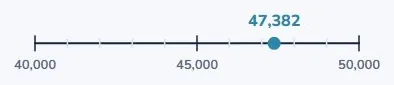
- 47,382 to the nearest ten thousand is 50,000.
- The 7 rounds the 4 up to 5.
- Everything to the right becomes zero.
Rounding a decimal
- Exactly the same rule, further right.
- 3.267 to the nearest hundredth is 3.27.
- To the nearest whole number it is just 3.
| Number | To the | Becomes |
|---|---|---|
| 3.267 | nearest hundredth | 3.27 |
| 3.267 | nearest tenth | 3.3 |
| 3.267 | nearest whole | 3 |
Estimating 0.73 + 0.8 + 0.19
- Round each one to the nearest tenth.
- 0.7 + 0.8 + 0.2 is 1.7.
- So the real answer should be near 1.7.
| Working | Answer | |
|---|---|---|
| Estimate | 0.7 + 0.8 + 0.2 | 1.7 |
| Exact | 0.73 + 0.8 + 0.19 | 1.72 |
| Close? | yes, so the answer is sensible |
What an estimate catches
- It will not catch a small slip.
- It catches the big ones: a lost decimal point.
- If you got 17.2, the estimate says look again.
| Answer | Against 1.7 | |
|---|---|---|
| 1.72 | close | sensible |
| 17.2 | ten times out | check it |
| 0.172 | ten times small | check it |
327 ÷ 5
- Five goes into 32 six times, with 2 left.
- Five goes into 27 five times, with 2 left.
- 65, and 2 left over.
| Step | Working |
|---|---|
| 32 ÷ 5 | 6, remainder 2 |
| carry the 2 | 27 ÷ 5 |
| 27 ÷ 5 | 5, remainder 2 |
| So far | 65 remainder 2 |
Three ways to say what is left
- 65 remainder 2. Or 65 and two fifths.
- Or 65.4, because two fifths is 0.4.
- All the same answer. The question picks the form.
| Form | Answer | Good for |
|---|---|---|
| Whole number | 65 remainder 2 | how many buses |
| Fraction | 65 and 2/5 | how much pizza |
| Decimal | 65.4 | how many dollars |
Common mistakes
- 3 + 4 × 5 = 7 × 5 = 35.Multiplicative comes before additive in GEMA, so 4 × 5 = 20 first, then 3 + 20 = 23.
- 2 × 3² = 6² = 36.Exponents come before multiplying, so 3² = 9 and 2 × 9 = 18.
- 20 − 3 × 4 + 2 = 20 − 12 + 2 = 20 − 14 = 6.+ and − share a step and go left to right: 20 − 12 = 8, then 8 + 2 = 10.
- 47,382 to the nearest ten thousand is 47,000.Look at the thousands digit, 7, which is 5 or more, so the 4 rounds up to 50,000.
Your turn: eight questions
- Try all eight.
- On question 1, do the exponent before anything else.
- On question 3, estimate before you decide.
Work out 6 + 2 × 3².
Round 58,461 to the nearest thousand.
Estimate 2.9 × 4.1. Is 11.89 reasonable?
Work out 419 ÷ 8 as a decimal.
Round 3.846 to the nearest tenth.
Work out 18 − 6 + 4 ÷ 2.
Sam works out 48.7 + 31.2 + 9.8 and gets 899. Use an estimate to check it.
143 Year 7 students go on a trip to Rotorua. Each van holds 12. How many vans are needed?
Show answer
1. 24. Exponents first: 3² = 9. Then 2 × 9 = 18. Then 6 + 18 = 24. 2. 58,000, because 461 is less than 500. 3. About 3 × 4 = 12, so 11.89 is very reasonable, and it is exact. 4. 52.375. 8 × 52 = 416, remainder 3, and 3/8 = 0.375. 5. 3.8. The digit after the tenths is 4, which is less than 5, so the 8 stays: 3.8. 6. 14. Multiplicative first: 4 ÷ 2 = 2. Then additive, left to right: 18 − 6 = 12, and 12 + 2 = 14. 7. About 90, so 899 is ten times too big. 49 + 31 + 10 = 90; the exact answer is 89.7, so the decimal point was lost. 8. 12 vans. 143 ÷ 12 = 11 remainder 11, and those 11 students still need a van, so 11 + 1 = 12.
The answers
- 3² = 9 first, so 6 + 18 = 24.
- 58,461 rounds to 58,000. And 11.89 is fine: 3 × 4 is 12.
- 419 ÷ 8 is 52.375.
| Answer | |
|---|---|
| 1 | 6 + 2 × 9 = 24 |
| 2 | 58,000 |
| 3 | estimate 12, so yes, 11.89 is reasonable |
| 4 | 52.375 |
What to take away
- GEMA: grouped, exponents, multiplicative, additive.
- The last two are pairs worked left to right.
- Estimate first, and let it check the answer you get.
| Remember | |
|---|---|
| GEMA | grouped, exponents, multiplicative, additive |
| × and ÷ | together, left to right; not all ÷ first |
| + and − | together, left to right |
| Estimate first | then check your answer is close |
| Remainders | whole, fraction or decimal: the context decides |
Challenge
Tia divides a whole number by 16 on her calculator and the screen shows 37.6875. What was the remainder when she divided by 16? What was her whole number? She then divides the same whole number by 12. Write that answer in all three forms: with a remainder, as a mixed number in simplest form, and as a decimal.
Hint
The 37 is the number of whole sixteens. The 0.6875 is the remainder written as a fraction of 16, turned into a decimal. What is 0.6875 of 16?
Answer
The remainder was 11 and the number was 603. 603 ÷ 12 = 50 remainder 3, which is 50 14, or 50.25.
Step by step
- The whole part, 37, tells you 16 went in 37 times.
- The decimal part is the remainder shared by 16, so the remainder is 0.6875 × 16 = 11.
- The number is 37 lots of 16 plus 11 more: 592 + 11 = 603.
- Now divide 603 by 12: 12 goes in 50 times (600), with 3 left over.
- 3 left out of 12 is 312 = 14, which is 0.25 as a decimal.
Full working
- 0.6875 × 16 = 11the decimal part is the remainder divided by 16
- 37 × 16 = 59237 whole sixteens
- 592 + 11 = 603add the remainder back on
- 603 ÷ 12 = 50 r 312 × 50 = 600, and 603 − 600 = 3
- 312 = 14 = 0.25HCF of 3 and 12 is 3
- remainder 11; number 603; 50 r 3 = 50 14 = 50.25
Put the digits 1, 2, 3, 4 and 5 in the boxes, one in each box, using every digit once: □ + □ × □² ÷ □ − □. Work it out using the order of operations (GEMA). What is the largest value you can make? What is the smallest? Give the smallest as a fraction and as a decimal.
Hint
The squared box matters most, so try the biggest and the smallest digit there. For the smallest value, think about which box you subtract and which box you divide by.
Answer
Largest 101, from 3 + 4 × 5² ÷ 1 − 2. Smallest −2 14 (−2.25), from 2 + 3 × 1² ÷ 4 − 5.
Step by step
- The exponent is done first, so the squared box has the biggest effect.
- For the largest: square the 5, multiply by the next biggest digit, 4, and divide by 1, which leaves it unchanged. That makes 100.
- The 2 and 3 are left: add 3 and subtract 2 to get 101.
- For the smallest: subtract the biggest digit, 5, and square the 1, since 1² is still 1.
- Now 2, 3 and 4 are left for □ + □ ÷ □. Dividing by 4 is best: 2 + 3 ÷ 4 = 2.75 beats 3 + 2 ÷ 4 = 3.5.
- So the smallest is 2.75 − 5 = −2.25.
Full working
- 3 + 4 × 5² ÷ 1 − 2exponent first: 5² = 25
- 3 + 4 × 25 ÷ 1 − 2 = 3 + 100 − 2× and ÷ left to right
- 3 + 100 − 2 = 101+ and − left to right
- 2 + 3 × 1² ÷ 4 − 5 = 2 + 3 ÷ 4 − 51² = 1 and 3 × 1 = 3
- 2 + 0.75 − 5 = −2.253 ÷ 4 = 0.75
- largest 101; smallest −2 14 = −2.25
Two whole numbers are hidden. The first rounds to 300 to the nearest hundred. The second rounds to 50 to the nearest ten. Hemi estimates their difference as 300 − 50 = 250 and their product as 300 × 50 = 15,000. What are the largest and smallest possible values of the difference? By how much, at most, can the estimate of the product be wrong?
Hint
First write down the smallest and largest whole number that rounds to 300, and the same for 50. To make a difference big, which number do you want big and which small?
Answer
The difference is between 196 and 304. The product estimate can be wrong by up to 3846 (the product could be as big as 18,846).
Step by step
- Numbers that round to 300 go from 250 up to 349. Numbers that round to 50 go from 45 up to 54.
- The biggest difference takes the biggest first number and the smallest second number: 349 − 45 = 304.
- The smallest difference does the opposite: 250 − 54 = 196.
- The smallest product is 250 × 45 = 11,250, which is 3750 below the estimate.
- The largest product is 349 × 54 = 18,846, which is 3846 above the estimate.
- So the estimate can be out by as much as 3846.
Full working
- 250 ≤ first ≤ 349250 rounds up to 300, 350 would round to 400
- 45 ≤ second ≤ 5445 rounds up to 50, 55 would round to 60
- 349 − 45 = 304largest difference
- 250 − 54 = 196smallest difference
- 250 × 45 = 11,250 and 15,000 − 11,250 = 3750smallest product
- 349 × 54 = 18,846 and 18,846 − 15,000 = 3846largest product
- difference from 196 to 304; product estimate out by up to 3846
Practise this
Report a mistake
More in Number
 Powers of 10 and expanded form6 min
 Primes, factors, HCF and LCM7 min
 Integers, and adding below zero6 minOrder of operations, rounding and remainders7 min
 Fractions, decimals and percentages7 min
 Multiplying and dividing fractions and decimals6 min
 Percentages, fractions of amounts, and proportion6 min
 Money, cash rounding and discounts6 min
Is your child on track?
Take the free placement test