Fractions, decimals and percentages
What this lesson covers
- A fraction can describe a proportional relationship between two amounts.
- Every fraction can be represented by an infinite set of equivalent fractions that occupy the same point on the number line.
- Fractions can be converted to decimals using division, and the result can be a terminating decimal or a recurring decimal.
A half plus a third is not two fifths
- Adding the tops and the bottoms feels right.
- But two fifths is less than a half.
- We just added something to a half. It cannot shrink.
What a fraction is
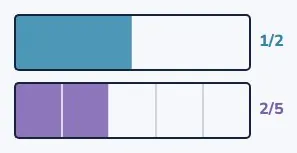
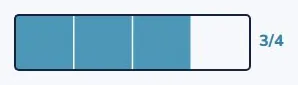
- Three quarters means three out of every four.
- It compares two amounts, not one.
- So it works on 4, on 40, on anything.
Same amount, different cuts
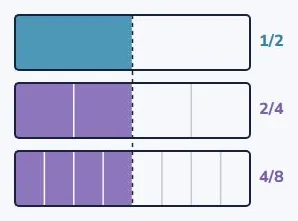
- One half. Two quarters. Four eighths.
- Cut it finer and take more pieces.
- The shaded width never changes.
Try it: change a percentage
Maths blocks
They are the same number
- Not just the same amount: the same point.
- One place on the line, several names.
- 0.5 and 50% are two more names for it.
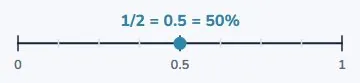
Four names, one number
- A fraction. An equivalent fraction. A decimal.
- A percentage. All the same value.
- You pick whichever suits the question.
| Form | Written |
|---|---|
| Fraction | 1/2 |
| Equivalent | 2/4, 5/10, 50/100 |
| Decimal | 0.5 |
| Percentage | 50% |
Making an equivalent fraction
- Multiply the top and the bottom by the same number.
- Both, or the value changes.
- There are infinitely many of them.
| From | Do this | Get |
|---|---|---|
| 1/2 | × 2 top and bottom | 2/4 |
| 1/2 | × 5 top and bottom | 5/10 |
| 1/2 | × 50 top and bottom | 50/100 |
Simplest form: 18/24
- Go the other way: divide instead.
- The HCF of 18 and 24 is 6.
- 18 ÷ 6 = 3 and 24 ÷ 6 = 4, so it is 3/4.
| Step | Working | Result |
|---|---|---|
| 18/24 | HCF of 18 and 24 is 6 | |
| ÷ 6 | 18 ÷ 6 = 3, 24 ÷ 6 = 4 | 3/4 |
| Check | 3 and 4 share nothing | done |
Try it: simplify it
Fraction to decimal: just divide
- The line in a fraction means divide.
- 5/16 means 5 ÷ 16.
- Which is 0.3125, and it stops there.
| Fraction | Divide | Decimal |
|---|---|---|
| 5/16 | 5 ÷ 16 | 0.3125 (stops) |
| 7/8 | 7 ÷ 8 | 0.875 (stops) |
Sometimes it does not stop
- 1 ÷ 3 gives 0.333 and it keeps going.
- 2 ÷ 11 gives 0.1818, repeating forever.
- That is normal. The division still worked.
| Fraction | Divide | Decimal |
|---|---|---|
| 5/16 | 5 ÷ 16 | 0.3125 (stops) |
| 7/8 | 7 ÷ 8 | 0.875 (stops) |
| 1/3 | 1 ÷ 3 | 0.333... (never stops) |
| 2/11 | 2 ÷ 11 | 0.1818... (repeats) |
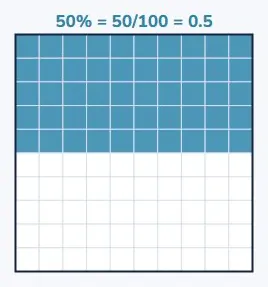
Percent means out of a hundred
- 50% is 50 hundredths, which is 0.5.
- The % sign is shorthand for "out of 100".
- So a percentage is just a decimal in disguise.
The ones worth knowing cold
- These five come up constantly.
- Knowing them saves working every time.
- And a third is the only messy one.
| Fraction | Decimal | Percentage |
|---|---|---|
| 1/2 | 0.5 | 50% |
| 1/4 | 0.25 | 25% |
| 3/4 | 0.75 | 75% |
| 1/5 | 0.2 | 20% |
| 1/3 | 0.333... | 33.3% |
Which is bigger: 3/5 or 0.62?
- You cannot compare different forms directly.
- Turn them all into decimals first.
- 3 ÷ 5 = 0.6, so 0.62 is bigger.
| Value | Working | As a decimal |
|---|---|---|
| 3/5 | 3 ÷ 5 | 0.6 |
| 0.62 | already a decimal | 0.62 |
| Bigger | 0.62 | so 0.62 wins |
Try it: pin it on the line
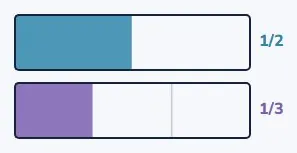
Why you cannot just add the tops
- Halves and thirds are different sized pieces.
- You cannot count them together.
- Cut them both into the same size first.
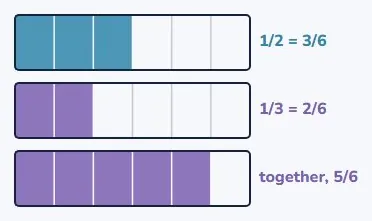
1/2 + 1/3 in sixths
- Sixths work for both: 2 and 3 both go into 6.
- A half is 3 sixths. A third is 2 sixths.
- 3 + 2 = 5 sixths.
Try it: match the pieces, then add
The same thing written down
- Find a denominator both go into.
- Rewrite each fraction with it.
- Add the tops. Leave the bottom alone.
| Fraction | Step | Becomes |
|---|---|---|
| 1/2 | becomes | 3/6 |
| 1/3 | becomes | 2/6 |
| Add the pieces | 3 + 2 = 5 | 5/6 |
Mixed numbers: 2 1/4 + 1 5/6
- Turn both into improper fractions first.
- Twelfths: 27/12 + 22/12 = 49/12.
- 49 ÷ 12 is 4 remainder 1, so 4 and 1/12.
| Step | Working | Result |
|---|---|---|
| 2 1/4 | as an improper fraction | 9/4 |
| 1 5/6 | as an improper fraction | 11/6 |
| Twelfths | 27/12 + 22/12 | 49/12 |
| Back to mixed | 49 ÷ 12 = 4 r 1 | 4 1/12 |
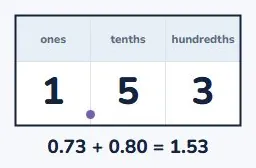
Adding decimals
- Much easier: the pieces already match.
- Line up the decimal points, not the last digits.
- 0.73 + 0.80 = 1.53.
Common mistakes
- 1/2 + 1/3 = 2/5.Halves and thirds are different sized pieces, so rewrite both in sixths first: 3/6 + 2/6 = 5/6.
- 0.6 is bigger than 5/8, because 5 is less than 6.Compare in one form: 5 ÷ 8 = 0.625, which is bigger than 0.6.
- 2/3 + 1/4 = 8/12 + 3/12 = 11/24.Add the tops and keep the common bottom, because twelfths plus twelfths are still twelfths: 11/12.
- To get an equivalent fraction for 3/4, I multiplied the top by 2: 6/4.Multiply the top and the bottom by the same number, or the value changes: 3/4 = 6/8.
Your turn: eight questions
- Try all eight.
- For question 3, find a denominator both go into.
- For question 4, turn the fraction into a decimal.
Write 18/24 in its simplest form.
Convert 7/8 to a decimal.
Work out 2/3 + 1/4.
Which is bigger: 5/8 or 0.6?
Write 0.35 as a percentage and as a fraction in its simplest form.
Put in order, smallest first: 2/3, 0.6, 65%.
Ana says 1/4 + 2/5 = 3/9. What is the correct answer?
Work out 3 1/2 − 1 2/3.
Show answer
1. 3/4. The HCF of 18 and 24 is 6, so divide both by 6. 2. 0.875, from 7 ÷ 8. 3. 11/12. Twelfths: 8/12 + 3/12. It is already in simplest form. 4. 5/8, because 5 ÷ 8 = 0.625, which is more than 0.6. 5. 35% and 7/20. 0.35 is 35 hundredths, so 35%, and 35/100 ÷ 5 on top and bottom is 7/20. 6. 0.6, 65%, 2/3. As decimals: 0.6, 0.65 and 2 ÷ 3 = 0.666..., so 2/3 is the biggest. 7. 13/20. Twentieths work for both: 5/20 + 8/20 = 13/20. Adding tops and bottoms gives 3/9, which is less than 2/5. 8. 1 5/6. As improper fractions, 7/2 − 5/3 = 21/6 − 10/6 = 11/6, which is 1 5/6.
The answers
- 18/24 simplifies to 3/4. And 7 ÷ 8 = 0.875.
- 2/3 + 1/4 in twelfths is 8/12 + 3/12 = 11/12.
- 5/8 is 0.625, so it beats 0.6.
| Answer | |
|---|---|
| 1 | 3/4 |
| 2 | 0.875 |
| 3 | 11/12 |
| 4 | 5/8, since it is 0.625 |
What to take away
- Equivalent fractions are one point on the line.
- To add, cut both into the same size pieces first.
- Never add the tops and the bottoms.
| Remember | |
|---|---|
| Equivalent fractions | the same point on the line |
| To simplify | divide top and bottom by their HCF |
| To decimalise | divide the top by the bottom |
| To add | cut both into the same size pieces first |
| Never | add the tops and add the bottoms |
Challenge
Without a calculator, divide 5 by 7 to write 57 as a decimal. Which digit is in the 100th place after the decimal point? What is the sum of the first 20 digits after the decimal point? Mere says 0.7143 is a little less than 57. Is she right?
Hint
Keep dividing until a remainder comes back that you have had before. From then on the digits repeat in the same order, so work out where the 100th digit falls in the repeating block.
Answer
57 = 0.714285714285..., with the block 714285 repeating. The 100th digit is 2. The first 20 digits add to 89. Mere is wrong: 0.7143 is a little more than 57.
Step by step
- Short division of 5 by 7 gives the digits 7, 1, 4, 2, 8, 5, and then the remainder 5 comes back, so the same six digits repeat forever.
- The block is 6 digits long. 100 = 16 × 6 + 4, so after 16 full blocks the 100th digit is the 4th digit of the block, which is 2.
- One block adds to 7 + 1 + 4 + 2 + 8 + 5 = 27.
- 20 digits are 3 full blocks (18 digits) and then 7 and 1, so the sum is 3 × 27 + 7 + 1 = 89.
- Compare 0.7143 with 0.714285...: the first three digits match, and in the ten-thousandths 3 is bigger than 2, so 0.7143 is bigger than 57.
Full working
- 5 ÷ 7 = 0.714285714285...remainders 5, 1, 3, 2, 6, 4, then 5 again
- block 714285 has 6 digitsit repeats forever
- 100 = 16 × 6 + 4, 4th digit of 714285 is 2100th digit
- 7 + 1 + 4 + 2 + 8 + 5 = 27 per blocksum of one block
- 3 × 27 + 7 + 1 = 8918 digits, then 2 more
- 0.7143 > 0.71428...compare the ten-thousandths: 3 > 2
- 100th digit 2; sum 89; 0.7143 is bigger than 57, so Mere is wrong
Use each of the digits 1, 2, 3, 4, 5 and 6 exactly once to fill the boxes in □□ + □□ + □□. What is the smallest total you can make? Give it as a fraction in simplest form and as a decimal.
Hint
Small tops and big bottoms make small fractions, so the tops should be 1, 2 and 3. Then try the three ways to pair them with 4, 5 and 6, and compare the totals as decimals.
Answer
2320 = 1.15, from 14 + 25 + 36
Step by step
- To keep the total small, the numerators should be 1, 2 and 3 and the denominators 4, 5 and 6.
- Now decide which top goes with which bottom.
- 16 + 25 + 34 is about 1.32, but 14 + 25 + 36 is 1.15, and the other pairings fall in between.
- Giving the biggest top the biggest bottom keeps each fraction small.
- Add 14 + 25 + 12 using twentieths: 520 + 820 + 1020 = 2320.
Full working
- tops 1, 2, 3; bottoms 4, 5, 6small over big
- 16 + 25 + 34 ≈ 0.167 + 0.4 + 0.75 = 1.317worst pairing
- 14 + 26 + 35 ≈ 0.25 + 0.333 + 0.6 = 1.183better
- 14 + 25 + 36 = 0.25 + 0.4 + 0.5 = 1.15best
- 520 + 820 + 1020 = 232036 = 12, and 20 works for 4, 5 and 2
- 2320 = 1 320 = 1.15
Some fractions give a decimal that stops (like 18 = 0.125) and some give one that goes on forever (like 13 = 0.333...). How many of the 19 fractions 12, 13, 14, ..., 120 give a decimal that stops? Then, of the 29 fractions 130, 230, 330, ..., 2930, how many give a decimal that stops?
Hint
A decimal that stops is a number of tenths, or hundredths, or thousandths, and so on. So ask: can this fraction be rewritten with 10, 100, 1000 or 10,000 on the bottom? Think about the prime factors of 10, and simplify each fraction first.
Answer
7 of the unit fractions stop (12, 14, 15, 18, 110, 116, 120). 9 of the thirtieths stop (330, 630, ..., 2730).
Step by step
- A decimal that stops can be written over 10, 100, 1000 and so on, and 10 = 2 × 5.
- So a fraction in simplest form stops exactly when its bottom is made only from 2s and 5s multiplied together.
- From 2 to 20, those bottoms are 2, 4, 5, 8, 10, 16 and 20: that is 7 fractions.
- For thirtieths, 30 = 2 × 3 × 5. The 3 must cancel when you simplify, so the top must be a multiple of 3.
- The tops 3, 6, 9, ..., 27 work: that is 9 fractions. For example 930 = 310 = 0.3.
Full working
- 10 = 2 × 5, 100 = 2² × 5², 1000 = 2³ × 5³powers of 10 only have 2s and 5s
- 2, 4 = 2², 5, 8 = 2³, 10 = 2 × 5, 16 = 2⁴, 20 = 2² × 5bottoms from 2 to 20 with only 2s and 5s
- e.g. 116 = 62510,000 = 0.0625, but 16 = 0.1666...6 = 2 × 3 has a 3
- 30 = 2 × 3 × 5the 3 has to cancel
- k30 stops when k is 3, 6, 9, 12, 15, 18, 21, 24, 27multiples of 3 below 30
- 7 unit fractions; 9 thirtieths
Where science uses this
Practise this
Report a mistake
More in Number
 Powers of 10 and expanded form6 min
 Primes, factors, HCF and LCM7 min
 Integers, and adding below zero6 min
 Order of operations, rounding and remainders7 minFractions, decimals and percentages7 min
 Multiplying and dividing fractions and decimals6 min
 Percentages, fractions of amounts, and proportion6 min
 Money, cash rounding and discounts6 min
Is your child on track?
Take the free placement test