The Moon's phases, and why it rises later each day
What this lesson covers
- The Moon is Earth's natural satellite, a roughly round ball of rock that orbits Earth
- The Moon shines only by reflected sunlight, and half of it is always lit
- Phases happen because, as the Moon orbits, we see different amounts of its lit half
- The cycle of phases (new, crescent, quarter, gibbous, full) repeats about every 29.5 days
- Why the Moon rises about 50 minutes later each day
- Finding patterns in Moon data, and using a lunar calendar to plan ahead
Earth's natural satellite
- A satellite is an object that travels in a path (an orbit) around a larger object.
- The Moon is Earth's only natural satellite. It is a roughly spherical ball of rock, about a quarter as wide as Earth.
- It takes about a month to go once around Earth, held in its orbit by gravity.
- Human-made satellites, such as weather and GPS satellites, also orbit Earth, but they are artificial.
Half the Moon is always lit
- The Moon makes no light of its own. We see it because sunlight bounces off it.
- At every moment, the half of the Moon facing the Sun is lit and the other half is dark, just like day and night on Earth.
- As the Moon orbits, we on Earth see different amounts of that lit half. This changing view is what we call the phases.
- When the Moon is between Earth and the Sun, its lit half faces away from us and we see almost nothing: a new moon. When it is on the far side of Earth from the Sun, we see the whole lit half: a full moon.
- The diagram looks down from far above the South Pole, with sunlight coming from the left. From there the Moon travels clockwise around Earth.
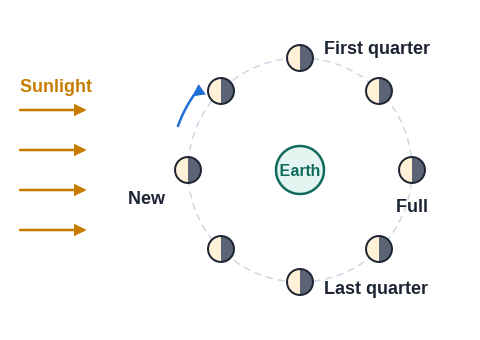
The cycle of phases from New Zealand
- After new moon, a thin crescent appears. The lit part grows each night: this is called waxing.
- About a week after new moon, half the disc is lit: the first quarter. Then comes a waxing gibbous moon (more than half lit), and then full moon.
- After full moon the lit part shrinks, called waning: waning gibbous, last quarter, waning crescent, and back to new.
- From New Zealand, a waxing Moon is lit on the left and a waning Moon on the right. In the Northern Hemisphere it looks the other way round.
- One full cycle, from new moon to the next new moon, takes about 29.5 days.
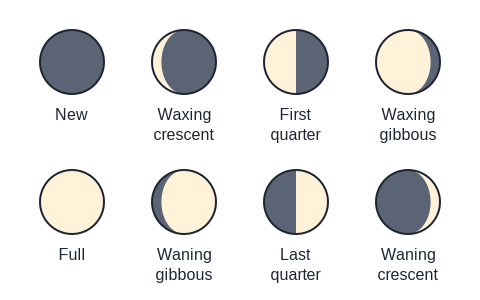
Try it: the Moon's phases from New Zealand
Why moonrise moves later
- Earth spins once a day, which makes the Sun, Moon and stars appear to rise in the east and set in the west.
- While Earth spins, the Moon is also moving along its orbit in the same direction.
- So after one full spin, Earth has to turn a little further to bring the Moon back into view. On average this takes about 50 minutes extra, so the Moon rises about 50 minutes later each day.
- That is why the phase and the time you can see the Moon go together.
| Phase | Rises about | Best seen |
|---|---|---|
| New | With the Sun | Not visible |
| First quarter | Midday | Afternoon and evening |
| Full | Sunset | All night |
| Last quarter | Midnight | After midnight and in the morning |
Try it: waxing or waning?
Example: finding the pattern in real dates
- Here are the main Moon phases for November and December 2026, in New Zealand time.
- How long is it between one main phase and the next, and from one new moon to the next?
| Phase | Date and time |
|---|---|
| New moon | 9 November, 8:02 pm |
| First quarter | 18 November, 12:48 am |
| Full moon | 25 November, 3:53 am |
| Last quarter | 1 December, 7:08 pm |
| New moon | 9 December, 1:52 pm |
- 9 Nov to 18 Nov: about 8 daysnew to first quarter
- 18 Nov to 25 Nov: about 7 days; 25 Nov to 1 Dec: about 7 daysthe next two gaps
- 1 Dec to 9 Dec: about 8 dayslast quarter to new
- 9 Nov 8:02 pm to 9 Dec 1:52 pm = 29 days 17 h 50 min ≈ 29.7 daysnew moon to new moon
- About a week between main phases, and about 29.5 days for the whole cycle
- The gaps vary a little because the Moon's orbit is not a perfect circle
Collecting your own Moon data
- Scientists find patterns by recording the same things again and again over a long time.
- A Moon diary records the date, the time, the shape of the Moon (draw it) and where it is in the sky, such as low in the east or high in the north.
- Over a few weeks you will see the phases change in order, and the Moon appear later each evening.
- Over several months you can check that the cycle really does repeat, and predict when the next full moon will be.
Try it: tonight's Moon
The maramataka
- The maramataka is a traditional Māori calendar based on the movements and phases of the Moon (te marama) and the stars (ngā whetū).
- Each night of the lunar month has its own name, linked to a particular phase of the Moon. Most iwi count 12 months in a year, each of about 30 nights.
- Maramataka differ between iwi and regions. Some iwi begin the month at the new moon, with the night called Whiro; others begin at the full moon, with Rākaunui.
- A local maramataka guides planting, fishing and gathering food, together with signs in the environment (tohu). To use one, find the maramataka for your own area, from your local iwi or marae.
| Practice | First night of the month | Moon phase |
|---|---|---|
| Some iwi | Whiro | New moon |
| Other iwi | Rākaunui | Full moon |
Example: planning with a lunar calendar
- Imagine your local maramataka marks the night of the full moon and the two nights after it as good for fishing in your area.
- In December 2026, the full moon is on 24 December at 2:28 pm, New Zealand time. Which nights should your whānau plan for?
- Full moon: afternoon of 24 Decemberfrom the phase table
- That night is the full-moon nightthe Moon rises around sunset
- Plus the next two nights: 25 and 26 Decemberthe two after it
- The nights of 24, 25 and 26 December 2026
Common mistakes
- The phases are caused by Earth's shadow falling on the Moon.Phases come from how much of the Moon's sunlit half we can see; Earth's shadow only reaches the Moon in a lunar eclipse.
- The Moon only comes out at night.The Moon is up for about half of each day, and you can often see it in daylight, especially near the quarter phases.
- A first quarter moon is a quarter lit.At first quarter, half the disc is lit; the name means the Moon is a quarter of the way through its cycle.
- The Moon gives off its own light.The Moon only reflects sunlight; half of it is always lit by the Sun.
Keep a Moon diary
You need: a notebook, a pencil, a clock or phone, a window or garden with a view of the sky
- Every clear evening for at least two weeks, look for the Moon at the same time, for example 8 pm.
- Draw its shape, and note the date, the time, and roughly where it is (which direction, and how high).
- If you cannot see it at 8 pm, write that down too; it may not have risen yet, or it may be cloudy.
- After two weeks, put your drawings in order and label each with its phase name.
- Look for the pattern: the lit part grows from the left towards full moon, and each evening the Moon sits further east than the night before at the same time.
Safety: Do your observing from home or with an adult, and never look at the Sun, even when looking for a daytime Moon.
Your turn
What do we call the phase when the Moon is between Earth and the Sun?
From New Zealand, a half Moon is lit on its left side. Is it first quarter or last quarter?
A full moon is on 23 January 2027. Roughly when will the next full moon be?
The Moon rises at 7:00 pm tonight. At about what time will it rise tomorrow?
Why do we see phases at all, if half the Moon is always lit?
Show answer
1. New moon. 2. First quarter, because from New Zealand a waxing Moon is lit on the left. 3. About 29.5 days later, around 21 or 22 February 2027. 4. About 50 minutes later, at around 7:50 pm. 5. As the Moon orbits Earth, we see different amounts of its lit half.
Recap
- The Moon is Earth's natural satellite, a roughly round ball of rock.
- It shines by reflected sunlight, and half of it is always lit.
- Phases happen because, as the Moon orbits, we see different amounts of its lit half.
- The cycle goes new, waxing crescent, first quarter, waxing gibbous, full, then waning back to new, in about 29.5 days.
- Because the Moon moves along its orbit, it rises about 50 minutes later each day.
- Recording the Moon over months reveals the pattern; the maramataka is a Māori calendar built on it.
Challenge
At 7 am, on his way to school in Whanganui, Hemi sees a Moon with exactly half of its disc lit, fairly high in the sky. (a) Which phase is it, and which side of the disc is lit? Explain how the time of day rules out the other half-lit phase. (b) Roughly when did this Moon rise, and roughly when will it set? (c) About how many days until the next new moon, and about how many days until Hemi next sees the Moon look exactly like this?
Hint
Use the table of rising times: one half-lit phase rises at about midday and the other at about midnight. A Moon is up for about 12 hours after it rises.
Answer
(a) Last quarter, lit on the right (it is waning, and from New Zealand a waning Moon is lit on the right). A first quarter Moon rises at about midday and sets at about midnight, so it cannot be in the sky at 7 am. (b) It rose at about midnight and will set at about midday. (c) About 7 days to new moon; about 29.5 days until it looks the same again.
Step by step
- The two half-lit phases are first quarter and last quarter.
- A first quarter Moon is up from about midday to about midnight, so it is below the horizon in the early morning.
- A last quarter Moon rises about midnight, so at 7 am it has been up for about 7 hours and is high in the sky.
- Last quarter comes after full moon, so the Moon is waning, and from New Zealand a waning Moon is lit on the right.
- The main phases are about a week apart, and the whole cycle takes about 29.5 days.
Full working
- Half lit: first quarter or last quarterthe two possible phases
- First quarter: rises about midday, sets about midnightnot up at 7 am
- Last quarter: rises about midnightup at 7 am, high in the sky
- After full moon, so waning; lit on the right from New Zealand(a)
- Rises about midnight + about 12 h up, sets about midday(b)
- Last quarter to new moon about 7 days; whole cycle about 29.5 days(c)
- Last quarter, lit on the right; rose about midnight, sets about midday; new moon in about 7 days, same view in about 29.5 days
The Moon goes from one full moon to the next in about 29.5 days. In that time it travels once around Earth compared with the Sun, so it moves 360° round its orbit compared with the direction of the Sun. Earth spins 360° in 24 hours. (a) How many degrees does the Moon move round its orbit, compared with the Sun, in one day (to 1 decimal place)? (b) How many degrees does Earth turn in one hour, and how many minutes does it take to turn 1°? (c) Use (a) and (b) to show that the Moon rises later each day by close to the lesson's 50 minutes. (d) Check your answer another way: over a whole cycle, how many minutes must the moonrise time slip in total to come back round to the same phase?
Hint
After one spin, Earth has to keep turning to catch up with the Moon, which has moved on along its orbit. Turn the Moon's daily move in degrees into minutes of Earth turning.
Answer
(a) About 12.2° a day. (b) 15° an hour, so 4 minutes for each degree. (c) 12.2 × 4 ≈ 48.8 minutes, close to 50 minutes. (d) A whole day, 1440 minutes, slipped over 29.5 days gives 1440 ÷ 29.5 ≈ 48.8 minutes a day, the same answer.
Step by step
- The Moon moves 360° compared with the Sun in 29.5 days, so divide to get its move per day.
- Earth turns 360° in 24 hours, which is 15° each hour, or 1° every 4 minutes.
- After a full spin, Earth must turn about 12.2° more to face the Moon again, which takes about 49 minutes.
- Over a full cycle, the moonrise time slips all the way round the clock, a full 24 hours.
- Both methods give about 49 minutes, which the lesson rounds to about 50 minutes; the real delay varies from day to day.
Full working
- 360 ÷ 29.5 ≈ 12.2° per day(a) the Moon's move compared with the Sun
- 360 ÷ 24 = 15° per hour(b) Earth's spin
- 60 ÷ 15 = 4 minutes per degreetime to turn 1°
- 12.2 × 4 ≈ 48.8 minutes(c) extra turning each day
- 24 × 60 = 1440 minutes, and 1440 ÷ 29.5 ≈ 48.8 minutes(d) the whole slip shared over the cycle
- About 49 minutes later each day, close to 50 minutes
An astronaut stands on the side of the Moon that faces Earth and looks back at Earth. Earth, like the Moon, is always half lit by the Sun. (a) On the night we see a new moon from New Zealand, how much of Earth's lit half does the astronaut see? (b) What does the astronaut see on the night we see a full moon, and on the night we see a first quarter Moon? (c) Describe the rule that connects the phase we see of the Moon and the phase the astronaut sees of Earth. (d) A few days after new moon, the dark part of a thin crescent Moon often glows faintly grey. Use your answers to explain where that light comes from.
Hint
Picture the Sun, Earth and Moon in the lesson's diagram. Whichever body is between the other body and the Sun has its lit half facing away from the other one.
Answer
(a) Almost all of it: a full Earth. (b) At our full moon the astronaut sees a new Earth (dark). At our first quarter the astronaut sees a half-lit Earth. (c) The phases are opposites: when we see more of the Moon's lit half, the astronaut sees less of Earth's, and the two lit fractions always add up to one whole disc (new with full, full with new, half with half). (d) Near new moon, the night side of the Moon faces an almost full Earth. Sunlight reflects off Earth onto the Moon's dark part, and some of that light reflects back to us, so the dark part glows faintly.
Step by step
- At new moon the Moon is between Earth and the Sun, so Earth's lit half faces the Moon.
- At full moon Earth is between the Moon and the Sun, so Earth's lit half faces away from the Moon.
- At first quarter the Sun, Earth and Moon make a right angle, so each sees the other half lit.
- So the Moon's phase from Earth and Earth's phase from the Moon are always opposites.
- A nearly full Earth lights the Moon's dark side, just as a full moon lights up a night on Earth.
Full working
- New moon: Sun, Moon, Earth in a line, Moon in the middleEarth's lit half faces the Moon
- Astronaut sees a full Earth(a)
- Full moon: Earth in the middleastronaut sees a new (dark) Earth
- First quarter: right angleastronaut sees a half-lit Earth
- Our view of the Moon and the astronaut's view of Earth are opposite phases(c)
- Near new moon, sunlight reflected from a nearly full Earth lights the Moon's dark part(d)
- Full Earth at new moon; new Earth at full moon; half Earth at quarter; earthshine lights the crescent's dark part
The maths behind it
Report a mistake
How is Year 7 maths going?
See the Year 7 maths guide