The Moon as a clock, the maramataka, and eclipses
What this lesson covers
- Using the Moon's phases to measure time: about a week between quarter phases and about a month for the whole cycle
- Predicting future phase dates from one known date
- How the maramataka uses the Moon, stars and local signs to organise the year
- Modelling the phases with a ball and a light
- A lunar eclipse: the Moon moves into Earth's shadow
- A solar eclipse: the Moon passes between Earth and the Sun
- Why eclipses do not happen every month
The Moon as a clock
- Because the phases repeat in the same order, the Moon works as a natural clock in the sky that everyone can see.
- The whole cycle, new moon to new moon, takes about 29.5 days. The word month comes from Moon.
- The cycle has four main phases (new, first quarter, full, last quarter), so the gap between them is about 29.5 ÷ 4 ≈ 7.4 days: roughly a week.
- So if you know the date of one phase, you can predict the next ones by counting on about 7 or 8 days at a time.
Example: predicting a month of phases
- New moon is on 9 December 2026. Predict the dates of first quarter, full moon, last quarter and the next new moon, then compare with the published dates.
| Phase | Date and time |
|---|---|
| New moon | 9 December 2026, 1:52 pm |
| First quarter | 17 December 2026, 6:42 pm |
| Full moon | 24 December 2026, 2:28 pm |
| Last quarter | 31 December 2026, 7:59 am |
| New moon | 8 January 2027, 9:24 am |
- First quarter: 9 + 7.4 ≈ 16 Decemberone step of about 7.4 days
- Full: 9 + 14.8 ≈ 24 Decembertwo steps
- Last quarter: 9 + 22.1 ≈ 31 Decemberthree steps
- Next new moon: 9 December + 29.5 days ≈ 7 or 8 Januarythe whole cycle
- Predicted about 16 Dec, 24 Dec, 31 Dec and 8 Jan
- Published: 17 Dec, 24 Dec, 31 Dec, 8 Jan, all within a day
The maramataka divides the year
- The maramataka is the traditional Māori calendar, built on the movements and phases of the Moon and on the stars.
- It splits the year into seasons and months (marama), and each month into named nights, each linked to a phase of the Moon.
- Stars mark the year too. The rising of Matariki, which always happens in June or July, signals the start of the new year and the first month of the maramataka. Some iwi look to the star Puanga at this time instead.
- Because the months follow the Moon, a calendar like this needs resetting every so often to stay in step with the seasons, and the stars help with that.
| Part of the maramataka | What it tracks |
|---|---|
| Night names | Each night's Moon phase |
| Marama (months) | Most iwi count 12, each of about 30 nights |
| Matariki or Puanga | The start of the new year |
| Tohu | Signs in the local environment |
Local signs, local calendars
- A maramataka is not one fixed calendar for the whole country. Each iwi and region has its own, fitted to its own coast, rivers, forests and climate.
- It uses environmental signs (tohu), such as the arrival of migrating inanga (whitebait) or tītī, together with the Moon phase, to guide planting, fishing and gathering food.
- Because the climate is changing, some tohu used for hundreds of years no longer appear at the same times, so people who use the maramataka keep observing and adjusting it.
- That is how science works too: careful observation over long periods, checked against what really happens.
Modelling the phases
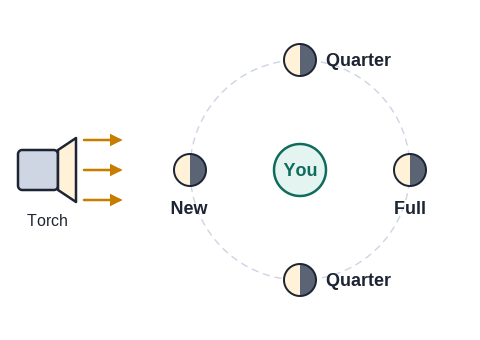
- You can model the phases in a dark room. A torch or lamp is the Sun, a ball on a stick is the Moon, and your head is Earth.
- Hold the ball at arm's length, a little above your head, and turn slowly on the spot so the ball orbits your head.
- Facing the torch, you see the dark side of the ball: new moon. With the torch behind you (and the ball above your shadow), you see the whole lit side: full moon.
- Halfway between, with the torch to one side, you see half the ball lit: a quarter moon.
- The ball is always half lit. Only your view of it changes, which is exactly what happens with the real Moon.
Example: using the model to explain
- In the model, you stand with the torch directly to your right and the ball held straight in front of you. How much of the ball looks lit, and which side?
- The torch lights the half of the ball facing itthe right-hand half
- You see the half of the ball facing youthe front half
- Overlap: half of what you seethe right side of the disc
- Half the ball looks lit, on its right side, like a quarter moon
A lunar eclipse
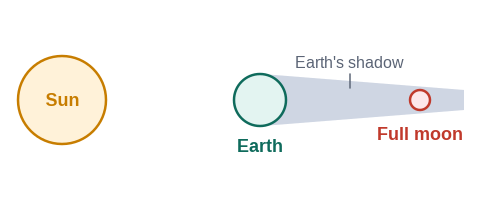
- Earth blocks sunlight and casts a long shadow into space, on the side away from the Sun.
- A lunar eclipse happens when the Moon moves into Earth's shadow. The Sun, Earth and Moon are then in a straight line, with Earth in the middle.
- This can only happen at full moon, because that is when the Moon is on the far side of Earth from the Sun.
- During a total lunar eclipse the Moon usually turns a dull red, because a little sunlight is bent through Earth's air and reaches it.
- Anyone on the night side of Earth can see it, and it is safe to look at.
A solar eclipse
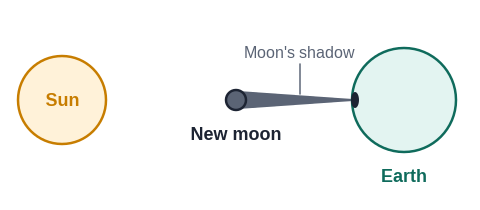
- A solar eclipse happens when the Moon passes exactly between Earth and the Sun, so the Moon blocks the Sun from view.
- This can only happen at new moon.
- The Moon's shadow is small, so it covers only a narrow strip of Earth. Inside that strip the Sun is completely hidden for a few minutes: a total eclipse. Nearby, people see only part of the Sun covered.
- Never look straight at the Sun, even during an eclipse: it can permanently damage your eyes. Use proper eclipse glasses or a pinhole viewer.
Try it: lunar or solar eclipse?
Why not every month?
- There is a new moon and a full moon every month, but not an eclipse every month.
- The Moon's orbit is tilted by about 5 degrees compared with Earth's orbit around the Sun.
- So most months the new moon passes a little above or below the Sun, and the full moon passes a little above or below Earth's shadow.
- Only when a new or full moon happens just as the Moon crosses the level of Earth's orbit do the three line up exactly, and we get an eclipse.
Try it: phases and eclipses
Common mistakes
- A solar eclipse is when Earth's shadow covers the Sun.In a solar eclipse the Moon blocks the Sun; Earth's shadow on the Moon is a lunar eclipse.
- There must be an eclipse every new moon and full moon.The Moon's orbit is tilted, so most months the three bodies do not line up exactly.
- The maramataka is the same everywhere in New Zealand.Each iwi and region has its own maramataka, fitted to local signs and conditions.
- A lunar eclipse can happen at any phase.A lunar eclipse needs Earth between the Sun and the Moon, which only happens at full moon.
Model the phases with a torch
You need: a torch (AA or AAA batteries), a light-coloured ball, such as a tennis ball, a pencil or stick, a dark room, a helper
- Push the pencil into the ball (or tape it on) so you can hold it up like a lollipop.
- Ask your helper to hold the torch at head height on one side of the dark room, shining towards you.
- Hold the ball at arm's length, slightly above your head, and turn slowly on the spot, anticlockwise.
- Stop at eight points around the circle and note the shape of the lit part you can see.
- Look for the pattern: the lit part grows from a thin crescent to a full circle and back again, just like the real Moon's phases.
Safety: Clear the floor before turning off the lights so nobody trips in the dark, and never shine the torch into anyone's eyes.
Your turn
Full moon is on 24 December 2026. Roughly when is the next last quarter?
Which phase must the Moon be in for a solar eclipse?
In a lunar eclipse, which body is in the middle of the line?
Why do iwi in different regions have different maramataka?
Why is a solar eclipse seen only from a small part of Earth, while a lunar eclipse is seen by everyone on the night side?
Show answer
1. About a week later, around 31 December 2026. 2. New moon. 3. Earth, between the Sun and the Moon. 4. Each region has its own climate, plants and animals, so the tohu and best times differ. 5. The Moon's shadow on Earth is small, but in a lunar eclipse the whole Moon goes into Earth's shadow, so everyone who can see the Moon sees it darken.
Recap
- The Moon's phases repeat about every 29.5 days, with about a week between main phases, so they can measure and predict time.
- The maramataka is the Māori lunar calendar: it names each night by the Moon, starts the year with Matariki or Puanga, and uses local tohu.
- A ball, a light and your head can model the phases: the ball is always half lit, and only the view changes.
- A lunar eclipse happens at full moon, when the Moon moves into Earth's shadow.
- A solar eclipse happens at new moon, when the Moon passes between Earth and the Sun.
- The Moon's tilted orbit is why eclipses do not happen every month.
Challenge
In the torch and ball model of the Moon, Ana stands with the torch shining from behind her, a little to her right, and holds the ball in front of her, just above her head. (a) How much of the ball looks lit, which side is lit, and which real phase does this model from New Zealand? (b) She now lowers the ball to exactly the height of her head and moves it a little to her left, so it is in a straight line with her head and the torch. What happens to the ball, and which real event does this model? Which real phase must the Moon be at for it to happen? (c) Explain why, in real life, this event does not happen every month even though that phase does.
Hint
The torch lights the half of the ball facing it, and you see the half facing you. In (b), think about what her head is blocking.
Answer
(a) More than half of the ball looks lit, on the right side: a waning gibbous Moon. (b) Her head blocks the torchlight, so the ball goes into her head's shadow and turns dark: this models a lunar eclipse, which can only happen at full moon. (c) The Moon's orbit is tilted by about 5° to Earth's orbit, so at most full moons the Moon passes a little above or below Earth's shadow, like holding the ball above your head in the model. Only when full moon happens just as the Moon crosses the level of Earth's orbit does it pass through the shadow.
Step by step
- With the torch mostly behind her, most of the ball's lit half faces her, so she sees more than half lit.
- The torch is to her right, so the lit side of the ball is on the right, which from New Zealand means a waning Moon.
- More than half lit and waning is a waning gibbous Moon.
- In line with head and torch, her head (Earth) blocks the light and the ball (Moon) is in shadow: a lunar eclipse.
- Holding the ball slightly above head height is like the tilted orbit: the Moon usually misses the shadow.
Full working
- Torch behind and right: most of the lit half faces Anamore than half lit
- Lit side on the right; New Zealand viewwaning
- More than half, waning(a) waning gibbous
- Torch, head, ball in a straight line; head blocks the light(b) lunar eclipse, full moon only
- Orbit tilted about 5°; usual full moon passes above or below the shadow(c)
- Waning gibbous; lunar eclipse at full moon; the tilt makes most full moons miss the shadow
A lunar calendar uses months that follow the Moon, from one new moon to the next. Take a lunar month as 29.5 days and a year as 365.25 days. (a) How many days do 12 lunar months last, and how many days short of a year is that? (b) A new moon fell on 9 December 2026. Predict the date of the new moon 12 lunar months later. (c) If nothing is done, by about how many days does the calendar drift each year? After how many years has it drifted by more than a whole lunar month? (d) Explain how watching for Matariki rising each year helps keep a maramataka in step with the seasons.
Hint
Count on 354 days from 9 December: December has 31 days, and 2027 is not a leap year. For (c), how many years of drift fit into one lunar month?
Answer
(a) 354 days, about 11 days short of a year. (b) 28 November 2027. (c) About 11 days each year; after 3 years it has drifted about 34 days, more than one 29.5-day month. (d) Matariki rises in the dawn sky at the same time of the solar year (June or July) every year, because it depends on Earth's journey around the Sun, not on the Moon. When the Moon months have slipped too early, people can wait for Matariki before starting the new year, which in effect adds an extra month and brings the months back in step with the seasons. (Some iwi watch for Puanga instead of Matariki.)
Step by step
- Twelve lunar months of 29.5 days make 354 days.
- A year has about 365.25 days, so 12 lunar months fall about 11 days short.
- Count 354 days on from 9 December 2026 to predict the date.
- Each year the calendar slips about another 11 days, so after 3 years the slip is bigger than a month.
- The stars rise at the same time of year every year, so they show when the Moon calendar has slipped.
Full working
- 12 × 29.5 = 354 days(a) twelve lunar months
- 365.25 − 354 = 11.25 daysabout 11 days short
- 9 Dec 2026 + 22 days = 31 Dec; 354 − 22 = 332 days into 2027count on
- Day 332 of 2027 is 28 November(b) predicted new moon
- 29.5 ÷ 11.25 ≈ 2.6, and 3 × 11.25 ≈ 34 days(c) more than a month after 3 years
- Matariki rising fixes the start of the year(d) resets the months
- 354 days; 28 November 2027; more than a month out after 3 years; Matariki resets it
The Moon's orbit is tilted about 5° to Earth's orbit, so at full moon the centre of the Moon can pass as much as about 34 000 km above or below the centre of Earth's shadow. At the Moon's distance, the dark central part of Earth's shadow is about 9 200 km wide, and the Moon is about 3 500 km wide. (a) How close to the centre of the shadow must the Moon's centre pass for at least part of the Moon to go into the dark shadow? (b) How close must it pass for the whole Moon to be inside the dark shadow, a total lunar eclipse? (c) Use your answers to explain why most full moons have no eclipse. (d) A total lunar eclipse can be seen from the whole night side of Earth, but a total solar eclipse only from a narrow strip. Explain why, using the sizes of the shadows.
Hint
Draw the shadow as a circle and the Moon as a smaller circle sliding past it. For part of the Moon to touch the shadow, the gap between their centres must be less than the two radii added together. For the whole Moon to fit inside, think about subtracting instead.
Answer
(a) Within about 6 350 km. (b) Within about 2 850 km. (c) The Moon's centre can pass anywhere up to about 34 000 km above or below the shadow's centre, which is more than 5 times further than 6 350 km, so at most full moons the Moon misses the shadow completely. Only when full moon happens near the point where the Moon crosses the level of Earth's orbit is it close enough. (d) In a lunar eclipse the Moon itself goes dark, so everyone who can see the Moon (the whole night side of Earth) sees it. In a solar eclipse the Moon's shadow falls on Earth, and that shadow is much smaller than Earth, so the Sun is completely hidden only for people inside the narrow strip it covers.
Step by step
- Use radii: the shadow's radius is 4 600 km and the Moon's radius is 1 750 km.
- The Moon first touches the shadow when the centres are 4 600 + 1 750 km apart.
- The whole Moon fits inside when the centres are no more than 4 600 − 1 750 km apart.
- Compare these small distances with the 34 000 km the tilt allows: most full moons miss.
- A lunar eclipse changes the Moon, which half of Earth can see; a solar eclipse depends on standing in the Moon's small shadow.
Full working
- 9 200 ÷ 2 = 4 600 km; 3 500 ÷ 2 = 1 750 kmradii of the shadow and the Moon
- 4 600 + 1 750 = 6 350 km(a) partial eclipse at most this far
- 4 600 − 1 750 = 2 850 km(b) total eclipse at most this far
- 34 000 ÷ 6 350 ≈ 5.4(c) the possible miss is over 5 times bigger
- Lunar: the Moon darkens, seen from the whole night side; solar: small Moon shadow on Earth(d)
- Within 6 350 km for a partial eclipse, 2 850 km for a total one; most full moons pass too far away
The maths behind it
Report a mistake
How is Year 7 maths going?
See the Year 7 maths guide