Time, timetables and elapsed time
What this lesson covers
- Vertically opposite angles are equal.
- Time and duration arise in a range of situations including solar calendars (e.g. Roman, Gregorian) and lunar calendars (e.g. maramataka Māori, Chinese).
- Timetables can be used to record the time and duration of events.
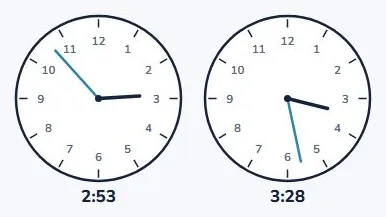
How long from 2:53 pm to 3:28 pm?
- Two clock faces, thirty-something minutes apart.
- Try subtracting: 28 minutes take 53 minutes.
- That goes negative, which cannot be right.
Because time is not base ten
- Last lesson everything divided by 10, 100 or 1000.
- Time does not. It counts in sixties.
- So 3.28 minus 2.53 is not a time calculation at all.
- Doing it that way gives 75 minutes, which is over an hour.
| Method | Gives | Sensible? |
|---|---|---|
| 28 − 53 | negative | no |
| 3.28 − 2.53 as decimals | 75 min | no |
| Bridge the hour | 35 min | yes |
Count up to the hour first
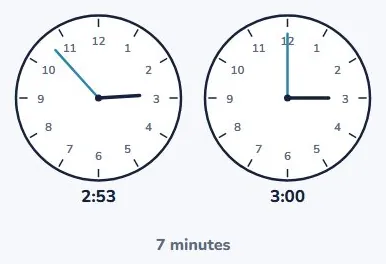
- From 2:53, how far to 3:00?
- 53 and 7 make 60, so 7 minutes.
- That gets you to a round hour, where counting is easy.
Then carry on from the hour
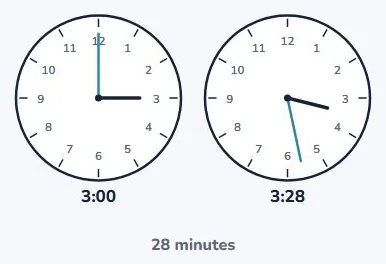
- From 3:00 to 3:28 is just 28 minutes.
- No borrowing, no sixties: you read it straight off.
Add the two pieces
- 7 minutes up to the hour, then 28 minutes after it.
- 7 + 28 = 35.
- So 2:53 pm to 3:28 pm is 35 minutes.
- Two easy steps instead of one impossible subtraction.
| Piece | How | Minutes |
|---|---|---|
| 2:53 pm to 3:00 pm | up to the hour | 7 min |
| 3:00 pm to 3:28 pm | then onwards | 28 min |
| Total | 7 + 28 | 35 min |
Try it: bridge the hour
This works every time
- Up to the next hour, then on to the finish.
- If both times are in the same hour, you do not need it.
- If they cross an hour, always bridge it.
Sixties all the way up
- 60 seconds in a minute. 60 minutes in an hour.
- Which makes 3600 seconds in an hour.
- Nothing here is a ten, a hundred or a thousand.
| One | Is |
|---|---|
| 1 minute | 60 seconds |
| 1 hour | 60 minutes |
| 1 hour | 3600 seconds |
Minutes into hours and minutes
- 150 minutes. How many whole hours fit?
- 150 ÷ 60 = 2, with 30 left over.
- So 150 minutes is 2 hours 30 minutes.
- A division with a remainder, exactly as in the division lesson.
| Convert | Working | Answer |
|---|---|---|
| 150 min | 150 ÷ 60 | 2 h 30 min |
| 2.5 hours | half of 60 is 30 | 2 h 30 min |
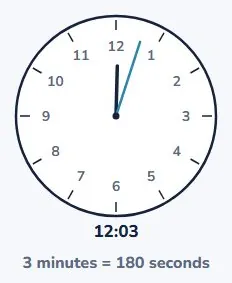
| 3 min | 3 × 60 | 180 s |
| 90 s | 90 − 60 | 1 min 30 s |
2.5 hours is not 2 hours 50
- Half of an hour is half of 60, which is 30.
- So 2.5 hours is 2 hours 30 minutes.
- The 5 after the point means half, not fifty.
- Same for 1.25 hours: a quarter of 60 is 15 minutes.
| Written | Means | Not |
|---|---|---|
| 2.5 h | 2 h 30 min | 2 h 50 min |
| 1.25 h | 1 h 15 min | 1 h 25 min |
And down to seconds
- 3 minutes into seconds: 3 × 60 = 180 s.
- 90 seconds back into minutes: 60 and 30 left, so 1 min 30 s.
- Multiply going down, divide going up. Always by 60.
12-hour time needs am or pm
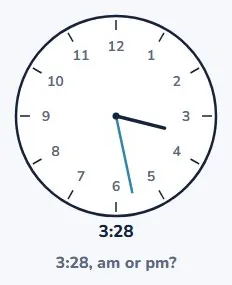
- A clock face only goes up to 12, so each number happens twice a day.
- Am is before midday. pm is after it.
- Leave them off and 3:28 could be either.
24-hour time does not
- The hours run 00 to 23, so every one is different.
- Morning hours look the same: 09:15 is 9:15 am.
- Afternoon ones have 12 added: 15:28 is 3:28 pm.
- No am, no pm, no confusion.
| 12-hour | 24-hour | When |
|---|---|---|
| 9:15 am | 09:15 | morning |
| 12:00 pm | 12:00 | midday |
| 3:28 pm | 15:28 | afternoon |
| 11:40 pm | 23:40 | night |
Swapping between them
- Afternoon into 24-hour: add 12 to the hour. 3:28 pm → 15:28.
- 24-hour into afternoon: subtract 12. 19:45 → 7:45 pm.
- Morning times need no change at all.
- Watch midnight: that is 00:00, not 24:00.
| From | Do this | To |
|---|---|---|
| 3:28 pm | add 12 | 15:28 |
| 19:45 | subtract 12 | 7:45 pm |
| 9:15 am | nothing | 09:15 |
Try it: 12-hour and 24-hour time
Which is why timetables use it
- A bus at 7:30 is very different from a bus at 19:30.
- Timetables cannot afford that kind of doubt.
- So schedules, hospitals and the army all use 24-hour time.
Reading a timetable
- Each row is a stop. Each column is one bus.
- Read down a column to follow one bus along the route.
- Read across a row to see when each bus reaches that stop.
- These times are made up, but the stops are real.
| Stop | Bus 1 | Bus 2 |
|---|---|---|
| Avondale | 8:15 | 8:45 |
| Mount Albert | 8:32 | 9:02 |
| Kingsland | 8:49 | 9:19 |
| Britomart | 9:05 | 9:35 |
How long is the whole trip?
- Bus 1 leaves Avondale at 8:15 and reaches Britomart at 9:05.
- Bridge the hour: 45 minutes to 9:00, then 5 more.
- 45 + 5 = 50 minutes.
- Check Bus 2: 8:45 to 9:35 is also 50. Same trip, same time.
| Stop | Bus 1 | Bus 2 |
|---|---|---|
| Avondale | 8:15 | 8:45 |
| Mount Albert | 8:32 | 9:02 |
| Kingsland | 8:49 | 9:19 |
| Britomart | 9:05 | 9:35 |
And part of the trip
- Mount Albert to Britomart on Bus 1: 8:32 to 9:05.
- 8:32 to 9:00 is 28 minutes.
- Then 9:00 to 9:05 is 5 more.
- 33 minutes. The bridge again.
| Piece | How | Minutes |
|---|---|---|
| 8:32 to 9:00 | up to the hour | 28 min |
| 9:00 to 9:05 | then onwards | 5 min |
| Total | 28 + 5 | 33 min |
And how long you would wait
- Miss Bus 1 at Avondale (8:15) and the next is 8:45.
- Both times are in the same hour, so no bridging needed.
- 45 − 15 = 30 minutes of waiting.
- Every stop is 30 minutes apart, because the buses are.
| Stop | Bus 1 | Bus 2 |
|---|---|---|
| Avondale | 8:15 | 8:45 |
| Mount Albert | 8:32 | 9:02 |
| Kingsland | 8:49 | 9:19 |
| Britomart | 9:05 | 9:35 |
Bigger units of time
- A solar calendar counts a year by the sun (the Gregorian one).
- A lunar calendar counts months by the moon.
- Maramataka Māori follows the moon’s phases.
- It has long guided the best times for planting and fishing.
| Calendar | Kind | Counts by |
|---|---|---|
| Gregorian | solar | the 365-day year most of the world uses |
| Maramataka Māori | lunar | follows the phases of the moon |
| Chinese | lunar | months set by the moon, year by the sun |
Common mistakes
- 2:53 pm to 3:28 pm is 3.28 − 2.53 = 75 minutes.Time counts in sixties, not tens. Go 7 minutes up to 3:00, then 28 more: 35 minutes.
- 3.5 hours is 350 minutes.An hour is 60 minutes, so 3 hours is 180 minutes and half an hour is 30. That makes 210 minutes.
- 21:05 is 9:05 am.Hours past 12 are after midday. Take away 12, so 21:05 is 9:05 pm.
- 150 minutes is 1.5 hours.150 ÷ 60 is 2 with 30 left over, so 150 minutes is 2 hours 30 minutes.
Eight to try
How long from 4:47 pm to 5:12 pm?
Write 21:05 as 12-hour time.
How many minutes is 3.5 hours?
On the timetable, how long is Kingsland to Britomart?
A runner finishes a race in 195 seconds. Write this in minutes and seconds.
A bus leaves Hamilton at 10:40 and arrives in Auckland at 13:15. How long is the trip?
A ferry leaves Wellington at 23:50 and the trip takes 40 minutes. What time does it arrive, in 24-hour time?
The bus to Britomart takes 50 minutes. Aroha must arrive by 9:20 am. What is the latest she can leave?
Show answer
Answers: 1. 25 minutes: 13 up to 5:00, then 12. An answer of 35 means they subtracted 47 from 12 and flipped the sign. 2. 9:05 pm. 3. 210 minutes: 3 × 60 is 180, plus half an hour. An answer of 350 is the decimal trap. 4. 8:49 to 9:05; 11 minutes up to the hour, then 5, so 16 minutes. 5. 3 min 15 s: 195 ÷ 60 = 3, with 15 left over. Do not read 195 ÷ 60 = 3.25 as 3 min 25 s. 6. 2 h 35 min: 20 minutes up to 11:00, 2 hours on to 13:00, then 15 more. Subtracting 10.40 from 13.15 as decimals gives nonsense. 7. 00:30: 10 minutes up to midnight, then 30 more. Midnight is 00:00, not 24:00, and 00:40 forgets the 10 minutes before midnight. 8. 8:30 am: count back 20 minutes to 9:00 am, then the other 30 to 8:30 am.
Bridge the hour, and count in sixties
- Crossing an hour? Go up to it, then on from it.
- Everything is 60s, never 10s, 100s or 1000s.
- And 24-hour time exists so nobody has to guess.
| Piece | How | Minutes |
|---|---|---|
| 2:53 pm to 3:00 pm | up to the hour | 7 min |
| 3:00 pm to 3:28 pm | then onwards | 28 min |
| Total | 7 + 28 | 35 min |
Challenge
Aroha's watch gains 2 minutes every hour. She sets it to the right time at 08:00 on Monday. What time does the watch show when the real time is 20:00 on Tuesday? Give the answer in 24-hour and 12-hour time. At what real time was the watch exactly one hour fast?
Hint
Count the real hours that pass first. For the second part: how many hours does it take to gain 60 minutes?
Answer
It shows 21:12 (9:12 pm). It was exactly one hour fast at 14:00 (2:00 pm) on Tuesday.
Step by step
- From 08:00 Monday to 08:00 Tuesday is 24 hours, and on to 20:00 Tuesday is 12 more: 36 hours.
- In 36 hours the watch gains 36 × 2 = 72 minutes, which is 1 hour 12 minutes.
- 20:00 plus 1 hour 12 minutes is 21:12, which is 9:12 pm.
- To gain 60 minutes at 2 minutes an hour takes 30 hours.
- 30 hours after 08:00 Monday is 14:00 on Tuesday.
Full working
- 24 + 12 = 36 hoursMonday 08:00 to Tuesday 20:00
- 36 × 2 = 72 min = 1 h 12 mintime gained
- 20:00 + 1 h 12 min = 21:12watch reading
- 21:12 − 12 h = 9:12 pm12-hour time
- 60 ÷ 2 = 30 hoursto gain one hour
- 08:00 Monday + 30 h = 14:00 Tuesday
- shows 21:12 (9:12 pm); one hour fast at 14:00 Tuesday
Two buses leave the same stop. Route 18 leaves every 12 minutes, starting at 07:05. Route 66 leaves every 18 minutes, starting at 07:11. At what time do the two buses first leave together? When is the next time after that?
Hint
List the times for each route, bridging the hour carefully. Once you find one shared time, think about how long until both timetables line up again.
Answer
They first leave together at 07:29, and next at 08:05.
Step by step
- Route 18: 07:05, 07:17, 07:29, 07:41, 07:53, 08:05, ...
- Route 66: 07:11, 07:29, 07:47, 08:05, ...
- The first time on both lists is 07:29.
- After that, both line up again after a time that is a multiple of 12 and of 18. The smallest is 36 minutes.
- 07:29 plus 36 minutes is 08:05, which is on both lists.
Full working
- 07:05, 07:17, 07:29, 07:41, 07:53, 08:05add 12 minutes each time
- 07:11, 07:29, 07:47, 08:05add 18 minutes each time
- first match 07:29on both lists
- 36 = 3 × 12 = 2 × 18smallest common multiple
- 07:29 + 36 min: 31 min to 08:00, then 5 more = 08:05bridge the hour
- 07:29, then 08:05
In a certain year, 1 March is a Wednesday. On what day of the week is Christmas Day (25 December) that year? Explain why it does not matter whether the year is a leap year.
Hint
Count the days from 1 March to 25 December, month by month (30 days hath September, April, June and November). Then think about whole weeks.
Answer
Christmas Day is a Monday. The leap day (29 February) comes before 1 March, so it does not change the count.
Step by step
- From 1 March to 1 December is the days in March to November: 31 + 30 + 31 + 30 + 31 + 31 + 30 + 31 + 30 = 275.
- From 1 December to 25 December is 24 more days, so 299 days in all.
- 299 = 42 × 7 + 5, so that is 42 whole weeks and 5 days.
- Whole weeks land on the same weekday, so count 5 days on from Wednesday: Thursday, Friday, Saturday, Sunday, Monday.
- February is not in the count at all, so a leap year changes nothing.
Full working
- 31 + 30 + 31 + 30 + 31 + 31 + 30 + 31 + 30 = 275March to November
- 275 + 24 = 299 dayson to 25 December
- 299 ÷ 7 = 42 remainder 5whole weeks and days left
- Wednesday + 5 days = Mondaycount on
- Christmas Day is a Monday, leap year or not
Where science uses this
Practise this
Report a mistake
More in Measurement
Is your child on track?
Take the free placement test