Area, volume and angles
What this lesson covers
- The volumes of rectangular prisms can be calculated by multiplication of side lengths.
- Angles at a point sum to 360°.
- Angles on a straight line sum to 180°.
Area is how many squares fit inside
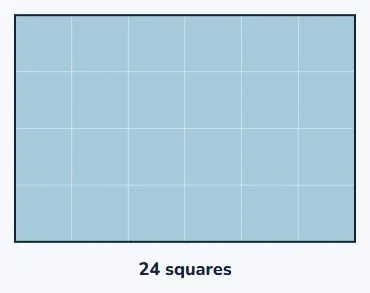
- This rectangle is 6 cm across and 4 cm down.
- You could count the centimetre squares one at a time.
- There are 24. But nobody wants to count 24 squares.
So multiply instead
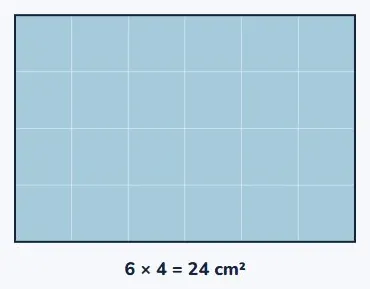
- Each row has 6 squares, and there are 4 rows.
- 6 × 4 = 24.
- Area of a rectangle is length times width. That is all.
Why cm² and not cm
- Cm measures a length: one direction.
- Cm² measures an area: two directions multiplied.
- The little 2 says two lengths went into it.
- An area written in cm has lost the point of the answer.
| Written | Measures | Lengths used |
|---|---|---|
| cm | length | 1 |
| cm² | area | 2 |
| cm³ | volume | 3 |
A right-angled triangle is half of it
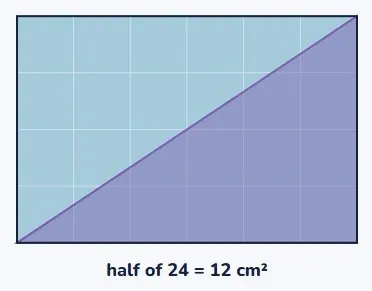
- Cut the rectangle corner to corner.
- Two identical right-angled triangles.
- So each one is half of 24, which is 12 cm².
- You never work out a triangle from scratch.
Base times height, then halve
- Find the rectangle it came out of: base × height.
- Then halve it.
- 6 × 4 = 24, and half of that is 12 cm².
- Halve at the end, not the start; the numbers stay whole longer.
| Step | Working | Answer |
|---|---|---|
| Whole rectangle | 6 × 4 | 24 cm² |
| Halve it | 24 ÷ 2 | 12 cm² |
Try it: half of a rectangle
And volume is three lengths
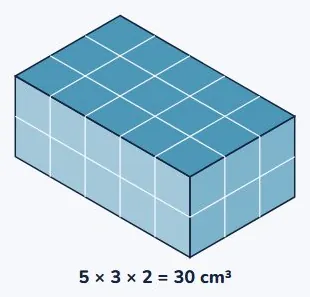
- A box 5 cm by 3 cm by 2 cm.
- The bottom layer is 5 × 3 = 15 cubes.
- Two layers, so 15 × 2 = 30.
- 30 cm³: cubic, because three lengths were multiplied.
An angle is an amount of turn
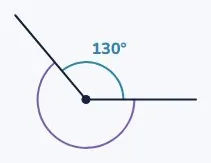
- Not a length, and not how long the arms are drawn.
- It is how far you turn to get from one arm to the other.
- Measured in degrees, and a full turn is 360 of them.
The five kinds, by size
- Under 90° is acute. Exactly 90° is a right angle.
- Between 90° and 180° is obtuse.
- Exactly 180° is straight, and over 180° is reflex.
- Classifying one is just reading its size.
| Kind | Size | Looks like |
|---|---|---|
| Acute | less than 90° | a sharp corner |
| Right | exactly 90° | a square corner |
| Obtuse | between 90° and 180° | a wide corner |
| Straight | exactly 180° | a straight line |
| Reflex | more than 180° | more than half a turn |
Reading a protractor without getting caught
- Line the centre on the corner and one arm on zero.
- A protractor has two scales, running opposite ways.
- Read the one that starts at zero on your arm.
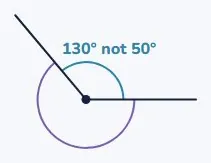
- Check the answer against the kind: an obtuse angle cannot be 50°.
Angles on a straight line add to 180°
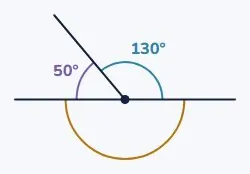
- A straight line is half a full turn.
- Half of 360 is 180.
- So any angles sitting on one side of a line add to 180°.
Which finds you a missing angle
- One angle on the line is marked 130°.
- The other is not marked. Call it the unknown.
- The two must add to 180, so subtract: 180 − 130.
- The unknown angle is 50°.
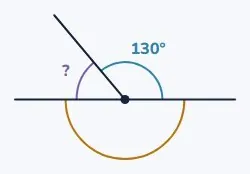
Try it: angles on a straight line
Angles at a point add to 360°
- All the way round is a full turn.
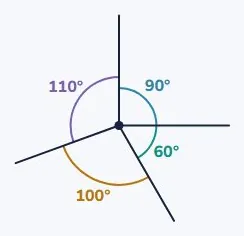
- So every angle meeting at one point adds to 360°.
- Here: 90 and 110 and 100 and 60. Add them up.
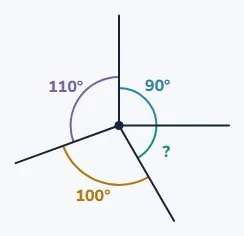
And finds a missing one the same way
- Three are marked: 90°, 110° and 100°.
- Those three add to 300.
- A full turn is 360, so the last one is 360 − 300.
- 60°.
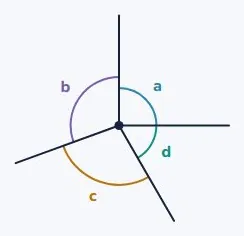
Naming an angle
- An angle sits between two arms, at a corner.
- Name it by the corner, or mark it with a letter.
- Saying "the angle at the point" is not enough when four meet there.
Two crossing lines make equal pairs
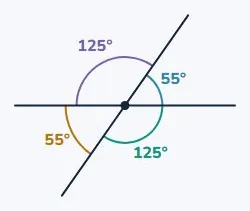
- Cross two straight lines. Four angles appear.
- The pairs facing each other are called vertically opposite.
- And vertically opposite angles are always equal.
- Here: 55° opposite 55°, and 125° opposite 125°.
Why they have to be equal
- The 55° and the 125° sit on a straight line, so they make 180.
- The 125° and the other 55° sit on a line too (also 180).
- Both 55s are "180 minus the same 125".
- So they cannot be anything but equal.
| Pair on a line | Adds to |
|---|---|
| 55° and 125° | 180° |
| 125° and 55° | 180° |
Using it
- One angle where two lines cross is marked 55°.
- The one directly opposite is vertically opposite it.
- So it is 55° too; no subtracting needed.
- Copy it straight across.
A problem needing two facts
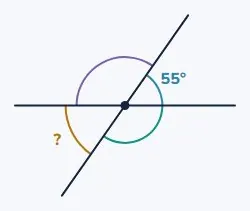
- Two lines cross. One angle is 55°.
- Find the angle next to it: on a line, so 180 − 55 = 125°.
- Now find the one opposite that: vertically opposite, so 125°.
- Two facts, two steps, all four angles known.
| Angle | Fact used | Size |
|---|---|---|
| Given | None | 55° |
| Next to it | line = 180° | 125° |
| Opposite the given | vertically opposite | 55° |
| The fourth | vertically opposite | 125° |
Common mistakes
- A right-angled triangle with base 8 cm and height 5 cm has area 8 × 5 = 40 cm².The triangle is half of its rectangle, so its area is 40 ÷ 2 = 20 cm².
- The rectangle is 6 cm by 4 cm, so its area is 24 cm.Area multiplies two lengths, so it is in square units: 24 cm².
- My protractor says this obtuse angle is 50°.You read the wrong scale. Use the one that starts at 0 on your arm. An obtuse angle is between 90° and 180°, so it is 130°.
- Two lines cross and one angle is 40°, so the angle opposite it is 140°.Vertically opposite angles are equal, so it is 40°. The angles next to it are 180 − 40 = 140°.
Eight to try
What is the area of a rectangle 8 cm by 5 cm?
What is the area of a right-angled triangle with base 8 and height 5?
Two angles on a straight line: one is 72°. What is the other?
Two lines cross and one angle is 40°. What are the other three?
An angle measures 205°. What kind of angle is it?
A rectangular garden has an area of 42 m² and is 7 m long. How wide is it?
Ana measures an obtuse angle and her protractor reads 60°. What is the angle most likely to be?
Eight angles meet at a point. Three are 90°, 85° and 120°. What is the fourth?
Show answer
Answers: 1. 40 cm², and the units must be squared. 2. 20 cm², half of 40; if they halve first and get 20 by another route that is fine. 3. 108°, because 180 − 72. 4. 140°, 40°, 140°: the opposite one is 40° by vertically opposite, and the two next to it are 180 − 40. Watch for an answer of 320° on question 4, which is 360 minus 40 and means they used the wrong fact. 5. Reflex, because 205° is more than 180°. 6. 6 m. Length × width = area, so the width is 42 ÷ 7 = 6. 7. 120°. An obtuse angle cannot be 60°, so she read the wrong scale, and 180 − 60 = 120. 8. 65°. The three add to 295, and angles at a point add to 360°, so 360 − 295 = 65.
Area Builder
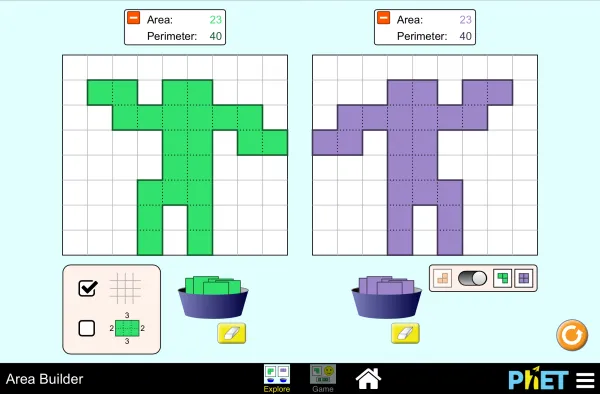
Full screen · PhET Interactive Simulations, University of Colorado Boulder, CC BY 4.0
Three facts, and what each is for
- A line is 180°. A point is 360°. Opposites are equal.
- Each one turns a marked angle into an unmarked one.
- And areas are squared units, volumes cubic.
| Where | Fact | Use it to |
|---|---|---|
| On a straight line | add to 180° | find one from the other |
| At a point | add to 360° | find one from the rest |
| Vertically opposite | are equal | copy it straight across |
Challenge
A square has a perimeter of 24 cm. A right-angled triangle has exactly the same area as the square. One of the two sides next to the triangle's right angle is 4 cm. How long is the other one?
Hint
Find the square's side and area first. The triangle is half of a rectangle: what area must that rectangle have?
Answer
The other side is 18 cm.
Step by step
- A square has 4 equal sides, so each side is 24 ÷ 4 = 6 cm.
- Its area is 6 × 6 = 36 cm², so the triangle's area is 36 cm² too.
- The triangle is half of a rectangle, so that rectangle has area 2 × 36 = 72 cm².
- The rectangle is 4 cm by the missing side, so the missing side is 72 ÷ 4 = 18 cm.
Full working
- 24 ÷ 4 = 6 cmside of the square
- 6 × 6 = 36 cm²area of the square
- 36 × 2 = 72 cm²the triangle's rectangle
- 72 ÷ 4 = 18 cmother side of the rectangle
- check: 4 × 18 = 72, half is 36 cm²
- the other side is 18 cm
Three straight lines all cross at one point, making six angles around it. Two of the angles that sit next to each other are 40° and 75°. Find the sizes of all six angles, going round the point in order.
Hint
Each line is straight, so three neighbouring angles make a straight line. Each angle also has a partner directly opposite it.
Answer
Going round: 40°, 75°, 65°, 40°, 75°, 65°.
Step by step
- Any three angles in a row around the point sit on one side of a straight line, so they add to 180°.
- So the angle after 40° and 75° is 180 − 40 − 75 = 65°.
- Each of the six angles is vertically opposite the one three places further round.
- So the other three are 40°, 75° and 65° again.
- Check: all six add to 360°.
Full working
- 40 + 75 + x = 180three angles on a straight line
- x = 180 − 115 = 65°the third angle
- opposite angles: 40°, 75°, 65°vertically opposite angles are equal
- 40 + 75 + 65 + 40 + 75 + 65 = 360angles at a point
- 40°, 75°, 65°, 40°, 75°, 65°
On centimetre grid paper, a triangle has its corners at the points (0, 0), (8, 2) and (3, 6). None of its angles is a right angle. Find its area.
Hint
Draw the smallest rectangle, along the grid lines, that the triangle fits inside. The pieces of the rectangle outside the triangle are all right-angled triangles.
Answer
The area is 21 cm².
Step by step
- The triangle fits in a rectangle from x = 0 to 8 and y = 0 to 6, which is 8 × 6 = 48 cm².
- Outside the triangle are three right-angled triangles, each half of a smaller rectangle.
- From (0, 0) to (8, 2): half of 8 × 2, which is 8 cm².
- From (8, 2) to (3, 6): half of 5 × 4, which is 10 cm². From (3, 6) to (0, 0): half of 3 × 6, which is 9 cm².
- So the triangle is 48 − 8 − 10 − 9 = 21 cm².
Full working
- 8 × 6 = 48 cm²surrounding rectangle
- 8 × 2 ÷ 2 = 8 cm²bottom corner piece
- 5 × 4 ÷ 2 = 10 cm²right corner piece
- 3 × 6 ÷ 2 = 9 cm²left corner piece
- 8 + 10 + 9 = 27 cm²all the outside pieces
- 48 − 27 = 21 cm²
Practise this
Report a mistake
More in Measurement
Is your child on track?
Take the free placement test