Metric units, measuring and volume
What this lesson covers
- Measurements can be approximated by referencing previously measured benchmark lengths, volumes, or areas.
- Prefixes are added to base metric units to signify larger or smaller quantities. The prefix: 'milli–' (m) signifies a unit one thousand times smaller than the base unit 'centi–' (c) signifies a unit one hundred times smaller than the base unit 'kilo–' (k) signifies a unit one thousand times larger than the base unit.
- Converting between metric units can involve multiplying and dividing by 10, 100, or 1000.
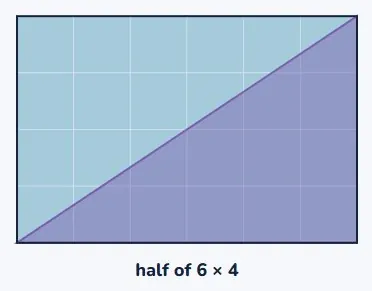
- The area of a right-angled triangle is equal to half the area of a rectangle with the same base and height.
You do not have to memorise a conversion table
- How many millimetres in a metre? Centimetres in a metre?
- Metres in a kilometre? Grams in a kilogram?
- That is four facts, and there are only three things to know.
- The words already tell you the numbers.
Milli means a thousandth
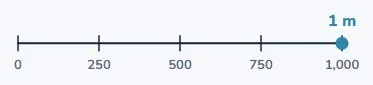
- A millimetre is a thousandth of a metre.
- So there are 1000 millimetres in a metre.
- The prefix is the fact. Nothing else to remember.
Centi means a hundredth
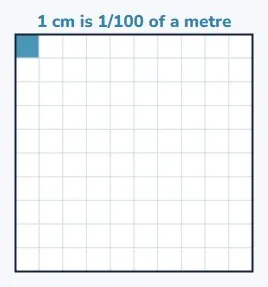
- A centimetre is a hundredth of a metre.
- So 100 centimetres make a metre.
- Same word as in "century": a hundred years.
Kilo means a thousand times bigger
- This one goes the other way: bigger, not smaller.
- A kilometre is a thousand metres.
- A kilogram is a thousand grams.
| Prefix | Means | So |
|---|---|---|
| milli– | a thousandth | 1000 mm = 1 m |
| centi– | a hundredth | 100 cm = 1 m |
| kilo– | a thousand times | 1000 m = 1 km |
And they work on everything
- The three prefixes are not about length. They are about size.
- So they attach to grams and litres in exactly the same way.
- Learn three words and you know every conversion in Year 6.
| Measures | Base unit | With prefixes |
|---|---|---|
| Length | metre | mm, cm, km |
| Mass | gram | mg, g, kg |
| Capacity | litre | mL, L |
Three rows, not twelve
- This is the whole of metric conversion.
- Every question is a multiply or divide by 10, 100 or 1000.
- Which one, and which direction: that is all you decide.
| Prefix | Means | So |
|---|---|---|
| milli– | a thousandth | 1000 mm = 1 m |
| centi– | a hundredth | 100 cm = 1 m |
| kilo– | a thousand times | 1000 m = 1 km |
Try it: three prefixes, every unit
Metres to centimetres
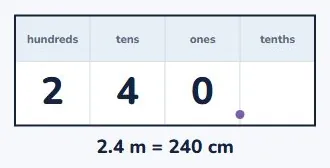
- Change 2.4 m into centimetres.
- 100 cm in a metre, so multiply by 100.
- 2.4 × 100 = 240 cm.
- Every digit moved up two columns, exactly as in the decimals lesson.
Grams to kilograms
- Change 2500 g into kilograms.
- 1000 g in a kilogram, so divide by 1000.
- 2500 ÷ 1000 = 2.5 kg.
| Change | Do this | Answer |
|---|---|---|
| 2.4 m to cm | × 100 | 240 cm |
| 2500 g to kg | ÷ 1000 | 2.5 kg |
| 3 km to m | × 1000 | 3000 m |
| 45 mm to cm | ÷ 10 | 4.5 cm |
Which way round? Ask which unit is bigger
- Going to a smaller unit needs MORE of them, so multiply.
- Going to a bigger unit needs FEWER, so divide.
- 2.4 m became 240 cm: more centimetres than metres. Correct.
- If your number went the wrong way, you divided instead of multiplying.
| Going to a… | You need | So |
|---|---|---|
| smaller unit | more of them | multiply |
| bigger unit | fewer of them | divide |
Combining mixed units
- 10 kg and 500 g. Write it as one number in kilograms.
- 500 g is half a kilogram, so 0.5 kg.
- 10 + 0.5 = 10.5 kg.
| Mixed | The small part | As one number |
|---|---|---|
| 10 kg and 500 g | 500 g is 0.5 kg | 10.5 kg |
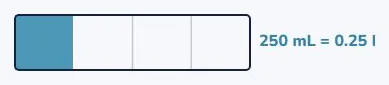
| 1 L and 250 mL | 250 mL is 0.25 L | 1.25 L |
| 2 m and 40 cm | 40 cm is 0.4 m | 2.4 m |
The same with capacity
- 1 L and 250 mL. There are 1000 mL in a litre.
- 250 out of 1000 is a quarter, so 0.25 L.
- 1 + 0.25 = 1.25 L.
- Two decimal places, and both of them mean something.
One thing is not metric: time
- 60 seconds in a minute. 60 minutes in an hour.
- No prefixes, and nothing divides by 10.
- So 2.5 hours is 2 hours 30 minutes, not 2 hours 50.
- Be careful when time turns up in a measuring question.
| Measurement | Divides by |
|---|---|
| Length, mass, capacity | 10, 100, 1000 |
| Time | 60 |
Reading a real instrument
- Ruler for length. Scales for mass. Jug for capacity.
- Thermometer for temperature. Timer for duration.
- For each one, check what the small marks are worth first.
- Not every ruler counts in millimetres, and not every jug in 100s.
| Measuring | Instrument | Units |
|---|---|---|
| Length | ruler | mm, cm, m |
| Mass | scales | g, kg |
| Capacity | measuring jug | mL, L |
| Temperature | thermometer | degrees |
| Duration | timer | min, s |
Estimating from things you already know
- A benchmark is a measurement you carry in your head.
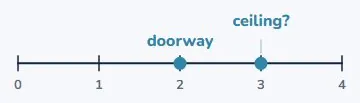
- A doorway is about 2 m. A bag of sugar is 1 kg.
- A big drink bottle is 1 L. A fingernail is about 1 cm.
- Compare the unknown thing with one of those.
| Benchmark | Roughly |
|---|---|
| A doorway | about 2 m tall |
| A bag of sugar | 1 kg |
| A big drink bottle | 1 L |
| A fingernail | about 1 cm across |
Using one
- How tall is your classroom? You cannot reach the ceiling.
- But the doorway is about 2 m, and the ceiling is higher.
- Looks like about one and a half doorways, so roughly 3 m.
- Not exact, and not meant to be. Sensible is the goal.
Volume is how many cubes fit inside
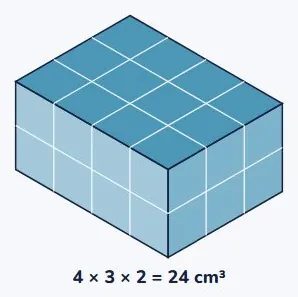
- Take a box 4 cm long, 3 cm wide and 2 cm tall.
- The bottom layer holds 4 × 3 = 12 centimetre cubes.
- There are 2 layers, so 12 × 2 = 24 cubes.
- That is 24 cubic centimetres.
So volume is just three lengths multiplied
- Length × width × height.
- It works in any order: 4 × 3 × 2 or 2 × 3 × 4.
- Counting the layers is why it works.
| Step | Working | Answer |
|---|---|---|
| One layer | 4 × 3 | 12 cubes |
| All layers | 12 × 2 | 24 cubes |
Try it: three lengths multiplied
Why the little 3
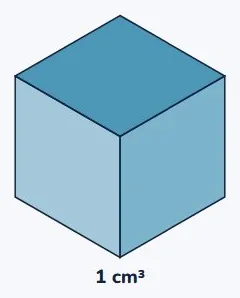
- Cm³ is read "cubic centimetres": a cube 1 cm each way.
- The 3 says three lengths were multiplied together.
- A cubic metre, m³, is a cube a metre each way. Much bigger.
- Use cm³ for a lunchbox and m³ for a room.
One fact to carry into the next lesson
- Draw a rectangle and cut it corner to corner.
- You get two identical right-angled triangles.
- So a right-angled triangle is exactly half its rectangle.
- Part 2 uses that to work out areas.
Common mistakes
- 2.4 m = 0.024 cmCentimetres are a smaller unit, so you need more of them. Multiply by 100: 2.4 m = 240 cm.
- 7 cm = 700 mmThere are 10 mm in 1 cm, not 100, so 7 cm = 70 mm.
- 10 kg and 50 g = 10.5 kg50 g is 50 out of 1000, which is 0.05 kg. So the total is 10.05 kg.
- A box 4 cm by 3 cm by 2 cm has a volume of 24 cm².Volume multiplies three lengths, so the unit is cubic: 24 cm³.
Eight to try
How many millimetres in 7 cm?
Write 3 kg and 250 g as one number in kilograms.
A box is 5 cm by 2 cm by 3 cm. What is its volume?
Estimate the height of a normal room, using a benchmark.
Change 4.5 L into millilitres.
The drive from Hamilton to Rotorua takes about 1.5 hours. Write that in hours and minutes.
Which is heavier, 1.2 kg of apples or 950 g of grapes, and by how much?
A box has a volume of 60 cm³. It is 5 cm long and 4 cm wide. How tall is it?
Show answer
Answers: 1. 70 mm: 10 mm in a centimetre, and going to a smaller unit means more of them. 2. 3.25 kg, because 250 g is a quarter of a kilogram. 3. 30 cm³ (5 × 2 × 3), and the units must be cubic. 4. Around 2.4 to 3 m; accept anything sensible with a stated benchmark, and reject a number with no reasoning behind it. On 3, watch for an answer written cm or cm² instead of cm³. 5. 4500 mL. There are 1000 mL in a litre, and going to a smaller unit means more of them: 4.5 × 1000 = 4500. 6. 1 hour 30 minutes. Time is not metric: half an hour is half of 60 minutes, which is 30. 7. The apples, by 250 g. 1.2 kg is 1200 g, and 1200 − 950 = 250. 8. 3 cm. One layer is 5 × 4 = 20 cubes, and 60 ÷ 20 = 3 layers.
Three prefixes and one direction check
- Milli, centi, kilo: on metres, grams and litres alike.
- Smaller unit means more of them, so multiply.
- And volume is three lengths multiplied, in cubic units.
| Prefix | Means | So |
|---|---|---|
| milli– | a thousandth | 1000 mm = 1 m |
| centi– | a hundredth | 100 cm = 1 m |
| kilo– | a thousand times | 1000 m = 1 km |
Challenge
A carton holds 24 identical tins of tomatoes. The full carton weighs 9.84 kg, and the empty carton weighs 240 g. The label on each tin says it holds 375 g of tomatoes. How much does one empty tin weigh, in grams?
Hint
Put everything into grams first. Take off the carton, share what is left between the tins, then take off the tomatoes.
Answer
One empty tin weighs 25 g.
Step by step
- 9.84 kg is 9840 g.
- Without the carton, the 24 full tins weigh 9840 − 240 = 9600 g.
- So one full tin weighs 9600 ÷ 24 = 400 g.
- The tomatoes are 375 g, so the tin itself is 400 − 375 = 25 g.
Full working
- 9.84 × 1000 = 9840 g1000 g in a kilogram
- 9840 − 240 = 9600 gtake off the carton
- 9600 ÷ 24 = 400 gone full tin
- 400 − 375 = 25 gtake off the tomatoes
- one empty tin weighs 25 g
A fish tank has a rectangular base 50 cm long and 40 cm wide. Rawiri pours in 30 L of water. One litre of water fills exactly 1000 cm³. How deep is the water? He then drops a rock in, and the water rises by 8 mm (the rock is completely under water). What is the volume of the rock?
Hint
Volume of water = base area × depth, so the depth is the volume divided by the base area. For the rock, think about the thin extra slab of water it pushes up.
Answer
The water is 15 cm deep, and the rock has a volume of 1600 cm³.
Step by step
- 30 L of water fills 30 × 1000 = 30 000 cm³.
- One 1 cm layer over the base holds 50 × 40 = 2000 cm³.
- 30 000 ÷ 2000 = 15, so there are 15 layers: the water is 15 cm deep.
- The rock pushes the water up 8 mm, which is 0.8 cm.
- The rock takes the place of a slab 50 cm by 40 cm by 0.8 cm, which is 1600 cm³.
Full working
- 30 × 1000 = 30 000 cm³1 L fills 1000 cm³
- 50 × 40 = 2000 cm³one 1 cm layer
- 30 000 ÷ 2000 = 15 cmnumber of layers
- 8 mm = 0.8 cm10 mm in a centimetre
- 50 × 40 × 0.8 = 1600 cm³slab the rock pushed up
- depth 15 cm, rock 1600 cm³
Tama glues together 120 one-centimetre cubes to make a solid block. The block is 6 cm long and 5 cm wide. He then dips the whole block in paint, so every outside face, including the bottom, is painted. When the paint is dry he pulls the cubes apart. How many of the small cubes have no paint on them at all, and how many have some paint?
Hint
First find the height from the volume. The unpainted cubes form a smaller block hidden inside: how much shorter is it in each direction?
Answer
24 cubes have no paint and 96 cubes have some paint.
Step by step
- One layer of the block is 6 × 5 = 30 cubes, and 120 ÷ 30 = 4, so the block is 4 cm tall.
- A cube has no paint only if it is not on any outside face.
- Peeling off one layer from each side takes 2 cm off every measurement.
- So the hidden block is 4 by 3 by 2, which is 24 cubes.
- The rest, 120 − 24 = 96 cubes, have some paint.
Full working
- 6 × 5 = 30 cubes in one layerlength × width
- 120 ÷ 30 = 4 cm tallnumber of layers
- 6 − 2 = 4, 5 − 2 = 3, 4 − 2 = 2remove an outside layer from both ends
- 4 × 3 × 2 = 24cubes hidden inside
- 120 − 24 = 96cubes touching the outside
- 24 cubes unpainted, 96 painted
Where science uses this
Practise this
Report a mistake
More in Measurement
Is your child on track?
Take the free placement test