Patterns, rules and the coordinate plane
What this lesson covers
- Inequalities can also include 'or equal to' (≤, ≥) to show a relationship that allows for the possibility of equality.
- Tables provide a way of organising the positions and elements of a pattern to reveal relationships or rules.
- A coordinate plane is formed when two perpendicular number lines intersect at (0, 0); usually the coordinate plane consists of a horizontal x-axis and a vertical y-axis.
- Coordinates are represented as (x,y), where the x-value represents horizontal movement and the y-value represents vertical movement. Plotting points on a coordinate plane can help to visualise numeric patterns.
Square tables pushed into a row
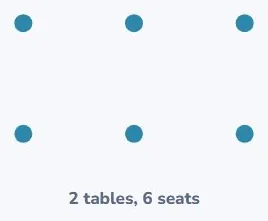
- One table on its own seats four people.
- Push a second one against it and the row seats six.
- Not eight: two seats get lost where they join.
- So how many does a row of twenty-five tables seat?
Keep going and watch what happens
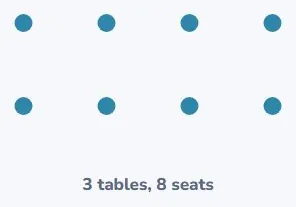
- Three tables seat eight. Four seat ten.
- Every extra table adds exactly two more seats.
- One along each side, and none on the joins.
Put it in a table to see it
- One column for the position, one for the answer.
- Now the pattern is lined up instead of remembered.
- A table is how you make a rule findable.
| Tables | Seats |
|---|---|
| 1 | 4 |
| 2 | 6 |
| 3 | 8 |
| 4 | 10 |
Try it: tables in a row
The gap is always two
- 4, 6, 8, 10, 12: up two every time.
- A constant difference means a simple rule exists.
- And the two is the two side seats per table.
| Tables | Seats | Gap |
|---|---|---|
| 1 | 4 | |
| 2 | 6 | +2 |
| 3 | 8 | +2 |
| 4 | 10 | +2 |
The rule, in words
- Two seats for every table: that is the "up two each time".
- Plus two more, one at each end of the row.
- So: double the number of tables, then add two.
- Those two end seats are the "plus two". You can point at them.
| Tables | Double it | Add 2 | Seats |
|---|---|---|---|
| 3 | 6 | +2 | 8 |
| 5 | 10 | +2 | 12 |
Now answer the original question
- Twenty-five tables. Double it: fifty.
- Add two: fifty-two seats.
- We never drew twenty-five tables. The rule did it.
- That is a conjecture: a prediction the rule lets you make.
| Tables | Working | Seats |
|---|---|---|
| 10 | 20 + 2 | 22 |
| 25 | 50 + 2 | 52 |
Always test a rule on a case you know
- Try the rule on 2 tables: double is 4, plus 2 is 6.
- And we counted 6 at the start. It agrees.
- A rule that fails a case you already know is wrong.
| Tables | Rule says | We counted |
|---|---|---|
| 1 | 4 | 4 |
| 2 | 6 | 6 |
| 3 | 8 | 8 |
Less than, and less than or equal to
- You know < and >. They mean strictly smaller and strictly bigger.
- ≤ and ≥ add three words: "or equal to".
- The little line underneath is the "or equal to".
| Symbol | Means |
|---|---|
| < | smaller than |
| ≤ | smaller than, or the same |
| > | bigger than |
| ≥ | bigger than, or the same |
Why those three words matter
- Is 5 < 5? No. Five is not smaller than five.
- Is 5 ≤ 5? Yes, because "or equal to" allows it.
- Same two numbers, opposite answers.
- So the symbol has to be read carefully, not skimmed.
| Sentence | True? |
|---|---|
| 5 < 5 | false |
| 5 ≤ 5 | true |
Is 8 × 7 ≤ 8 × 5 + 4² true?
- Work out each side, respecting the order of operations.
- Left: 8 × 7 = 56.
- Right: the square first, 4² = 16. Then 8 × 5 = 40. So 40 + 16 = 56.
- 56 ≤ 56 is true, and only because of the "or equal to".
| Side | Working | Value |
|---|---|---|
| Left | 8 × 7 | 56 |
| Right | 40 + 16 | 56 |
One symbol, opposite answers
- Is 3 × 6 > 2 × 9? Both sides are 18.
- 18 > 18 is false. Eighteen is not bigger than itself.
- But 3 × 6 ≥ 2 × 9 is true.
- Same six numbers. One extra line. Different answer.
| Sentence | Becomes | True? |
|---|---|---|
| 8 × 7 ≤ 8 × 5 + 4² | 56 ≤ 56 | true |
| 3 × 6 > 2 × 9 | 18 > 18 | false |
| 3 × 6 ≥ 2 × 9 | 18 ≥ 18 | true |
Completing an open sentence
- Fill the gap: 5 × ? = 45 − 5.
- Do the side you can first: 45 − 5 = 40.
- So 5 × ? = 40, which means ? is 8.
- Simplify one side, then the gap is obvious.
| Step | Sentence |
|---|---|
| Given | 5 × ? = 45 − 5 |
| Simplify the right | 5 × ? = 40 |
| Answer | ? = 8 |
Two number lines, crossed
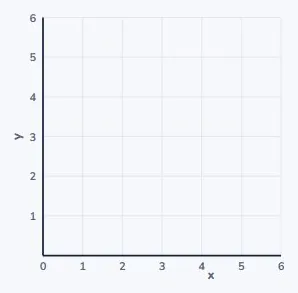
- Take a horizontal number line and a vertical one.
- Cross them at zero, at right angles.
- That is a coordinate plane, and the crossing point is (0, 0).
The x-axis and the y-axis
- The horizontal one is the x-axis.
- The vertical one is the y-axis.
- x goes across. y goes up. That order never changes.
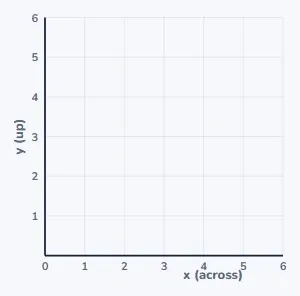
Along the corridor, then up the stairs
- A point is written (x, y), always in that order.
- The first number is how far across.
- The second is how far up.
- Along the corridor, then up the stairs.
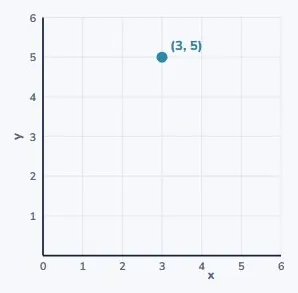
Plotting (3, 5)
- Start at (0, 0). Count 3 across.
- Then count 5 up from there.
- Mark the point. That is (3, 5).
- Get the order wrong and you land on (5, 3), somewhere else entirely.
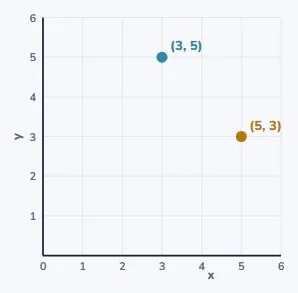
Try it: plot a point
Points that sit on an axis
- (4, 0) means 4 across and none up: it sits on the x-axis.
- (0, 3) means none across and 3 up (on the y-axis).
- A zero does not mean the point is missing.
- It means no movement in that direction.
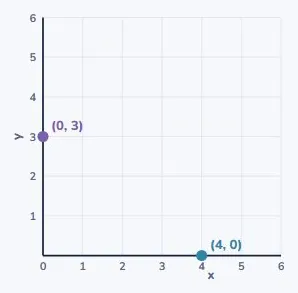
Now plot the tables
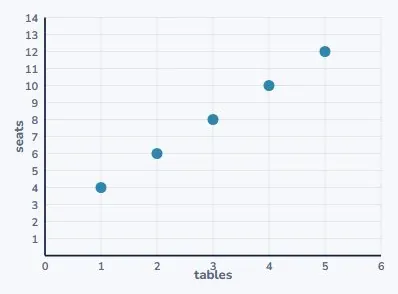
- Tables across, seats up. Each row of the table is one point.
- 1 table and 4 seats is the point (1, 4).
- Then (2, 6), (3, 8), (4, 10), (5, 12).
They make a straight line
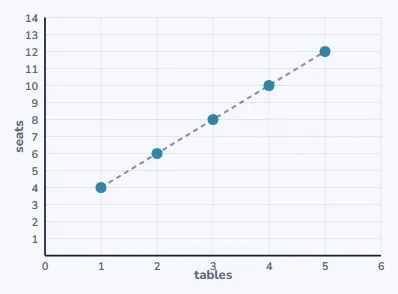
- Every point lies on one straight line.
- That is what a constant difference looks like when you plot it.
- And it means you could read off 6 tables without calculating.
- This is why plotting a pattern is worth doing.
Common mistakes
- One table seats 4, so 2 tables seat 8 and 25 tables seat 100.Two seats are lost at every join. The rule is double the tables, then add 2, so 25 tables seat 52.
- 8 × 5 + 4² = 40 + 8 = 484² means 4 × 4, which is 16, not 4 × 2. So the right side is 40 + 16 = 56.
- 3 × 6 > 2 × 9 is true, because both sides are 18.18 is not bigger than 18, so it is false. It would only be true with ≥, which allows equal.
- To plot (3, 5) I went 3 up and then 5 across.The x-value comes first: go 3 across, then 5 up. The other way lands you on (5, 3).
Eight to try
A pattern goes 5, 8, 11, 14. What is the rule in words?
Is 6 × 4 ≥ 5 × 5 true or false?
Fill the gap: 7 × ? = 30 + 5.
Which point is on the y-axis: (0, 6) or (6, 0)?
A pattern's rule is eight times the position, plus one. What is the 10th term?
What is the largest whole number that makes 6 × ? ≤ 42 true?
Point A is at (5, 2). Moana moves it 3 units straight up. Where is it now?
A pattern gives the points (1, 7), (2, 9) and (3, 11). Which point is on the same straight line?
Show answer
Answers: 1. Three times the position, plus two: 3, 6, 9, 12 plus 2 gives 5, 8, 11, 14. Accept "add 3 each time" but push for the position rule. 2. False: 24 ≥ 25 is not true, and the ≥ does not rescue it because they are not equal. 3. 5, since 30 + 5 is 35. 4. (0, 6): no movement across, so it stays on the y-axis. If they pick (6, 0) they have the axes swapped, and beat 15 is the one to revisit. 5. 41. Four times 10 is 40, plus one is 41. 6. 7. 6 × 7 = 42, and 42 ≤ 42 is true because of the "or equal to"; 6 × 8 = 48 is too big. 7. (5, 5). Moving up changes only the second number, the y-value: 2 + 3 = 5, and x stays 5. 8. (6, 17). The rule is double the position, then add 5, and 6 × 2 + 5 = 17.
Function Builder: Basics
Full screen · PhET Interactive Simulations, University of Colorado Boulder, CC BY 4.0
Pattern, table, rule, plot
- A table reveals the rule. The rule makes predictions.
- Plotting turns the pattern into a picture.
- And the little line under < means "or equal to".
| Step | What it gives you |
|---|---|
| Draw the pattern | the first few answers |
| Put it in a table | the constant difference |
| Write the rule | any answer you like |
| Plot the points | a straight line |
Challenge
Hexagons are made from matchsticks in a row, with neighbouring hexagons sharing a side. 1 hexagon needs 6 matchsticks, 2 need 11, and 3 need 16. Find the rule. Mere has 100 matchsticks. How many hexagons can she make in one row, and how many sticks are left over? She then decides to make several separate rows instead, using every one of the 100 sticks. What is the fewest rows she can make?
Hint
Put the pattern in a table and look at the gap. For separate rows, every row needs its own extra stick at the start, so count how many sticks are needed for the hexagons and how many for the rows.
Answer
Rule: 5 times the number of hexagons, plus 1. One row: 19 hexagons, with 4 sticks left over. Using all 100 sticks needs at least 5 separate rows (19 hexagons in all).
Step by step
- The table goes 6, 11, 16: up 5 each time, because each new hexagon shares one side and adds 5 sticks.
- 1 hexagon is 5 + 1, so the rule is 5 × hexagons + 1. The extra 1 is the first upright stick of the row.
- One row: 5 × 19 + 1 = 96 ≤ 100, but 5 × 20 + 1 = 101 is too many. So 19 hexagons and 4 left.
- With separate rows, every hexagon costs 5 sticks and every row costs 1 extra stick.
- 1, 2, 3 or 4 rows leave 99, 98, 97 or 96 sticks for hexagons, and none of those is a multiple of 5. 5 rows leave 95, which is 19 hexagons.
Full working
- 6, 11, 16up 5 each time
- sticks = 5 × hexagons + 1check: 5 × 3 + 1 = 16
- 5 × 19 + 1 = 96 ≤ 100, 5 × 20 + 1 = 101 > 100largest row is 19
- 100 − 96 = 4sticks left
- 100 − rows must be a multiple of 55 sticks per hexagon
- 100 − 5 = 95 = 5 × 19the first number of rows that works
- 19 hexagons with 4 left; fewest rows using all 100 sticks is 5
Find every whole number ? that makes both of these true: 3 × ? + 4² ≤ 2 × 17 and 2 × ? ≥ 10 − 2. Then answer again with ≤ changed to < and ≥ changed to >.
Hint
Work out every part you can first, so each sentence has only one unknown piece. Then test the numbers at the edges carefully, remembering what the little line under the symbol allows.
Answer
4, 5 and 6. With < and > instead, only 5 works.
Step by step
- 4² = 16 and 2 × 17 = 34, so the first sentence is 3 × ? + 16 ≤ 34, which means 3 × ? ≤ 18.
- 3 × 6 = 18 is allowed by ≤, but 3 × 7 = 21 is too big. So ? is 6 or less.
- 10 − 2 = 8, so the second sentence is 2 × ? ≥ 8. 2 × 4 = 8 is allowed by ≥, so ? is 4 or more.
- Both together: 4, 5 or 6.
- With < and >, 3 × 6 = 18 is not less than 18 and 2 × 4 = 8 is not more than 8, so 6 and 4 drop out, leaving only 5.
Full working
- 3 × ? + 16 ≤ 344² = 16, 2 × 17 = 34
- 3 × ? ≤ 18, so ? ≤ 63 × 6 = 18 is allowed
- 2 × ? ≥ 8, so ? ≥ 410 − 2 = 8, and 2 × 4 = 8 is allowed
- ? = 4, 5, 6both sentences true
- 3 × ? < 18 and 2 × ? > 8strict versions: ? = 5 only
- 4, 5 and 6; with < and >, only 5
Mia has $10 and saves $3 every week. Sam has $2 and saves $5 every week. Make a table for weeks 0 to 5 and plot both as points (week, dollars). At which point do the two patterns meet? For which weeks is Mia's total ≥ Sam's? After how many weeks does Sam first have at least $10 more than Mia?
Hint
Write both rules in words, like "3 times the week, plus 10". Look at how the gap between them changes each week.
Answer
They meet at (4, 22). Mia's total is ≥ Sam's for weeks 0, 1, 2, 3 and 4. Sam first has at least $10 more after 9 weeks ($47 against $37).
Step by step
- Mia: 10, 13, 16, 19, 22, 25. Sam: 2, 7, 12, 17, 22, 27.
- At week 4 both have $22, so both lines pass through the point (4, 22).
- Mia starts $8 ahead, and Sam catches up by $2 a week. So Mia is ahead until week 4, equal at week 4, then behind. ≥ includes the equal week.
- After week 4, Sam pulls ahead by $2 a week. To be $10 ahead takes 10 ÷ 2 = 5 more weeks: week 9.
- Check: Mia 10 + 27 = 37, Sam 2 + 45 = 47, a gap of exactly $10.
Full working
- Mia = 3 × week + 10, Sam = 5 × week + 2rules in words
- week 4: 3 × 4 + 10 = 22, 5 × 4 + 2 = 22they meet at (4, 22)
- gap at week 0: 10 − 2 = 8, closing by 5 − 3 = 2 a weekMia ≥ Sam for weeks 0 to 4
- 4 + 10 ÷ 2 = 9Sam $10 ahead
- week 9: Mia 37, Sam 4747 − 37 = 10
- Meet at (4, 22); Mia ≥ Sam for weeks 0 to 4; Sam $10 ahead after 9 weeks
Practise this
Report a mistake
Is your child on track?
Take the free placement test