Chemical change: new substances and the signs to look for
What this lesson covers
- What makes a change chemical: a new substance is made
- Reactants go in, products come out
- Four clues that a chemical change has happened
- Why most chemical changes are hard to undo
- Chemical changes in living things and in machines
- How people use chemical changes every day
A change that makes something new
- A substance is one kind of matter, such as water, salt, sugar or iron.
- In a chemical change, the tiny particles in the starting materials swap partners and join up in a new way, so a new substance is made.
- The new substance has different properties. Properties are things you can notice or measure, such as colour, smell, hardness, or whether it burns.
- Cooking an egg is a chemical change: the clear, runny part turns white and firm, and it never turns clear again.
- Melting ice is not a chemical change. The water is still water, so we call it a physical change.
Reactants and products
- Scientists call a chemical change a chemical reaction.
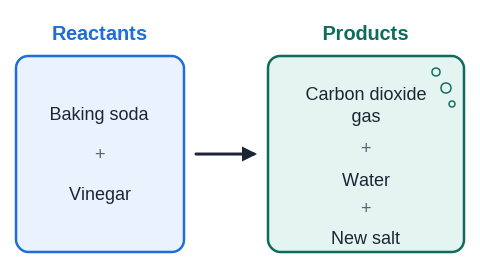
- The substances you start with are the reactants. The new substances the reaction makes are the products.
- We write a reaction with an arrow that means "turns into": reactants → products.
- When you bake a cake, the batter is the reactants and the soft, spongy cake is the product.
- When baking soda meets vinegar, one of the products is carbon dioxide, a gas that makes the fizz.
Four clues to look for
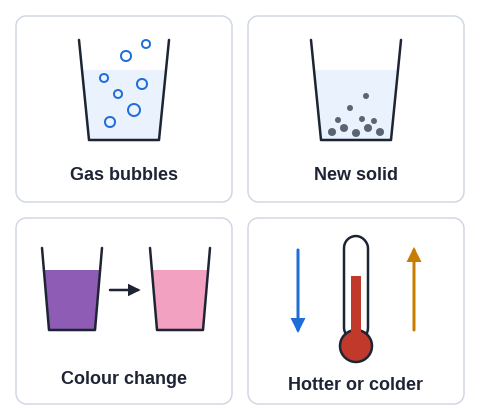
- You cannot see particles, so you look for clues that a new substance has been made.
- A precipitate is a new solid that suddenly appears in a liquid, often as cloudy specks or lumps.
- A clue is good evidence, not proof. Boiling water also bubbles, but no new substance is made, so check more than one clue when you can.
| Clue | What you notice | Example |
|---|---|---|
| Gas | Bubbles or fizzing | Baking soda in vinegar |
| A new solid (precipitate) | Cloudy specks or lumps form | Vinegar stirred into milk makes white lumps |
| Colour change | A new colour that stays | A cut apple turning brown |
| Temperature change | The mixture gets hotter or colder | A hand warmer heating up; baking soda and vinegar cooling down |
Try it: which clue?
Recording observations in a table
- Room 9 tested four mixtures. For each one they wrote what they saw before and after, under the same headings, and took the temperature at the start and after 2 minutes. Which mixtures had a chemical change?
| Mixture | Bubbles? | New solid? | Colour change? | Temperature (°C) |
|---|---|---|---|---|
| A: baking soda + vinegar | Yes, lots | No | No | 19 then 15 |
| B: milk + vinegar | No | Yes, white lumps | No | 18 then 18 |
| C: salt + water | No | No, salt disappears | No | 18 then 18 |
| D: purple cabbage juice + lemon juice | No | No | Yes, purple to pink | 18 then 18 |
- A: bubbles of gas, and it got 4 °C coldertwo clues
- B: a new solid appeareda precipitate
- C: no clues, and the salt comes back if the water dries upphysical change
- D: a new colour that stayscolour change
- A, B and D are chemical changes; C is a physical change
Try it: chemical or physical?
Most chemical changes are hard to undo
- You cannot turn a baked cake back into flour, eggs and sugar, or turn burnt toast back into bread.
- Corrosion is a slow chemical change where a metal is eaten away by air and water. Rust on an old gate is corrosion of iron, and the rust does not turn back into shiny iron by itself.
- A few reactions can be run backwards in special conditions. When a rechargeable battery powers a torch, a chemical change happens inside it, and plugging it into a charger pushes that change back the other way.
In living things and in machines
- Chemical reactions happen inside living things all the time.
- Digestion is the way your body breaks food into smaller, new substances that can pass into your blood. Your stomach and gut use special chemicals to do this.
- Plants make their own sugar from water and carbon dioxide using the energy in sunlight, which is another chemical change.
- Chemical reactions also happen in non-living things. Combustion means burning: a fuel reacts with oxygen from the air and gives out heat and light. A car engine burns petrol this way to make the car move.
Try it: what is made?
How people use chemical changes
- People use chemical changes on purpose, every day.
| Use | The chemical change | Example |
|---|---|---|
| Cooking | Heat changes the substances in food, making new tastes, smells and textures | A hāngī, a roast, a fried egg |
| Combustion | Fuel burns with oxygen to release heat | A wood burner warming a house in winter |
| Manufacturing | Raw materials react to make new materials | Cement setting hard in concrete; making plastics and steel |
| Keeping safe | Gas made very quickly fills a bag | A car airbag opening in a crash |
Explaining a chemical change: why bread rises
- Bread dough is made with flour, water, sugar and yeast. Left in a warm place for an hour, it swells to about twice its size. Explain why, using the idea of a chemical change.
- Yeast is a tiny living thing that feeds on the sugar in the doughreactant: sugar
- Its chemical change makes carbon dioxide gasa product
- The gas makes bubbles that get trapped in the stretchy doughclue: gas
- The yeast makes a gas by a chemical change, and the trapped bubbles make the dough rise
Common mistakes
- Ice melting is a chemical change because it looks different.Melting is a physical change: the water is still water, and it freezes back into ice.
- Any bubbles mean a chemical change.Bubbles are only a clue; boiling water bubbles too, but no new substance is made.
- The products are the things you mix together at the start.The things you start with are the reactants; the products are the new substances made at the end.
- Salt dissolving in water makes a new substance, because the salt disappears.The salt is still there, spread through the water, and you get it back when the water dries up, so it is a physical change.
Hunt for chemical change clues
You need: baking soda, vinegar, milk, sugar, 3 clear cups, a teaspoon, paper and a pencil
- Draw a table with the headings: cup, bubbles, new solid, colour change, feels warmer or colder.
- Cup 1: put in a teaspoon of baking soda, then add 3 teaspoons of vinegar. Hold the outside of the cup and write down what you see and feel.
- Cup 2: pour in a quarter of a cup of milk, stir in 3 teaspoons of vinegar, and leave it for 5 minutes. Write down what you see.
- Cup 3: stir a teaspoon of sugar into a quarter of a cup of water and write down what you see.
- Look for the clues: cup 1 fizzes and feels a little colder, cup 2 grows white lumps, so both made new substances; the sugar in cup 3 just dissolves, with no clues.
Safety: Ask an adult to help. Vinegar stings if it gets in your eyes, so keep your face back from the fizzing cup, and do not drink any of the mixtures.
Your turn
Is melting butter for a cake a chemical change or a physical change?
A steel nail left outside turns orange and flaky. What clue is this, and what kind of change is it?
In the reaction wood + oxygen → ash + smoke + carbon dioxide, what are the reactants?
Why can a cake never be turned back into batter?
Name a chemical change that happens inside your own body.
Show answer
1. A physical change: it is still butter, and it goes solid again when it cools. 2. A colour change, with a new flaky solid; it is a chemical change called rusting, a kind of corrosion. 3. Wood and oxygen, the substances before the arrow. 4. Baking made new substances, and they cannot be turned back into the ingredients. 5. Digestion, which breaks food into new, smaller substances.
Recap
- A chemical change makes a new substance with different properties.
- In a chemical reaction, reactants turn into products.
- Clues are gas bubbles, a new solid, a colour change, and getting hotter or colder.
- Most chemical changes are hard to undo, though a rechargeable battery can be run backwards.
- Chemical changes happen in living things, like digestion, and in machines, like engines.
- People use chemical changes for cooking, burning fuel and making new materials.
Challenge
A chemist shop sells three packs. Pack A is a single-use hand warmer: it holds iron powder, salt and a little water, sealed in an airtight wrapper. Once the wrapper is opened and air gets in, it warms up and stays warm for hours. Afterwards the powder has set into hard lumps, partly reddish-brown, and it never warms up again. Pack B is an instant cold pack: you squeeze it, a small bag of water bursts, white crystals dissolve in the water and the pack goes icy cold. If you dried the liquid out, you would get the same white crystals back. Pack C is a reusable hand warmer: it holds a clear liquid, and when you click a metal disc inside, white crystals spread through it and it goes hot. Boiling it in a pot of water turns it back into clear liquid, ready to use again, and the crystals are the same substance that was dissolved in the liquid. Mia says all three are chemical changes because they all change temperature. Is she right? Decide for each pack and give your evidence.
Hint
A temperature change is a clue, not proof. For each pack ask the real question: has a new substance been made? Look for other clues, and think about whether the starting substance comes back.
Answer
No. Only pack A is a chemical change: the iron reacts with oxygen from the air to make rust, a new substance. Packs B (dissolving) and C (crystals forming from a liquid) are physical changes, because no new substance is made and the starting substance can be got back
Step by step
- All three change temperature, but so can physical changes, so temperature alone cannot decide it.
- Pack A needs air to start, so oxygen is a reactant. The iron turns into reddish-brown lumps that never turn back: that is rust, a new substance, so it is a chemical change, like a rusty gate but much faster.
- Pack B is crystals dissolving. Drying out the liquid gives back the same white crystals, just like salt in water, so no new substance was made: a physical change.
- Pack C is crystals forming out of a liquid. They are the same substance that was dissolved, and heating dissolves them again, so it is also a physical change.
- So Mia is wrong: you need more than one clue, and the best test is whether a new substance with new properties was made.
Full working
- Pack A: needs air, new reddish-brown solid, cannot be reusediron + oxygen → rust
- Pack A: new substance madechemical change
- Pack B: crystals dissolve, and come back if the water dries outsame substance
- Pack B: no new substancephysical change
- Pack C: same substance goes from dissolved to crystals and back againno new substance
- Pack C: physical change, even though it gets hottemperature is only a clue
- Mia is wrong: only pack A is a chemical change
With an adult's help, Kahu sets a scale to zero with a fireproof dish on it, puts 10.0 g of fine steel wool (thin threads of iron) in the dish and touches it with the ends of a 9-volt battery. It glows orange as the glow creeps through it, and it ends up dark grey and crumbly. Now the scale shows 11.2 g of solid. Kahu also burns a 10.0 g piece of wood in the same dish (all the masses here are made up, to keep the numbers simple), and only a little grey ash is left. His friend says: "Burning makes things lighter, so the scale must be broken." Explain both results using the idea of a chemical change: name the reactants, say what happened to the products, and say whether any mass was really gained or lost.
Hint
Burning is a chemical change with oxygen from the air. In each case, ask: is the product a solid that stays in the dish, or a gas that drifts away?
Answer
The scale is fine. Iron + oxygen → iron oxide: the oxygen from the air joins the iron, and the product is a solid that stays in the dish, so it weighs more (1.2 g of oxygen was added). Wood + oxygen → mostly carbon dioxide and water vapour: those products are gases that escape into the air, so only the light ash is left. In both cases the mass was not made or destroyed; it moved into or out of the air
Step by step
- The steel wool glowing, giving off heat and light, and turning into a dark crumbly solid are clues that a new substance has been made: burning is a chemical change.
- The reactants are iron and oxygen from the air. They join to make iron oxide, and the oxygen is now part of the solid in the dish.
- So the solid gains the mass of the oxygen that joined it: 11.2 − 10.0 = 1.2 g.
- Wood also reacts with oxygen, but most of its products are carbon dioxide and water vapour, which are gases that float away. Only the ash stays behind, so the dish gets lighter.
- Neither burning destroys or makes mass. The particles just swap partners; whether the scale goes up or down depends on whether the products stay on it.
Full working
- iron + oxygen → iron oxidereactants → products
- the oxygen came from the air, which is not on the scaleso the dish gains it
- 11.2 g − 10.0 g = 1.2 gmass of oxygen that joined the iron
- wood + oxygen → carbon dioxide + water vapour + ashthe gases escape
- the dish loses the gases' massonly ash stays behind
- No mass is gained or lost overall: the iron oxide trapped oxygen from the air, and the wood's products went into the air
Ms Tane does a teacher demonstration (do not try Set-up B yourself: the gas builds up pressure in the capped bottle). The readings are made up, but they behave like real ones. Set-up A: an open cup of vinegar and a paper cup holding 4.2 g of baking soda sit together on a scale reading 154.2 g. She tips the baking soda in. It fizzes, gets colder, and when the fizzing stops the scale reads 152.1 g. Set-up B: a strong fizzy-drink bottle holds vinegar, and a twist of tissue holding another 4.2 g of baking soda. She drops the tissue in, screws the cap on fast and puts it all on the scale: 161.5 g. It fizzes, the bottle goes hard, and when the fizzing stops it still reads 161.5 g. (a) Give two clues that a chemical change happened. (b) Why did A lose mass, and how much? (c) Why did B not lose any? (d) Predict what happens to the reading of B when she slowly unscrews the cap, and explain. (e) If she repeated A with 8.4 g of baking soda and plenty of vinegar, about how much mass would it lose?
Hint
One product of baking soda and vinegar is carbon dioxide gas. Follow the gas: in which set-up can it leave the scale, and in which is it trapped?
Answer
(a) Fizzing (a gas is made) and the mixture getting colder. (b) The carbon dioxide made escaped into the air: 154.2 − 152.1 = 2.1 g. (c) The cap trapped the gas, so all the products stayed on the scale. (d) The gas hisses out and the reading drops by about 2 g, to about 159.4 g. (e) About double, roughly 4 g
Step by step
- Bubbles and a temperature drop are two clues; together they are strong evidence that a new substance, a gas, was made.
- In the open cup the carbon dioxide bubbles off into the room. The scale is no longer weighing it, so the reading falls by 154.2 − 152.1 = 2.1 g.
- In the capped bottle the same gas is made but cannot get out (that is why the bottle goes hard), so everything is still on the scale and the reading stays at 161.5 g.
- When the cap is opened, the trapped gas escapes, so the reading should drop by about the same amount as in A, to roughly 159.4 g. Nothing was lost in the reaction itself; the mass only goes when the gas leaves.
- With twice the baking soda and enough vinegar, about twice as much gas is made, so A would lose about 2 × 2.1 = 4.2 g, roughly 4 g.
Full working
- clues: fizzing, and coldera gas is made, and a temperature change
- baking soda + vinegar → carbon dioxide + other productsreactants → products
- A: 154.2 g − 152.1 g = 2.1 gcarbon dioxide that left the open cup
- B: 161.5 g before and afterthe cap keeps the gas on the scale
- B opened: about 161.5 g − 2.1 g ≈ 159.4 gthe same gas escapes
- double baking soda: 2 × 2.1 g = 4.2 gabout twice as much gas
- A lost about 2 g of escaping carbon dioxide; B keeps its mass until opened, then drops by about 2 g; double the baking soda loses about 4 g
The maths behind it
Report a mistake
How is Year 6 maths going?
See the Year 6 maths guide