Drawing forces with arrows, and how levers help
What this lesson covers
- Every force has a size and a direction
- Showing forces with arrows and free-body diagrams
- What a rigid body is
- Equal, opposite forces cancel and leave motion unchanged
- Levers, pivots, loads and effort
- Why pushing far from the pivot takes less force
Size and direction
- A force is a push or a pull.
- We measure the size of a force in newtons, written N. Holding up an apple takes about 1 N.
- Every force also has a direction. Pushing a door at the handle opens it, but pushing the same door at the edge toward the hinges does nothing.
- So to describe a force fully, you need both: how big it is, and which way it acts.
Showing forces with arrows
- Scientists draw a force as an arrow.
- The arrow points the way the force acts.
- The length of the arrow shows the size: a force twice as big gets an arrow twice as long.
- Each arrow is labelled with the name of the force, and its size in newtons if you know it.
| Force | What it does | Usual direction |
|---|---|---|
| Gravity (weight) | Pulls everything toward the centre of Earth | Straight down |
| Support force | A surface pushes back on what rests on it | Up, away from the surface |
| Friction | Rubbing between surfaces that slows sliding | Opposite to the movement |
| Air resistance | Air pushing against a moving object | Opposite to the movement |
Try it: which way does it act?
Free-body diagrams
- A free-body diagram shows one object on its own, drawn as a simple box or dot, with an arrow for every force acting on it.
- Only forces on that object go in. The table, the floor and the person are left out.
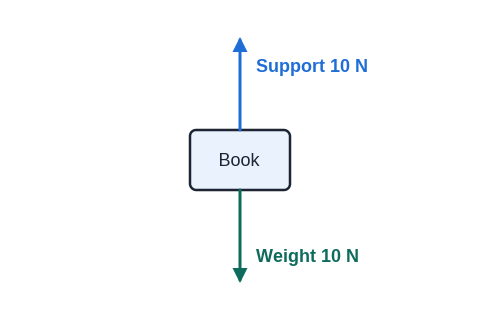
- A book resting on a table has two forces: its weight pulling down and the table's support force pushing up.
- The book is still, so the two arrows are the same length. If the book weighs 10 N, the table pushes up with 10 N.
Rigid bodies and forces that cancel
- A rigid body is an object that keeps its shape when forces push or pull on it, like a brick or a steel bar. A sponge squashes, so it is not rigid.
- When two forces on the same rigid object are the same size but point in opposite directions, they cancel out. We call them balanced forces.
- Balanced forces do not change how an object moves. A still object stays still, and a moving object keeps going at the same speed in the same direction.
- In a tug of war where both teams pull with the same force, the rope does not move.
Try it: balance the forces
Drawing a free-body diagram
- Ana pushes a box of books across the floor with a force of 30 N. The box weighs 50 N and slides at a steady speed. Draw the free-body diagram.
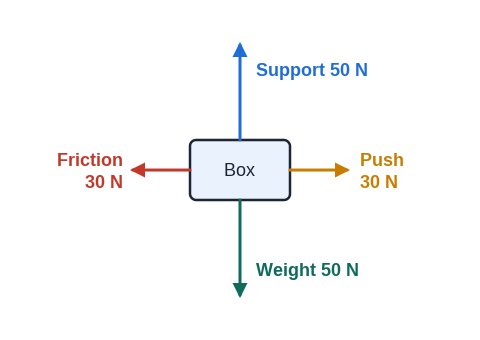
- Weight: 50 N, arrow pointing downgravity
- Support from the floor: 50 N, arrow pointing upthe box does not sink or lift
- Push: 30 N, arrow pointing the way Ana pushesher force
- Friction: 30 N, arrow pointing the other waysteady speed, so the forces balance
- Four arrows: up and down both 50 N, push and friction both 30 N
Try it: draw the missing forces
Levers
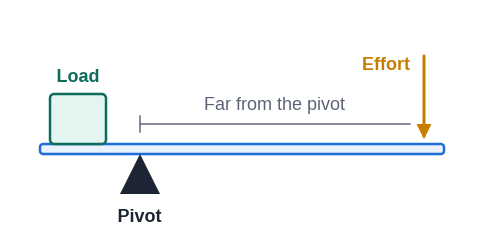
- A lever is a stiff bar that can turn about one fixed point, called the pivot.
- The load is the object you want to move. The effort is the force you put in.
- A crowbar, a seesaw, a spade and a bottle opener are all levers.
Push far from the pivot
- Room 14 tested how far from the pivot to push. They hung a 4 N bag 20 cm from the pivot of a long ruler and pressed down on the other side with a force meter.
- They changed one thing, the distance from the pivot to where they pushed. They measured the force needed to lift the bag. They kept the bag, its position and the ruler the same, so the test was fair.
- The farther from the pivot they pushed, the less force it took. Doubling the distance roughly halved the force.
| Distance from pivot to push (cm) | Force needed (N) |
|---|---|
| 10 | 8.1 |
| 20 | 4.0 |
| 40 | 2.1 |
Try it: balance a seesaw
Opening a paint tin
- You use a long screwdriver to lever the lid off a paint tin. The tip goes under the lid and the screwdriver rests on the rim. Where is the pivot, and where should you push to use the least force?
- The screwdriver turns on the rim of the tinpivot
- The lid edge on the tip is the load, very close to the pivotload
- Pushing near the end of the handle puts your effort far from the pivotless force
- Pivot: the rim. Push at the end of the handle, as far from the rim as you can
Levers all around you
- Levers help people move things that would be too hard to shift by hand.
| Lever | Pivot | What it helps you do |
|---|---|---|
| Spade | Where the blade digs into the soil edge | Lift and turn heavy soil |
| Bottle opener | The edge resting on top of the cap | Lift a tight cap |
| Wheelbarrow | The wheel | Lift a heavy load |
| Seesaw | The middle post | Lift a person on the other end |
Common mistakes
- A still book has no forces on it.Its weight and the support force both act on it; they are balanced, so it stays still.
- All force arrows can be the same length as long as they point the right way.The length shows the size, so a bigger force needs a longer arrow.
- If something is moving, the forces on it cannot be balanced.Balanced forces can act on a moving object; it just keeps going at the same speed and direction.
- To make a lever easier, push close to the pivot.Push as far from the pivot as you can; that needs the least force.
Balance coins on a ruler lever
You need: a 30 cm ruler, a round pencil, 12 coins of the same kind, paper and a pencil to record
- Lay the pencil on a table and balance the ruler across it at the 15 cm mark. The pencil is your pivot.
- Stack 6 coins on one side, 5 cm from the pivot.
- On the other side, find how many coins balance them when you place the stack 5 cm, 10 cm and then 15 cm from the pivot. Record each result.
- Look for this: the farther from the pivot you put the stack, the fewer coins you need to balance the 6: about 6, then 3, then 2.
Safety: Coins are a choking danger for babies and toddlers, so ask an adult to help and count every coin back into a container when you finish.
Your turn
A force arrow for a 20 N push is 4 cm long. How long should the arrow for a 40 N push be?
A cup sits still on a bench. Name the two forces on it and say how they compare.
A bike rolls along at a steady speed. The forward push is 60 N. How big is the backward force of friction and air resistance together?
A wheelbarrow is a lever. What is its pivot?
Why is a long-handled spade easier for turning soil than a short trowel?
Show answer
1. 8 cm, because the force is twice as big. 2. Weight pulls it down and the bench's support force pushes it up; they are the same size. 3. 60 N, because steady speed means the forces are balanced. 4. The wheel. 5. Your hands are farther from the pivot, so you need less force to lift the soil.
Balancing Act
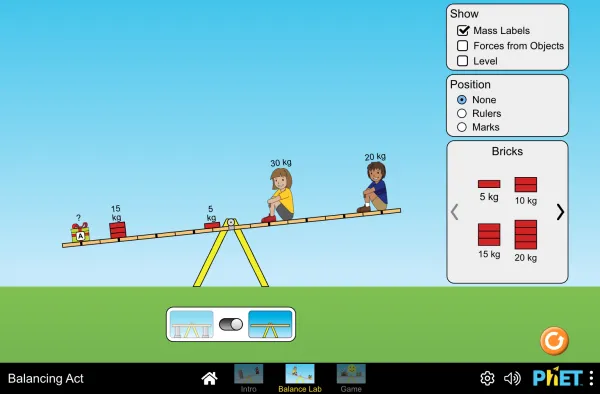
Full screen · PhET Interactive Simulations, University of Colorado Boulder, CC BY 4.0
Recap
- A force has a size, in newtons, and a direction.
- Arrows show forces: they point the way the force acts, and a longer arrow means a bigger force.
- A free-body diagram shows one object with an arrow for every force on it.
- Equal and opposite forces on a rigid body cancel, so its motion does not change.
- A lever turns on a pivot; pushing farther from the pivot takes less force.
Challenge
Hemi's toolbox weighs 60 N and stands on the garage floor. He pulls straight up on the handle with a force of 25 N, but the toolbox does not leave the floor. (a) How big is the support force from the floor? (b) His sister puts a 10 N bag on top of the toolbox while Hemi keeps pulling up with 25 N. Now how big is the support force from the floor? (c) With the bag still on top, how hard must Hemi pull to just lift the toolbox and bag off the floor?
Hint
Think of the toolbox and bag as one object. It is still, so the up forces must add to the same as the down forces. The floor only makes up whatever is missing.
Answer
(a) 35 N. (b) 45 N. (c) 70 N.
Step by step
- The toolbox is still, so the forces on it are balanced: total up equals total down.
- Down: the 60 N weight. Up: Hemi's 25 N plus the floor's support, so the floor gives 35 N.
- With the bag, the down forces add to 70 N. Hemi still gives 25 N, so the floor gives 45 N.
- The toolbox just lifts when the floor no longer needs to push at all, so Hemi alone must give all 70 N.
Full working
- Up = downthe toolbox is still, so the forces balance
- 25 + support = 60Hemi's pull plus the floor's push
- support = 60 − 25 = 35 Nanswer (a)
- down = 60 + 10 = 70 Ntoolbox plus bag
- support = 70 − 25 = 45 Nanswer (b)
- pull = 70 − 0 = 70 Nsupport drops to 0 just as it lifts
- (a) 35 N, (b) 45 N, (c) 70 N
Ana and Ben move a heavy trolley across a car park. Ana pushes it east with 50 N and Ben, who is being silly, pushes it west with 20 N. The trolley rolls east at a steady speed. (a) How big is the friction force on the trolley, and which way does it act? (b) Ben now goes round to Ana's side and also pushes east with 20 N. Friction stays the same size. Are the forces still balanced, and what happens to the trolley's motion? (c) If Ben keeps pushing east with 20 N, how hard should Ana push so the trolley rolls at a steady speed again?
Hint
Steady speed means balanced forces. Add up everything pushing east, then add up everything pushing west, and compare.
Answer
(a) 30 N, acting west. (b) No: 70 N east against 30 N west, so the trolley speeds up. (c) 10 N.
Step by step
- Friction acts opposite to the motion, so it points west, the same way as Ben's push.
- Steady speed means east forces equal west forces: 50 = 20 + friction, so friction is 30 N.
- When Ben swaps sides, east forces are 50 + 20 = 70 N and west is only the 30 N of friction.
- The forces are unbalanced towards the east, so the trolley speeds up.
- For steady speed again, the east pushes must add to 30 N. Ben gives 20 N, so Ana needs only 10 N.
Full working
- east = weststeady speed, so balanced
- 50 = 20 + frictionAna east; Ben and friction west
- friction = 30 N westanswer (a)
- east = 50 + 20 = 70 N, west = 30 NBen on Ana's side
- 70 N > 30 Nunbalanced, so it speeds up eastwards
- Ana + 20 = 30east must equal friction again
- (a) 30 N west, (b) unbalanced, it speeds up, (c) Ana pushes 10 N
Look at Room 14's results: a 4 N bag 20 cm from the pivot, and the force needed at 10 cm, 20 cm and 40 cm from the pivot on the other side was 8.1 N, 4.0 N and 2.1 N. (a) Multiply each force by its distance. What do you notice, and how does it compare with 4 N × 20 cm? (b) A playground seesaw is 3 m long with the pivot in the middle. Aroha (weight 300 N) sits at the very end of the left side. Use your rule to find where Tama (weight 450 N) must sit on the right side to balance her. (c) Tama then slides to the very end of his side. Their cousin (weight 225 N) climbs on to Aroha's side to balance it again. How far from the pivot must the cousin sit?
Hint
Each of Room 14's products comes out close to the same number. For a seesaw, work out weight × distance from the pivot for each child, and make the two sides equal.
Answer
(a) About 80 each time (81, 80 and 84), the same as 4 × 20 = 80. (b) 1 m from the pivot. (c) 1 m from the pivot.
Step by step
- Room 14's force × distance gives 81, 80 and 84: all close to 80, the bag's 4 × 20. The small differences are measuring error.
- So a lever balances when force × distance is the same on both sides of the pivot.
- The seesaw is 3 m long, so each end is 1.5 m from the pivot. Aroha gives 300 × 1.5 = 450.
- Tama needs 450 × distance = 450, so he sits 1 m from the pivot.
- At the end, Tama gives 450 × 1.5 = 675. The left side has 450 from Aroha, so the cousin must add 225.
- 225 × distance = 225, so the cousin sits 1 m from the pivot.
Full working
- 8.1 × 10 = 81, 4.0 × 20 = 80, 2.1 × 40 = 84force × distance, Room 14
- 4 × 20 = 80the bag's side: the products all match it closely
- 300 × 1.5 = 450Aroha, at the end of a 3 m seesaw
- 450 × d = 450, so d = 1 mTama's side must match
- 450 × 1.5 = 675Tama at the end
- 450 + 225 × d = 675, so 225 × d = 225left side must match
- (a) about 80 each time, (b) Tama 1 m from the pivot, (c) cousin 1 m from the pivot
The maths behind it
Report a mistake
How is Year 6 maths going?
See the Year 6 maths guide