Stationary points, concavity and points of inflection
What this lesson covers
- A stationary point is where the derivative is zero; concavity is the sign of the second derivative.
- Set the full derivative equal to zero before clearing any denominator.
Where the gradient is zero
- Stationary: dy/dx = 0, a flat tangent.
- Maximum, minimum or inflection.
- d²y/dx² gives the concavity.
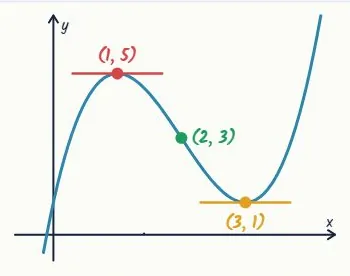
y = x³ − 6x² + 9x + 1
- A peak, then a dip.
- Flat tangents at both.
- An inflection between them.
Finding the stationary points
- Write dy/dx = 0.
- Factorise, then solve.
- Give both coordinates.
- y = x³ − 6x² + 9x + 1
- dy/dx = 3x² − 12x + 9differentiate
- 3x² − 12x + 9 = 0stationary: dy/dx = 0
- 3(x² − 4x + 3) = 0
- 3(x − 1)(x − 3) = 0factorise
- x = 1 or x = 3
- x = 1: y = 1 − 6 + 9 + 1 = 5
- x = 3: y = 27 − 54 + 27 + 1 = 1
- (1, 5) and (3, 1)
Classifying with d²y/dx²
- Negative: concave down.
- Positive: concave up.
- d²y/dx² = 6x − 12differentiate again
- x = 1: 6 − 12 = −6 < 0concave down
- (1, 5) is a maximum
- x = 3: 18 − 12 = 6 > 0concave up
- (3, 1) is a minimum
Increasing and decreasing
- Increasing: dy/dx > 0.
- Decreasing: dy/dx < 0.
- Test each interval.
- dy/dx = 3(x − 1)(x − 3)
- x = 0: 3(−1)(−3) = 9 > 0x < 1
- x = 2: 3(1)(−1) = −3 < 01 < x < 3
- x = 4: 3(3)(1) = 9 > 0x > 3
- decreasing for 1 < x < 3
- increasing for x < 1, x > 3
Concavity and inflection
- Zero, then a sign change.
- A zero alone is not enough.
- 6x − 12 = 0, so x = 2d²y/dx² = 0
- x < 2: 6x − 12 < 0concave down
- x > 2: 6x − 12 > 0concave up
- sign changes at x = 2
- y = 8 − 24 + 18 + 1 = 3
- inflection at (2, 3)
The 2025 error: rational functions
- Candidates cleared the denominator first.
- Write the full derivative = 0.
- Then clear the denominator.
y = x/(x² + 4)
- Quotient rule first.
- Whole fraction = 0 first.
- y = x/(x² + 4)
- u = x, v = x² + 4quotient rule
- u′ = 1, v′ = 2x
- dy/dx = (vu′ − uv′)/v²
- = (x² + 4 − 2x²)/(x² + 4)²
- = (4 − x²)/(x² + 4)²simplify the top
- (4 − x²)/(x² + 4)² = 0write this first
Then clear the denominator
- Fraction = 0: top = 0.
- Give both coordinates.
- (4 − x²)/(x² + 4)² = 0
- 4 − x² = 0top = 0
- x² = 4, so x = ±2
- x = 2: y = 2/(4 + 4) = 1/4
- x = −2: y = −2/8 = −1/4
- (2, 1/4) and (−2, −1/4)
y = xe^−x
- Product rule.
- e^−x is never zero.
- u = x, v = e^−xproduct rule
- u′ = 1, v′ = −e^−xchain rule
- dy/dx = e^−x − xe^−xu′v + uv′
- = (1 − x)e^−xfactorise
- (1 − x)e^−x = 0stationary
- e^−x > 0, so x = 1e^−x is never 0
- y = 1 × e^−1 = 1/e
- stationary at (1, 1/e)
Try it: stationary points and inflection
The second derivative
- Product rule again.
- Check the sign change.
- dy/dx = (1 − x)e^−x
- d²y/dx² = −e^−x − (1 − x)e^−x
- = (x − 2)e^−xcollect
- x = 1: −e^−1 < 0a maximum
- (x − 2)e^−x = 0 at x = 2
- x − 2 goes from − to +e^−x > 0
- y = 2e^−2 = 2/e²
- inflection at (2, 2/e²)
y = x + 2cos x, 0 ≤ x ≤ 2π
- Sin x = 1/2 in the range.
- Find both y-values.
- dy/dx = 1 − 2sin x
- 1 − 2sin x = 0stationary
- sin x = 1/2
- x = π/6 or x = 5π/60 ≤ x ≤ 2π
- y(π/6) = π/6 + 2(√3/2)
- = π/6 + √3 ≈ 2.26
- y(5π/6) = 5π/6 + 2(−√3/2)
- = 5π/6 − √3 ≈ 0.886
Classifying with −2cos x
- Negative: a maximum.
- Positive: a minimum.
- x = π/6 or x = 5π/6
- d²y/dx² = −2cos x
- π/6: −2(√3/2) = −√3 < 0
- maximum at (π/6, π/6 + √3)
- 5π/6: −2(−√3/2) = √3 > 0
- minimum at (5π/6, 5π/6 − √3)
Try it: build the sign chart
Unknown constants
- y = xe^−kx: stationary at x = 1/k.
- The calculator cannot do this.
- Show the derivative every time.
Where the marks are
- Achieved: both coordinates, conditions.
- Merit: find and classify, clear algebra.
- Excellence: harder inflections, constants.
What to take away
- Full derivative = 0, then both coordinates.
| Stationary | dy/dx = 0, written |
| Rational | whole dy/dx = 0 first |
| Point | both x and y |
| Increasing | dy/dx > 0 |
| Concavity | sign of d²y/dx² |
| Inflection | d²y/dx² = 0, sign change |
Common mistakes
- d²y/dx² = 6x − 12 = 0 at x = 2, so (2, 3) is a point of inflection.A zero alone is not enough; show d²y/dx² changes sign at x = 2, here from negative to positive.
- y = x/(x² + 4): x² + 4 − 2x² = 0, so x = ±2.Write the full derivative (4 − x²)/(x² + 4)² = 0 first, then set the top to 0; skipping it was the 2025 error.
- The stationary points are x = 1 and x = 3.Give both coordinates: substitute into y to get (1, 5) and (3, 1).
- d²y/dx² = −6 at x = 1, so (1, 5) is a minimum.Negative means concave down, so (1, 5) is a maximum; a positive second derivative gives a minimum.
Your turn: eight questions
- Question 2 uses the curve from question 1.
- Question 3: full derivative = 0 first.
| Curve | Find | |
|---|---|---|
| 1 | y = x³ − 3x² − 9x + 5 | stationary points |
| 2 | the same curve | decreasing; inflection |
| 3 | y = (x + 1)/(x² + 3) | stationary points |
| 4 | y = x ln x | stationary point, type |
| 5 | y = x⁴ − 6x² | where concave down |
| 6 | y = x²e^−x | stationary points |
| 7 | y = x − 2sin x, 0 ≤ x ≤ 2π | maximum point |
| 8 | y = x² − k ln x, k > 0 | stationary point, type |
Show answer
1. dy/dx = 3x² − 6x − 9 = 3(x − 3)(x + 1) = 0: (−1, 10) and (3, −22). 2. Decreasing for −1 < x < 3. d²y/dx² = 6x − 6 = 0 at x = 1: inflection (1, −6). 3. dy/dx = (3 − 2x − x²)/(x² + 3)² = 0, so x = 1 or −3: (1, 1/2) and (−3, −1/6). 4. dy/dx = ln x + 1 = 0, x = 1/e: (1/e, −1/e). d²y/dx² = 1/x > 0, a minimum. 5. −1 < x < 1. d²y/dx² = 12x² − 12 < 0 when x² < 1, so −1 < x < 1. 6. (0, 0) and (2, 4/e²). dy/dx = (2x − x²)e^−x = x(2 − x)e^−x = 0, and e^−x is never zero, so x = 0 or 2. 7. (5π/3, 5π/3 + √3). cos x = 1/2 gives x = π/3 or 5π/3; d²y/dx² = 2sin x is negative at 5π/3, so a maximum. 8. x = √(k/2), a minimum. dy/dx = 2x − k/x = 0 gives x² = k/2 (x > 0); d²y/dx² = 2 + k/x² > 0.
The answers: questions 1 and 2
- 1. dy/dx = 3x² − 6x − 9 = 0
- 3(x − 3)(x + 1) = 0factorise
- x = −1: y = −1 − 3 + 9 + 5 = 10
- x = 3: y = 27 − 27 − 27 + 5 = −22
- (−1, 10) and (3, −22)
- 2. decreasing for −1 < x < 3dy/dx < 0 between roots
- d²y/dx² = 6x − 6 = 0, x = 1changes sign
- y = 1 − 3 − 9 + 5 = −6
- inflection at (1, −6)
The answers: question 3
- 3. top: (x² + 3)(1) − (x + 1)(2x)quotient rule
- dy/dx = (3 − 2x − x²)/(x² + 3)²simplify
- (3 − 2x − x²)/(x² + 3)² = 0write this first
- x² + 2x − 3 = 0top = 0
- (x − 1)(x + 3) = 0factorise
- x = 1: y = 2/4 = 1/2
- x = −3: y = −2/12 = −1/6
- (1, 1/2) and (−3, −1/6)
The answers: question 4
- 4. dy/dx = ln x + x(1/x)product rule
- = ln x + 1
- ln x + 1 = 0, ln x = −1stationary
- x = e^−1 = 1/e
- y = (1/e) ln(1/e) = −1/eln(1/e) = −1
- d²y/dx² = 1/x = e > 0concave up
- minimum at (1/e, −1/e)
Sample question: Achieved
Find the coordinates of the stationary points of y = 2x³ − 3x² − 12x + 4.
Hint
Set dydx = 0 and solve, then put each x back into the original equation for y.
Answer
(−1, 11) and (2, −16)
Step by step
- A stationary point is where the gradient is zero, so we solve dydx = 0.
- dydx = 6x² − 6x − 12.
- Set it to zero and take out the common factor 6: 6(x² − x − 2) = 0.
- Factorise: 6(x − 2)(x + 1) = 0, so x = 2 or x = −1.
- A point needs both coordinates. Put each x into the original y, not into dydx.
- x = −1: y = −2 − 3 + 12 + 4 = 11. x = 2: y = 16 − 12 − 24 + 4 = −16.
- The stationary points are (−1, 11) and (2, −16).
Full working
- dydx = 6x² − 6x − 12 = 0
- 6(x − 2)(x + 1) = 0, x = 2 or −1
- x = −1: y = −2 − 3 + 12 + 4 = 11original equation
- x = 2: y = 16 − 12 − 24 + 4 = −16
- (−1, 11) and (2, −16)
Sample questions: Merit
Find the exact coordinates of the stationary points of y = x²e⁻ˣ, and use the second derivative to classify each one.
Hint
Product rule, then factorise out e⁻ˣ. Since e⁻ˣ is never zero, only the other factor can be zero.
Answer
(0, 0) is a minimum and (2, 4e²) is a maximum.
Step by step
- Product rule with u = x², u′ = 2x, v = e⁻ˣ and v′ = −e⁻ˣ. Do not drop the minus sign from the chain rule.
- dydx = 2xe⁻ˣ − x²e⁻ˣ = (2x − x²)e⁻ˣ = x(2 − x)e⁻ˣ.
- Set it to zero. e⁻ˣ is always positive, so x(2 − x) = 0, giving x = 0 or x = 2.
- x = 0: y = 0. x = 2: y = 4e⁻² = 4e².
- For the second derivative, use the product rule on (2x − x²)e⁻ˣ: d²ydx² = (2 − 2x)e⁻ˣ − (2x − x²)e⁻ˣ = (x² − 4x + 2)e⁻ˣ.
- x = 0: d²ydx² = 2 > 0, so (0, 0) is a minimum.
- x = 2: d²ydx² = (4 − 8 + 2)e⁻² = −2e⁻², which is negative, so (2, 4e²) is a maximum.
- Sense check: y = x²e⁻ˣ is never negative, so a minimum at (0, 0) makes sense.
Full working
- dydx = (2x − x²)e⁻ˣ = x(2 − x)e⁻ˣproduct rule
- x = 0 or x = 2e⁻ˣ > 0
- (0, 0) and (2, 4e²)
- d²ydx² = (x² − 4x + 2)e⁻ˣ
- x = 0: 2 > 0, minimum; x = 2: −2e⁻² < 0, maximum
- (0, 0) minimum, (2, 4e²) maximum
Find the stationary points of y = x² + 3x − 1 and classify them. Explain how the maximum can be lower than the minimum.
Hint
Use the quotient rule and set the whole derivative equal to zero before clearing the denominator. Classify by testing the sign of dydx either side.
Answer
(−1, −2) is a maximum and (3, 6) is a minimum. They are on different branches of the curve, separated by the asymptote x = 1.
Step by step
- Quotient rule: u = x² + 3, u′ = 2x, v = x − 1, v′ = 1.
- dydx = 2x(x − 1) − (x² + 3)(x − 1)² = x² − 2x − 3(x − 1)².
- Set it to zero. A fraction is zero only when its top is zero (and the bottom is not): x² − 2x − 3 = 0.
- Factorise: (x − 3)(x + 1) = 0, so x = 3 or x = −1. Neither is 1, so both are allowed.
- x = 3: y = 122 = 6. x = −1: y = 4−2 = −2.
- Classify with the sign of dydx. The bottom (x − 1)² is positive, so the sign is the sign of (x − 3)(x + 1).
- Near x = −1: at x = −2 it is (−5)(−1) = 5 > 0, and at x = 0 it is (−3)(1) = −3 < 0. Rising then falling: (−1, −2) is a maximum.
- Near x = 3: at x = 2 it is (−1)(3) = −3 < 0, and at x = 4 it is (1)(5) = 5 > 0. Falling then rising: (3, 6) is a minimum.
- The maximum −2 is lower than the minimum 6. That is possible because the curve breaks at x = 1, where the bottom is zero.
- Maximum and minimum here are local: each is the highest or lowest point near it, on its own branch of the curve.
Full working
- dydx = 2x(x − 1) − (x² + 3)(x − 1)²quotient rule
- = x² − 2x − 3(x − 1)² = 0
- (x − 3)(x + 1) = 0, x = 3 or −1top = 0
- (3, 6) and (−1, −2)
- dydx: + then − at x = −1, − then + at x = 3
- (−1, −2) maximum, (3, 6) minimum; separated by the asymptote x = 1
Sample questions: Excellence
f(x) = x³ − 3kx² + 3x + 2, where k is a constant. Find the values of k for which f is increasing for every x. Describe what happens at the stationary point when k = 1.
Hint
f is increasing everywhere when f′(x) ≥ 0 for every x. f′ is a quadratic, so think about its discriminant.
Answer
−1 ≤ k ≤ 1. When k = 1, f′(x) = 3(x − 1)², so (1, 3) is a stationary point of inflection.
Step by step
- f is increasing everywhere when its gradient is never negative: f′(x) ≥ 0 for every x.
- f′(x) = 3x² − 6kx + 3. This is a quadratic with a positive x² coefficient, so it is a U shape.
- A U-shaped quadratic is never negative when it touches the axis at most once. That means its discriminant is at most 0.
- Discriminant: (−6k)² − 4(3)(3) = 36k² − 36.
- 36k² − 36 ≤ 0 gives k² ≤ 1, so −1 ≤ k ≤ 1.
- The ends are included. At k = ±1 the gradient is zero at one point only and positive everywhere else, so f still increases.
- When k = 1: f′(x) = 3x² − 6x + 3 = 3(x − 1)². It is zero at x = 1 and positive on both sides.
- A stationary point where the gradient does not change sign is not a maximum or a minimum. It is a stationary point of inflection.
- f(1) = 1 − 3 + 3 + 2 = 3, so the point is (1, 3).
- Check with f″: f″(x) = 6x − 6, which is 0 at x = 1 and changes sign there. Concavity changes, which confirms the inflection.
Full working
- f′(x) = 3x² − 6kx + 3 ≥ 0 for all xincreasing everywhere
- b² − 4ac = 36k² − 36 ≤ 0touches the axis at most once
- k² ≤ 1, so −1 ≤ k ≤ 1
- k = 1: f′(x) = 3(x − 1)² ≥ 0no sign change at x = 1
- f(1) = 3, f″(x) = 6x − 6 changes sign at x = 1
- −1 ≤ k ≤ 1; at k = 1, (1, 3) is a stationary point of inflection
Find and classify all the stationary points of y = sin 2x + 2cos x for 0 ≤ x ≤ 2π. Give exact coordinates.
Hint
Write cos 2x as 1 − 2sin²x so dydx becomes a quadratic in sin x. One stationary point has d²ydx² = 0, so test the sign of dydx either side of it.
Answer
Maximum (π6, 3√32), minimum (5π6, −3√32), stationary point of inflection (3π2, 0)
Step by step
- dydx = 2cos 2x − 2sin x. Do not forget the 2 from differentiating sin 2x.
- To solve dydx = 0, get one trig function. Use cos 2x = 1 − 2sin²x: dydx = 2 − 4sin²x − 2sin x.
- Set it to zero and divide by −2: 2sin²x + sin x − 1 = 0, which factorises to (2sin x − 1)(sin x + 1) = 0.
- sin x = 12 gives x = π6 or 5π6. sin x = −1 gives x = 3π2.
- y values: at π6, sin(π3) + 2cos(π6) = √32 + √3 = 3√32. At 5π6, sin(5π3) + 2cos(5π6) = −√32 − √3 = −3√32. At 3π2, sin 3π + 2cos(3π2) = 0.
- Second derivative: d²ydx² = −4sin 2x − 2cos x.
- At π6: −4(√32) − 2(√32) = −3√3 < 0, a maximum. At 5π6: −4(−√32) − 2(−√32) = 3√3 > 0, a minimum.
- At 3π2: −4sin 3π − 2cos(3π2) = 0. The second derivative test fails here, so test the sign of dydx instead.
- dydx = −2(2sin x − 1)(sin x + 1). Near 3π2, sin x is close to −1, so 2sin x − 1 is negative and sin x + 1 is positive (zero only at 3π2).
- So dydx = −2 × (negative) × (positive) is positive on both sides. No sign change: (3π2, 0) is a stationary point of inflection.
- Sense check: the largest possible value of sin 2x + 2cos x is 3√32 ≈ 2.60, below 1 + 2 = 3. That fits.
Full working
- dydx = 2cos 2x − 2sin x = 2 − 4sin²x − 2sin xcos 2x = 1 − 2sin²x
- (2sin x − 1)(sin x + 1) = 0
- x = π6, 5π6, 3π2
- y = 3√32, −3√32, 0
- d²ydx² = −4sin 2x − 2cos x: −3√3, 3√3, 0
- at 3π2: dydx > 0 on both sidesno sign change
- maximum (π6, 3√32), minimum (5π6, −3√32), inflection (3π2, 0)
Calculus Grapher
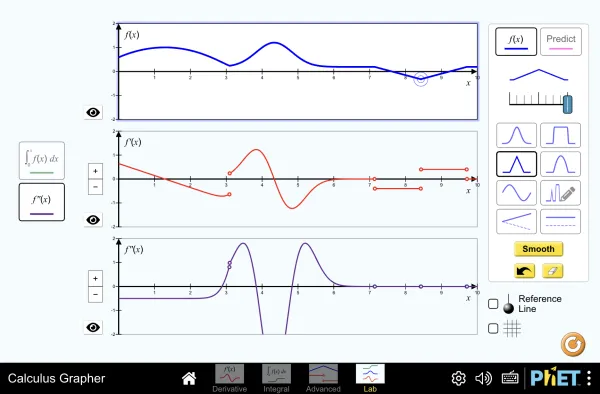
Full screen · PhET Interactive Simulations, University of Colorado Boulder, CC BY 4.0
Challenge
y = sin x2 + cos x, for 0 ≤ x ≤ 2π. Find the exact coordinates of the stationary points and classify them using the second derivative. Find the point of inflection strictly between 0 and 2π, and justify it. Hence state the greatest and least values of y for every real x.
Hint
Use the quotient rule; sin²x + cos²x = 1 tidies the top of dydx. The second derivative simplifies to 2sin x(cos x − 1)(2 + cos x)³. Think about which factors can change sign.
Answer
Maximum (2π3, √33), minimum (4π3, −√33); inflection at (π, 0); since y repeats every 2π, −√33 ≤ y ≤ √33 for every x
Step by step
- The quotient rule gives dydx = 2cos x + 1(2 + cos x)², using sin²x + cos²x = 1.
- dydx = 0 when cos x = −12, so x = 2π3 or 4π3, with y = ±(√32) ÷ (32) = ±√33.
- d²ydx² = 2sin x(cos x − 1)(2 + cos x)³ is negative at 2π3 (a maximum) and positive at 4π3 (a minimum).
- Between 0 and 2π, d²ydx² = 0 only at x = π, and there sin x changes sign while (cos x − 1) stays negative, so the concavity changes: an inflection at (π, 0).
- The function repeats every 2π, so these are the greatest and least values for all x.
Full working
- dydx = cos x(2 + cos x) + sin²x(2 + cos x)²quotient rule
- = 2cos x + 1(2 + cos x)²cos²x + sin²x = 1
- 2cos x + 1 = 0, cos x = −12, x = 2π3 or 4π3stationary
- y = (√32) ÷ (32) = √33 and y = −√33the y-values
- d²ydx² = 2sin x(cos x − 1)(2 + cos x)³quotient rule again
- x = 2π3: 2(√32)(−32)/(32)³ = −4√39 < 0a maximum
- x = 4π3: 2(−√32)(−32)/(32)³ = 4√39 > 0a minimum
- 0 < x < 2π: d²ydx² = 0 only at x = π; sin x goes + to −, cos x − 1 < 0sign change
- inflection at (π, 0)y = 01
- max (2π3, √33), min (4π3, −√33), inflection (π, 0); −√33 ≤ y ≤ √33
The curve y = xˣ is defined for x > 0. Find the exact coordinates of its stationary point. Show that d²ydx² > 0 for every x > 0, and explain what this tells you about the stationary point and about points of inflection on this curve.
Hint
You cannot use the power rule here, because the power is not a constant. Write xˣ = e^(x ln x) and use the chain rule. After that, the product rule gives the second derivative.
Answer
Minimum at (1e, e^(−1e)) ≈ (0.368, 0.692); d²ydx² = xˣ((ln x + 1)² + 1x) > 0, so the curve is concave up everywhere: the stationary point is a minimum (the least value of xˣ) and there are no points of inflection
Step by step
- xˣ = e^(x ln x), so dydx = e^(x ln x) × (ln x + 1) = xˣ(ln x + 1).
- xˣ is never 0, so dydx = 0 when ln x = −1, x = 1e, and y = (1e)^(1e) = e^(−1e).
- The product rule gives d²ydx² = xˣ(ln x + 1)² + xˣ × (1x) = xˣ((ln x + 1)² + 1x).
- For x > 0 every part is positive, so d²ydx² > 0 everywhere.
- Always concave up: the stationary point is a minimum, the lowest point of the whole curve, and the concavity never changes, so there is no inflection.
Full working
- y = xˣ = e^(x ln x)rewrite the power
- dydx = e^(x ln x) × (ln x + 1) = xˣ(ln x + 1)chain and product rules
- ln x + 1 = 0, x = e⁻¹ = 1exˣ > 0
- y = (1e)^(1e) = e^(−1e) ≈ 0.692the y-value
- d²ydx² = xˣ(ln x + 1)(ln x + 1) + xˣ(1x)product rule
- = xˣ((ln x + 1)² + 1x)factorise
- xˣ > 0, (ln x + 1)² ≥ 0, 1x > 0for every x > 0
- d²ydx² > 0 for all x > 0concave up everywhere
- minimum (1e, e^(−1e)); always concave up, so no points of inflection
y = x√(4 − x²), for −2 ≤ x ≤ 2. Find the exact coordinates of the stationary points and classify them using the second derivative. Show that the curve has exactly one point of inflection, and find the gradient there. Then describe what happens to the gradient as x approaches 2 and as x approaches −2, and what this means for the shape of the curve at its ends.
Hint
Write √(4 − x²) as (4 − x²)^(12) and use the product and chain rules, then put everything over √(4 − x²). For d²ydx², use the quotient rule and look at which factors can be zero when −2 < x < 2.
Answer
Maximum (√2, 2), minimum (−√2, −2); one inflection at (0, 0), where the gradient is 2; as x approaches 2 or −2 the gradient tends to −∞, so the curve meets the x-axis at (2, 0) and (−2, 0) with vertical tangents
Step by step
- dydx = √(4 − x²) − x²√(4 − x²) = 4 − 2x²√(4 − x²), which is 0 when x² = 2.
- x = √2 gives y = √2 × √2 = 2, and x = −√2 gives y = −2.
- The quotient rule gives d²ydx² = 2x(x² − 6)(4 − x²)^(32): −4 < 0 at x = √2 (a maximum) and 4 > 0 at x = −√2 (a minimum).
- For −2 < x < 2, x² − 6 < 0 and the bottom is positive, so d²ydx² = 0 only at x = 0, and its sign goes from + to −: an inflection at (0, 0), where the gradient is 42 = 2.
- As x approaches 2 or −2, the top of dydx approaches −4 while the bottom shrinks to 0 through positive values, so the gradient goes to −∞: the curve meets the x-axis vertically at both ends.
Full working
- y = x(4 − x²)^(12)rewrite the root
- dydx = (4 − x²)^(12) + x × (12)(4 − x²)^(−12)(−2x)product and chain rules
- = 4 − x² − x²√(4 − x²) = 4 − 2x²√(4 − x²)common denominator
- 4 − 2x² = 0, x = ±√2, y = ±√2 × √2 = ±2stationary points
- d²ydx² = (−4x√(4 − x²) + x(4 − 2x²)√(4 − x²))/(4 − x²)quotient rule
- = −4x(4 − x²) + x(4 − 2x²)(4 − x²)^(32) = 2x(x² − 6)(4 − x²)^(32)simplify the top
- x = √2: 2√2(−4)2^(32) = −4 < 0, maximum; x = −√2: 4 > 0, minimumclassify
- x² − 6 < 0 for −2 < x < 2, so d²ydx² = 0 only at x = 0, sign + to −exactly one inflection
- x = 0: y = 0, dydx = 4√4 = 2gradient at (0, 0)
- x → ±2: top → −4, bottom → 0 through positive values, dydx → −∞vertical tangents at the ends
- max (√2, 2), min (−√2, −2); inflection (0, 0) with gradient 2; vertical tangents at (2, 0) and (−2, 0)
Practise this
Report a mistake
More in AS 91578
 The derivative toolkit: chain, product and quotient rules11 minStationary points, concavity and points of inflection11 min
 Tangents and normals: from gradient to finished equation11 min
 Parametric differentiation, and the second derivative11 min
 Related rates of change: spheres, cones and the chain rule10 min
 Optimisation: building the model and finding the max or min11 min
 Limits, continuity and differentiability from a graph8 min
 Derivative toolkit: 7 exam questions solved step by step11 min
 Stationary points: 7 exam questions solved step by step12 min
 Tangents and normals: 7 exam questions solved step by step12 min
 Parametric curves: 7 exam questions solved step by step11 min
 Related rates of change: 7 exam questions solved step by step11 min
 Optimisation: 7 exam questions solved step by step11 min
 Limits and continuity: 7 exam questions solved step by step11 min
Is your child on track?
Take the free placement test