Related rates of change: 7 exam questions solved step by step

What this lesson covers
- When two quantities change with time, the chain rule links their rates.
- Write every rate you know and the one you want before differentiating anything.
Related rates with the chain rule
- Write the rate given and the rate wanted, with units.
- Find a formula linking the two variables.
- Differentiate, then substitute values.
- Link the rates with the chain rule; answer in words.
Question 1 · Achieved
- y = x³ − 2x, and x increases at
- 3 units per second.
- Find dy/dt when x = 2.
Q1: dy/dt when x = 2
- Given dx/dt, want dy/dt.
- Dy/dx links them.
- given: dx/dt = 3
- want: dy/dt when x = 2
- dy/dx = 3x² − 2differentiate
- x = 2: dy/dx = 12 − 2 = 10
- dy/dt = dy/dx × dx/dtchain rule
- = 10 × 3 = 30
- y increases at 30 units/s
Question 2 · Achieved, in context
- A farm water tank is a cylinder
- Of radius 2 m. Water flows in at
- 0.5 m³ per minute.
- How fast is the water level rising?
Q2: the water tank
- The radius stays 2 m.
- Divide to undo.
- given: dV/dt = 0.5 m³/min
- want: dh/dt
- V = π(2)²h = 4πhcylinder, r = 2
- dV/dh = 4πdifferentiate
- dV/dt = dV/dh × dh/dtchain rule
- 0.5 = 4π × dh/dtsubstitute
- dh/dt = 0.5/(4π) = 1/(8π)
- ≈ 0.0398 m/min3 s.f.
- rising about 4 cm a minutein words
Try it: the water tank
Question 3 · Merit
- A spherical balloon is let down.
- Its radius falls at 0.2 cm/s.
- How fast is the volume changing
- When the radius is 10 cm?
Q3: a shrinking balloon
- Falling: a negative rate.
- Differentiate, then r = 10.
- given: dr/dt = −0.2 cm/sfalling
- want: dV/dt when r = 10
- V = (4/3)πr³sphere
- dV/dr = 4πr²(4/3) × 3 = 4
- r = 10: dV/dr = 400π
- dV/dt = dV/dr × dr/dtchain rule
- = 400π × (−0.2) = −80π
- ≈ −251 cm³/s3 s.f.
- volume falls at 251 cm³/s
Try it: a balloon
Question 4 · Merit, in context
- A 5 m ladder leans on a wall.
- Its foot slides away at 0.3 m/s.
- How fast is the top sliding down
- When the foot is 3 m from the wall?
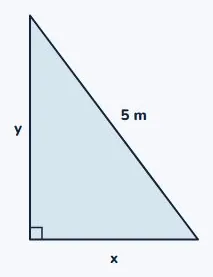
Q4: the sliding ladder
- Pythagoras links x and y.
- Chain rule twice.
- given: dx/dt = 0.3 m/s
- want: dy/dt when x = 3
- x² + y² = 25, y = √(25 − x²)
- dy/dx = −x/√(25 − x²)chain rule
- x = 3: y = 4, dy/dx = −3/4
- dy/dt = dy/dx × dx/dtchain rule
- = (−3/4) × 0.3 = −0.225
- top slides down at 0.225 m/s
Question 5 · Merit, in context
- A conical tank, point down, has radius
- 2 m at the top and depth 8 m.
- Water flows in at 3 m³ per minute.
- How fast does the depth rise at 6 m?
Q5: V in terms of h only
- Similar triangles: r = h/4.
- Substitute before differentiating.
- given: dV/dt = 3 m³/min
- want: dh/dt when h = 6
- V = (1/3)πr²hcone
- r/h = 2/8, so r = h/4similar triangles
- V = (1/3)π(h/4)²hsubstitute r
- = (1/3)π(h²/16)h
- = πh³/48one variable
Q5: chain the rates
- Differentiate, then h = 6.
- Divide to undo.
- V = πh³/48
- dV/dh = 3πh²/48 = πh²/16differentiate
- h = 6: dV/dh = 36π/16 = 9π/4
- dV/dt = dV/dh × dh/dtchain rule
- 3 = (9π/4) × dh/dtsubstitute
- dh/dt = 12/(9π) = 4/(3π)3 × 4/(9π)
- ≈ 0.424 m/min3 s.f.
- depth rises at 0.424 m/minin words
Question 6 · Excellence, in context
- Mere, 1.8 m tall, walks away from a
- 6 m street light at 1.5 m/s.
- How fast is her shadow lengthening?
- Does it depend on where she is?
Q6: link shadow and distance
- Name both lengths.
- Similar triangles.
- x = distance from the post
- s = length of the shadow
- given: dx/dt = 1.5 m/s
- want: ds/dt
- s/1.8 = (x + s)/6similar triangles
- 6s = 1.8x + 1.8scross-multiply
- 4.2s = 1.8x− 1.8s
- s = 1.8x/4.2 = 3x/7
Q6: the rate, and the reason
- Chain rule.
- Look for x in the answer.
- s = 3x/7
- ds/dx = 3/7differentiate
- ds/dt = ds/dx × dx/dtchain rule
- = (3/7) × 1.5 = 9/14
- ≈ 0.643 m/s3 s.f.
- no x in ds/dta constant rate
- the same at every distance
Question 7 · Excellence, in context
- A plane flies level at a height of 3 km,
- Towards an observer, at 0.2 km/s.
- Θ is its angle of elevation. Find dθ/dt
- When it is 3 km away horizontally.
Q7: x in terms of θ
- Trig links x and θ.
- Radians throughout.
- given: dx/dt = −0.2 km/sx is decreasing
- want: dθ/dt when x = 3
- tan θ = 3/xopposite ÷ adjacent
- x = 3/tan θ = 3cot θ
- dx/dθ = −3cosec²θd/dθ cot θ = −cosec²θ
- x = 3: tan θ = 1, θ = π/4
- cosec²(π/4) = 1 ÷ (1/2) = 2
- dx/dθ = −3 × 2 = −6
Q7: chain the rates
- Divide to undo.
- Say what the sign means.
- x = 3: dx/dθ = −6
- dx/dt = dx/dθ × dθ/dtchain rule
- −0.2 = −6 × dθ/dtsubstitute
- dθ/dt = −0.2 ÷ −6 = 1/30
- ≈ 0.0333 rad/s3 s.f.
- positive: θ is increasinghigher in the sky
Try it: ladder, shadow, plane
Common mistakes
- Substituting h = 6 before differentiating.Differentiate while it still varies. Put in the value afterwards.
- A shrinking radius gives dr/dt = 0.2.A falling quantity has a negative rate: dr/dt = −0.2.
- Leaving r in the cone's volume formula.Use similar triangles first, so V depends on h alone.
The method that solved all seven
- Rates, link, differentiate, chain, answer.
| Step | How |
|---|---|
| Given | the rate you know, with units |
| Want | the rate you need, and when |
| Link | one formula, one variable |
| Derivative | before you substitute |
| Chain | multiply, or divide to undo |
| Answer | sign, units, in words |
Challenge
A spherical ball of ice melts so that its volume falls at a rate, in cm³ per minute, equal to 0.1 times its surface area in cm². Show that the radius falls at a constant rate. The ball starts with radius 3 cm: how long does it take to melt completely, and how fast is its surface area changing when the radius is 2 cm?
Hint
Write dVdt two ways: from the rule in the question (using S = 4πr²) and from the chain rule (dVdr × drdt). Then compare.
Answer
drdt = −0.1 cm per minute, constant; it melts in 30 minutes; at r = 2 the surface area falls at 1.6π ≈ 5.03 cm² per minute
Step by step
- The rule says dVdt = −0.1 × 4πr², negative because the volume falls.
- The chain rule says dVdt = 4πr² × drdt, since V = (43)πr³.
- Set them equal and divide by 4πr²: drdt = −0.1, the same at every size.
- Losing 0.1 cm every minute, a 3 cm radius lasts 3 ÷ 0.1 = 30 minutes.
- S = 4πr², so dSdt = 8πr × drdt = 8π(2)(−0.1) = −1.6π.
Full working
- dVdt = −0.1(4πr²)the melting rule
- V = (43)πr³, dVdr = 4πr²sphere
- 4πr² × drdt = −0.4πr²chain rule
- drdt = −0.1 cm per minuteno r left: constant
- 3 ÷ 0.1 = 30 minutesradius from 3 cm to 0
- dSdt = 8πr × drdt = 8π(2)(−0.1)S = 4πr², r = 2
- dSdt = −1.6π ≈ −5.03 cm² per minute3 s.f.
- constant drdt = −0.1; 30 minutes; area falling at 5.03 cm² per minute
Two roads cross at right angles near Taupō. Car A is 3 km north of the crossing, driving north at 60 km per hour. Car B is 4 km east of the crossing, driving towards it at 80 km per hour. How fast is the distance between the cars changing at this moment? Find the least distance between the cars, and how long after this moment it happens.
Hint
Call A's distance y and B's distance x, so D² = x² + y². Differentiate with respect to t, keeping the sign of each rate. For the least distance, write x and y as functions of time.
Answer
Decreasing at 28 km per hour; least distance 4.8 km, 7500 hour = 50.4 seconds later
Step by step
- B is moving towards the crossing, so dxdt = −80; A moves away, so dydt = 60.
- Differentiate D² = x² + y²: 2D dDdt = 2x dxdt + 2y dydt.
- With x = 4, y = 3, D = 5: dDdt = (4(−80) + 3(60)) ÷ 5 = −28, so the gap is closing.
- After t hours, x = 4 − 80t and y = 3 + 60t. Minimise D² = (4 − 80t)² + (3 + 60t)², which is least when D is least.
- The derivative is 20000t − 280, which is 0 at t = 0.014 h. Then x = 2.88, y = 3.84 and D = 4.8 km.
Full working
- dxdt = −80, dydt = 60B approaches, A leaves
- D² = x² + y², so 2D dDdt = 2x dxdt + 2y dydtdifferentiate in t
- 5 dDdt = 4(−80) + 3(60) = −140x = 4, y = 3, D = 5
- dDdt = −28 km per hourthe gap is closing
- D² = (4 − 80t)² + (3 + 60t)²t hours from now
- d(D²)dt = −160(4 − 80t) + 120(3 + 60t) = 20000t − 280chain rule
- t = 28020000 = 7500 h = 50.4 s− before, + after: a minimum
- D² = 2.88² + 3.84² = 23.04, so D = 4.8x = 2.88, y = 3.84
- closing at 28 km per hour; least distance 4.8 km after 50.4 seconds
A tank is a cone, point down, with radius always half the depth of water in it. Water is pumped in at 3π m³ per hour and leaks out of the bottom at 0.75π√h m³ per hour, where h m is the depth. How fast is the depth changing when h = 4 and when h = 9? Explain why, starting from empty, the depth can never go above a certain level, and find that level.
Hint
The net rate is dVdt = in − out. Write V in terms of h only, then use dVdt = dVdh × dhdt.
Answer
At h = 4: rising at 38 = 0.375 m per hour; at h = 9: rising at 127 ≈ 0.0370 m per hour; the level approaches 16 m but never passes it
Step by step
- r = h2, so V = (13)π(h2)²h = πh³12 and dVdh = πh²4.
- Net flow: dVdt = 3π − 0.75π√h.
- Divide: dhdt = (3π − 0.75π√h) ÷ (πh²4) = 12 − 3√hh².
- h = 4 gives 616 = 38. h = 9 gives 381 = 127. It is still rising, but much more slowly.
- The level stops changing when 3 = 0.75√h, that is h = 16. Below 16 m, dhdt > 0, but it shrinks to 0 as h nears 16, so the depth creeps up towards 16 m and never passes it.
Full working
- V = (13)πr²h with r = h2 gives V = πh³12one variable
- dVdh = πh²4differentiate
- dVdt = 3π − 0.75π√hin − out
- dhdt = (3π − 0.75π√h) ÷ (πh²4) = 12 − 3√hh²dVdt = dVdh × dhdt
- h = 4: 12 − 616 = 38 = 0.375 m per hourrising
- h = 9: 12 − 981 = 127 ≈ 0.0370 m per hour3 s.f.
- 12 − 3√h = 0, so √h = 4, h = 16inflow equals leak
- h < 16: dhdt > 0 and dhdt → 0 as h → 16the level is approached, not passed
- 0.375 and 0.0370 m per hour; the depth never passes 16 m
Practise this
Report a mistake
More in AS 91578
 The derivative toolkit: chain, product and quotient rules11 min
 Stationary points, concavity and points of inflection11 min
 Tangents and normals: from gradient to finished equation11 min
 Parametric differentiation, and the second derivative11 min
 Related rates of change: spheres, cones and the chain rule10 min
 Optimisation: building the model and finding the max or min11 min
 Limits, continuity and differentiability from a graph8 min
 Derivative toolkit: 7 exam questions solved step by step11 min
 Stationary points: 7 exam questions solved step by step12 min
 Tangents and normals: 7 exam questions solved step by step12 min
 Parametric curves: 7 exam questions solved step by step11 minRelated rates of change: 7 exam questions solved step by step11 min
 Optimisation: 7 exam questions solved step by step11 min
 Limits and continuity: 7 exam questions solved step by step11 min
Is your child on track?
Take the free placement test