Related rates of change: spheres, cones and the chain rule

What this lesson covers
- When two quantities change with time, the chain rule links their rates.
- Write every rate you know and the one you want before differentiating anything.
Rates that are linked
- Radius and volume both change with time.
- Know one rate, find the other.
- The chain rule makes the link.
Write it down before you differentiate
- The rate you are given.
- The rate you want.
- A formula linking the two quantities.
The chain rule links the rates
- DV/dt = dV/dr × dr/dt.
- The dr parts cancel like fractions.
- Want dr/dt? Divide by dV/dr.
A ripple: dr/dt = 3 cm/s
- Given dr/dt, want dA/dt.
- Chain: dA/dr × dr/dt.
- given: dr/dt = 3 cm/s
- want: dA/dt when r = 10
- A = πr², dA/dr = 2πrthe link
- dA/dt = dA/dr × dr/dtchain rule
- = 2π(10) × 3r = 10, dr/dt = 3
- = 60π ≈ 188 cm²/s
A balloon: dV/dt = 100 cm³/s
- Given dV/dt, want dr/dt.
- Divide by dV/dr.
- given: dV/dt = 100 cm³/s
- want: dr/dt when r = 5
- V = (4/3)πr³the link
- dV/dr = 4πr²(4/3) × 3 = 4
- r = 5: dV/dr = 4π(25) = 100π
- dV/dt = dV/dr × dr/dtchain rule
- 100 = 100π × dr/dtsubstitute
- dr/dt = 100/100π = 1/πdivide by 100π
- ≈ 0.318 cm/s
Try it: a balloon
Then the surface area
- Dr/dt = 1/π from before.
- Chain: dS/dr × dr/dt.
- S = 4πr², dS/dr = 8πrthe link
- r = 5: dS/dr = 8π(5) = 40π
- dS/dt = dS/dr × dr/dtchain rule
- = 40π × 1/πdr/dt from before
- = 40 cm²/s
Substituting too early
- r is 5 at one instant only.
- Differentiate first.
- V = (4/3)π(5)³ = 500π/3r = 5 too early
- dV/dt = 0a constant
- dV/dr = 4πr²differentiate first
- r = 5: dV/dr = 100πthen substitute
A cone: two variables, one link
- Radius 4 cm, height 12 cm, point down.
- Water depth h, surface radius r.
- Similar triangles: r = h/3.
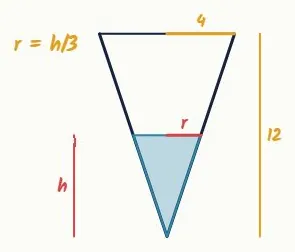
Filling the cone: dV/dt = 8 cm³/s
- Substitute r = h/3 into V.
- One variable, then d/dh.
- given: dV/dt = 8 cm³/s
- want: dh/dt when h = 6
- V = (1/3)πr²hcone volume
- r = h/3similar triangles
- V = (1/3)π(h/3)²hsubstitute r = h/3
- = (1/3)π(h²/9)h(h/3)² = h²/9
- = πh³/27one variable
Try it: filling the cone
Filling the cone: dh/dt at h = 6
- Chain: dV/dh × dh/dt.
- Then substitute h = 6.
- V = πh³/27
- dV/dh = 3πh²/27 = πh²/9differentiate
- h = 6: dV/dh = 36π/9 = 4π
- dV/dt = dV/dh × dh/dtchain rule
- 8 = 4π × dh/dtsubstitute
- dh/dt = 8/4π = 2/πdivide by 4π
- ≈ 0.637 cm/s
Negative means falling
- Leaking: dV/dt is negative.
- Say it in words.
- dV/dt = −100 cm³/sleaking
- r = 5: dV/dr = 100πas before
- −100 = 100π × dr/dtchain rule
- dr/dt = −1/π ≈ −0.318 cm/s
- the radius falls at 0.318 cm/s
Try it: four linked rates
Show it and say it
- Every derivative, and the chain rule step.
- Full accuracy, then 3 significant figures.
- Units, and a sentence in context.
Where the marks are
- Achieved: both pieces, differentiated.
- Merit: through to the rate, e.g. a sphere.
- Excellence: build the link yourself.
What to take away
- List the rates, link them in one variable, differentiate, then substitute.
| List | given and wanted |
| Link | a formula, one variable |
| Differentiate | before substituting |
| Chain | multiply or divide |
| Sign | negative is falling |
| Answer | units, in context |
Common mistakes
- V = (4/3)π(5)³ = 500π/3, so dV/dt = 0.r is 5 at one instant only; differentiate first, dV/dr = 4πr², then substitute r = 5.
- Cone: V = (1/3)πr²h, so dV/dh = (1/3)πr².r changes with h; substitute r = h/3 first to get V = πh³/27, then dV/dh = πh²/9.
- Leaking at 100 cm³/s, so dV/dt = 100.The volume is falling, so dV/dt = −100 and dr/dt = −1/π ≈ −0.318 cm/s; then say the radius falls.
- dV/dt = 100 and dV/dr = 100π, so dr/dt = 100 × 100π.dV/dt = dV/dr × dr/dt, so divide: dr/dt = 100 ÷ 100π = 1/π ≈ 0.318 cm/s.
Your turn: eight questions
- Question 4: the cone has r = h/2.
- Show every derivative, give units.
| Given | Find | |
|---|---|---|
| 1 | circle, dr/dt = 2 | dA/dt at r = 5 |
| 2 | sphere, dV/dt = 36π | dr/dt at r = 3 |
| 3 | cube, ds/dt = 0.5 | dV/dt at s = 4 |
| 4 | cone r = h/2, leak 2π | dh/dt at h = 4 |
| 5 | circle, dA/dt = 12π | dr/dt at r = 3 |
| 6 | sphere, dr/dt = 0.2 | dS/dt at r = 5 (S = 4πr²) |
| 7 | balloon, leak 50 cm³/s | dr/dt at r = 5 |
| 8 | cone radius 6, height 9, fill 4π | dh/dt at h = 3 |
Show answer
1. dA/dt = 2πr × dr/dt = 20π ≈ 62.8 cm²/s. 2. dV/dr = 4πr² = 36π, so dr/dt = 36π ÷ 36π = 1 cm/s. 3. dV/ds = 3s² = 48, so dV/dt = 48 × 0.5 = 24 cm³/s. 4. V = πh³/12, dV/dh = πh²/4 = 4π, dV/dt = −2π, so dh/dt = −0.5 cm/s: the depth falls at 0.5 cm/s. 5. 2 cm/s. dA/dr = 2πr = 6π, so dr/dt = 12π ÷ 6π = 2 cm/s. 6. 8π ≈ 25.1 cm²/s. dS/dr = 8πr = 40π, so dS/dt = 40π × 0.2 = 8π ≈ 25.1 cm²/s. 7. Falls at 0.159 cm/s. dV/dr = 4πr² = 100π, so dr/dt = −50 ÷ 100π ≈ −0.159 cm/s: the radius falls at 0.159 cm/s. 8. 1 cm/s. Similar triangles give r = 2h/3, so V = (1/3)π(2h/3)²h = 4πh³/27, dV/dh = 4πh²/9 = 4π at h = 3, and dh/dt = 4π ÷ 4π = 1 cm/s.
The answers: questions 1 and 2
- 1. A = πr², dA/dr = 2πr = 10πr = 5
- dA/dt = dA/dr × dr/dtchain rule
- = 10π × 2 = 20π ≈ 62.8 cm²/s
- 2. V = (4/3)πr³, dV/dr = 4πr²
- r = 3: dV/dr = 36π
- dV/dt = dV/dr × dr/dtchain rule
- 36π = 36π × dr/dtsubstitute
- dr/dt = 1 cm/sdivide by 36π
The answers: questions 3 and 4
- 3. V = s³, dV/ds = 3s² = 48s = 4
- dV/dt = dV/ds × ds/dtchain rule
- = 48 × 0.5 = 24 cm³/s
- 4. V = (1/3)π(h/2)²hsubstitute r = h/2
- = πh³/12(1/3)(1/4) = 1/12
- dV/dh = πh²/4 = 4πh = 4
- dV/dt = dV/dh × dh/dtchain rule
- −2π = 4π × dh/dtleaking, so negative
- dh/dt = −0.5 cm/sthe depth falls
Sample question: Achieved
An oil slick spreads as a circle. Its radius grows at 0.4 m per s. How fast is its area growing when the radius is 30 m?
Hint
Write the rate you know, drdt, and the rate you want, dAdt. Link them with dAdt = dAdr × drdt.
Answer
24π ≈ 75.4 m² per s
Step by step
- Write down what you know and what you want. Given: drdt = 0.4 m per s. Want: dAdt when r = 30.
- The link between A and r is the area formula A = πr².
- Differentiate with respect to r: dAdr = 2πr.
- The chain rule links the rates: dAdt = dAdr × drdt.
- Substitute r = 30 only now, after differentiating: dAdt = 2π(30) × 0.4 = 24π.
- 24π ≈ 75.4, so the area grows at about 75.4 m² per s. Area is in m², so the rate is in m² per s.
Full working
- given drdt = 0.4, want dAdt at r = 30
- A = πr², dAdr = 2πr
- dAdt = dAdr × drdt = 2π(30)(0.4)chain rule
- 24π ≈ 75.4 m² per s
Sample questions: Merit
A cone-shaped tank stands point down. It is 12 cm deep and its top has radius 3 cm. Water is poured in at 5 cm³ per s. How fast is the depth rising when the water is 8 cm deep?
Hint
The water is a smaller cone of the same shape, so its radius is r = h4. Use this to write V in terms of h only before you differentiate.
Answer
54π ≈ 0.398 cm per s
Step by step
- Given: dVdt = 5 cm³ per s. Want: dhdt when h = 8.
- The volume of a cone is V = (13)πr²h. It has two variables, r and h, so we need to remove one.
- The water forms a cone the same shape as the tank. The tank's radius is 3 when its depth is 12, so r ÷ h = 3 ÷ 12 = 14, and r = h4.
- Substitute: V = (13)π(h4)²h = (13)π(h²16)h = πh³48.
- Differentiate: dVdh = 3πh²48 = πh²16.
- At h = 8: dVdh = 64π16 = 4π.
- Chain rule: dVdt = dVdh × dhdt, so 5 = 4π × dhdt.
- dhdt = 54π ≈ 0.398 cm per s. The depth is rising, so the rate is positive.
- The classic mistake is to put h = 8 in before differentiating. Then V would be a fixed number with derivative 0.
Full working
- given dVdt = 5, want dhdt at h = 8
- r = h4similar cones, 3 ÷ 12
- V = (13)π(h4)²h = πh³48
- dVdh = πh²16 = 4π at h = 8
- 5 = 4π × dhdtdVdt = dVdh × dhdt
- dhdt = 54π ≈ 0.398 cm per s
A 5 m ladder leans against a vertical wall. Its foot slides away from the wall at 0.3 m per s. How fast is the top of the ladder sliding down the wall when the foot is 3 m from the wall?
Hint
Let x be the distance of the foot from the wall and y the height of the top. Pythagoras gives y = √(25 − x²). Then dydt = dydx × dxdt.
Answer
The top slides down at 0.225 m per s (dydt = −0.225 m per s).
Step by step
- Given: dxdt = 0.3 m per s. Want: dydt when x = 3.
- The ladder, the wall and the ground make a right triangle: x² + y² = 25, so y = √(25 − x²).
- Differentiate with the chain rule. Write y = (25 − x²)^½. Then dydx = ½(25 − x²)^−½ × (−2x) = −x√(25 − x²).
- At x = 3: √(25 − 9) = 4, so dydx = −34.
- Link the rates: dydt = dydx × dxdt = −34 × 0.3 = −0.225.
- The negative sign means y is getting smaller: the top is moving down.
- So the top slides down the wall at 0.225 m per s.
- Sense check: the foot moves out, so the top must come down. A negative dydt agrees.
Full working
- given dxdt = 0.3, want dydt at x = 3
- y = √(25 − x²)Pythagoras
- dydx = −x√(25 − x²) = −34 at x = 3chain rule
- dydt = −34 × 0.3 = −0.225dydt = dydx × dxdt
- the top slides down at 0.225 m per s
Sample questions: Excellence
A spherical balloon is inflated so that its volume increases at a constant 50 cm³ per s. Show that the rate of increase of its surface area is 100r cm² per s, where r is the radius. Hence find the rate when r = 10 cm, and explain what happens to this rate as the balloon grows.
Hint
Find drdt in terms of r from V = (43)πr³, then use S = 4πr² and dSdt = dSdr × drdt.
Answer
dSdt = 100r, which is 10 cm² per s when r = 10. As r grows, 100r gets smaller, so the surface area grows more and more slowly.
Step by step
- Given: dVdt = 50 cm³ per s. Want: dSdt for any radius r. Keep r as a letter, because we need a general result.
- Volume: V = (43)πr³, so dVdr = 4πr².
- Chain rule: dVdt = dVdr × drdt, so 50 = 4πr² × drdt, and drdt = 504πr².
- Surface area: S = 4πr², so dSdr = 8πr.
- dSdt = dSdr × drdt = 8πr × 504πr².
- Simplify: 8π × 50 = 400π on top and 4π on the bottom, so it is 100rr² = 100r. That is the result we had to show.
- Hence, at r = 10: dSdt = 10010 = 10 cm² per s.
- As the balloon grows, r gets bigger, so 100r gets smaller. The surface area keeps growing, but more and more slowly.
- Why: the same 50 cm³ each second is spread over a bigger and bigger surface, so the radius grows more slowly.
- Check at r = 10 the long way: drdt = 50400π = 18π, and 8π(10) × 18π = 10. Correct.
Full working
- V = (43)πr³, dVdr = 4πr²
- drdt = 504πr²50 = 4πr² × drdt
- S = 4πr², dSdr = 8πr
- dSdt = 8πr × 504πr² = 100rchain rule
- r = 10: dSdt = 10
- 100r decreases as r increases
- dSdt = 100r; 10 cm² per s at r = 10; the rate falls as the balloon grows
A street light is 6 m above the ground. A person 1.8 m tall walks directly away from the base of the light at 1.2 m per s. Find how fast the length of their shadow is increasing, and how fast the tip of the shadow is moving. Explain why neither rate depends on how far away the person is.
Hint
Let x be the person's distance from the light and s the length of the shadow. Similar triangles give 1.8 ÷ s = 6 ÷ (x + s).
Answer
The shadow grows at 1835 ≈ 0.514 m per s and the tip moves at 127 ≈ 1.71 m per s. Both are constants, because s is a fixed multiple of x.
Step by step
- Given: dxdt = 1.2 m per s. Want: dsdt, and the rate of the tip, which is at distance x + s from the light.
- There are two similar right triangles: the light with the whole ground length x + s, and the person with the shadow s.
- Matching sides: 1.8s = 6x + s. Cross-multiply: 1.8(x + s) = 6s.
- So 1.8x = 4.2s, and s = 1.8x ÷ 4.2 = 3x7.
- Differentiate with respect to t: dsdt = (37) × dxdt = (37)(1.2) = 1835 ≈ 0.514 m per s.
- The tip is at distance x + s = x + 3x7 = 10x7. Its speed is (107) × 1.2 = 127 ≈ 1.71 m per s.
- Check: 1.2 + 1835 = 4235 + 1835 = 6035 = 127. Correct.
- Why no dependence on distance: s is always 37 of x, a straight-line relationship, so dsdt is always 37 of dxdt.
- So the answers are the same whether the person is 2 m or 20 m from the light, as long as they walk at a steady 1.2 m per s.
Full working
- 1.8s = 6x + ssimilar triangles
- 1.8x = 4.2s, so s = 3x7
- dsdt = (37)(1.2) = 1835 ≈ 0.514
- tip: x + s = 10x7, rate (107)(1.2) = 127 ≈ 1.71
- s is a fixed multiple of x, so the rates are constant
- shadow grows at 1835 m per s, tip moves at 127 m per s
Challenge
A kite flies at a steady height of 60 m above a beach at Ōtaki and drifts horizontally away from the person holding it at 4 m s⁻¹. The string is straight. When 100 m of string is out, how fast is the string being let out, and how fast is the angle between the string and the ground changing?
Hint
Let x be the horizontal distance and s the string length, so s² = x² + 60². For the angle, tan θ = 60x. Differentiate each with respect to time and use the 3 : 4 : 5 triangle at that moment.
Answer
The string is let out at 3.2 m s⁻¹; the angle falls at 0.024 radians per second
Step by step
- With s = 100 and height 60, Pythagoras gives x = 80.
- From s² = x² + 3600: 2s × dsdt = 2x × dxdt, so dsdt = (80100) × 4 = 3.2.
- From tan θ = 60x: sec²θ × dθdt = −60x² × dxdt.
- At this moment tan θ = 34, so sec²θ = 1 + 916 = 2516.
- dθdt = (−606400 × 4) ÷ (2516) = −0.024: the angle is getting smaller.
Full working
- x = √(100² − 60²) = 80Pythagoras
- s² = x² + 3600, 2s(dsdt) = 2x(dxdt)differentiate in time
- dsdt = 80 × 4100 = 3.2 m s⁻¹substitute
- tan θ = 60x = 60x⁻¹the angle at the ground
- sec²θ(dθdt) = −60x⁻²(dxdt)chain rule
- sec²θ = 1 + (34)² = 2516tan θ = 6080
- dθdt = (−606400 × 4) × 1625 = −3125rearrange
- string out at 3.2 m s⁻¹; angle falling at 0.024 radians per second
A hemispherical bowl of radius 10 cm is being filled with water at 2 cm³ per second. When the water is h cm deep, its volume is V = (13)πh²(30 − h). Find how fast the depth is rising when h = 4. Show that the area of the water's surface is π(20h − h²), and find how fast it is growing when h = 4. Then explain what happens to the rate of growth of the surface area as the bowl fills to the brim.
Hint
For the surface, draw the vertical cross-section through the centre: the radius from the centre of the hemisphere to the edge of the water is 10 cm, and the centre is (10 − h) cm above the water. For the last part, find dAdt as a fraction in h.
Answer
dhdt = 132π ≈ 0.00995 cm per second; the surface grows at 38 = 0.375 cm² per second; in general dAdt = 4(10 − h)h(20 − h), which falls to 0 as h reaches 10
Step by step
- V = (13)π(30h² − h³), so dVdh = π(20h − h²), which is 64π at h = 4.
- dhdt = dVdt ÷ dVdh = 264π = 132π.
- The surface radius a satisfies a² + (10 − h)² = 10², so a² = 20h − h² and A = π(20h − h²).
- dAdt = π(20 − 2h) × dhdt = 12π × 132π = 38 at h = 4.
- In general dAdt = 4(10 − h)h(20 − h), which shrinks to 0 at h = 10: at the brim the surface is as wide as the bowl and stops growing.
Full working
- V = (13)π(30h² − h³)expand
- dVdh = π(20h − h²)differentiate
- h = 4: dVdh = π(80 − 16) = 64πsubstitute
- dhdt = 264π = 132π ≈ 0.00995 cm per secondchain rule
- a² = 10² − (10 − h)² = 20h − h², A = π(20h − h²)Pythagoras
- dAdh = π(20 − 2h) = 12π at h = 4differentiate
- dAdt = 12π × 132π = 38 cm² per secondchain rule
- dAdt = π(20 − 2h) × 2π(20h − h²) = 4(10 − h)h(20 − h)general h
- h → 10: 4(10 − h) → 0the surface stops widening at the brim
- 132π ≈ 0.00995 cm per second; 0.375 cm² per second; the surface rate falls to 0 at the brim
A clock has an hour hand 3 cm long and a minute hand 4 cm long. How fast, in cm per hour, is the distance between the tips of the hands changing at exactly 3 o'clock? Then find the greatest rate at which this distance ever changes, and the distance between the tips at that moment.
Hint
Let θ be the angle between the hands. The minute hand turns at 2π radians per hour and the hour hand at π6, so θ changes at 11π6 radians per hour. Use the cosine rule for the distance D, differentiate, and then maximise |dDdt| as a function of θ (a quadratic in cos θ appears).
Answer
At 3 o'clock the distance is falling at 22π5 = 4.4π ≈ 13.8 cm per hour; the greatest rate is 11π2 = 5.5π ≈ 17.3 cm per hour, when cos θ = 34 and the tips are √7 ≈ 2.65 cm apart
Step by step
- The cosine rule gives D² = 3² + 4² − 2(3)(4)cos θ = 25 − 24cos θ, and |dθdt| = 2π − π6 = 11π6.
- Differentiating, 2D × dDdt = 24sin θ × dθdt. At 3 o'clock θ = π2, D = 5 and θ is shrinking, so dDdt = −(24 × 11π6)/10 = −4.4π.
- In general |dDdt| = (11π6) × 12sin θ√(25 − 24cos θ), so maximise f(θ) = sin θ√(25 − 24cos θ).
- f′(θ) = 0 leads to cos θ(25 − 24cos θ) = 12sin²θ, that is 12cos²θ − 25cos θ + 12 = 0, so cos θ = 34 (43 is impossible).
- Then D² = 25 − 18 = 7, sin θ = √74, and |dDdt| = (11π6) × 12(√74)/√7 = 11π2.
Full working
- D² = 25 − 24cos θcosine rule
- dθdt = −(2π − π6) = −11π6 radians per hourθ shrinks as the minute hand catches up
- 2D(dDdt) = 24sin θ(dθdt)differentiate in time
- 3 o'clock: θ = π2, D = 5substitute
- dDdt = 24(1)(−11π6) ÷ 10 = −22π5 ≈ −13.8 cm per hourthe tips are closing
- size of dDdt = (11π6) × 12f(θ), f(θ) = sin θ(25 − 24cos θ)^(−12)rate as a function of θ
- f′(θ) = cos θ(25 − 24cos θ)^(−12) − 12sin²θ(25 − 24cos θ)^(−32)product and chain rules
- cos θ(25 − 24cos θ) = 12(1 − cos²θ), 12cos²θ − 25cos θ + 12 = 0f′(θ) = 0
- (4cos θ − 3)(3cos θ − 4) = 0, cos θ = 34cos θ ≤ 1
- D² = 25 − 24(34) = 7, sin θ = √74at that moment
- size of dDdt = (11π6) × 12(√74) ÷ √7 = 11π2 ≈ 17.3 cm per hourgreatest rate
- −4.4π ≈ −13.8 cm per hour at 3 o'clock; greatest 5.5π ≈ 17.3 cm per hour, tips √7 cm apart
Where science uses this
Practise this
Report a mistake
More in AS 91578
 The derivative toolkit: chain, product and quotient rules11 min
 Stationary points, concavity and points of inflection11 min
 Tangents and normals: from gradient to finished equation11 min
 Parametric differentiation, and the second derivative11 minRelated rates of change: spheres, cones and the chain rule10 min
 Optimisation: building the model and finding the max or min11 min
 Limits, continuity and differentiability from a graph8 min
 Derivative toolkit: 7 exam questions solved step by step11 min
 Stationary points: 7 exam questions solved step by step12 min
 Tangents and normals: 7 exam questions solved step by step12 min
 Parametric curves: 7 exam questions solved step by step11 min
 Related rates of change: 7 exam questions solved step by step11 min
 Optimisation: 7 exam questions solved step by step11 min
 Limits and continuity: 7 exam questions solved step by step11 min
Is your child on track?
Take the free placement test