Parametric differentiation, and the second derivative
What this lesson covers
- For a curve given by x(t) and y(t), dy/dx is dy/dt divided by dx/dt.
- The second derivative is the derivative of dy/dx with respect to t, divided by dx/dt again.
A curve drawn by a parameter
- x and y are both given in terms of t.
- As t changes, the point (x, y) moves.
- To differentiate, work through t.
x = t², y = t³ − 3t
- t = 0 is the origin.
- From t = −2 to 2 it swings out and back.
- It crosses itself at (3, 0).
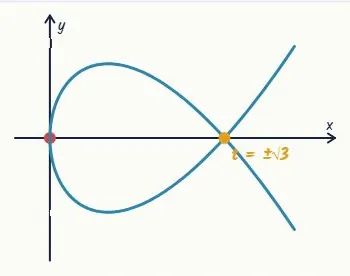
Where it crosses itself
- Two values of t, one point.
- t and −t give the same x.
- x(−t) = (−t)² = x(t)same x
- need y(t) = y(−t)
- t³ − 3t = −t³ + 3t
- 2t³ − 6t = 0collect terms
- 2t(t² − 3) = 0factorise
- t = 0t and −t are equal
- t = ±√3
- x = 3, y = 3√3 − 3√3 = 0
- crosses itself at (3, 0)
The first derivative
- Differentiate x and y in t.
- Dy/dx = dy/dt ÷ dx/dt.
- In the formula booklet.
- x = t², y = t³ − 3t
- dx/dt = 2t
- dy/dt = 3t² − 3
- dy/dx = (dy/dt) ÷ (dx/dt)chain rule
- = (3t² − 3)/(2t)
Try it: trace the curve
Stationary points and vertical tangents
- Stationary: dy/dt = 0.
- Vertical: dx/dt = 0.
- 3t² − 3 = 0dy/dt = 0
- t² = 1, so t = ±1
- t = 1: x = 1, y = 1 − 3 = −2
- t = −1: x = 1, y = −1 + 3 = 2
- (1, −2) and (1, 2)stationary points
- 2t = 0, so t = 0dx/dt = 0
- vertical tangent at (0, 0)
The tangent at t = 2
- Point and gradient: same t.
- Finish in y = mx + c.
- t = 2: x = 2² = 4
- y = 2³ − 3(2) = 2
- point (4, 2)
- m = (3(2)² − 3)/(2(2))into dy/dx
- = 9/4
- y − 2 = (9/4)(x − 4)point-gradient form
- y = (9/4)x − 9 + 2expand
- y = (9/4)x − 7
The normal at t = 2
- Normal: perpendicular.
- Gradients multiply to −1.
- End in y = mx + c.
- point (4, 2), tangent m = 9/4
- m = −1 ÷ (9/4) = −4/9negative reciprocal
- y − 2 = −(4/9)(x − 4)same point
- y = −(4/9)x + 16/9 + 2expand
- y = −(4/9)x + 34/9
- (9/4) × (−4/9) = −1
The second derivative: the 2025 error
- d²y/dx² means differentiate dy/dx with respect to x.
- But dy/dx is written in t.
- So differentiate with respect to t, then ÷ dx/dt.
Where candidates stopped
- d/dt alone is not finished.
- Then ÷ dx/dt = 2t.
- dy/dx = (3t² − 3)/(2t)
- = (3/2)t − 3/(2t)split the fraction
- d/dt: 3/2 + 3/(2t²)not d²y/dx² yet
- d²y/dx² = (3/2 + 3/(2t²)) ÷ 2t
- = ((3t² + 3)/(2t²)) ÷ 2tcommon denominator
- = (3t² + 3)/(4t³)
Using it to classify
- Positive: a minimum.
- Negative: a maximum.
- t = 1: (3 + 3)/4 = 3/2
- 3/2 > 0: (1, −2) is a minimum
- t = −1: (3 + 3)/(−4) = −3/2
- −3/2 < 0: (1, 2) is a maximum
- stopped early: 3/2 + 3/2 = 3
- 3 > 0 at both: two minima?impossible
Try it: spot, gradient, bend
Trig: x = 2cos t, y = 3sin t
- Work through t again.
- Then ÷ dx/dt = −2sin t.
- dx/dt = −2sin t
- dy/dt = 3cos t
- dy/dx = 3cos t/(−2sin t)
- = −(3/2)cot t
- d/dt: (3/2)cosec² td/dt cot t = −cosec² t
- ÷ (−2sin t): −3/(4sin³ t)÷ dx/dt
- t = π/2: −3/(4(1)³) = −3/4
- negative: concave down
Try it: an ellipse
Points of inflection
- d²y/dx² = 0 and changes sign.
- Set its numerator to zero and solve for t.
- Then find x and y.
Show every derivative
- No credit for a calculator answer alone.
- Unknown constants stop the calculator.
- Write dx/dt, dy/dt and the division.
Where the marks are
- Achieved: dy/dx of a parametric curve.
- Merit: tangents, normals, second derivatives.
- Excellence: both derivatives together.
What to take away
- Work through t, and divide by dx/dt again for the second derivative.
| dy/dx | dy/dt ÷ dx/dt |
| Stationary | dy/dt = 0 |
| Vertical tangent | dx/dt = 0 |
| Tangent | y = mx + c |
| d²y/dx² | d/dt(dy/dx) ÷ dx/dt |
| Show it | every derivative |
Common mistakes
- d²y/dx² = d/dt((3/2)t − 3/(2t)) = 3/2 + 3/(2t²)That is only d/dt; divide by dx/dt = 2t as well, giving d²y/dx² = (3t² + 3)/(4t³). Stopping early was the 2025 error.
- dy/dx = (dx/dt) ÷ (dy/dt) = 2t/(3t² − 3)It is dy/dt ÷ dx/dt, so dy/dx = (3t² − 3)/(2t), with y on top.
- At t = 2 the gradient is 9/4, so the tangent is y = (9/4)x.Use the same t for the point: t = 2 gives (4, 2), so y − 2 = (9/4)(x − 4) and y = (9/4)x − 7.
- Stationary points: dx/dt = 2t = 0, so t = 0.Stationary needs dy/dt = 0, so t = ±1; dx/dt = 0 gives a vertical tangent at (0, 0) instead.
Your turn: eight questions
- Question 2 uses the curve from question 1.
- Question 3: the tangent as a full equation.
| Curve | Find | |
|---|---|---|
| 1 | x = t² + 1, y = t³ − 12t | stationary points |
| 2 | the same curve | classify t = 2 |
| 3 | x = eᵗ, y = e²ᵗ − 4t | tangent at t = 0 |
| 4 | x = 3sin t, y = 2cos t | dy/dx at t = π/4 |
| 5 | x = 2t + 1, y = t² − 4t | dy/dx at t = 4 |
| 6 | x = t² − 4t, y = t³ − 3t | vertical tangent |
| 7 | x = 2t, y = t³ | d²y/dx² |
| 8 | x = 4cos t, y = 2sin t | normal at t = π/4 |
Show answer
1. dy/dx = (3t² − 12)/(2t); t = ±2: (5, −16) and (5, 16). 2. d²y/dx² = (3t² + 12)/(4t³); 3/4 at t = 2, so (5, −16) is a minimum. 3. Point (1, 1), gradient −2: y = −2x + 3. 4. dy/dx = −(2/3)tan t = −2/3. 5. dy/dx = 2. dy/dx = dy/dt ÷ dx/dt = (2t − 4)/2 = t − 2, which is 2 at t = 4. 6. (−4, 2). Vertical: dx/dt = 2t − 4 = 0, so t = 2, giving x = −4 and y = 2. 7. 3t/2. dy/dx = 3t²/2; d/dt of that is 3t, then ÷ dx/dt = 2 gives 3t/2. 8. y = 2x − 3√2. Point (2√2, √2); dy/dx = 2cos t/(−4sin t) = −1/2, so the normal gradient is 2.
The answers: question 1
- 1. dx/dt = 2t, dy/dt = 3t² − 12
- dy/dx = (3t² − 12)/(2t)
- 3t² − 12 = 0, so t = ±2top = 0
- t = 2: x = 5, y = 8 − 24 = −16
- t = −2: x = 5, y = −8 + 24 = 16
- (5, −16) and (5, 16)
The answers: question 2
- 2. dy/dx = (3/2)t − 6/tsplit the fraction
- d/dt: 3/2 + 6/t²
- ÷ 2t: (3t² + 12)/(4t³)÷ dx/dt
- t = 2: (12 + 12)/32 = 3/4
- 3/4 > 0: (5, −16) is a minimum
The answers: questions 3 and 4
- 3. x = e⁰ = 1, y = e⁰ − 0 = 1t = 0
- dx/dt = eᵗ, dy/dt = 2e²ᵗ − 4
- m = (2 − 4)/1 = −2at t = 0
- y − 1 = −2(x − 1), so y = −2x + 3
- 4. dx/dt = 3cos t
- dy/dt = −2sin t
- dy/dx = −2sin t/(3cos t)
- = −(2/3)tan t
- t = π/4: −(2/3)(1) = −2/3
Sample question: Achieved
A curve has x = t² + 1 and y = 2t³ − t. Find dydx when t = 1.
Hint
dydx = (dydt) ÷ (dxdt). Differentiate x and y with respect to t first.
Answer
dydx = 52
Step by step
- For a parametric curve, dydx is dydt divided by dxdt.
- Differentiate x with respect to t: dxdt = 2t.
- Differentiate y with respect to t: dydt = 6t² − 1.
- So dydx = 6t² − 12t.
- At t = 1: 6 − 12 = 52.
- A common slip is to put t = 1 into x and y first. Substitute only after differentiating.
Full working
- dxdt = 2t, dydt = 6t² − 1
- dydx = 6t² − 12t(dydt) ÷ (dxdt)
- t = 1: 6 − 12
- dydx = 52
Sample questions: Merit
A curve has x = t − 1t and y = t + 1t. Find the equation of the tangent at the point where t = 2.
Hint
Find the point from x and y at t = 2, and the gradient from (dydt) ÷ (dxdt). Write 1t as t⁻¹ to differentiate.
Answer
y = (35)x + 85, or 3x − 5y + 8 = 0
Step by step
- A tangent needs a point and a gradient.
- The point: at t = 2, x = 2 − 12 = 32 and y = 2 + 12 = 52.
- Write 1t as t⁻¹. Then dxdt = 1 + t⁻² = 1 + 1t², and dydt = 1 − 1t².
- At t = 2: dxdt = 1 + 14 = 54 and dydt = 1 − 14 = 34.
- Gradient: dydx = (34) ÷ (54) = 35.
- Use y − y1 = m(x − x1): y − 52 = (35)(x − 32).
- Expand: y = (35)x − 910 + 2510 = (35)x + 85.
- Finish the equation: multiply by 5 to get 5y = 3x + 8, or 3x − 5y + 8 = 0.
- Check the point is on the line: 3(32) − 5(52) + 8 = 92 − 252 + 162 = 0. Correct.
Full working
- t = 2: x = 32, y = 52the point
- dxdt = 1 + 1t², dydt = 1 − 1t²
- m = (34) ÷ (54) = 35t = 2
- y − 52 = (35)(x − 32)
- y = (35)x + 85check: 92 − 252 + 8 = 0
- y = (35)x + 85
A curve has x = 2t + 1 and y = t³ − 3t². Find the stationary points and use the second derivative to decide whether each is a maximum or a minimum.
Hint
Stationary means dydt = 0 (with dxdt not zero). For the second derivative, differentiate dydx with respect to t, then divide by dxdt again.
Answer
(1, 0) is a maximum and (5, −4) is a minimum.
Step by step
- dxdt = 2 and dydt = 3t² − 6t, so dydx = 3t² − 6t2.
- Stationary points have dydx = 0. dxdt is never 0, so we need 3t² − 6t = 0, which is 3t(t − 2) = 0. So t = 0 or t = 2.
- t = 0: x = 1, y = 0. The point is (1, 0).
- t = 2: x = 5, y = 8 − 12 = −4. The point is (5, −4).
- The second derivative: differentiate dydx with respect to t, then divide by dxdt again.
- ddt of 3t² − 6t2 is 6t − 62 = 3t − 3. Divide by dxdt = 2: d²ydx² = 3t − 32.
- The classic mistake is to stop at 3t − 3 and forget the second division by dxdt. Here it would not change the signs, but it changes the value.
- t = 0: d²ydx² = −32, which is negative, so (1, 0) is a maximum.
- t = 2: d²ydx² = 32, which is positive, so (5, −4) is a minimum.
Full working
- dxdt = 2, dydt = 3t² − 6t
- 3t(t − 2) = 0, so t = 0 or 2dydx = 0
- t = 0: (1, 0); t = 2: (5, −4)
- d²ydx² = (3t − 3) ÷ 2ddt of dydx, then ÷ dxdt
- t = 0: −32 < 0, maximum; t = 2: 32 > 0, minimum
- (1, 0) maximum, (5, −4) minimum
Sample questions: Excellence
A curve has x = eᵗ and y = t²eᵗ. Find the exact coordinates of its stationary points and classify them. Then find the exact coordinates of the point of inflection, and justify that it is one.
Hint
dydx simplifies because eᵗ cancels. For d²ydx², differentiate dydx with respect to t and divide by dxdt = eᵗ.
Answer
Minimum at (1, 0), maximum at (e⁻², 4e⁻²), point of inflection at (e⁻¹, e⁻¹)
Step by step
- dxdt = eᵗ. For y use the product rule: dydt = 2teᵗ + t²eᵗ = (t² + 2t)eᵗ.
- dydx = (t² + 2t)eᵗ ÷ eᵗ = t² + 2t.
- Stationary: t² + 2t = 0, so t(t + 2) = 0, giving t = 0 or t = −2. eᵗ is never 0, so both are fine.
- t = 0: x = 1, y = 0. t = −2: x = e⁻², y = 4e⁻².
- Second derivative: ddt of t² + 2t is 2t + 2. Divide by dxdt = eᵗ: d²ydx² = (2t + 2)e⁻ᵗ.
- t = 0: d²ydx² = 2 > 0, so (1, 0) is a minimum. t = −2: d²ydx² = −2e² < 0, so (e⁻², 4e⁻²) is a maximum.
- A point of inflection needs d²ydx² = 0 and a change of sign. 2t + 2 = 0 gives t = −1.
- e⁻ᵗ is always positive, so the sign of d²ydx² is the sign of 2t + 2. It is negative for t < −1 and positive for t > −1, so it does change sign.
- x = eᵗ always increases with t, so a sign change in t is also a sign change as we move along the curve in x.
- t = −1: x = e⁻¹ and y = (−1)²e⁻¹ = e⁻¹. The point of inflection is (e⁻¹, e⁻¹).
- Check: eliminating t gives y = x(ln x)². At x = 1, y = 0, and y is never negative, so (1, 0) being a minimum makes sense.
Full working
- dxdt = eᵗ, dydt = (t² + 2t)eᵗproduct rule
- dydx = t² + 2t = 0, t = 0 or −2
- t = 0: (1, 0); t = −2: (e⁻², 4e⁻²)
- d²ydx² = (2t + 2) ÷ eᵗ = (2t + 2)e⁻ᵗ
- t = 0: 2 > 0, minimum; t = −2: −2e² < 0, maximum
- 2t + 2 = 0 at t = −1, sign − to +e⁻ᵗ > 0, x increases with t
- minimum (1, 0), maximum (e⁻², 4e⁻²), inflection (e⁻¹, e⁻¹)
A curve has x = t² and y = t³. The tangent at the point where t = 1 meets the curve again at the point Q. Find the equation of the tangent and the coordinates of Q.
Hint
Substitute x = t² and y = t³ into the tangent's equation. You get a cubic in t, and t = 1 is a repeated root of it, because the tangent touches the curve there.
Answer
The tangent is y = (32)x − 12, and Q = (14, −18).
Step by step
- The point at t = 1 is (1, 1).
- dxdt = 2t and dydt = 3t², so dydx = 3t²2t = 3t2. At t = 1 the gradient is 32.
- Tangent: y − 1 = (32)(x − 1), so y = (32)x − 12.
- To find where it meets the curve, substitute x = t² and y = t³: t³ = (32)t² − 12.
- Multiply by 2 and tidy: 2t³ − 3t² + 1 = 0.
- The tangent touches the curve at t = 1, so t = 1 is a repeated root. That means (t − 1)² is a factor.
- (t − 1)² = t² − 2t + 1. Matching the t³ and constant terms, the other factor is 2t + 1: (t − 1)²(2t + 1) = 2t³ − 3t² + 1.
- So the new point has 2t + 1 = 0, which is t = −12.
- Q: x = (−12)² = 14 and y = (−12)³ = −18.
- Check Q is on the tangent: (32)(14) − 12 = 38 − 48 = −18. Correct.
Full working
- t = 1: point (1, 1), dydx = 3t2 = 32
- y = (32)x − 12tangent
- t³ = (32)t² − 12substitute x = t², y = t³
- 2t³ − 3t² + 1 = (t − 1)²(2t + 1) = 0t = 1 is a repeated root
- t = −12
- x = 14, y = −18check: 38 − 12 = −18
- y = (32)x − 12, Q = (14, −18)
Challenge
A curve is given by x = cos³t, y = sin³t, for 0 < t < π2. Show that the tangent at the point with parameter t meets the x-axis at (cos t, 0) and the y-axis at (0, sin t), and hence that the piece of every tangent between the axes has length exactly 1. Then find the exact point where the tangent has gradient −√3.
Hint
dydx = (dydt) ÷ (dxdt); a lot cancels. Write the tangent in point-gradient form, then put y = 0 and x = 0. Remember sin²t + cos²t = 1.
Answer
dydx = −tan t; the tangent meets the axes at (cos t, 0) and (0, sin t), so the length is √(cos²t + sin²t) = 1; gradient −√3 at t = π3, the point (18, 3√38)
Step by step
- dxdt = −3cos²t sin t and dydt = 3sin²t cos t, so dydx = −tan t.
- The tangent is y − sin³t = −tan t (x − cos³t).
- Put y = 0: x − cos³t = sin²t cos t, so x = cos t(cos²t + sin²t) = cos t.
- Put x = 0: y = sin³t + sin t cos²t = sin t. The distance between the two points is √(cos²t + sin²t) = 1.
- −tan t = −√3 gives t = π3, so x = (12)³ = 18 and y = (√32)³ = 3√38.
Full working
- dxdt = −3cos²t sin t, dydt = 3sin²t cos tchain rule
- dydx = 3sin²t cos t ÷ (−3cos²t sin t) = −tan tdivide
- y − sin³t = −tan t (x − cos³t)tangent at t
- y = 0: −sin³t × (cos tsin t) = −(x − cos³t), x = cos³t + sin²t cos t = cos tx-intercept
- x = 0: y = sin³t + tan t cos³t = sin³t + sin t cos²t = sin ty-intercept
- length = √(cos²t + sin²t) = 1Pythagoras
- −tan t = −√3, t = π3gradient −√3
- x = cos³(π3) = 18, y = sin³(π3) = 3√38the point
- length always 1; gradient −√3 at (18, 3√38)
A curve is given by x = sin t, y = sin 2t, for 0 ≤ t < 2π. It passes through the origin twice. Find the gradients of the two tangents at the origin and the acute angle between them. Find the points where the tangent is vertical, find the highest points of the curve, and use d²ydx² to show that the point (√22, 1) is a maximum.
Hint
The origin comes at t = 0 and t = π. For the angle, find the angle each tangent makes with the x-axis. For d²ydx², differentiate dydx with respect to t (quotient rule), then divide by dxdt.
Answer
Gradients 2 and −2, acute angle ≈ 53.1°; vertical tangents at (1, 0) and (−1, 0); highest points (√22, 1) and (−√22, 1); at (√22, 1), d²ydx² = −8 < 0, a maximum
Step by step
- dydx = 2cos 2tcos t, which is 2 at t = 0 and −2 at t = π.
- Each tangent makes about 63.4° with the x-axis on opposite sides, so the angle between them is 180° − 2 × 63.4° ≈ 53.1°.
- Vertical tangents need dxdt = cos t = 0: t = π2 and 3π2, giving (1, 0) and (−1, 0).
- The highest value of sin 2t is 1, at t = π4 and 5π4, the points (√22, 1) and (−√22, 1).
- At t = π4, d(dydx)/dt = −4√2 and dxdt = √22, so d²ydx² = −8, which is negative: a maximum.
Full working
- dxdt = cos t, dydt = 2cos 2tdifferentiate in t
- dydx = 2cos 2tcos tdivide
- t = 0: dydx = 2; t = π: dydx = 2−1 = −2both at the origin
- tan⁻¹ 2 ≈ 63.43°, 180° − 2(63.43°) ≈ 53.13°angle between the lines
- cos t = 0: t = π2 or 3π2, points (1, 0) and (−1, 0)vertical tangents
- sin 2t = 1: t = π4 or 5π4, points (√22, 1) and (−√22, 1)highest points
- d(dydx)/dt = −4sin 2t cos t + 2cos 2t sin tcos²tquotient rule
- t = π4: (−4(1)(√22) + 0) ÷ (12) = −4√2cos 2t = 0
- d²ydx² = −4√2 ÷ (√22) = −8then divide by dxdt
- gradients ±2, angle ≈ 53.1°; vertical at (±1, 0); highest (±√22, 1); d²ydx² = −8 < 0, a maximum
A spiral is given by x = eᵗcos t, y = eᵗsin t, for 0 ≤ t ≤ 2π. Show that dydx = tan(t + π4). Hence show that at every point the tangent makes an angle of exactly 45° with the line from the origin to that point. Then find the exact coordinates of the two points where the tangent is horizontal.
Hint
Use the product rule for dxdt and dydt. Divide the top and bottom of dydx by cos t and compare with tan(A + B) = tan A + tan B1 − tan A tan B. The line from the origin to the point makes an angle t with the x-axis.
Answer
dydx = sin t + cos tcos t − sin t = tan(t + π4), so the tangent makes an angle t + π4 with the x-axis while the line to the origin makes an angle t: the difference is always π4 = 45°; horizontal tangents at (−(√22)e^(3π4), (√22)e^(3π4)) ≈ (−7.46, 7.46) and ((√22)e^(7π4), −(√22)e^(7π4)) ≈ (172.6, −172.6)
Step by step
- dxdt = eᵗ(cos t − sin t) and dydt = eᵗ(sin t + cos t), so dydx = sin t + cos tcos t − sin t.
- Dividing the top and bottom by cos t gives tan t + 11 − tan t, which is tan(t + π4) because tan(π4) = 1.
- So the tangent makes an angle t + π4 with the x-axis. The line from the origin to the point makes an angle t, so the angle between them is always π4 = 45°.
- The tangent is horizontal when dydt = 0 and dxdt ≠ 0: sin t + cos t = 0, so tan t = −1 and t = 3π4 or 7π4.
- At these values cos t − sin t = ∓√2 ≠ 0, and the points are (−(√22)e^(3π4), (√22)e^(3π4)) and ((√22)e^(7π4), −(√22)e^(7π4)).
Full working
- dxdt = eᵗcos t − eᵗsin t = eᵗ(cos t − sin t)product rule
- dydt = eᵗsin t + eᵗcos t = eᵗ(sin t + cos t)product rule
- dydx = sin t + cos tcos t − sin tdivide, eᵗ cancels
- = tan t + 11 − tan t = (tan t + tan(π4))/(1 − tan t tan(π4)) = tan(t + π4)divide by cos t
- tangent at angle t + π4, line to the origin at angle tits gradient is yx = tan t
- (t + π4) − t = π4 = 45°the same at every point
- sin t + cos t = 0, tan t = −1, t = 3π4 or 7π4horizontal tangent
- t = 3π4: (−(√22)e^(3π4), (√22)e^(3π4)) ≈ (−7.46, 7.46)cos t − sin t = −√2 ≠ 0
- t = 7π4: ((√22)e^(7π4), −(√22)e^(7π4)) ≈ (172.6, −172.6)cos t − sin t = √2 ≠ 0
- dydx = tan(t + π4), always 45° to the line from the origin; horizontal at (−(√22)e^(3π4), (√22)e^(3π4)) and ((√22)e^(7π4), −(√22)e^(7π4))
Practise this
Report a mistake
More in AS 91578
 The derivative toolkit: chain, product and quotient rules11 min
 Stationary points, concavity and points of inflection11 min
 Tangents and normals: from gradient to finished equation11 minParametric differentiation, and the second derivative11 min
 Related rates of change: spheres, cones and the chain rule10 min
 Optimisation: building the model and finding the max or min11 min
 Limits, continuity and differentiability from a graph8 min
 Derivative toolkit: 7 exam questions solved step by step11 min
 Stationary points: 7 exam questions solved step by step12 min
 Tangents and normals: 7 exam questions solved step by step12 min
 Parametric curves: 7 exam questions solved step by step11 min
 Related rates of change: 7 exam questions solved step by step11 min
 Optimisation: 7 exam questions solved step by step11 min
 Limits and continuity: 7 exam questions solved step by step11 min
Is your child on track?
Take the free placement test