The derivative toolkit: chain, product and quotient rules

What this lesson covers
- Every Level 3 derivative is built from a few standard results and three rules for combining them.
- A dropped factor or a missing bracket loses the whole question, even if later working is right.
A few results and three rules
- Standard results, from the booklet.
- Chain, product and quotient rules.
- Every factor, every bracket.
The results to know
- Ln x gives 1/x.
- Sec, cosec and cot are in the booklet.
- Check the signs there.
| f(x) | f′(x) |
|---|---|
| ln x | 1/x |
| sec x | sec x tan x |
| cosec x | −cosec x cot x |
| cot x | −cosec² x |
Surds: powers first
- Every root as a power.
- Then the power rule.
- y = 4√x + 2/√x
- = 4x^½ + 2x^−½roots as powers
- dy/dx = 4(½)x^−½ + 2(−½)x^−³ᐟ²
- = 2x^−½ − x^−³ᐟ²power rule
- x = 4: 2(4)^−½ − (4)^−³ᐟ²
- = 2(½) − 1/84^½ = 2, 4^³ᐟ² = 8
- = 1 − 1/8 = 7/8
The chain rule: y = √(x² + 9)
- Differentiate the outside.
- Times the inside derivative.
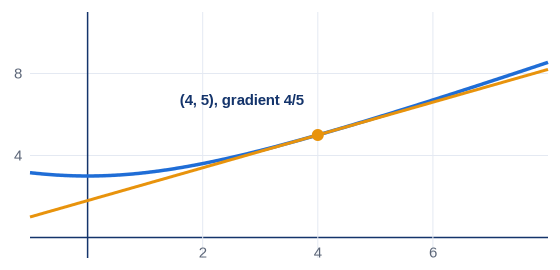
- y = (x² + 9)^½root as a power
- outside: ½(x² + 9)^−½inside left alone
- inside: d/dx(x² + 9) = 2x
- dy/dx = ½(x² + 9)^−½ × 2x
- = x(x² + 9)^−½½ × 2x = x
- = x/√(x² + 9)
Try it: a function and its derivative
Which rule?
- Inside another: chain.
- Multiplied: product.
- Divided: quotient.
| If | Rule | Example |
|---|---|---|
| function inside | chain | sec(x²) |
| two multiplied | product | x³e^−2x |
| one over another | quotient | ln x / x² |
The product rule: y = e²ˣ sin 3x
- A product: u′v + uv′.
- Chain rule inside each part.
- u = e²ˣ, u′ = 2e²ˣchain: × 2
- v = sin 3x, v′ = 3cos 3xchain: × 3
- dy/dx = u′v + uv′product rule
- = (2e²ˣ)(sin 3x) + (e²ˣ)(3cos 3x)
- = 2e²ˣ sin 3x + 3e²ˣ cos 3x
The 2025 error: a dropped factor
- Chain rule in each part.
- No trig identities needed.
- u′ = e²ˣthe 2 is dropped
- v′ = cos 3xthe 3 is dropped
- e²ˣ sin 3x + e²ˣ cos 3xscores nothing
- u′ = 2e²ˣ, v′ = 3cos 3xkeep both factors
- 2e²ˣ sin 3x + 3e²ˣ cos 3x
The quotient rule: y = (x² + 1)/(2x − 3)
- Top: u′v − uv′.
- Bottom: v².
- u = x² + 1, u′ = 2xthe top
- v = 2x − 3, v′ = 2the bottom
- dy/dx = (u′v − uv′)/v²quotient rule
- top: 2x(2x − 3) − 2(x² + 1)
- bottom: (2x − 3)²
The 2025 error: missing brackets
- The minus hits both terms.
- Then collect like terms.
- top: 2x(2x − 3) − 2(x² + 1)
- 2x(2x − 3) = 4x² − 6xexpand
- top: 4x² − 6x − 2x² + 1minus misses the 1
- −2(x² + 1) = −2x² − 2minus reaches both
- top: 4x² − 6x − 2x² − 2
- = 2x² − 6x − 2collect
- dy/dx = (2x² − 6x − 2)/(2x − 3)²
“You do not need to simplify”
- Take it literally: stop.
- A slip after that can cost the grade.
- Simplify only when the next step needs it.
Reciprocal trig and ln
- Booklet result, then × u′.
- Ln u gives u′/u.
- d/du cosec u = −cosec u cot u
- y = cosec 3x: u = 3x, u′ = 3
- dy/dx = −cosec 3x cot 3x × 3
- = −3cosec 3x cot 3x
- ln(sin x): u = sin x, u′ = cos x
- dy/dx = (1/sin x) × cos xchain: × u′
- = cos x/sin x = cot x
Try it: a trig function
Reciprocal trig: y = sec(x²)
- The inside is x².
- Its derivative 2x comes out.
- d/du sec u = sec u tan ubooklet
- u = x², u′ = 2xthe inside
- dy/dx = sec(x²) tan(x²) × 2x
- = 2x sec(x²) tan(x²)
Try it: keep every factor
Show every derivative
- No credit for a calculator answer alone.
- Unknown constants: eᵏˣ gives keᵏˣ.
- Radians for trig.
Where the marks are
- Achieved: the three rules, correctly.
- Merit: derivatives in a longer problem.
- Excellence: surds, trig, full algebra.
What to take away
- Choose the rule, keep every factor and bracket.
| Surds | fractional powers first |
| Inside | chain: × its derivative |
| Multiplied | product: u′v + uv′ |
| Divided | quotient, in brackets |
| Every factor | or no credit |
| Simplify? | not if told no need |
Common mistakes
- d/dx(e²ˣ sin 3x) = e²ˣ sin 3x + e²ˣ cos 3xKeep the chain rule factors: u′ = 2e²ˣ and v′ = 3cos 3x, giving 2e²ˣ sin 3x + 3e²ˣ cos 3x. The 2025 answer without them scored nothing.
- top: 2x(2x − 3) − 2(x² + 1) = 4x² − 6x − 2x² + 1The minus reaches both terms: −2(x² + 1) = −2x² − 2, so the top is 2x² − 6x − 2.
- d/dx(2/√x) = 2 × ½x^−½ = x^−½Write 2/√x as 2x^−½ first, so the derivative is 2(−½)x^−³ᐟ² = −x^−³ᐟ².
- d/dx sec(x²) = sec(x²) tan(x²)Multiply by the derivative of the inside, 2x: dy/dx = 2x sec(x²) tan(x²).
Your turn: eight questions
- Question 1: surds to powers first.
- Question 3 simplifies neatly.
| Function | Find | |
|---|---|---|
| 1 | y = 6√x + 4/x | dy/dx |
| 2 | y = x³e^−2x | dy/dx |
| 3 | y = sin x / (1 + cos x) | dy/dx, simplified |
| 4 | y = cot 2x | gradient at x = π/8 |
| 5 | y = ln(x² + 5) | dy/dx |
| 6 | y = x√(2x + 1) | dy/dx, no need to simplify |
| 7 | y = ln x / x² | dy/dx, simplified |
| 8 | y = √(sin 2x) | gradient at x = π/12 |
Show answer
1. y = 6x^½ + 4x^−1, dy/dx = 3x^−½ − 4x^−2 = 3/√x − 4/x². 2. dy/dx = 3x²e^−2x − 2x³e^−2x. 3. Top cos x(1 + cos x) + sin² x = 1 + cos x, so dy/dx = 1/(1 + cos x). 4. dy/dx = −2cosec² 2x; cosec(π/4) = √2, so the gradient is −4. 5. 2x/(x² + 5). ln u gives u′/u, and the inside x² + 5 has derivative 2x. 6. √(2x + 1) + x/√(2x + 1). Product rule u′v + uv′, with the chain rule giving (2x + 1)^½ the derivative 2 × ½(2x + 1)^−½ = 1/√(2x + 1). 7. (1 − 2ln x)/x³. Quotient rule: ((1/x)x² − 2x ln x)/x⁴ = (x − 2x ln x)/x⁴, then divide top and bottom by x. 8. √6/2. dy/dx = ½(sin 2x)^−½ × 2cos 2x = cos 2x/√(sin 2x); at x = π/12 this is (√3/2) ÷ √(1/2) = √6/2.
The answers: questions 1 and 2
- 1. y = 6√x + 4/x
- = 6x^½ + 4x^−1roots as powers
- dy/dx = 3x^−½ − 4x^−2power rule
- = 3/√x − 4/x²
- 2. u = x³, u′ = 3x²
- v = e^−2x, v′ = −2e^−2xchain: × −2
- dy/dx = 3x²e^−2x + x³(−2e^−2x)u′v + uv′
- = 3x²e^−2x − 2x³e^−2x
The answers: question 3
- 3. u = sin x, u′ = cos x
- v = 1 + cos x, v′ = −sin x
- u′v = cos x(1 + cos x)
- uv′ = sin x(−sin x) = −sin² x
- top = cos x + cos² x + sin² xu′v − uv′
- = cos x + 1sin² x + cos² x = 1
- dy/dx = (1 + cos x)/(1 + cos x)²over v²
- = 1/(1 + cos x)cancel 1 + cos x
The answers: question 4
- 4. d/du cot u = −cosec² ubooklet
- dy/dx = −cosec² 2x × 2chain: u = 2x, u′ = 2
- = −2cosec² 2x
- x = π/8: cosec(π/4) = √22x = π/4
- −2(√2)² = −2 × 2 = −4the gradient
Sample question: Achieved
Find the gradient of y = x³ ln x at x = e.
Hint
It is a product of x³ and ln x, so use the product rule. Remember ln e = 1.
Answer
The gradient is 4e².
Step by step
- y is one function times another, x³ times ln x, so use the product rule: dydx = u′v + uv′.
- Let u = x³, so u′ = 3x². Let v = ln x, so v′ = 1x.
- dydx = 3x² ln x + x³ × 1x = 3x² ln x + x².
- Substitute x = e. Since ln e = 1: 3e² × 1 + e² = 4e².
- Leave it exact as 4e². It is about 29.6.
Full working
- u = x³, u′ = 3x²; v = ln x, v′ = 1x
- dydx = 3x² ln x + x³ × 1xproduct rule
- = 3x² ln x + x²
- x = e: 3e²(1) + e²ln e = 1
- 4e²
Sample questions: Merit
y = e²ˣx² + 1. Show that dydx = 2e²ˣ(x² − x + 1)(x² + 1)², and explain why the gradient of the curve is positive for every x.
Hint
Use the quotient rule with u = e²ˣ and v = x² + 1, then take out the common factor 2e²ˣ. For the second part, look at the discriminant of x² − x + 1.
Answer
dydx = 2e²ˣ(x² − x + 1)(x² + 1)². e²ˣ > 0, (x² + 1)² > 0, and x² − x + 1 > 0 because its discriminant is −3, so dydx > 0 for all x.
Step by step
- y is a fraction, so use the quotient rule: dydx = u′v − uv′v².
- u = e²ˣ, so u′ = 2e²ˣ. Do not drop the 2 from the chain rule.
- v = x² + 1, so v′ = 2x.
- Top: 2e²ˣ(x² + 1) − e²ˣ(2x). Keep the brackets so every term is multiplied.
- Take out 2e²ˣ: 2e²ˣ(x² + 1 − x) = 2e²ˣ(x² − x + 1). So dydx = 2e²ˣ(x² − x + 1)(x² + 1)², as required.
- Now the sign. e²ˣ is always positive, and (x² + 1)² is a square of a positive number, so it is positive too.
- For x² − x + 1, the discriminant is (−1)² − 4(1)(1) = −3. It is negative, so x² − x + 1 is never zero.
- A quadratic that is never zero keeps one sign. At x = 0 it is 1, which is positive, so it is always positive.
- All three parts are positive, so dydx > 0 for every x. The curve is always increasing.
- Check at x = 1: the formula gives 2e²(1)4 = e²2 ≈ 3.69, which is positive.
Full working
- u = e²ˣ, u′ = 2e²ˣ; v = x² + 1, v′ = 2x
- dydx = 2e²ˣ(x² + 1) − e²ˣ(2x)(x² + 1)²quotient rule
- = 2e²ˣ(x² − x + 1)(x² + 1)²factor out 2e²ˣ
- x² − x + 1: b² − 4ac = 1 − 4 = −3 < 0never zero, and 1 > 0 at x = 0
- e²ˣ > 0 and (x² + 1)² > 0
- dydx > 0 for every x
Show that the derivative of y = ln(sec x + tan x) is sec x.
Hint
The derivative of ln u is u′u. Find u′, then take out a common factor of sec x from the top.
Answer
dydx = sec x tan x + sec²xsec x + tan x = sec x
Step by step
- This is ln of a function, so use the chain rule: the derivative of ln u is u′u.
- Here u = sec x + tan x.
- Recall the two standard results: the derivative of sec x is sec x tan x, and the derivative of tan x is sec²x.
- So u′ = sec x tan x + sec²x.
- dydx = sec x tan x + sec²xsec x + tan x.
- Both terms on top have a factor sec x: sec x tan x + sec²x = sec x(tan x + sec x).
- The bracket tan x + sec x is the same as the bottom, so it cancels.
- dydx = sec x, as required.
- Check at x = 0: u′u = 0 + 11 + 0 = 1, and sec 0 = 1. Correct.
Full working
- u = sec x + tan xderivative of ln u is u′u
- u′ = sec x tan x + sec²xstandard results
- dydx = sec x tan x + sec²xsec x + tan x
- = sec x(tan x + sec x)sec x + tan xfactor out sec x
- dydx = sec x
Sample questions: Excellence
y = eᵏˣ sin x, where k is a constant. Find the value of k for which d²ydx² − 4 dydx + 5y = 0 for every value of x.
Hint
Find dydx and d²ydx² with the product rule. Every term has a factor eᵏˣ. For the equation to hold for every x, the sin x part and the cos x part must each be zero.
Answer
k = 2
Step by step
- Use the product rule with u = eᵏˣ, u′ = keᵏˣ, v = sin x and v′ = cos x.
- dydx = keᵏˣ sin x + eᵏˣ cos x = eᵏˣ(k sin x + cos x).
- Differentiate again, using the product rule on eᵏˣ times the bracket. The bracket's derivative is k cos x − sin x.
- d²ydx² = keᵏˣ(k sin x + cos x) + eᵏˣ(k cos x − sin x) = eᵏˣ((k² − 1)sin x + 2k cos x).
- Substitute into d²ydx² − 4 dydx + 5y and take out eᵏˣ.
- sin x terms: (k² − 1) − 4k + 5 = k² − 4k + 4. cos x terms: 2k − 4.
- So the expression is eᵏˣ((k² − 4k + 4)sin x + (2k − 4)cos x).
- eᵏˣ is never zero. For the bracket to be zero for every x, both coefficients must be zero. Testing just one value of x is not enough.
- 2k − 4 = 0 gives k = 2. Then k² − 4k + 4 = (k − 2)² = 0 as well. Both are satisfied by k = 2.
- So k = 2. The classic mistake here is a dropped factor k when differentiating eᵏˣ.
- Check at x = 0 with k = 2: y = 0, dydx = 1, d²ydx² = 4. Then 4 − 4(1) + 0 = 0. Correct.
Full working
- dydx = eᵏˣ(k sin x + cos x)product rule
- d²ydx² = eᵏˣ((k² − 1)sin x + 2k cos x)product rule again
- eᵏˣ((k² − 4k + 4)sin x + (2k − 4)cos x) = 0substitute, factor out eᵏˣ
- k² − 4k + 4 = 0 and 2k − 4 = 0true for every x
- (k − 2)² = 0 and k = 2
- k = 2
y = cos x1 + sin x. Show that dydx = −11 + sin x. Hence find the values of x in 0 ≤ x ≤ 2π where the gradient is −23, and explain why the gradient is never greater than −12.
Hint
In the quotient rule, the top simplifies with sin²x + cos²x = 1. For the last part, think about the largest and smallest values of 1 + sin x.
Answer
x = π6 or 5π6. Since 0 < 1 + sin x ≤ 2, dydx = −11 + sin x ≤ −12.
Step by step
- Quotient rule: dydx = u′v − uv′v², with u = cos x, u′ = −sin x, v = 1 + sin x and v′ = cos x.
- Top: −sin x(1 + sin x) − cos x × cos x = −sin x − sin²x − cos²x.
- Use sin²x + cos²x = 1: the top is −sin x − 1 = −(1 + sin x).
- So dydx = −1 + sin x(1 + sin x)² = −11 + sin x, as required.
- Hence: −11 + sin x = −23 means 1 + sin x = 32, so sin x = 12.
- sin is positive in quadrants 1 and 2: x = π6 or x = π − π6 = 5π6.
- Last part: sin x is at most 1, so 1 + sin x is at most 2. The curve is undefined where 1 + sin x = 0, so elsewhere 0 < 1 + sin x ≤ 2.
- Dividing 1 by a positive number that is at most 2 gives at least 12. So 11 + sin x ≥ 12.
- Multiplying by −1 flips the inequality: dydx = −11 + sin x ≤ −12. It equals −12 only where sin x = 1, at x = π2.
- Check at x = π6: 1 + sin(π6) = 32, so dydx = −1 ÷ 32 = −23. Correct.
Full working
- u = cos x, u′ = −sin x; v = 1 + sin x, v′ = cos x
- top: −sin x(1 + sin x) − cos²x = −(1 + sin x)sin²x + cos²x = 1
- dydx = −11 + sin x
- 1 + sin x = 32, sin x = 12gradient −23
- x = π6, 5π6quadrants 1 and 2
- 0 < 1 + sin x ≤ 2, so 11 + sin x ≥ 12
- x = π6 or 5π6; dydx ≤ −12 always
Challenge
y = x√(x² + 1) + ln(x + √(x² + 1)). Show that dydx = 2√(x² + 1).
Hint
Product rule on the first part, chain rule on the second. In the second part, put the inside derivative over one denominator and look for the bracket x + √(x² + 1) to cancel.
Answer
dydx = √(x² + 1) + x²√(x² + 1) + 1√(x² + 1) = x² + 1 + x² + 1√(x² + 1) = 2(x² + 1)√(x² + 1) = 2√(x² + 1).
Step by step
- The first part is a product of x and √(x² + 1); the root needs the chain rule, giving x√(x² + 1).
- The second part is ln u with u = x + √(x² + 1), so its derivative is u′u.
- Writing u′ over the denominator √(x² + 1) makes its top equal to u, so u cancels and leaves 1√(x² + 1).
- Put all three terms over √(x² + 1), add the tops, and cancel one factor of √(x² + 1).
Full working
- ddx[x√(x² + 1)] = √(x² + 1) + x × x√(x² + 1)product rule, chain rule inside
- = √(x² + 1) + x²√(x² + 1)tidy
- ddx[x + √(x² + 1)] = 1 + x√(x² + 1) = √(x² + 1) + x√(x² + 1)common denominator
- ddx ln(x + √(x² + 1)) = [(x + √(x² + 1))√(x² + 1)] ÷ (x + √(x² + 1)) = 1√(x² + 1)ln u gives u′u
- dydx = x² + 1√(x² + 1) + x²√(x² + 1) + 1√(x² + 1)√(x² + 1) written over √(x² + 1)
- = 2x² + 2√(x² + 1) = 2(x² + 1)√(x² + 1)add the tops
- dydx = 2√(x² + 1)
y = sin³x cos x for 0 ≤ x ≤ π. (a) Show that dydx = sin²x(4cos²x − 1). (b) Find every x in 0 ≤ x ≤ π where the gradient is 0. (c) Find the exact greatest value of y on this interval.
Hint
Product rule, with the chain rule for sin³x. Take out the common factor sin²x and use sin²x = 1 − cos²x. For (c), compare y at every x from (b).
Answer
(a) dydx = 3sin²x cos²x − sin⁴x = sin²x(3cos²x − (1 − cos²x)) = sin²x(4cos²x − 1). (b) x = 0, π3, 2π3 and π. (c) The greatest value is 3√316, at x = π3.
Step by step
- sin³x is (sin x)³, so its derivative is 3sin²x times cos x.
- The product rule gives two terms; both have a factor sin²x.
- Replace the leftover sin²x by 1 − cos²x so the bracket has only cosines.
- The gradient is 0 when sin x = 0 or cos x = ±12.
- The greatest value on a closed interval is at a stationary point or an end, so compare all four values.
Full working
- u = sin³x, u′ = 3sin²x cos xchain rule
- v = cos x, v′ = −sin xstandard result
- dydx = 3sin²x cos²x − sin⁴xproduct rule
- = sin²x(3cos²x − sin²x) = sin²x(3cos²x − 1 + cos²x)sin²x = 1 − cos²x
- = sin²x(4cos²x − 1)collect
- sin x = 0: x = 0, πfirst factor
- cos²x = 14, cos x = ±12: x = π3, 2π3second factor
- y(0) = y(π) = 0, y(π3) = (√32)³(12) = 3√316, y(2π3) = −3√316compare
- greatest value 3√316, at x = π3
y = xe²ˣ. (a) Find dydx and d²ydx², and show that both fit the pattern dⁿydxⁿ = 2ⁿ⁻¹(2x + n)e²ˣ. (b) Show that if the pattern holds for one value of n, then differentiating once more gives the pattern for n + 1. (c) Hence find the value of n for which the nth derivative is 0 at x = −5, and the exact value of the 11th derivative at x = −5.
Hint
Use the product rule each time and take out the factor e²ˣ. For (b), differentiate 2ⁿ⁻¹(2x + n)e²ˣ: the constant 2ⁿ⁻¹ just rides along.
Answer
(a) dydx = (2x + 1)e²ˣ and d²ydx² = (4x + 4)e²ˣ = 2(2x + 2)e²ˣ. (b) ddx[2ⁿ⁻¹(2x + n)e²ˣ] = 2ⁿ(2x + n + 1)e²ˣ, the pattern for n + 1. (c) n = 10; the 11th derivative at x = −5 is 1024e⁻¹⁰.
Step by step
- Differentiate twice with the product rule and compare with the pattern for n = 1 and n = 2.
- For (b), apply the product rule to (2x + n)e²ˣ and keep the constant 2ⁿ⁻¹ in front.
- Taking out a 2 turns 2ⁿ⁻¹ into 2ⁿ and the bracket into 2x + n + 1, which is the pattern with n + 1.
- Since the pattern holds for n = 1 and each step passes it on, it holds for every n.
- 2ⁿ⁻¹ and e²ˣ are never 0, so the nth derivative is 0 only when 2x + n = 0.
Full working
- dydx = e²ˣ + 2xe²ˣ = (2x + 1)e²ˣproduct rule; n = 1 gives 2⁰(2x + 1)e²ˣ
- d²ydx² = 2e²ˣ + 2(2x + 1)e²ˣ = (4x + 4)e²ˣproduct rule again
- = 2(2x + 2)e²ˣn = 2 gives 2¹(2x + 2)e²ˣ
- ddx[2ⁿ⁻¹(2x + n)e²ˣ] = 2ⁿ⁻¹[2e²ˣ + 2(2x + n)e²ˣ]product rule
- = 2ⁿ⁻¹ × 2(2x + n + 1)e²ˣ = 2ⁿ(2x + n + 1)e²ˣthe pattern for n + 1
- 2x + n = 0 at x = −5, so n = 102ⁿ⁻¹ and e²ˣ are never 0
- 11th derivative at x = −5: 2¹⁰(−10 + 11)e⁻¹⁰ = 1024e⁻¹⁰n = 11
- n = 10; the 11th derivative at x = −5 is 1024e⁻¹⁰
Practise this
Report a mistake
More in AS 91578
The derivative toolkit: chain, product and quotient rules11 min Stationary points, concavity and points of inflection11 min
 Tangents and normals: from gradient to finished equation11 min
 Parametric differentiation, and the second derivative11 min
 Related rates of change: spheres, cones and the chain rule10 min
 Optimisation: building the model and finding the max or min11 min
 Limits, continuity and differentiability from a graph8 min
 Derivative toolkit: 7 exam questions solved step by step11 min
 Stationary points: 7 exam questions solved step by step12 min
 Tangents and normals: 7 exam questions solved step by step12 min
 Parametric curves: 7 exam questions solved step by step11 min
 Related rates of change: 7 exam questions solved step by step11 min
 Optimisation: 7 exam questions solved step by step11 min
 Limits and continuity: 7 exam questions solved step by step11 min
Is your child on track?
Take the free placement test