Optimisation: 7 exam questions solved step by step
What this lesson covers
- Optimising means writing the quantity as a function of one variable, then finding its stationary point.
- At Achieved and Merit the question tells you whether it is a maximum or minimum.
Optimisation from a written problem
- Write the quantity to maximise or minimise.
- Use the constraint to get one variable.
- Set the derivative to 0 and solve.
- Answer the question asked, with units.
Question 1 · Achieved, in context
- A harbour ferry trip costs
- C = 2v + 800/v dollars at v km/h.
- Find the speed for the least cost,
- And that cost. Assume it is a minimum.
Q1: the cheapest speed
- Power form first.
- A speed is positive.
- C = 2v + 800v⁻¹power form
- dC/dv = 2 − 800v⁻²differentiate
- = 2 − 800/v²
- 2 − 800/v² = 0stationary
- 2v² = 800, so v² = 400× v²
- v = −20a speed is positive
- v = 20: C = 40 + 800/20
- = 40 + 40 = 80
- 20 km/h, costing $80 a trip
Question 2 · Achieved, in context
- A medicine in the blood t hours after
- A dose: C = 20te⁻ᵗ mg/L.
- When is C greatest, and what is it?
- Assume it is a maximum.
Q2: the highest concentration
- Product rule.
- e⁻ᵗ is never 0.
- u = 20t, v = e⁻ᵗproduct rule
- u′ = 20, v′ = −e⁻ᵗchain rule
- dC/dt = 20e⁻ᵗ − 20te⁻ᵗu′v + uv′
- = 20e⁻ᵗ(1 − t)factorise
- e⁻ᵗ > 0, so 1 − t = 0stationary
- t = 1
- C = 20(1)e⁻¹ = 20/e
- ≈ 7.36 mg/L3 s.f.
- greatest after 1 h: 7.36 mg/L
Question 3 · Merit, in context
- A rectangular paddock of 1800 m² is
- Fenced on three sides; a river is the
- Fourth. Find the least fence needed.
Q3: the paddock by the river
- Area fixes y.
- Fence: two x, one y.
- x out from the river, y along it
- xy = 1800, so y = 1800/xarea
- L = 2x + y = 2x + 1800/x
- dL/dx = 2 − 1800/x²differentiate
- 2 − 1800/x² = 0stationary
- x² = 900, so x = 30x > 0
- y = 1800/30 = 60
- L = 60 + 60 = 120
- 30 m by 60 m: 120 m of fence
Try it: the paddock by the river
Question 4 · Merit, in context
- A closed food tin is a cylinder
- Holding 128π cm³.
- Find the radius and height that use
- The least metal. Assume it is a minimum.
Q4: surface area in r only
- Metal = surface area.
- Volume gives h.
- πr²h = 128πvolume
- h = 128/r²÷ πr²
- S = 2πr² + 2πrhtwo ends + side
- = 2πr² + 2πr(128/r²)substitute h
- = 2πr² + 256π/rone variable
Q4: the least metal
- Derivative = 0.
- Give both dimensions.
- S = 2πr² + 256π/r
- dS/dr = 4πr − 256π/r²differentiate
- 4πr − 256π/r² = 0stationary
- 4πr³ = 256π× r²
- r³ = 64, so r = 4÷ 4π
- h = 128/16 = 8
- S = 32π + 64π = 96π
- ≈ 302 cm²3 s.f.
- radius 4 cm, height 8 cm
Question 5 · Merit, in context
- A poster has 384 cm² of print,
- Margins 3 cm top and bottom,
- 2 cm each side. Find the paper size
- That uses the least paper.
Q5: paper area in x only
- Add the margins.
- Print area gives y.
- print: x wide, y high
- xy = 384, so y = 384/xprint area
- paper: (x + 4) by (y + 6)
- A = (x + 4)(y + 6)
- = xy + 6x + 4y + 24expand
- = 384 + 6x + 1536/x + 244y = 1536/x
- = 408 + 6x + 1536/x
Q5: the least paper
- Derivative = 0.
- Answer for the paper.
- A = 408 + 6x + 1536/x
- dA/dx = 6 − 1536/x²differentiate
- 6 − 1536/x² = 0stationary
- x² = 256, so x = 16x > 0
- y = 384/16 = 24
- 16 cm by 24 cmthe print, not the paper
- paper 20 cm by 30 cmx + 4, y + 6
- A = 20 × 30 = 600 cm²
Try it: an open box
Question 6 · Excellence
- Find the point on y = √x nearest
- To A(2, 0), and its distance.
- Justify that it is the nearest.
Q6: distance as a function of x
- A point on the curve.
- Work with D².
- point P(x, √x) on the curve
- D² = (x − 2)² + (√x − 0)²distance formula
- = x² − 4x + 4 + xexpand
- = x² − 3x + 4
- D least when D² leastD ≥ 0
Q6: nearest, and why
- Excellence: justify the min.
- Square root at the end.
- D² = x² − 3x + 4
- d(D²)/dx = 2x − 3differentiate
- 2x − 3 = 0, so x = 3/2stationary
- d²(D²)/dx² = 2 > 0a minimum
- D² = 9/4 − 9/2 + 4 = 7/4
- D = √7/2 ≈ 1.323 s.f.
- P(1.5, √1.5) ≈ (1.5, 1.22)
- nearest distance ≈ 1.32 units
Question 7 · Excellence, in context
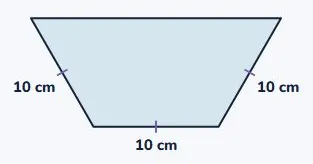
- A 30 cm sheet is folded 10 cm from
- Each edge to make a gutter. Each side
- Makes angle θ with the horizontal.
- Find θ for the greatest cross-section.
Q7: the area in θ
- A rectangle and two triangles.
- Trig for each length.
- height = 10sin θside 10 cm
- overhang = 10cos θeach side
- middle: 10 × 10sin θ = 100sin θ
- ends: 2 × (1/2)(10cos θ)(10sin θ)
- = 100sin θ cos θ
- A = 100sin θ + 100sin θ cos θ
Q7: the best angle
- A quadratic in cos θ.
- Justify the maximum.
- A = 100sin θ + 100sin θ cos θ
- dA/dθ = 100(cos θ + cos²θ − sin²θ)
- = 100(2cos²θ + cos θ − 1)sin²θ = 1 − cos²θ
- = 100(2cos θ − 1)(cos θ + 1)factorise
- cos θ = 1/2, so θ = π/3stationary
- cos θ = −1: θ = πfolded flat, A = 0
- dA/dθ: + before π/3, − aftera maximum
- A = 100(√3/2)(1 + 1/2) = 75√3
- θ = π/3 (60°): A ≈ 130 cm²
Try it: find the best shape
Common mistakes
- Setting the derivative to zero is the whole answer.Also justify that it is a maximum or minimum, unless the question says to assume it, then give what was asked.
- The fence in the river paddock is 2x + 2y.A river is one side, so the fence covers three sides: 2x + y.
- Leaving two variables in the formula before differentiating.Use the constraint to write the quantity in one variable first.
The method that solved all seven
- Model, one variable, derivative, answer.
| Step | How |
|---|---|
| Name | the variables, with units |
| Model | the quantity to optimise |
| Constraint | down to one variable |
| Derivative | set it equal to 0 |
| Reject | values that cannot happen |
| Answer | what was asked, units |
Challenge
A lifeguard at Piha stands at A on the water's edge (a straight shoreline). A swimmer is 40 m out to sea from point B on the shoreline, and AB = 100 m. The lifeguard runs at 5 m s⁻¹ along the sand and swims at 3 m s⁻¹. Where should the lifeguard enter the water to reach the swimmer in the least time? Find that time and justify that it is the least.
Hint
Let the lifeguard enter the water x m from B. Time = distance ÷ speed for each part. The swim is the hypotenuse of a right-angled triangle.
Answer
Enter the water 70 m from A (30 m short of B); least time 923 ≈ 30.7 s
Step by step
- If the entry point is x m from B, the run is 100 − x and the swim is √(x² + 1600).
- T = 100 − x5 + √(x² + 1600)3.
- dTdx = −15 + x3√(x² + 1600) = 0 gives 5x = 3√(x² + 1600), so 16x² = 14400 and x = 30.
- At x = 30 the swim is 50 m, so T = 705 + 503 = 923 s.
- Compare the ends: x = 0 gives 33.3 s and x = 100 gives 35.9 s, both longer, so x = 30 gives the least time.
Full working
- T = 100 − x5 + √(x² + 1600)3, 0 ≤ x ≤ 100time = distance ÷ speed
- dTdx = −15 + x3√(x² + 1600)chain rule
- 5x = 3√(x² + 1600)dTdx = 0
- 25x² = 9x² + 14400, so x² = 900, x = 30square, x ≥ 0
- swim = √(900 + 1600) = 50 m3, 4, 5 triangle
- T = 705 + 503 = 14 + 503 = 923substitute
- T(0) = 20 + 403 ≈ 33.3, T(100) = √116003 ≈ 35.9the ends are longer
- enter the water 70 m from A; least time 923 ≈ 30.7 s
A cone is placed inside a sphere of radius 3 cm, with its tip and the whole rim of its base touching the sphere. Find the height of the cone with the greatest volume, and show that this cone fills exactly 827 of the sphere.
Hint
Let the cone's height be h. Draw the cross-section through the axis: the centre of the sphere is 3 from the tip, so it is h − 3 from the base. Pythagoras then gives r² in terms of h.
Answer
Height 4 cm (base radius 2√2 cm), volume 32π3 cm³, which is 827 of the sphere's 36π cm³
Step by step
- In the cross-section, the base radius r, the distance h − 3 from the centre to the base, and the sphere's radius 3 make a right-angled triangle.
- So r² = 9 − (h − 3)² = 6h − h².
- V = (13)πr²h = (π3)(6h² − h³), with 0 < h < 6.
- dVdh = (π3)(12h − 3h²) = πh(4 − h), which is 0 at h = 4. The second derivative is negative there, so it is a maximum.
- At h = 4, r² = 8 and V = 32π3. The sphere holds (43)π(27) = 36π, and (32π3) ÷ 36π = 827.
Full working
- r² + (h − 3)² = 3², so r² = 6h − h²Pythagoras in the cross-section
- V = (13)π(6h − h²)h = (π3)(6h² − h³)one variable
- dVdh = (π3)(12h − 3h²) = πh(4 − h)differentiate
- h = 4h > 0
- d²Vdh² = (π3)(12 − 6h) = −4π < 0 at h = 4a maximum
- r² = 24 − 16 = 8, V = (π3)(8)(4) = 32π3the greatest cone
- sphere: (43)π(3³) = 36πvolume of the sphere
- (32π3) ÷ 36π = 32108 = 827the fraction
- height 4 cm; the cone fills 827 of the sphere
A corridor 2.7 m wide meets a corridor 6.4 m wide at a right-angled corner. Find the length of the longest straight pole that can be carried horizontally around the corner, and explain why your method gives the longest.
Hint
Picture the pole touching the inside corner and both outer walls, at angle θ to the walls of the wide corridor. Its length is a function of θ. The pole fits only if it is shorter than this length at every angle.
Answer
12.5 m, when tan θ = 43
Step by step
- With the pole touching the inside corner at angle θ, the part in the narrow corridor is 2.7cos θ and the part in the wide corridor is 6.4sin θ.
- So the gap length at angle θ is L(θ) = 2.7cos θ + 6.4sin θ, for 0 < θ < π2.
- A pole gets around only if it fits at every angle, so the longest pole equals the smallest value of L. That is why we minimise to find a longest.
- dLdθ = 2.7sin θcos²θ − 6.4cos θsin²θ = 0 gives tan³θ = 6.42.7 = 6427, so tan θ = 43.
- Then sin θ = 45 and cos θ = 35, so L = 2.7 ÷ 0.6 + 6.4 ÷ 0.8 = 4.5 + 8 = 12.5 m. L is very large near both ends, so this is the minimum.
Full working
- L(θ) = 2.7cos θ + 6.4sin θ, 0 < θ < π2the gap at angle θ
- dLdθ = 2.7sin θcos²θ − 6.4cos θsin²θddθ(sec θ) = sec θ tan θ, ddθ(cosec θ) = −cosec θ cot θ
- 2.7sin³θ = 6.4cos³θdLdθ = 0, × sin²θcos²θ
- tan³θ = 6427, so tan θ = 43cube root
- sin θ = 45, cos θ = 353, 4, 5 triangle
- L = 2.70.6 + 6.40.8 = 4.5 + 8 = 12.5substitute
- L → ∞ as θ → 0 and as θ → π2so 12.5 is the least value
- longest pole = least gap = 12.5 m
Practise this
Report a mistake
More in AS 91578
 The derivative toolkit: chain, product and quotient rules11 min
 Stationary points, concavity and points of inflection11 min
 Tangents and normals: from gradient to finished equation11 min
 Parametric differentiation, and the second derivative11 min
 Related rates of change: spheres, cones and the chain rule10 min
 Optimisation: building the model and finding the max or min11 min
 Limits, continuity and differentiability from a graph8 min
 Derivative toolkit: 7 exam questions solved step by step11 min
 Stationary points: 7 exam questions solved step by step12 min
 Tangents and normals: 7 exam questions solved step by step12 min
 Parametric curves: 7 exam questions solved step by step11 min
 Related rates of change: 7 exam questions solved step by step11 minOptimisation: 7 exam questions solved step by step11 min
 Limits and continuity: 7 exam questions solved step by step11 min
Is your child on track?
Take the free placement test