Relative risk: above 1, below 1, and evaluating a claim
What this lesson covers
- Relative risk compares the risk in one group with the risk in another by dividing.
- A relative risk above 1 means higher risk for the first group; below 1 means lower.
Comparing risk between groups
- Risk is a probability of something bad.
- Relative risk compares two groups.
- Divide one risk by the other.
Phones and crashes
- 2000 drivers, followed for a year.
- 400 used a phone while driving.
- 36 of them crashed; 48 of the other 1600 did.
| Crashed | Did not | Total | |
|---|---|---|---|
| Used a phone | 36 | 364 | 400 |
| Did not | 48 | 1552 | 1600 |
Try it: risks from the table
Two risks, then divide
- Each group, its own total.
- Then divide the risks.
- others: 2000 − 400 = 1600group total
- risk, phone = 36 ÷ 400crashed ÷ group
- = 0.09
- risk, others = 48 ÷ 1600crashed ÷ group
- = 0.03
- RR = 0.09 ÷ 0.03phone ÷ others
- = 3
Try it: two risks, then divide
Three times the risk
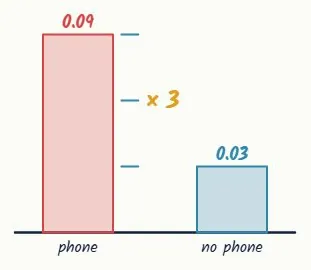
- Phone users: 9 in every 100 crashed.
- Others: 3 in every 100.
- Three of the small bars make the tall one.
"Three times as likely", not "3% more"
- RR 3: three times as likely.
- Not "3% more".
- RR = 0.09 ÷ 0.03 = 3times as likely
- difference = 0.09 − 0.03absolute
- = 0.06: 6 in every 100
- no crash: 400 − 36 = 364phone users
- 364 ÷ 400 = 0.9191% did not crash
A relative risk below 1
- Helmet ÷ no helmet.
- Below 1: a lower risk.
- risk, helmet = 10 ÷ 500injured ÷ group
- = 0.02
- risk, no helmet = 20 ÷ 250injured ÷ group
- = 0.08
- RR = 0.02 ÷ 0.08helmet ÷ no helmet
- = 0.25
- 1 − 0.25 = 0.7575% lower risk
Reading a relative risk below 1
- 0.25: a quarter of the risk.
- Or: the risk is 75% lower.
- The group on top is the one being described.
| Relative risk | Means | Example |
|---|---|---|
| RR > 1 | first group at higher risk | 3: three times as likely |
| RR = 1 | same risk | no difference |
| RR < 1 | first group at lower risk | 0.25: a quarter of the risk |
Which group goes on top?
- Name both groups.
- Same order as the division.
- helmet vs none: 0.02 ÷ 0.08
- = 0.25a quarter of the risk
- none vs helmet: 0.08 ÷ 0.02
- = 4four times as likely
- 1 ÷ 0.25 = 4the same fact
Try it: the scale that pivots at 1
Evaluating "phones triple your crash risk"
- The number supports it, in this sample.
- But how were drivers chosen? Is it cause?
- And 91% of phone users did not crash.
| Check | Here | So |
|---|---|---|
| The number | RR = 3 in this sample | supports "three times" |
| The sample | which drivers, how chosen? | may not represent all |
| Cause | observational data | cannot prove cause |
| Absolute | 9% against 3% | 91% did not crash |
Where the marks are
- Achieved: calculate risks from a table.
- Merit: the relative risk, interpreted.
- Excellence: evaluate the claim itself.
What to take away
- Divide the risks, name the groups, question the claim.
| Risk | cases ÷ group total |
| Relative risk | risk in group 1 ÷ risk in group 2 |
| Above 1 | first group more at risk |
| Below 1 | first group less at risk |
| Say | "times as likely", not "% more" |
| Evaluate | sample, cause, absolute risk |
Common mistakes
- Risk of a crash for phone users = 36 ÷ 2000 = 0.018Each risk uses its own group total: 36 ÷ 400 = 0.09.
- RR = 3, so phone users are 3% more likely to crash.A relative risk is a ratio: phone users are three times as likely to crash as other drivers.
- RR = 0.02 ÷ 0.08 = 0.25, so helmet wearers are 4 times as likely to be injured.The group on top is the one described: helmet wearers are 0.25 times as likely to be injured, a 75% lower risk.
- RR = 0.6, so exercise prevents colds.This is observational data, not an experiment, so it cannot show cause; other factors may differ between the groups.
Your turn: eight questions
- Each risk uses its own group total.
- Question 4: interpret, and give a limitation.
| Question | |
|---|---|
| Data | Exercisers: 30 of 200 had a cold. Others: 75 of 300. |
| 1 | Find the risk of a cold for people who exercise. |
| 2 | Find the risk for people who do not. |
| 3 | Find the relative risk, exercisers compared with others. |
| 4 | Interpret it in a sentence, with one limitation. |
| 5 | Cyclists: 12 of 400 helmet wearers and 45 of 500 non-wearers had a head injury. Find the relative risk, wearers compared with non-wearers. |
| 6 | The relative risk of a cough, vapers compared with non-vapers, is 1.25. Which statement is correct? |
| 7 | Others' risk is 0.25. If the relative risk, exercisers compared with others, were 0.8, how many of the 200 exercisers would catch a cold? |
| 8 | At a Wellington running club, 2 of 20 runners in new shoes and 6 of 30 others were injured. A brand claims its shoes halve injury risk. Best evaluation? |
Show answer
1. 30 ÷ 200 = 0.15. 2. 75 ÷ 300 = 0.25. 3. 0.15 ÷ 0.25 = 0.6. 4. In this sample, people who exercise were 0.6 times as likely to catch a cold (a 40% lower risk). The data cannot show exercise causes it; other factors may differ between the groups. 5. 0.33. Risks 12 ÷ 400 = 0.03 and 45 ÷ 500 = 0.09, so RR = 0.03 ÷ 0.09 = 0.33. 6. Vapers are 1.25 times as likely to have a cough: a 25% higher risk. 7. 40 exercisers. Exercisers' risk = 0.8 × 0.25 = 0.2, and 0.2 × 200 = 40. 8. RR = 0.1 ÷ 0.2 = 0.5 supports "halve" in this sample, but 50 runners is a small sample and observational data cannot show cause.
The answers: questions 1 to 3
- 1. risk = 30 ÷ 200exercisers
- = 0.15
- 2. risk = 75 ÷ 300others
- = 0.25
- 3. RR = 0.15 ÷ 0.25exercisers ÷ others
- = 0.6
The answers: question 4
- 4. RR = 0.6, below 1a lower risk
- 1 − 0.6 = 0.440% lower
- In this sample, exercisers were
- 0.6 times as likely to get a cold
- Limitation: not an experiment,
- so it cannot show cause.
- Other factors may differ.
Sample question: Achieved
In a study, 30 of 250 smokers and 45 of 750 non-smokers developed a lung condition. Find the risk of the condition for smokers and for non-smokers, and say which group had the higher risk.
Hint
Risk = number with the condition ÷ the total of that group. Each group uses its own total.
Answer
Smokers 0.12, non-smokers 0.06; smokers had the higher risk
Step by step
- Recall: risk is the probability of the bad outcome in one group, so risk = cases ÷ group total.
- Smokers: 30 cases out of 250 smokers. 30 ÷ 250 = 0.12.
- Non-smokers: 45 cases out of 750 non-smokers. 45 ÷ 750 = 0.06.
- In words: 12 in every 100 smokers and 6 in every 100 non-smokers developed the condition.
- The classic mistake is to compare the counts. 45 is more than 30, but there were three times as many non-smokers, so the counts are not fair to compare.
- Another mistake is to divide by the overall total, 1000. Each risk uses its own group's total.
- Check: smokers' risk 0.12 is higher than 0.06, so smokers had the higher risk.
Full working
- risk, smokers = 30 ÷ 250 = 0.12cases ÷ group total
- risk, non-smokers = 45 ÷ 750 = 0.06
- smokers 0.12, non-smokers 0.06; smokers higher
Sample questions: Merit
In one winter, 24 of 800 vaccinated people and 108 of 1200 unvaccinated people caught the flu. Find the relative risk of flu for vaccinated people compared with unvaccinated people. Interpret it in two ways: as a fraction of the risk and as a percentage.
Hint
Find each group's risk, then divide with the vaccinated risk on top because they are the group being described.
Answer
RR = 13 = 0.3333: vaccinated people had a third of the risk, about 67% lower
Step by step
- First the two risks, each with its own group total.
- Vaccinated: 24 ÷ 800 = 0.03. Unvaccinated: 108 ÷ 1200 = 0.09.
- Recall: relative risk = risk in the first group ÷ risk in the second group. "Vaccinated compared with unvaccinated" puts vaccinated on top.
- RR = 0.03 ÷ 0.09 = 13 = 0.3333.
- Below 1 means the first group, vaccinated people, had the lower risk.
- As a fraction: vaccinated people were about a third as likely to catch the flu.
- As a percentage: 1 − 0.3333 = 0.6667, so the risk was about 67% lower.
- Turned the other way, 0.09 ÷ 0.03 = 3: unvaccinated people were three times as likely to catch it. Same fact, groups swapped.
- The classic mistake is to say "6% lower". 0.09 − 0.03 = 0.06 is the difference in risk, 6 percentage points, not the relative risk.
- Check: 0.03 × 3 = 0.09, so the ratio is right.
Full working
- risk, vaccinated = 24 ÷ 800 = 0.03
- risk, unvaccinated = 108 ÷ 1200 = 0.09
- RR = 0.03 ÷ 0.09 = 0.3333vaccinated on top
- 1 − 0.3333 = 0.6667percentage lower
- RR = 0.3333: a third of the risk, about 67% lower
A survey of 600 Year 12 students found that 240 slept less than 7 hours a night. 90 students caught a cold during term, and 48 of those were short sleepers. Find the relative risk of a cold for short sleepers compared with the other students, and interpret it.
Hint
Build the two-way table first: the other students are 600 − 240 and their colds are 90 − 48.
Answer
RR = 1.7143: short sleepers were about 1.7 times as likely to catch a cold
Step by step
- The information is not in a table yet, so build one. Rows: short sleep, other. Columns: cold, no cold.
- Short sleepers: 240, of whom 48 had a cold and 192 did not.
- Other students: 600 − 240 = 360. Colds: 90 − 48 = 42, and 318 did not.
- Check the table: 48 + 192 + 42 + 318 = 600.
- Risk for short sleepers: 48 ÷ 240 = 0.2.
- Risk for the others: 42 ÷ 360 = 0.1167.
- Relative risk, short sleepers compared with others: 0.2 ÷ 0.11667 = 1.7143.
- Above 1, so short sleepers had the higher risk: about 1.7 times as likely to catch a cold.
- The classic mistake is 48 ÷ 90 = 0.5333. That is the proportion of colds that were short sleepers, which uses the wrong total.
- Keep 42 ÷ 360 unrounded in the division. Using 0.12 would give 1.67, which is less accurate.
Full working
- others: 600 − 240 = 360; their colds: 90 − 48 = 42complete the table
- risk, short = 48 ÷ 240 = 0.2
- risk, others = 42 ÷ 360 = 0.1167
- RR = 0.2 ÷ 0.11667 = 1.7143short sleepers on top
- RR = 1.7143: about 1.7 times as likely
Sample questions: Excellence
A news site reports: "Energy drinks double the risk of poor sleep in teens." It is based on an online survey of 600 teens who chose to respond. Of the 150 who drink energy drinks most days, 36 reported poor sleep. Of the 450 who do not, 54 reported poor sleep. Calculate the relative risk and evaluate the headline.
Hint
Check the number first, then question the sample, the cause, and the absolute risks.
Answer
RR = 0.24 ÷ 0.12 = 2, so "double" matches this sample, but a self-selected survey cannot show that energy drinks cause poor sleep
Step by step
- Start with the number. Risk for drinkers: 36 ÷ 150 = 0.24. Risk for non-drinkers: 54 ÷ 450 = 0.12.
- RR = 0.24 ÷ 0.12 = 2. In this sample drinkers were twice as likely to report poor sleep, so the word "double" matches the data.
- Now evaluate. First, the sample. Teens chose to answer an online survey, so it is self-selected. Teens with sleep problems may be keener to answer, so it may not represent all teens.
- Second, the word "risk" here comes from self-reported sleep, which may not be accurate.
- Third, cause. This is an observational survey, not an experiment. Teens who drink energy drinks might also use screens late or have more stress, and that could cause the poor sleep.
- So the headline's "double the risk" suggests the drinks cause it. The data shows an association only.
- Fourth, absolute risk. 76% of the drinkers reported good sleep. The difference is 0.24 − 0.12 = 0.12, or 12 percentage points.
- A fair headline: "Teens who drink energy drinks were twice as likely to report poor sleep in an online survey."
- To test cause properly, a study would randomly assign teens to drink or not drink, which raises ethical issues, or at least take a random sample and record other factors.
Full working
- risk, drinkers = 36 ÷ 150 = 0.24
- risk, non-drinkers = 54 ÷ 450 = 0.12
- RR = 0.24 ÷ 0.12 = 2supports "double" in this sample
- self-selected online samplemay not represent all teens
- observational, other factorscannot show cause
- 1 − 0.24 = 0.76most drinkers sleep well
- RR = 2, but the claim of cause is not justified
In a study, 30 of 200 people in group A had an infection. Group B has 400 people, and x of them had the infection. Find the least value of x that makes the relative risk of group A compared with group B less than 1, and the greatest value of x that makes it at least 2. Explain what each case would mean.
Hint
Write RR = 0.15 ÷ (x400) and solve the two inequalities. x must be a whole number.
Answer
RR < 1 needs x ≥ 61; RR ≥ 2 needs x ≤ 30
Step by step
- Risk in group A: 30 ÷ 200 = 0.15. Risk in group B: x400.
- Relative risk, A compared with B: RR = 0.15 ÷ (x400) = 60x.
- First case: RR < 1 means 60x < 1, so x > 60 (x is positive, so multiplying by it keeps the sign).
- x counts people, so it is a whole number. The least value is x = 61.
- Check: 0.15 ÷ (61400) = 0.15 ÷ 0.1525 = 0.9836, which is below 1. With x = 60, RR is exactly 1.
- Meaning: if 61 or more of group B were infected, group A would have the lower risk.
- Second case: RR ≥ 2 means 60x ≥ 2, so x ≤ 30.
- Check: x = 30 gives 0.15 ÷ 0.075 = 2 exactly. x = 31 gives 1.94, too small.
- Meaning: if 30 or fewer of group B were infected, group A would be at least twice as likely to be infected.
- Notice that the same 30 cases in B gives a risk of only 0.075, half of A's, because B has twice as many people. Each risk must use its own total.
- The classic mistake is to compare counts: 30 in A and 30 in B looks equal, but the risks are 0.15 and 0.075.
Full working
- RR = (30 ÷ 200) ÷ (x400) = 60xrisk in A ÷ risk in B
- 60x < 1, so x > 60; least whole x = 61RR = 0.9836
- 60x ≥ 2, so x ≤ 30x = 30 gives RR = 2
- x ≥ 61 for RR < 1; x ≤ 30 for RR ≥ 2
Challenge
A study checked 750 people for a condition: 250 in each of three groups, A, B and C. The risk of the condition in group A is 1.5 times the risk in group B, and the risk in group B is twice the risk in group C. Altogether 60 of the 750 people had the condition. Find the risk in each group. Then find the relative risk for group A compared with everyone not in group A, and explain why it is not 1.5 × 2 = 3.
Hint
Call group C's risk r and write the other two risks in terms of r. Each group has 250 people, so the number of cases in a group is 250 times its risk.
Answer
Risks: A 0.12, B 0.08, C 0.04. Relative risk of A compared with everyone else = 0.12 ÷ 0.06 = 2. The 3 compares A with C only; the people outside A include group B, whose risk is higher than C's.
Step by step
- Let group C's risk be r. Then B's risk is 2r and A's risk is 1.5 × 2r = 3r.
- Cases: 250 × 3r + 250 × 2r + 250 × r = 1500r = 60, so r = 0.04.
- Risks: A 0.12 (30 cases), B 0.08 (20 cases), C 0.04 (10 cases). Check: 30 + 20 + 10 = 60.
- Not in A: 20 + 10 = 30 cases out of 500, a risk of 0.06. Relative risk = 0.12 ÷ 0.06 = 2.
- 1.5 × 2 = 3 is the relative risk of A compared with C alone (0.12 ÷ 0.04). The comparison group 'not A' mixes B and C, so its risk 0.06 lies between 0.04 and 0.08, and the relative risk is smaller.
- A relative risk always depends on which group you compare with, so a report must say what the comparison group is.
Full working
- risk C = r, risk B = 2r, risk A = 3r
- 250(3r + 2r + r) = 1500r = 60, so r = 0.04
- A 0.12 (30), B 0.08 (20), C 0.04 (10)check: 60 cases
- not A: 30 ÷ 500 = 0.06
- RR = 0.12 ÷ 0.06 = 2A against B and C together
- A against C: 0.12 ÷ 0.04 = 3a different comparison group
- risks 0.12, 0.08, 0.04; RR = 2
In a study, the risk of an outcome in group A is twice the risk in group B. The relative risk of NOT having the outcome, group A compared with group B, is 0.8. Find the risk in each group. If group A has 240 people and group B has 360, how many in each group had the outcome? Explain why the relative risk of not having the outcome is not 1 ÷ 2 = 0.5.
Hint
Call group B's risk r, so group A's risk is 2r. The chance of not having the outcome is 1 minus the risk in each group.
Answer
Risk in B = 16, risk in A = 13; 80 people in A and 60 in B had the outcome
Step by step
- Let B's risk be r and A's risk be 2r.
- Not having it: A is 1 − 2r and B is 1 − r. So (1 − 2r) ÷ (1 − r) = 0.8.
- Multiply out: 1 − 2r = 0.8 − 0.8r, so 0.2 = 1.2r and r = 16. A's risk is 13.
- Counts: 240 × 13 = 80 in group A and 360 × 16 = 60 in group B.
- Check: not having it is 23 in A and 56 in B, and 23 ÷ 56 = 0.8.
- Relative risk compares the risks themselves, not their complements. Doubling a risk from 16 to 13 only takes the safe chance from 56 down to 23, not to half.
Full working
- risk B = r, risk A = 2r
- (1 − 2r) ÷ (1 − r) = 0.8RR of not having it
- 1 − 2r = 0.8 − 0.8r, so 0.2 = 1.2r
- r = 16, 2r = 13
- A: 240 × 13 = 80, B: 360 × 16 = 60
- check: 23 ÷ 56 = 0.8
- risks 13 (A) and 16 (B); 80 and 60 people
Over five years, a heart medicine lowers the risk of a heart attack from 5% to 3.5%, but raises the risk of a stomach bleed from 2% to 3%. One headline says "Heart attack risk cut by 30%". Another says "Bleeding risk up 50%". Find both relative risks and both absolute changes in risk. If 60 000 people take the medicine, how many heart attacks does it prevent and how many extra bleeds does it cause? Which headline sounds bigger, and which effect is bigger? What else would you need to know to decide whether the medicine is worth taking?
Hint
Relative risk = risk with the medicine ÷ risk without it. The absolute change is the difference of the two risks, and multiplying it by 60 000 gives a number of people.
Answer
Heart attack RR = 0.7 (absolute drop 0.015); bleed RR = 1.5 (absolute rise 0.01). For 60 000 people: 900 heart attacks prevented, 600 extra bleeds. The 50% sounds bigger, but the heart attack effect is bigger in people. You would also need to know how serious each outcome is.
Step by step
- Heart attack: RR = 0.035 ÷ 0.05 = 0.7, so the risk is 30% lower. The headline is right. Absolute drop: 0.05 − 0.035 = 0.015.
- Stomach bleed: RR = 0.03 ÷ 0.02 = 1.5, so the risk is 50% higher. That headline is also right. Absolute rise: 0.03 − 0.02 = 0.01.
- For 60 000 people: 60 000 × 0.015 = 900 fewer heart attacks and 60 000 × 0.01 = 600 extra bleeds.
- The 50% sounds bigger than the 30% because the bleeding risk starts small. In numbers of people, the heart attack change (900) is bigger than the bleeding change (600).
- Relative risks alone can mislead. Absolute changes say how many people are affected.
- To decide, you would also need to know how serious a heart attack is compared with a bleed, and each person's own starting risks.
Full working
- heart attack: RR = 0.035 ÷ 0.05 = 0.7, drop 0.01530% lower
- bleed: RR = 0.03 ÷ 0.02 = 1.5, rise 0.0150% higher
- 60 000 × 0.015 = 900 heart attacks prevented
- 60 000 × 0.01 = 600 extra bleeds
- 50% sounds bigger; 900 > 600 peoplerelative against absolute
- RR 0.7 and 1.5; 900 prevented, 600 extra
Practise this
Report a mistake
More in AS 91267
 Probability: when to add and when to multiply7 min
 Two-way tables and conditional probability6 min
 Probability trees from written information, forwards and backwards8 min
 Expected value and expected numbers7 minRelative risk: above 1, below 1, and evaluating a claim7 min
 The normal distribution: probabilities and z-values8 min
 Inverse normal: finding a value, the mean or the standard deviation8 min
 Comparing distributions: shape, centre and spread7 min
 Probability rules: 7 exam questions solved step by step10 min
 Two-way tables: 7 exam questions solved step by step10 min
 Probability trees: 7 exam questions solved step by step10 min
 Expected value: 7 exam questions solved step by step10 min
 Relative risk: 7 exam questions solved step by step9 min
 Normal distribution: 7 exam questions solved step by step10 min
 Inverse normal: 7 exam questions solved step by step10 min
 Comparing distributions: 7 exam questions solved step by step10 min
Is your child on track?
Take the free placement test