Probability trees: 7 exam questions solved step by step
What this lesson covers
- Each branch of a tree carries a probability conditional on the branches before it.
- Working backwards through a tree finds the probability of an earlier event given a later one.
Probability trees
- Draw the tree from the words, first event first.
- Along a path: multiply.
- Across paths: add.
- Working backwards: that path ÷ the total.
Question 1 · Achieved, in context
- Ferry: wind warning on 30% of days.
- Warning: late 60%. No warning: late 10%.
- Draw the tree. Find P(warning and late).
Q1: build the tree
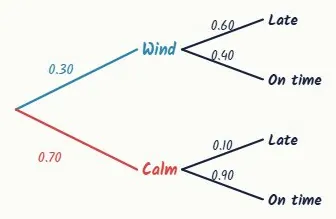
- First: wind 0.3, calm 0.7.
- After wind: late 0.6, on time 0.4.
- After calm: late 0.1, on time 0.9.
Q1: P(warning and late)
- Follow one path.
- Multiply along it.
- W: warning, L: late
- P(W and L) = P(W) × P(L | W)
- = 0.3 × 0.6multiply along
- = 0.18
Try it: multiply along the branches
Question 2 · Achieved
- Same ferry tree.
- Find P(the ferry is late).
Q2: P(late)
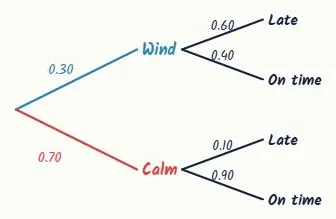
- Two paths end in late.
- Add across them.
- P(W and L) = 0.3 × 0.6 = 0.18
- P(not W and L) = 0.7 × 0.1 = 0.07
- P(L) = 0.18 + 0.07add across
- = 0.25
- 0.12 + 0.63 = 0.75 = 1 − 0.25
Question 3 · Merit
- Same ferry tree.
- The ferry is late today.
- Find P(there was a warning).
Q3: P(W | L)
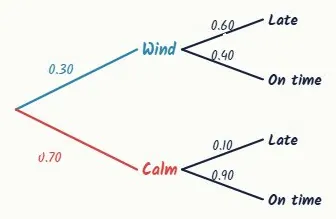
- Given late: late paths only.
- Path ÷ reduced total.
- P(W | L) = P(W and L) ÷ P(L)
- = 0.18 ÷ 0.25reduced total: P(L)
- = 0.72
- P(L | W) = 0.6forwards, not backwards
- 72% of late days had a warning
Try it: turn it around
Question 4 · Merit, in context
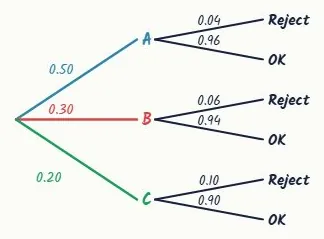
- Kiwifruit from orchards A 50%,
- B 30% and C 20%.
- Rejected: A 4%, B 6%, C 10%.
- Find P(a kiwifruit is rejected).
Q4: three first branches
- First: A 0.5, B 0.3, C 0.2.
- Then reject or OK: each pair adds to 1.
Q4: P(rejected)
- Three paths end in reject.
- Multiply along, add across.
- A, R: 0.5 × 0.04 = 0.02
- B, R: 0.3 × 0.06 = 0.018
- C, R: 0.2 × 0.1 = 0.02
- P(R) = 0.02 + 0.018 + 0.02add across
- = 0.058
- about 5.8% of fruit is rejected
Question 5 · Merit, in context
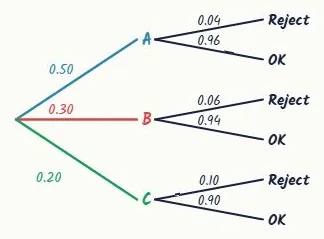
- Same kiwifruit tree.
- A kiwifruit is rejected.
- Find P(it came from orchard C).
- Compare with C's 20% share.
Q5: P(C | R)
- Reduced total: P(R).
- Answer in words.
- P(C | R) = P(C and R) ÷ P(R)
- = 0.02 ÷ 0.058P(R) from question 4
- = 0.344827…calculator
- = 0.34484 d.p.
- C: 20% of fruit, 34% of rejects
Question 6 · Excellence
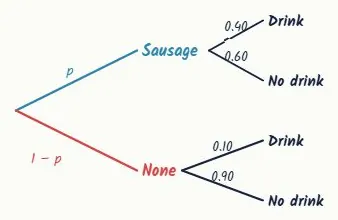
- Sausage sizzle: P(buys a sausage) = p.
- Drink: 40% of sausage buyers, 10% of others.
- 28% buy a drink. Find p,
- Then P(sausage | drink).
Q6: a tree with an unknown
- First: sausage p, none 1 − p.
- Then drink or no drink.
Q6: form the equation
- Two paths end in a drink.
- Together they are 0.28.
- P(S) = p, P(not S) = 1 − pbranches add to 1
- P(S and D) = 0.4pmultiply along
- P(not S and D) = 0.1(1 − p)multiply along
- 0.4p + 0.1(1 − p) = 0.28add across: P(D)
- 0.4p + 0.1 − 0.1p = 0.28expand
- 0.3p + 0.1 = 0.28collect p terms
Q6: solve, then go backwards
- Check p in the equation.
- Then path ÷ total.
- 0.3p + 0.1 = 0.28
- 0.3p = 0.18subtract 0.1
- p = 0.18 ÷ 0.3 = 0.6divide by 0.3
- check: 0.4 × 0.6 + 0.1 × 0.4
- = 0.24 + 0.04 = 0.28
- P(S | D) = 0.24 ÷ 0.28path ÷ total
- = 0.857142…calculator
- = 0.85714 d.p.
Question 7 · Excellence, in context
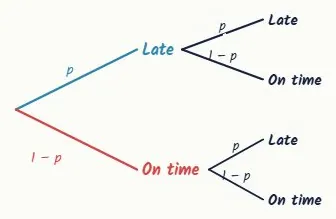
- Two Auckland buses to school.
- Each is late with probability p,
- Independently.
- P(at least one late) = 0.36. Find p.
Q7: p on every branch
- Late p, on time 1 − p.
- The same at both stages.
Q7: use the complement
- At least one = 1 − none.
- A probability is 0 to 1.
- P(neither late) = (1 − p)²on time × on time
- (1 − p)² = 1 − 0.36 = 0.64complement
- 1 − p = 0.8 or 1 − p = −0.8
- p = 0.2
- p = 1.8a probability is ≤ 1
- check: 1 − 0.8² = 1 − 0.64 = 0.36
- each bus is late 20% of the time
Try it: three tree traps
Common mistakes
- The ferry is late, so P(warning) = P(late | warning) = 0.6.Going backwards divides the path by the reduced total: P(W | L) = 0.18 ÷ 0.25 = 0.72.
- P(late) = 0.6 + 0.1 = 0.7Multiply along each path first, then add across: 0.3 × 0.6 + 0.7 × 0.1 = 0.25.
- P(no sausage and drink) = 0.1pThe no-sausage branch is 1 − p, because each set of branches adds to 1, so that path is 0.1(1 − p).
- (1 − p)² = 0.64, so p = 0.2 or p = 1.8.Reject p = 1.8 and say why: a probability cannot be more than 1, so p = 0.2.
The method that solved all seven
- Along, multiply. Across, add. Backwards, divide.
| Step | How |
|---|---|
| Draw | first event, then conditional |
| Each set | of branches adds to 1 |
| Along | multiply |
| Across | add the paths |
| Backwards | path ÷ the reduced total |
| Unknown | form an equation, then check |
Challenge
A tray of 12 eggs has 3 cracked ones. Three eggs are taken out one at a time, without replacement. First show that P(the third egg is cracked) = 14. Then, given that the third egg is cracked, find P(at least one of the first two eggs was cracked).
Hint
Draw a three-stage tree; the branch probabilities change after each egg. For the second part, go backwards: the path where the first two are fine and the third is cracked, divided by P(third cracked).
Answer
P(third cracked) = 14. Given the third is cracked, P(at least one of the first two cracked) = 1955 ≈ 0.3455.
Step by step
- There are four paths that end with a cracked third egg: CC, CF, FC and FF for the first two eggs.
- Multiply along each path and add: the total is 3301320 = 14, the same as for the first egg.
- The path 'fine, fine, cracked' is 912 × 811 × 310 = 2161320.
- Backwards: P(first two fine given third cracked) = 216 ÷ 330 = 3655.
- At least one cracked is the complement: 1 − 3655 = 1955.
Full working
- C C C: 312 × 211 × 110 = 61320multiply along
- C F C: 312 × 911 × 210 = 541320
- F C C: 912 × 311 × 210 = 541320
- F F C: 912 × 811 × 310 = 2161320
- P(third C) = (6 + 54 + 54 + 216) ÷ 1320 = 3301320 = 14add across
- P(first two fine given third C) = 216 ÷ 330 = 3655path ÷ reduced total
- P(at least one cracked given third C) = 1 − 3655 = 1955 ≈ 0.3455
A soil test for kauri dieback is used in a Northland forest where 2% of sites are infected. The test is positive at 95% of infected sites and at 8% of clean sites. A site tests positive: find P(it is infected). The site is then tested a second time, and the two results are independent for a given site. It is positive again: now find P(it is infected).
Hint
One positive: a two-stage tree, then path ÷ total. Two positives: make each path three stages long (infected or not, then test 1, then test 2) and only keep the paths with two positives.
Answer
After one positive, P(infected) ≈ 0.1951. After two positives, P(infected) ≈ 0.7421.
Step by step
- Most sites are clean, so even a small false-positive rate gives many positives from clean sites.
- One positive: 0.02 × 0.95 = 0.019 infected, 0.98 × 0.08 = 0.0784 clean, total 0.0974.
- P(infected | positive) = 0.019 ÷ 0.0974 ≈ 0.1951: only about 1 in 5.
- Two positives: infected 0.02 × 0.95 × 0.95 = 0.01805, clean 0.98 × 0.08 × 0.08 = 0.006272.
- P(infected | two positives) = 0.01805 ÷ 0.024322 ≈ 0.7421. The second test makes a big difference.
Full working
- P(I and +) = 0.02 × 0.95 = 0.019multiply along
- P(clean and +) = 0.98 × 0.08 = 0.0784
- P(+) = 0.019 + 0.0784 = 0.0974add across
- P(I given +) = 0.019 ÷ 0.0974 = 0.1951path ÷ total
- P(I and + +) = 0.02 × 0.95² = 0.01805; P(clean and + +) = 0.98 × 0.08² = 0.006272three stages
- P(+ +) = 0.01805 + 0.006272 = 0.024322add across
- P(I given + +) = 0.01805 ÷ 0.024322 = 0.7421
A jar holds 10 lollies: some are pineapple lumps and the rest are jaffas, with more pineapple lumps than jaffas. Two lollies are taken without replacement. The chance that they are the same kind is 715. How many pineapple lumps are in the jar? Given that the two lollies match, find P(both are pineapple lumps).
Hint
Call the number of pineapple lumps r, so there are 10 − r jaffas. Write P(same) from the two 'same' paths of the tree, set it equal to 715 and solve the quadratic. One root breaks a condition in the question.
Answer
6 pineapple lumps. Given the two match, P(both pineapple lumps) = 57 ≈ 0.7143.
Step by step
- Both pineapple: r10 × r − 19. Both jaffa: 10 − r10 × 9 − r9.
- Add them and set equal to 715, which is 4290.
- This simplifies to r² − 10r + 24 = 0, so r = 4 or r = 6.
- There are more pineapple lumps than jaffas, so r = 6 (r = 4 is the jar the other way round).
- Backwards: P(both P) = 3090, P(same) = 4290, so the answer is 3042 = 57.
Full working
- P(same) = r(r − 1) ÷ 90 + (10 − r)(9 − r) ÷ 90two paths
- r² − r + 90 − 19r + r² = 42× 90, as 715 = 4290
- 2r² − 20r + 48 = 0, so r² − 10r + 24 = 0collect
- (r − 4)(r − 6) = 0, r = 4 or 6factorise
- r = 6more pineapple lumps than jaffas
- check: (6 × 5 + 4 × 3) ÷ 90 = 4290 = 715
- 6 pineapple lumps; P(both P given same) = 3042 = 57 ≈ 0.7143
Practise this
Report a mistake
More in AS 91267
 Probability: when to add and when to multiply7 min
 Two-way tables and conditional probability6 min
 Probability trees from written information, forwards and backwards8 min
 Expected value and expected numbers7 min
 Relative risk: above 1, below 1, and evaluating a claim7 min
 The normal distribution: probabilities and z-values8 min
 Inverse normal: finding a value, the mean or the standard deviation8 min
 Comparing distributions: shape, centre and spread7 min
 Probability rules: 7 exam questions solved step by step10 min
 Two-way tables: 7 exam questions solved step by step10 minProbability trees: 7 exam questions solved step by step10 min
 Expected value: 7 exam questions solved step by step10 min
 Relative risk: 7 exam questions solved step by step9 min
 Normal distribution: 7 exam questions solved step by step10 min
 Inverse normal: 7 exam questions solved step by step10 min
 Comparing distributions: 7 exam questions solved step by step10 min
Is your child on track?
Take the free placement test