Expected value: 7 exam questions solved step by step
What this lesson covers
- An expected number is the probability multiplied by the number of trials.
- Expected value is a long-run average, so it need not be a possible single outcome.
Two formulas for expected values
- Expected number = n × p.
- E(X) = Σ x × P(X = x): each value × its probability.
- Take off any cost to play.
- Round, and explain it in context.
Question 1 · Achieved, in context
- A packhouse grades 2500 kiwifruit.
- P(undersized) = 0.08
- How many are expected to be undersized?
Q1: expected number
- Trials × probability.
- Answer with units.
- expected number = n × p
- = 2500 × 0.08
- = 200
- about 200 undersized kiwifruit
- not undersized: 2500 − 200 = 2300
Try it: expected numbers
Question 2 · Achieved
- A fair spinner pays these prizes.
- Find the expected prize, E(X).
| Prize, x | P(X = x) |
|---|---|
| $0 | 0.5 |
| $2 | 0.3 |
| $5 | 0.15 |
| $20 | 0.05 |
Q2: E(X) for the spinner
- Check the total is 1.
- Each prize × its probability.
- 0.5 + 0.3 + 0.15 + 0.05 = 1
- E(X) = Σ x × P(X = x)
- = 0 × 0.5 + 2 × 0.3
- + 5 × 0.15 + 20 × 0.05
- = 0 + 0.6 + 0.75 + 1
- = 2.35
- expected prize: $2.35 a spin
Try it: the long run
Question 3 · Merit, in context
- The school charges $3 a spin.
- Find the player's expected net gain.
- Expected profit from 200 spins?
| Prize, x | P(X = x) |
|---|---|
| $0 | 0.5 |
| $2 | 0.3 |
| $5 | 0.15 |
| $20 | 0.05 |
Q3: subtract the cost
- E(X) is not the profit.
- Net = prize − cost.
- E(net) = E(X) − cost
- = 2.35 − 3
- = −0.65
- player: −$0.65 a spin on average
- school: +$0.65 a spin
- 200 × 0.65 = 130
- expected profit: $130
Question 4 · Merit
- X = people in a car on the bridge.
- Find k, then E(X).
- Explain what E(X) means.
| People, x | P(X = x) |
|---|---|
| 1 | 0.1 |
| 2 | 0.35 |
| 3 | k |
| 4 | 0.2 |
Q4: find k, then E(X)
- Find k first.
- E(X) need not be whole.
- 0.1 + 0.35 + k + 0.2 = 1total is 1
- 0.65 + k = 1add
- k = 0.35subtract 0.65
- E(X) = 1 × 0.1 + 2 × 0.35
- + 3 × 0.35 + 4 × 0.2
- = 0.1 + 0.7 + 1.05 + 0.8
- = 2.65 people
- a long-run average per car
Question 5 · Merit, in context
- A rugby club has 80 players.
- 60% are forwards, 40% backs.
- Injured: 15% of forwards, 10% of backs.
- How many injured players are expected?
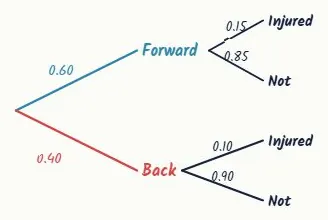
Q5: tree, then n × p
- Find P(injured) first.
- Round to whole people.
- P(F and I) = 0.6 × 0.15 = 0.09
- P(B and I) = 0.4 × 0.1 = 0.04
- P(I) = 0.09 + 0.04 = 0.13add across
- expected = 80 × 0.13
- = 10.4
- about 10 injured playerswhole people
- 48 × 0.15 + 32 × 0.1 = 10.4
Question 6 · Excellence
- A fair stall game costs $4 to play.
- Find x so the game is fair.
- Then find x for $1 profit a game.
| Result | Probability | Win |
|---|---|---|
| Top prize | 0.1 | $x |
| Money back | 0.25 | $4 |
| Nothing | the rest | $0 |
Q6: a fair game
- Fair: E(winnings) = cost.
- Form an equation in x.
- P(nothing) = 1 − 0.1 − 0.25 = 0.65
- E(W) = 0.1x + 0.25 × 4 + 0.65 × 0
- = 0.1x + 1
- 0.1x + 1 = 4fair: E(W) = cost
- 0.1x = 3subtract 1
- x = 30divide by 0.1
- fair top prize: $30
Q6: $1 profit a game
- Profit = cost − E(W).
- Check the new prize.
- E(W) = 0.1x + 1
- E(W) = 4 − 1 = 3school keeps $1
- 0.1x + 1 = 3
- 0.1x = 2, x = 20
- check: 0.1 × 20 + 1 = 3
- profit: 4 − 3 = $1 a game
- top prize: $20
Try it: run a fair stall
Question 7 · Excellence, in context
- P(damaging frost this season) = 0.15
- No fans: a frost costs $40 000.
- Fans: $5000, and a frost costs $8000.
- Should the grower hire the fans?
Q7: expected cost each way
- Fans cost $5000 for sure.
- The frost loss is a chance.
- no fans: 0.15 × 40 000 = $6000
- fans: 5000 + 0.15 × 8000
- = 5000 + 1200 = $6200
- 6200 − 6000 = $200fans cost more
- 40 000p = 5000 + 8000pbreak-even frost risk
- 32 000p = 5000− 8000p
- p = 5000 ÷ 32 000 = 0.15625
Q7: decide, with reasons
- E(cost) is a long-run average.
- One season: look at the worst case.
- 0.15 is just under 0.156
- no fans: $200 cheaper on average
- no fans: lose $0 or $40 000
- fans: lose $5000 or $13 000
- fans cost $200 more, cap the loss
Common mistakes
- E(X) = $2.35, so the player gains $2.35 a spin.Subtract the $3 cost: the expected net gain is 2.35 − 3 = −$0.65, a loss of 65c a spin.
- Expected injured = 80 × (0.15 + 0.10) = 20Weight each group: P(injured) = 0.6 × 0.15 + 0.4 × 0.10 = 0.13, so 80 × 0.13 = 10.4, about 10 players.
- E(X) = 2.65, so a car usually has 2.65 people in it.E(X) is a long-run average over many cars; no single car carries 2.65 people.
- Fans cost $5000, which is less than $40 000, so hire them.Compare expected costs: 0.15 × 40 000 = $6000 without fans, 5000 + 0.15 × 8000 = $6200 with fans.
The method that solved all seven
- Multiply, add, subtract the cost, then explain.
| Step | How |
|---|---|
| Number | n × p, rounded in context |
| Check | probabilities add to 1 |
| Value | Σ x × P(X = x) |
| Net | subtract the cost to play |
| Fair | E(winnings) = cost |
| Meaning | a long-run average |
Challenge
X is the number of goals a Wellington football team scores in a match. P(X = 0) = 0.2, P(X = 1) = a, P(X = 2) = b and P(X = 3) = 0.1, and no other values are possible. The long-run average is 1.4 goals a match. Find a and b. In a season of 30 matches, how many matches are expected to have at least 2 goals?
Hint
Two unknowns need two equations. One comes from the probabilities adding to 1, the other from E(X) = Σ x × P(X = x) = 1.4.
Answer
a = 0.3 and b = 0.4. About 15 of the 30 matches are expected to have at least 2 goals.
Step by step
- The probabilities add to 1, so a + b = 0.7.
- E(X) = 0 × 0.2 + 1 × a + 2 × b + 3 × 0.1 = 1.4, so a + 2b = 1.1.
- Subtract the first equation from the second: b = 0.4, then a = 0.3.
- P(X ≥ 2) = 0.4 + 0.1 = 0.5.
- Expected number = n × p = 30 × 0.5 = 15 matches.
Full working
- 0.2 + a + b + 0.1 = 1, so a + b = 0.7total is 1
- a + 2b + 0.3 = 1.4, so a + 2b = 1.1E(X) = 1.4
- b = 1.1 − 0.7 = 0.4subtract
- a = 0.7 − 0.4 = 0.3
- check: 0 + 0.3 + 0.8 + 0.3 = 1.4
- P(X ≥ 2) = 0.4 + 0.1 = 0.5add
- a = 0.3, b = 0.4; expected 30 × 0.5 = 15 matches
A quality inspector tests bottles from a batch one at a time, up to a limit of 3. She stops as soon as she finds a faulty bottle. Each bottle is faulty with probability 0.1, independently. Find the expected number of bottles tested per batch. Each test costs $15: what is the expected testing cost for 200 batches?
Hint
X is the number tested: 1, 2 or 3. She tests exactly 1 if the first is faulty. Be careful with X = 3: she reaches the third bottle whether or not it is faulty.
Answer
E(X) = 2.71 bottles a batch. The expected cost is $40.65 a batch, so $8130 for 200 batches.
Step by step
- X = 1 when the first bottle is faulty: 0.1.
- X = 2 when the first is fine and the second is faulty: 0.9 × 0.1 = 0.09.
- X = 3 when the first two are fine, whatever the third is: 0.9 × 0.9 = 0.81.
- Check: 0.1 + 0.09 + 0.81 = 1. Then E(X) = Σ x × P(X = x) = 2.71.
- Cost per batch is 15 × 2.71 = $40.65 on average; over 200 batches, 200 × 40.65 = $8130.
Full working
- P(X = 1) = 0.1first faulty
- P(X = 2) = 0.9 × 0.1 = 0.09fine, then faulty
- P(X = 3) = 0.9 × 0.9 = 0.81first two fine
- 0.1 + 0.09 + 0.81 = 1check
- E(X) = 1 × 0.1 + 2 × 0.09 + 3 × 0.81 = 0.1 + 0.18 + 2.43 = 2.71
- E(cost) = 15 × 2.71 = $40.65 a batch$15 a test
- 200 batches: 200 × 40.65 = $8130
Kiwifruit weights at a packhouse are normal with mean 110 g and standard deviation 9 g. Fruit under 95 g earn nothing, fruit from 95 g to 120 g earn 40c, and fruit over 120 g earn 65c. Find the expected income per fruit. A new feed would raise the mean to 113 g (same standard deviation) and costs $25 per 1000 fruit. Is it worth using?
Hint
Use the normal distribution to find the probability of each grade, then use E(X) = Σ x × P(X = x). Repeat with mean 113 g and compare the gain per 1000 fruit with the cost of the feed.
Answer
About 41.4c per fruit now and 44.5c with the feed. The feed adds about $31 per 1000 fruit, which is more than its $25 cost, so on average it is worth using (about $6 more per 1000 fruit).
Step by step
- Find P(under 95 g) and P(over 120 g) with the normal distribution; the middle grade is what is left.
- Multiply each income by its probability and add.
- Repeat with mean 113 g: fewer small fruit and more large fruit.
- The expected income rises by about 3.13c a fruit, or about $31.29 per 1000 fruit.
- $31.29 is more than the $25 cost, so the feed is worth it in the long run, by about $6.29 per 1000 fruit.
Full working
- μ = 110: P(X < 95) = 0.0478, P(X > 120) = 0.1333normal, σ = 9
- P(95 ≤ X ≤ 120) = 1 − 0.0478 − 0.1333 = 0.8189the rest
- E = 0 × 0.0478 + 0.40 × 0.8189 + 0.65 × 0.1333 = $0.4142Σ x × P
- μ = 113: P(X < 95) = 0.0228, P(X > 120) = 0.2184, middle 0.7589
- E = 0.40 × 0.7589 + 0.65 × 0.2184 = $0.4455Σ x × P
- gain per 1000 = 1000 × (0.44549 − 0.41420) = $31.29unrounded values
- $31.29 > $25: the feed is worth it, about $6.29 more per 1000 fruit
Practise this
Report a mistake
More in AS 91267
 Probability: when to add and when to multiply7 min
 Two-way tables and conditional probability6 min
 Probability trees from written information, forwards and backwards8 min
 Expected value and expected numbers7 min
 Relative risk: above 1, below 1, and evaluating a claim7 min
 The normal distribution: probabilities and z-values8 min
 Inverse normal: finding a value, the mean or the standard deviation8 min
 Comparing distributions: shape, centre and spread7 min
 Probability rules: 7 exam questions solved step by step10 min
 Two-way tables: 7 exam questions solved step by step10 min
 Probability trees: 7 exam questions solved step by step10 minExpected value: 7 exam questions solved step by step10 min
 Relative risk: 7 exam questions solved step by step9 min
 Normal distribution: 7 exam questions solved step by step10 min
 Inverse normal: 7 exam questions solved step by step10 min
 Comparing distributions: 7 exam questions solved step by step10 min
Is your child on track?
Take the free placement test