Expected value and expected numbers
What this lesson covers
- An expected number is the probability multiplied by the number of trials.
- Expected value is a long-run average, so it need not be a possible single outcome.
What to expect
- A probability says how likely.
- An expected number says how many.
- An expected value says how much, on average.
Expected number: n × p
- 11% buy a warranty.
- Expected number = n × p.
- n = 400, p = 0.11
- expected = n × p
- = 400 × 0.11
- = 44 customers
Try it: expected is not guaranteed
Expected is not guaranteed
- Another 400 customers might give 40, or 49.
- 44 is the long-run average.
- Say "about 44" or "expected".
A game: $2.50 to roll a die
- A 6 wins $9.
- A 4 or 5 wins $2.
- Anything else wins nothing.
| Outcome | P | Win |
|---|---|---|
| Roll a 6 | 1/6 | $9 |
| Roll a 4 or 5 | 2/6 | $2 |
| Roll 1, 2 or 3 | 3/6 | $0 |
Try it: play it a thousand times
The expected value of the game
- Σ prize × probability.
- Then subtract the cost.
- E(win) = 9 × 1/6 + 2 × 2/6
- + 0 × 3/6
- = 1.5 + 0.6667 + 0
- = $2.1667
- E(net) = 2.1667 − 2.50subtract the cost
- = −$0.3333about −33c a game
You never lose exactly 33 cents
- No game loses exactly 33c.
- A long-run average.
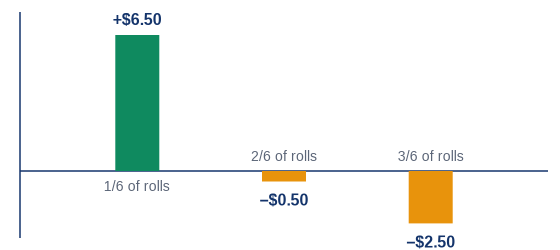
- roll 6: 9 − 2.50 = $6.50
- roll 4, 5: 2 − 2.50 = −$0.50
- roll 1–3: 0 − 2.50 = −$2.50
- E(net) = 6.50 × 1/6 − 0.50 × 2/6
- − 2.50 × 3/6
- = 1.0833 − 0.1667 − 1.25
- = −$0.33as before
Is it a fair game?
- Fair means E(net) = 0.
- Fee: E(win), to the cent.
- fair: E(net) = 0
- E(win) − fee = 0
- fee = $2.1667
- ≈ $2.17to the cent
- 2.1667 − 2.17 = −0.0033a third of a cent
Expected numbers from a tree
- p comes from the tree.
- Round to whole people.
- P(warranty) = 0.11from the tree
- expected = 250 × 0.11
- = 27.5
- about 28 customerspeople are whole
Round in context
- People and days are whole numbers.
- Money is to the cent.
- Keep full accuracy until the final answer.
| Value | Because | Report |
|---|---|---|
| 27.5 customers | people are whole | about 28 |
| 2.64 late days | days are whole | about 3 |
| $2.1667 per game | money | $2.17 |
Try it: forecast and balance
Where the marks are
- Achieved: an expected number.
- Merit: an expected value using a tree.
- Excellence: interpreting it, and its limits.
What to take away
- n × p for numbers; Σ value × p for value.
| Expected number | n × p |
| Expected value | Σ value × probability |
| Net | subtract the cost |
| Meaning | a long-run average |
| Rounding | whole things in context, money to cents |
Common mistakes
- E = 9 × 1/6 + 2 × 2/6 = $2.17, so the player wins on average.That is the expected winnings. Subtract the $2.50 cost: E(net) = 2.1667 − 2.50 = −$0.33 a game.
- E(net) = −$0.33, so you lose 33 cents every game.No single game loses 33c. It is the long-run average loss per game over many games.
- 250 × 0.11 = 27.5, so 27.5 customers will buy a warranty.People are whole, so say about 28 customers are expected; another 250 customers could give a different number.
- Fair fee: 2.1667 rounds to $2.20.Money is given to the cent, so the fair fee is $2.17. At $2.20 the player would lose about 3c a game.
Your turn: eight questions
- Question 2: subtract the ticket price.
- Round sensibly in context.
P(defect) = 0.035. How many defects in 2000 items?
500 tickets at $5, prizes $500 and $200. E(net)?
P(late) = 0.12 a day. Late days in 22 days?
P(claim) 0.02, pays $3000, premium $80. Profit?
A shop expects 18 returns from 450 sales. What is P(a sale is returned)?
Roll a die: a 6 wins $10, a 5 wins $4, anything else nothing. What entry fee makes the game fair?
A school fair game has E(net) = −$0.50 for the player. Which statement is true?
A courier sends 80% of parcels by van and 20% by bike. 5% of van and 15% of bike parcels arrive late. Expected late parcels out of 600?
Show answer
1. 0.035 × 2000 = 70. 2. E(win) = 700 ÷ 500 = $1.40, so E(net) = 1.40 − 5 = −$3.60. 3. 0.12 × 22 = 2.64, about 3 days. 4. Expected payout 0.02 × 3000 = $60, so $80 − $60 = $20 expected profit per policy. 5. 0.04. Expected number = n × p, so p = 18 ÷ 450 = 0.04. 6. $2.33. Fair means the fee equals E(win) = 10 × 1/6 + 4 × 1/6 = $2.33 (to the cent). 7. Over many games a player loses about 50c a game on average. Expected value is a long-run average, not the result of one game. 8. 42 parcels. P(late) = 0.8 × 0.05 + 0.2 × 0.15 = 0.07, and 600 × 0.07 = 42.
The answers: questions 1 and 2
- 1. expected = 2000 × 0.035
- = 70 defects
- 2. P(each prize) = 1/500
- E(win) = 500 × 1/500
- + 200 × 1/500
- = 1 + 0.40 = $1.40
- E(net) = 1.40 − 5 = −$3.60per ticket
The answers: questions 3 and 4
- 3. expected = 22 × 0.12
- = 2.64
- about 3 daysdays are whole
- 4. E(payout) = 3000 × 0.02
- = $60
- profit = 80 − 60 = $20per policy
Sample question: Achieved
The probability that a morning flight from Wellington to Christchurch is delayed is 0.14. How many delayed flights would you expect over 30 mornings?
Hint
Expected number = n × p.
Answer
About 4 delayed flights (4.2)
Step by step
- Recall the rule: expected number = number of trials × probability, n × p.
- Here each morning is one trial, so n = 30. The probability of a delay is p = 0.14.
- Multiply: 30 × 0.14 = 4.2.
- Flights are whole things, so you cannot have 4.2 delays. Say about 4.
- Expected does not mean guaranteed: one month might have 2 delays and another 7. 4.2 is the long-run average.
- Check: 0.14 is a bit more than 1 in 10, and 1 in 10 of 30 is 3, so a bit more than 3 is sensible.
Full working
- n = 30, p = 0.14
- expected = 30 × 0.14 = 4.2n × p
- about 4 delayed flights
Sample questions: Merit
At a school gala, a spinner game costs $4 a go. The spinner lands on red with probability 0.25 and pays $10, on blue with probability 0.35 and pays $3, and otherwise pays nothing. Find the expected net gain for a player. What price would make the game fair, and how much profit should the stall expect from 300 plays at $4?
Hint
Find E(win) = Σ prize × probability first, then subtract the cost. A fair game has an expected net gain of 0.
Answer
E(net) = −$0.45; a fair price is $3.55; the stall expects about $135 profit
Step by step
- Set out the outcomes with their probabilities: red 0.25 pays 10, blue 0.35 pays 3, other 0.40 pays 0.
- Check the probabilities add to 1: 0.25 + 0.35 + 0.40 = 1. Good.
- Recall: expected value = Σ value × probability.
- E(win) = 10 × 0.25 + 3 × 0.35 + 0 × 0.40 = 2.50 + 1.05 + 0 = $3.55.
- The player paid $4, so E(net) = 3.55 − 4 = −$0.45. On average the player loses 45 cents a go.
- Fair means the expected net gain is 0, so the price must equal E(win): $3.55.
- The stall gains what the players lose: $0.45 a play on average. Over 300 plays that is 300 × 0.45 = $135.
- The classic mistake is to forget the cost and say the player expects to gain $3.55.
- Check: no single play ever loses exactly 45 cents. It is a long-run average over many plays.
Full working
- E(win) = 10 × 0.25 + 3 × 0.35 + 0 × 0.40 = 3.55Σ value × probability
- E(net) = 3.55 − 4 = −0.45subtract the cost
- fair price = $3.55fair means E(net) = 0
- stall profit = 300 × 0.45 = $135
- E(net) = −$0.45; fair price $3.55; $135 profit
A bag holds 3 red and 2 blue marbles. A player pays $3 and takes two marbles without replacement. Two reds win $6, one of each colour wins $2, and two blues win nothing. Show that the game is fair.
Hint
Draw a tree for the two draws. The second-draw probabilities change because the first marble is not put back.
Answer
P(two red) = 0.3, P(one of each) = 0.6, P(two blue) = 0.1; E(win) = $3 = the cost, so E(net) = 0 and the game is fair
Step by step
- Fair means the expected net gain is 0, so we must show E(win) is exactly $3.
- Draw a tree. First draw: red 35, blue 25.
- Without replacement, the bag has 4 marbles for the second draw. After a red: red 24, blue 24. After a blue: red 34, blue 14.
- Multiply along each path. Red, red: 35 × 24 = 620 = 0.3. Blue, blue: 25 × 14 = 220 = 0.1.
- One of each has two paths: red then blue 35 × 24 = 0.3, and blue then red 25 × 34 = 0.3. Add them: 0.6.
- Check the tree: 0.3 + 0.6 + 0.1 = 1.
- E(win) = 6 × 0.3 + 2 × 0.6 + 0 × 0.1 = 1.8 + 1.2 = $3.
- E(net) = 3 − 3 = 0, so the game is fair.
- The classic mistake is to use 35 again on the second draw. That treats the marble as if it went back in.
- Another one: forgetting that "one of each" can happen in two orders.
Full working
- P(RR) = 35 × 24 = 0.3without replacement
- P(one of each) = 35 × 24 + 25 × 34 = 0.6two orders, so add
- P(BB) = 25 × 14 = 0.1
- E(win) = 6 × 0.3 + 2 × 0.6 + 0 × 0.1 = 3Σ value × probability
- E(net) = 3 − 3 = 0, so the game is fair
Sample questions: Excellence
A phone insurer pays $900 if a phone is stolen (probability 0.03 a year) and $250 if it is damaged (probability 0.08 a year). Assume a phone cannot be both. The insurer wants an expected profit of $15 a policy. Find the yearly premium, and the expected profit from 4000 policies. Hence, keeping that premium, find the largest damage payout that still gives an expected profit of at least $10 a policy. Give one limitation of these expected values.
Hint
Expected profit = premium − expected payout. Find the expected payout first, then set up an inequality with the damage payout as the unknown.
Answer
Premium $62; $60,000 from 4000 policies; damage payout at most $312.50
Step by step
- The insurer's profit on a policy is the premium minus whatever it pays out. So find the expected payout first.
- Recall: expected value = Σ value × probability. The two claims cannot both happen, so their parts simply add.
- Expected payout = 900 × 0.03 + 250 × 0.08 = 27 + 20 = $47.
- For $15 expected profit: premium − 47 = 15, so the premium is $62.
- Over 4000 policies, the expected profit is 4000 × 15 = $60,000.
- Hence part: call the new damage payout d. The expected payout becomes 27 + 0.08d.
- The expected profit is 62 − 27 − 0.08d = 35 − 0.08d, and we need 35 − 0.08d ≥ 10.
- So 0.08d ≤ 25 and d ≤ 25 ÷ 0.08 = 312.5. The largest payout is $312.50.
- Check: 62 − 27 − 0.08 × 312.5 = 62 − 27 − 25 = 10. Exactly 10, as wanted.
- Limitation: these are long-run averages. In one year the actual profit could be much lower if more phones are stolen than 3%, for example after a burglary spree.
- Another limitation: the probabilities 0.03 and 0.08 come from past data and may not hold for new customers.
Full working
- E(payout) = 900 × 0.03 + 250 × 0.08 = 47Σ value × probability
- premium = 47 + 15 = $62
- 4000 × 15 = $60,000
- 62 − (27 + 0.08d) ≥ 10new damage payout d
- 0.08d ≤ 25, d ≤ 312.5
- $62; $60,000; d ≤ $312.50
At a fair, a player pays $3 and rolls two dice. A total of 7 wins x dollars, a double wins $5, and anything else wins nothing. Find x so the game is fair. The organisers instead want to raise about $200 from 400 plays. What should x be then? Explain whether the $200 is guaranteed.
Hint
List the 36 equally likely outcomes. A double can never total 7, so the two prizes cannot both happen.
Answer
Fair: x = $13; to raise $200 from 400 plays: x = $10; the $200 is an expected amount, not guaranteed
Step by step
- Two dice give 36 equally likely outcomes.
- A total of 7: (1,6), (2,5), (3,4), (4,3), (5,2), (6,1). That is 6 outcomes, so P(7) = 636 = 16.
- A double: (1,1) up to (6,6). Also 6 outcomes, so P(double) = 16. A double totals an even number, so it can never be 7.
- E(win) = x × 16 + 5 × 16 = x + 56.
- Fair means E(win) equals the cost: x + 56 = 3, so x + 5 = 18 and x = 13.
- For the fundraiser: $200 from 400 plays is 200 ÷ 400 = $0.50 a play. So the player's E(net) must be −0.50.
- That means E(win) = 3 − 0.50 = 2.50: x + 56 = 2.5, so x + 5 = 15 and x = 10.
- Check: with x = 10, E(win) = 106 + 56 = 156 = 2.50, so the organisers keep 0.50 a play.
- Not guaranteed: $200 is a long-run average. With only 400 plays, a lucky run of 7s could leave the organisers with much less.
- The classic mistake is to count a double 7 or to use P(7) = 111, treating the 11 totals as equally likely. They are not.
Full working
- P(7) = 636 = 16, P(double) = 636 = 16a double is never 7
- E(win) = x + 56Σ value × probability
- x + 56 = 3, x = 13fair: E(win) = cost
- 200 ÷ 400 = 0.50 a play, so E(win) = 2.50
- x + 56 = 2.5, x = 10
- x = 13 for fair; x = 10 to raise about $200
Challenge
A small airline flies a 10-seat plane from Wellington to Nelson. Every ticket sold earns $200, whether or not the passenger turns up. Each booked passenger turns up with probability 0.9, independently. If more passengers turn up than there are seats, each one who cannot fly is paid $300 compensation. Find the expected income for a flight if the airline sells 10 tickets, and if it sells 11 tickets. Should it sell 11? Then find the largest compensation for which selling 11 tickets still gives a higher expected income than selling 10.
Hint
With 11 tickets, someone misses out only if all 11 turn up. Find that probability first, then the expected compensation. For the last part, call the compensation c and compare.
Answer
10 tickets: $2000; 11 tickets: about $2105.86, so selling 11 is better on average; it stays better while the compensation is under about $637
Step by step
- With 10 tickets nobody can miss out, so the income is always 10 × 200 = $2000.
- With 11 tickets the income from tickets is 11 × 200 = $2200. One passenger misses out only if all 11 turn up.
- P(all 11 turn up) = 0.9¹¹ = 0.3138, because the passengers are independent.
- Expected compensation = 300 × 0.3138 = $94.14, so the expected income is 2200 − 94.14 = $2105.86.
- 2105.86 > 2000, so on average selling 11 tickets earns about $106 more a flight.
- With compensation c, selling 11 is better when 2200 − 0.3138c > 2000, that is 0.3138c < 200, so c < 200 ÷ 0.3138 = $637.33.
- This is a long-run average: on about 31% of flights a passenger is turned away, which could cost the airline goodwill as well as money.
Full working
- 10 tickets: 10 × 200 = 2000nobody misses out
- P(all 11 turn up) = 0.9¹¹ = 0.3138independent passengers
- 11 tickets: 2200 − 300 × 0.3138 = 2105.86expected income
- 2105.86 > 2000sell 11
- 2200 − 0.3138c > 2000, c < 200 ÷ 0.3138 = 637.33largest compensation
- $2000 against $2105.86, so sell 11; worthwhile while compensation is under about $637
A lab tests water from farm bores for E. coli. Each bore is contaminated with probability 0.04, independently. Instead of testing every bore separately, the lab mixes samples from 5 bores and tests the mix once. If the mix is clear, all 5 bores are clear. If not, each of the 5 bores is then tested on its own, making 6 tests in total. Find the expected number of tests for a group of 5 bores, and the expected number of tests per bore. How many tests would the lab expect to save on 1000 bores compared with testing each bore separately? Then find the largest probability of contamination for which mixing groups of 5 still saves tests on average.
Hint
The mix is clear only if all 5 bores are clear. The number of tests for a group is either 1 or 6. For the last part, call P(clear) for one bore q and solve E(tests) < 5.
Answer
1.923 tests a group, 0.385 tests per bore; about 615 tests saved on 1000 bores; mixing saves tests while the contamination probability is below about 0.275
Step by step
- P(mix clear) = P(all 5 clear) = 0.96⁵ = 0.8154.
- So 1 test with probability 0.8154 and 6 tests with probability 1 − 0.8154 = 0.1846.
- E(tests) = 1 × 0.8154 + 6 × 0.1846 = 1 + 5 × 0.1846 = 1.923 tests a group, which is 1.923 ÷ 5 = 0.385 tests per bore.
- 1000 bores make 200 groups: expected 200 × 1.923 = 384.6 tests, against 1000 tests one at a time. That saves about 615 tests.
- With q = P(one bore clear), E(tests) = 1 + 5(1 − q⁵). Mixing saves tests when this is under 5: 5(1 − q⁵) < 4, so q⁵ > 0.2 and q > 0.2^(15) = 0.7248.
- So mixing groups of 5 saves tests on average whenever the contamination probability is below 1 − 0.7248 = 0.275.
- The saving is a long-run average: some groups will need 6 tests, but over many groups the total is much lower.
Full working
- P(mix clear) = 0.96⁵ = 0.8154all 5 clear
- E(tests) = 1 × 0.8154 + 6 × 0.1846 = 1.923per group of 5
- 1.923 ÷ 5 = 0.385per bore
- 1000 − 200 × 1.923 = 615saved on 1000 bores
- 1 + 5(1 − q⁵) < 5, q⁵ > 0.2, q > 0.7248mixing pays
- 1.923 tests a group, 0.385 per bore; about 615 saved; worthwhile while p < 0.275
On a TV quiz, Mere answers a first question, which she gets right with probability 0.7. Wrong ends the game with $0; right banks $100. She may then stop with $100, or try a second question, which she gets right with probability 0.4. Right on the second gives $300 in total; wrong on the second loses everything. Should she try the second question if she wants the highest expected winnings? Find the smallest probability of getting the second question right that makes trying it worthwhile, and her expected winnings before the show starts if she plays her best plan. Give one reason she might still stop.
Hint
Work backwards. Once she has $100, compare $100 for certain with the expected value of trying. Then go back to the start and include the first question.
Answer
Yes: trying is worth $120 on average against $100 for stopping; it is worthwhile whenever the probability is above 13; expected winnings $84 (against $70 if she always stops); she might stop because $100 for certain avoids a 60% chance of leaving with nothing
Step by step
- Work backwards from the decision. With $100 banked, stopping is worth $100 for certain.
- Trying is worth 300 × 0.4 + 0 × 0.6 = $120 on average. 120 > 100, so for the highest expected winnings she should try.
- With probability p of getting it right, trying is worth 300p. It beats $100 when 300p > 100, so p > 13.
- Before the show, she reaches the decision with probability 0.7. Playing her best plan: E = 0.7 × 120 + 0.3 × 0 = $84. Always stopping would give 0.7 × 100 = $70.
- Expected value is a long-run average over many plays. Mere plays once, and trying means a 0.6 chance of losing a sure $100, so a careful player might still stop.
Full working
- stop: $100certain
- try: 300 × 0.4 + 0 × 0.6 = 120expected value of trying
- 300p > 100, so p > 13when trying beats stopping
- best plan: E = 0.7 × 120 = 84reach the decision with probability 0.7
- always stop: E = 0.7 × 100 = 70compare
- try the second question; worthwhile when p > 13; expected winnings $84
Practise this
Report a mistake
More in AS 91267
 Probability: when to add and when to multiply7 min
 Two-way tables and conditional probability6 min
 Probability trees from written information, forwards and backwards8 minExpected value and expected numbers7 min
 Relative risk: above 1, below 1, and evaluating a claim7 min
 The normal distribution: probabilities and z-values8 min
 Inverse normal: finding a value, the mean or the standard deviation8 min
 Comparing distributions: shape, centre and spread7 min
 Probability rules: 7 exam questions solved step by step10 min
 Two-way tables: 7 exam questions solved step by step10 min
 Probability trees: 7 exam questions solved step by step10 min
 Expected value: 7 exam questions solved step by step10 min
 Relative risk: 7 exam questions solved step by step9 min
 Normal distribution: 7 exam questions solved step by step10 min
 Inverse normal: 7 exam questions solved step by step10 min
 Comparing distributions: 7 exam questions solved step by step10 min
Is your child on track?
Take the free placement test