Probability trees from written information, forwards and backwards
What this lesson covers
- Each branch of a tree carries a probability conditional on the branches before it.
- Working backwards through a tree finds the probability of an earlier event given a later one.
From words to a tree
- The exam gives a paragraph, not a tree.
- Drawing the tree is part of the question.
- First event first, then what depends on it.
| Information | Means | On the tree |
|---|---|---|
| 60% of customers | pay by card | first stage |
| 15% of card payers | buy a warranty | second stage, card branch |
| 5% of cash payers | buy a warranty | second stage, cash branch |
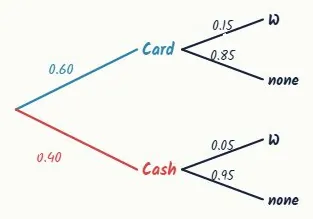
Build the tree
- First stage: card 0.6, cash 0.4.
- After card: warranty 0.15, none 0.85.
- After cash: warranty 0.05, none 0.95.
Try it: multiply along, add across
Multiply along each path
- Card and warranty: 0.6 × 0.15 = 0.09.
- Every path gets its product.
- The four products add to 1.
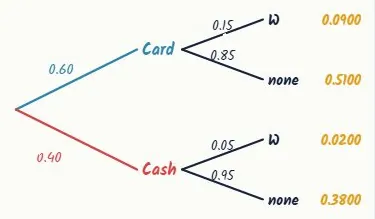
The four paths
- Along a path: multiply.
- Check: the four total 1.
- card, W: 0.6 × 0.15 = 0.09
- card, none: 0.6 × 0.85 = 0.51
- cash, W: 0.4 × 0.05 = 0.02
- cash, none: 0.4 × 0.95 = 0.38
- check: 0.09 + 0.51 + 0.02 + 0.38
- = 1
Add across paths
- Two paths end in W.
- Across paths: add.
- P(W) = 0.6 × 0.15 + 0.4 × 0.05
- = 0.09 + 0.02multiply along
- = 0.11add across
Working backwards
- Given W: only the W paths.
- The path ÷ the total.
- P(card | W)
- = P(card and W) ÷ P(W)
- = 0.09 ÷ 0.11
- = 0.81818…calculator
- = 0.81824 d.p.
Try it: the reverse question
Why the answer is so high
- Only 60% pay by card.
- But 82% of W buyers did.
- P(card) = 0.6forwards
- 0.15 ÷ 0.05 = 3card rate ÷ cash rate
- P(card | W) = 0.8182backwards: 82%
An unknown on the tree
- Call P(card) p.
- Multiply along, add across.
- P(card) = pthe unknown
- P(cash) = 1 − pbranches add to 1
- P(card and W) = 0.15pmultiply along
- P(cash and W) = 0.05(1 − p)multiply along
- 0.15p + 0.05(1 − p) = 0.12add: P(W) = 0.12
Solve for p
- Expand, collect, solve.
- Check in the equation.
- 0.15p + 0.05(1 − p) = 0.12
- 0.15p + 0.05 − 0.05p = 0.12expand
- 0.1p + 0.05 = 0.12collect p terms
- 0.1p = 0.07subtract 0.05
- p = 0.07 ÷ 0.1 = 0.7divide by 0.1
- P(card) = 0.7: 70% by card
- check: 0.15 × 0.7 + 0.05 × 0.3
- = 0.105 + 0.015 = 0.12
Try it: words to a tree and back
Where the marks are
- Achieved: a path probability.
- Merit: adding paths, and working backwards.
- Excellence: forming and solving an equation.
What to take away
- Along, multiply. Across, add. Backwards, divide.
| Build | first event, then conditional branches |
| Each set of branches | adds to 1 |
| Along a path | multiply |
| Across paths | add |
| Backwards | the path ÷ the total |
| Unknown | an equation from the tree |
Common mistakes
- P(warranty) = 0.15 + 0.05 = 0.2Multiply along each path first, then add across: 0.6 × 0.15 + 0.4 × 0.05 = 0.11.
- A warranty buyer is chosen, so P(card | warranty) = 0.15.0.15 is P(warranty | card). Backwards is path ÷ total: 0.09 ÷ 0.11 = 0.8182.
- P(cash and no warranty) = 0.4 × 0.05 = 0.02After cash, no warranty is 1 − 0.05 = 0.95, so the path is 0.4 × 0.95 = 0.38. Each set of branches adds to 1.
- Tested positive, so P(has the condition) = 0.9.That is P(positive | condition). Backwards: 0.036 ÷ 0.1128 = 0.3191, because most positives come from the 96% without it.
Your turn: eight questions
- Draw the tree first.
- Eight decimal places.
| Question | |
|---|---|
| Info | 4% have it. Positive: 90% if they do, 8% if not. |
| 1 | P(a random person tests positive)? |
| 2 | P(has the condition | tests positive)? |
| 3 | P(does not have it and tests negative)? |
| 4 | Of 1000 people tested, how many positives expected? |
| 5 | P(has the condition and tests negative)? |
| 6 | P(does not have it | tests negative)? |
| 7 | The test finds 90% of cases, yet P(has it | positive) is only 0.3191. Why? |
| 8 | A new test: still 4% have it and 90% of them test positive. If P(positive) = 0.084, what is P(positive | does not have it)? |
Show answer
1. 0.04 × 0.9 + 0.96 × 0.08 = 0.036 + 0.0768 = 0.1128. 2. 0.036 ÷ 0.1128 = 0.3191. 3. 0.96 × 0.92 = 0.8832. 4. 1000 × 0.1128 = 112.8, about 113. 5. 0.0040. Along the path: 0.04 × 0.1 = 0.0040 (a negative is 1 − 0.9 = 0.1 for those who have it). 6. 0.9955. P(negative) = 0.8832 + 0.0040 = 0.8872, so 0.8832 ÷ 0.8872 = 0.9955. 7. Most positives come from the many people without it: 0.0768 of everyone are false positives against 0.036 true ones. 8. 0.0500. Let it be p: 0.04 × 0.9 + 0.96p = 0.084, so 0.96p = 0.048 and p = 0.0500.
The answers: questions 1 and 2
- 1. P(not C) = 1 − 0.04 = 0.96C: has the condition
- P(pos) = 0.04 × 0.9 + 0.96 × 0.08two positive paths
- = 0.036 + 0.0768multiply along
- = 0.1128add across
- 2. P(C | pos) = 0.036 ÷ 0.1128path ÷ total
- = 0.31914…
- = 0.31914 d.p.
The answers: questions 3 and 4
- 3. P(neg | not C) = 1 − 0.08branches add to 1
- = 0.92
- P(not C and neg) = 0.96 × 0.92multiply along
- = 0.8832
- 4. expected = 1000 × P(pos)
- = 1000 × 0.1128
- = 112.8
- about 113 positiveswhole people
Sample question: Achieved
70% of students at a Hamilton school catch the bus. 10% of bus students are late on a given day, and 25% of the other students are late. Find the probability that a randomly chosen student catches the bus and is late.
Hint
Draw the tree with bus first, then late or on time. "And" along a path means multiply.
Answer
P(bus and late) = 0.07
Step by step
- Start the tree with the first event: bus 0.7 and not bus 0.3. These add to 1.
- From the bus branch, draw late 0.1 and on time 0.9. From the not-bus branch, draw late 0.25 and on time 0.75.
- The 10% is only for bus students, so it goes on the bus branch. That is what "of bus students" means.
- We want bus and late, which is one path through the tree.
- Along a path, multiply: 0.7 × 0.1 = 0.07.
- The classic mistake is to give 0.1. That is the chance a bus student is late, not the chance a random student is a late bus student.
- Check: 0.07 is smaller than 0.7 and smaller than 0.1, as an "and" probability must be.
Full working
- P(bus) = 0.7, P(late given bus) = 0.1read from the tree
- P(bus and late) = 0.7 × 0.1multiply along the path
- P(bus and late) = 0.07
Sample questions: Merit
70% of students at a Hamilton school catch the bus. 10% of bus students are late on a given day, and 25% of the other students are late. A student is late. Find the probability that they caught the bus.
Hint
Find P(late) by adding the two late paths, then divide the bus-and-late path by it.
Answer
P(bus given late) = 0.4828
Step by step
- Draw the tree: bus 0.7, not bus 0.3; then late 0.1 on the bus branch and late 0.25 on the other branch.
- "A student is late" is the given part. We only look at the paths that end in late.
- Bus and late: 0.7 × 0.1 = 0.07. Not bus and late: 0.3 × 0.25 = 0.075.
- Across paths, add: P(late) = 0.07 + 0.075 = 0.145.
- Working backwards: P(bus given late) = P(bus and late) ÷ P(late) = 0.07 ÷ 0.145.
- 0.07 ÷ 0.145 = 0.48276, so 0.4828.
- In words: although 70% catch the bus, only about 48% of late students are bus students, because bus students are rarely late.
- The classic mistake is to divide by 1 or by 0.7. The total is P(late), because "given late" restricts us to the late paths.
- Check: the late paths split as 0.4828 bus and 0.5172 not bus, and these add to 1.
Full working
- P(bus and late) = 0.7 × 0.1 = 0.07
- P(not bus and late) = 0.3 × 0.25 = 0.075
- P(late) = 0.07 + 0.075 = 0.145add across paths
- P(bus given late) = 0.07 ÷ 0.145the path ÷ the total
- P(bus given late) = 0.4828
A bag has 5 green and 3 yellow lollies. Mere takes two lollies without replacement. Find the probability they are the same colour. Given they are the same colour, find the probability they are both green.
Hint
Draw a tree where the second-draw numbers drop by one. Same colour is two paths: add them, then divide.
Answer
P(same colour) = 1328 = 0.4643; P(both green given same colour) = 1013 = 0.7692
Step by step
- First draw: green 58, yellow 38.
- Without replacement, 7 lollies are left for the second draw. After a green: green 47, yellow 37. After a yellow: green 57, yellow 27.
- Both green: 58 × 47 = 2056. Both yellow: 38 × 27 = 656.
- Same colour means green-green or yellow-yellow. They cannot both happen, so add: 2056 + 656 = 2656 = 1328 = 0.4643.
- For the second part, "given same colour" means we only look at those two paths.
- P(both green given same) = (2056) ÷ (2656) = 2026 = 1013 = 0.7692.
- There are more green lollies, so most same-colour pairs are green. 0.7692 makes sense.
- The classic mistake is to use 58 × 58 for both green. That puts the first lolly back in the bag.
- Check: green-green 20, green-yellow 15, yellow-green 15, yellow-yellow 6, all out of 56. 20 + 15 + 15 + 6 = 56.
Full working
- P(GG) = 58 × 47 = 2056without replacement
- P(YY) = 38 × 27 = 656
- P(same) = 2656 = 1328 = 0.4643add the two paths
- P(GG given same) = 2056 ÷ 2656 = 1013the path ÷ the total
- 0.4643 and 0.7692
Sample questions: Excellence
A screening test for a condition gives a positive result for 95% of people who have the condition, and for 5% of people who do not. In a large town, 10% of people tested get a positive result. Find the proportion p of people tested who have the condition. Hence find the probability that a person with a positive result has the condition, and explain what this means for someone who tests positive.
Hint
Put p on the first branch and 1 − p on the other. Adding the two positive paths gives an equation equal to 0.1.
Answer
p = 118 = 0.0556; P(condition given positive) = 0.5278
Step by step
- The unknown is the first branch, so call P(condition) = p and P(no condition) = 1 − p.
- Second stage: positive 0.95 after condition, positive 0.05 after no condition.
- Multiply along the positive paths: 0.95p and 0.05(1 − p).
- Add across them and set equal to the given total: 0.95p + 0.05(1 − p) = 0.1.
- Expand: 0.95p + 0.05 − 0.05p = 0.1, so 0.9p = 0.05.
- p = 0.05 ÷ 0.9 = 118 = 0.0556. About 5.6% of people tested have the condition.
- Working backwards: P(condition given positive) = P(condition and positive) ÷ P(positive).
- P(condition and positive) = 0.95 × 118 = 0.052778. Divide by 0.1: 0.5278.
- Meaning: even with a positive result, there is only about a 53% chance the person has the condition. About 47% of positives are false alarms.
- Why: the condition is rare, so the 5% false positives from the large healthy group are almost as many as the true positives.
- So a positive result should lead to a second, more accurate test, not a diagnosis.
- Check: 0.95 × 0.0556 + 0.05 × 0.9444 = 0.0528 + 0.0472 = 0.1. Correct.
Full working
- P(C) = p, P(not C) = 1 − p
- 0.95p + 0.05(1 − p) = 0.1add the two positive paths
- 0.9p = 0.05, p = 118 = 0.0556
- P(C and pos) = 0.95 × 118 = 0.052778
- P(C given pos) = 0.052778 ÷ 0.1the path ÷ the total
- p = 0.0556; P(C given pos) = 0.5278
A bag holds n red balls and 3 blue balls, with more red than blue. Two balls are taken without replacement. The probability that they are the same colour is 12. Find n.
Hint
Write P(same colour) in terms of n from the tree. Set it equal to 12 and you get a quadratic.
Answer
n = 6
Step by step
- There are n + 3 balls at the start, and n + 2 after one is taken out.
- Both red: nn + 3 × n − 1n + 2 = n(n − 1)(n + 3)(n + 2).
- Both blue: 3n + 3 × 2n + 2 = 6(n + 3)(n + 2).
- Same colour is both red or both blue, so add: n(n − 1) + 6(n + 3)(n + 2) = 12.
- Cross-multiply: 2(n² − n + 6) = (n + 3)(n + 2).
- Expand both sides: 2n² − 2n + 12 = n² + 5n + 6.
- Collect everything on one side: n² − 7n + 6 = 0.
- Factorise: (n − 1)(n − 6) = 0, so n = 1 or n = 6.
- Both make the probability 12, but the question says there are more red than blue, so n = 1 is out. n = 6.
- Check n = 6: both red 69 × 58 = 3072, both blue 39 × 28 = 672. Total 3672 = 12. Correct.
- The classic mistake is to forget that the second denominator is n + 2, not n + 3.
Full working
- P(RR) = n(n − 1)(n + 3)(n + 2)without replacement
- P(BB) = 6(n + 3)(n + 2)
- 2(n² − n + 6) = (n + 3)(n + 2)set the sum equal to 12
- n² − 7n + 6 = 0, so (n − 1)(n − 6) = 0
- n = 1 or 6; more red than blue, so n = 6check: 3072 + 672 = 12
- n = 6
Challenge
A Christchurch bottling plant has two machines. Machine A fills 60% of the bottles and machine B fills the rest. 3% of machine A's bottles are faulty. Of all the faulty bottles, 40% come from machine B. Find the percentage of machine B's bottles that are faulty, and the probability that a randomly chosen bottle is faulty. Explain why your answer to the first part makes sense.
Hint
Put the unknown fault rate d on machine B's branch. Write P(B given faulty) as the B path ÷ the total of the faulty paths, and set it equal to 0.4.
Answer
Machine B: 3% faulty; P(faulty) = 0.03. Both machines have the same fault rate, so the faulty bottles split 60 to 40, just like all bottles.
Step by step
- Tree: A 0.6, B 0.4. Faulty after A is 0.03. Faulty after B is the unknown d.
- Faulty paths: A and faulty = 0.6 × 0.03 = 0.018, B and faulty = 0.4d.
- Working backwards: P(B given faulty) = 0.4d ÷ (0.018 + 0.4d) = 0.4.
- Multiply out: 0.4d = 0.0072 + 0.16d, so 0.24d = 0.0072 and d = 0.03. Machine B also makes 3% faulty bottles.
- P(faulty) = 0.018 + 0.4 × 0.03 = 0.03.
- It makes sense: B makes 40% of all bottles and 40% of the faulty ones, so B is no more or less likely to make a fault. The machine and being faulty are independent.
Full working
- P(A and F) = 0.6 × 0.03 = 0.018multiply along
- P(B and F) = 0.4d
- 0.4d ÷ (0.018 + 0.4d) = 0.4the path ÷ the total
- 0.4d = 0.0072 + 0.16d, so 0.24d = 0.0072
- d = 0.03
- P(F) = 0.018 + 0.012 = 0.03add across
- machine B: 3% faulty; P(faulty) = 0.03
In Wellington, if it rains on a day, the probability that it rains the next day is 0.6. If a day is dry, the probability that it rains the next day is 0.2. It rains on Monday. Find the probability that it rains on Wednesday, and the probability that it rains on exactly one of Tuesday, Wednesday and Thursday. Given that it rains on Wednesday, find the probability that it also rained on Tuesday.
Hint
Draw a tree with a stage for Tuesday, Wednesday and Thursday. The branch probabilities on each stage depend on the day before, so after a rainy day use 0.6 and 0.4, after a dry day use 0.2 and 0.8.
Answer
P(rain on Wednesday) = 0.44; P(rain on exactly one of the three days) = 0.288; P(rain on Tuesday given rain on Wednesday) = 911 ≈ 0.8182
Step by step
- Tuesday follows a rainy Monday: rain 0.6, dry 0.4.
- Wednesday: rain after rain is 0.6 × 0.6 = 0.36, rain after dry is 0.4 × 0.2 = 0.08. So P(rain Wednesday) = 0.36 + 0.08 = 0.44.
- Exactly one rainy day has three paths. Rain, dry, dry: 0.6 × 0.4 × 0.8 = 0.192. Dry, rain, dry: 0.4 × 0.2 × 0.4 = 0.032. Dry, dry, rain: 0.4 × 0.8 × 0.2 = 0.064.
- Add across: 0.192 + 0.032 + 0.064 = 0.288.
- Working backwards: P(rain Tuesday given rain Wednesday) = 0.36 ÷ 0.44 = 911 ≈ 0.8182.
- The classic mistake is to use 0.6 for every branch. After a dry day the chance of rain drops to 0.2, so each branch must use the day before it.
Full working
- Tuesday: rain 0.6, dry 0.4Monday was rainy
- P(R, R) = 0.6 × 0.6 = 0.36; P(D, R) = 0.4 × 0.2 = 0.08multiply along
- P(rain Wednesday) = 0.36 + 0.08 = 0.44add across
- RDD 0.6 × 0.4 × 0.8 = 0.192; DRD 0.4 × 0.2 × 0.4 = 0.032; DDR 0.4 × 0.8 × 0.2 = 0.064
- P(exactly one) = 0.192 + 0.032 + 0.064 = 0.288add across
- P(rain Tuesday given rain Wednesday) = 0.36 ÷ 0.44 = 911the path ÷ the total
- 0.44; 0.288; 911 ≈ 0.8182
Bag A holds 3 red and 2 blue marbles. Bag B holds 2 red and 3 blue. Tama rolls a die: on a 1 or 2 he uses bag A, otherwise bag B. He takes two marbles from that bag without replacement. Given that both marbles are red, find the probability he used bag A. Then, given only that the first marble is red, find the probability the second is red too.
Hint
The first stage of the tree is the bag, with 13 and 23. For the second part, P(second red given first red) = P(both red) ÷ P(first red), and the first red can come from either bag.
Answer
P(bag A given both red) = 35 = 0.6; P(second red given first red) = 514 ≈ 0.3571
Step by step
- P(A) = 26 = 13 and P(B) = 23.
- Both red from A: 35 × 24 = 310. Both red from B: 25 × 14 = 110.
- P(both red) = 13 × 310 + 23 × 110 = 110 + 115 = 16. So P(A given both red) = (110) ÷ (16) = 35.
- P(first red) = 13 × 35 + 23 × 25 = 15 + 415 = 715.
- P(second red given first red) = (16) ÷ (715) = 1542 = 514 ≈ 0.3571.
- The classic mistake is to pick one bag's numbers. A red first marble makes bag A more likely, so both bags must stay in the calculation.
Full working
- P(A) = 13, P(B) = 23die: 1 or 2 out of 6
- P(A, R, R) = 13 × 35 × 24 = 110without replacement
- P(B, R, R) = 23 × 25 × 14 = 115
- P(R, R) = 110 + 115 = 16, so P(A given R, R) = 110 ÷ 16 = 35
- P(first R) = 13 × 35 + 23 × 25 = 715add across
- P(second R given first R) = 16 ÷ 715 = 514the path ÷ the total
- 35 = 0.6; 514 ≈ 0.3571
Practise this
Report a mistake
More in AS 91267
 Probability: when to add and when to multiply7 min
 Two-way tables and conditional probability6 minProbability trees from written information, forwards and backwards8 min
 Expected value and expected numbers7 min
 Relative risk: above 1, below 1, and evaluating a claim7 min
 The normal distribution: probabilities and z-values8 min
 Inverse normal: finding a value, the mean or the standard deviation8 min
 Comparing distributions: shape, centre and spread7 min
 Probability rules: 7 exam questions solved step by step10 min
 Two-way tables: 7 exam questions solved step by step10 min
 Probability trees: 7 exam questions solved step by step10 min
 Expected value: 7 exam questions solved step by step10 min
 Relative risk: 7 exam questions solved step by step9 min
 Normal distribution: 7 exam questions solved step by step10 min
 Inverse normal: 7 exam questions solved step by step10 min
 Comparing distributions: 7 exam questions solved step by step10 min
Is your child on track?
Take the free placement test