Inverse normal: finding a value, the mean or the standard deviation
What this lesson covers
- An inverse normal problem starts from a probability and works back to a value.
- The z-value for a known probability links the unknown mean or standard deviation to the data.
Backwards: from area to value
- So far: a value in, a probability out.
- Inverse normal: a probability in, a value out.
- "Top 10%", "fastest 15%", "only 2% under".
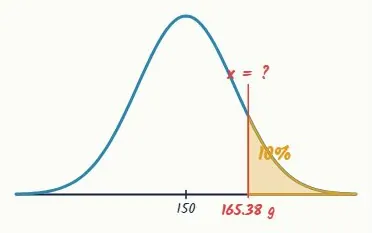
The heaviest 10% of apples
- Shade the top 10% first.
- The cut-off is unknown: call it x.
- z = 1.2816, so x = 165.38 g.
Try it: from an area back to a value
The working
- Area to the left: 0.9.
- Then x = μ + zσ.
- P(X < x) = 1 − 0.1 = 0.9top 10%
- left tail, area 0.9σ = 1, μ = 0
- z = 1.2816
- z = (x − μ) ÷ σ, so x = μ + zσ
- x = 150 + 1.2816 × 12substitute
- = 150 + 15.3792
- = 165.38 g
Try it: shade the curve
The lightest 5%: a negative z
- Below the mean: z < 0.
- Check: x is below 150.
- left tail, area 0.05σ = 1, μ = 0
- z = −1.6449below the mean
- x = μ + zσ
- = 150 + (−1.6449) × 12
- = 150 − 19.7388
- = 130.26 g
- 130.26 < 150below the mean
An unknown standard deviation
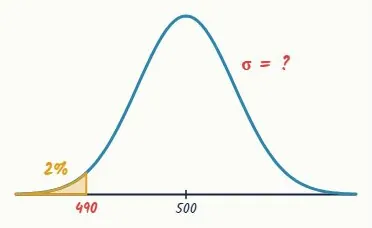
- Bottles: mean 500 ml, 2% under 490 ml.
- z for 0.02 is −2.0537.
- Σ = 10 ÷ 2.0537 = 4.869 ml.
The steps for σ
- z from the probability.
- Substitute, solve for σ.
- left tail, area 0.02σ = 1, μ = 0
- z = −2.0537490 is below 500
- z = (x − μ) ÷ σ
- −2.0537 = (490 − 500) ÷ σsubstitute
- −2.0537 = −10 ÷ σ
- −2.0537σ = −10× σ
- σ = −10 ÷ −2.0537÷ −2.0537
- = 4.869 ml
- σ > 0as it must be
An unknown mean
- Σ known, μ unknown.
- Same equation: solve for μ.
- σ = 4, P(X < 490) = 0.01given
- left tail, area 0.01σ = 1, μ = 0
- z = −2.3263below the mean
- −2.3263 = (490 − μ) ÷ 4substitute
- −9.3052 = 490 − μ× 4
- μ = 490 + 9.3052rearrange
- = 499.31 mlround up
The sign of z does the work
- A value below the mean has negative z.
- Get the sign wrong and σ comes out negative.
- A negative σ is impossible: a free check.
Probability calculator
Try it: squeeze or slide the curve
Where the marks are
- Achieved: find the z-value.
- Merit: use it for a value or a missing σ.
- Excellence: interpret the answer in context.
What to take away
- Area first, z with its sign, then solve.
| Start | with the area, not the value |
| Left area | the calculator's inverse normal |
| Sign of z | negative below the mean |
| A value | x = μ + zσ |
| Unknown σ or μ | z = (x − μ) ÷ σ, then solve |
| Check | does the answer sit on the right side? |
Common mistakes
- Heaviest 10% of apples: inverse normal with area 0.1 gives the cut-off.The calculator uses the area to the left, so the top 10% needs area 0.9: z = 1.2816 and x = 165.38 g.
- x = zσ = 1.2816 × 12 = 15.38 gz counts standard deviations from the mean, so add the mean: x = μ + zσ = 150 + 15.38 = 165.38 g.
- 2% under 490 ml: 2.0537 = (490 − 500) ÷ σ, so σ = −4.869490 is below the mean, so z = −2.0537 and σ = 4.869 ml. A negative σ is impossible, so it flags a wrong sign.
Your turn: eight questions
- Sketch and shade each one first.
- Watch the sign of z.
| Question | |
|---|---|
| Data | Race times: normal, mean 42 min, sd 6 min. |
| 1 | Fastest 15% get a medal. What time must they beat? |
| 2 | The slowest 5% take longer than what time? |
| 3 | Another race: mean 60 min, 10% take over 75 min. Find σ. |
| 4 | A third: σ = 3 min, and 2.5% take over 20 min. Find μ. |
| 5 | What z-value has an area of 0.25 to its left? |
| 6 | The middle 80% of runners finish between which two times? |
| 7 | Mean 30 min, 20% take under 25 min. Mere uses z = 0.8416 and gets σ = −5.94. What is the fix? |
| 8 | Another race: 10% finish under 30 min and 10% over 50 min. Find μ and σ. |
Show answer
1. z = −1.0364: 42 − 1.0364 × 6 = 35.78 min. 2. z = 1.6449: 42 + 1.6449 × 6 = 51.87 min. 3. 1.2816 = 15 ÷ σ, so σ = 11.70 min. 4. 1.96 = (20 − μ) ÷ 3, so μ = 20 − 5.88 = 14.12 min. 5. z = −0.6745. Inverse normal with area 0.25; it is negative because 0.25 is less than half. 6. 34.31 and 49.69 min. 10% in each tail, so z = ±1.2816: 42 ± 1.2816 × 6 gives 34.31 and 49.69 min. 7. z should be −0.8416, so σ = 5.94 min. 25 is below the mean, so −0.8416 = (25 − 30) ÷ σ gives σ = 5.94 min. 8. μ = 40 min, σ = 7.80 min. By symmetry μ is halfway, 40; then 1.2816 = (50 − 40) ÷ σ, so σ = 7.80 min.
The answers: questions 1 and 2
- 1. left area 0.15: z = −1.0364
- x = 42 − 1.0364 × 6
- = 42 − 6.2184 = 35.78 min
- 2. left area 0.95: z = 1.6449
- x = 42 + 1.6449 × 6
- = 42 + 9.8694 = 51.87 min
The answers: questions 3 and 4
- 3. left area 0.9: z = 1.2816
- 1.2816 = (75 − 60) ÷ σsubstitute
- 1.2816σ = 15× σ
- σ = 15 ÷ 1.2816 = 11.70 min
- 4. left area 0.975: z = 1.96
- 1.96 = (20 − μ) ÷ 3substitute
- 5.88 = 20 − μ× 3
- μ = 20 − 5.88 = 14.12 min
Sample question: Achieved
The heights of adult women in a survey are normally distributed with mean 165 cm and standard deviation 6.5 cm. Only the tallest 20% are taller than h cm. Find h.
Hint
Tallest 20% means 80% of the area is to the left of h. Use inverse normal with area 0.8.
Answer
h = 170.47 cm
Step by step
- Sketch the curve and shade the top 20% on the right. h is the cut-off, to the right of 165.
- Inverse normal on most calculators wants the area to the left. That is 1 − 0.2 = 0.8.
- Inverse normal with area 0.8, μ = 0, σ = 1 gives z = 0.8416. It is positive because h is above the mean.
- Recall z = (x − μ) ÷ σ, which rearranges to x = μ + zσ.
- h = 165 + 0.8416 × 6.5 = 165 + 5.4705 = 170.47 cm.
- The classic mistake is to put 0.2 into inverse normal. That gives the shortest 20%, below the mean.
- Check: 170.47 is above 165, which matches the sketch, and normal cdf below 170.47 gives 0.8.
Full working
- P(X < h) = 1 − 0.2 = 0.8area to the left
- z = 0.8416inverse normal, area 0.8
- h = 165 + 0.8416 × 6.5x = μ + zσ
- h = 170.47 cm
Sample questions: Merit
A machine fills 2 L bottles of milk. The fill volume is normally distributed with mean 2.03 L, and 4% of bottles contain less than 2 L. Find the standard deviation of the fill volume.
Hint
Find the z-value with 0.04 to its left (it is negative), then put it into z = (x − μ) ÷ σ and solve for σ.
Answer
σ = 0.0171 L (about 17 mL)
Step by step
- Sketch: mean 2.03 in the middle, 2 L just to the left, and the small left tail shaded with area 0.04.
- The unknown is σ, so we cannot use normal cdf. Start from the area instead.
- Inverse normal with area 0.04 gives z = −1.7507. It is negative because 2 L is below the mean.
- Recall z = (x − μ) ÷ σ. Put in what we know: −1.7507 = (2 − 2.03) ÷ σ.
- That is −1.7507 = −0.03 ÷ σ.
- Multiply both sides by σ: −1.7507σ = −0.03.
- Divide: σ = −0.03 ÷ −1.7507 = 0.0171 L.
- The classic mistake is to use z = +1.7507. Then σ comes out negative, which is impossible, so a negative σ tells you the sign of z is wrong.
- Check: with σ = 0.017136, normal cdf below 2 gives 0.04. Correct.
Full working
- z = −1.7507inverse normal, left area 0.04
- −1.7507 = (2 − 2.03) ÷ σz = (x − μ) ÷ σ
- −1.7507σ = −0.03
- σ = 0.03 ÷ 1.7507 = 0.017136σ must be positive
- σ = 0.0171 L
A café's coffee machine pours cups whose volume is normally distributed with standard deviation 6 mL. The owner wants only 3% of cups to hold less than 230 mL. Find the mean volume the machine should be set to.
Hint
Find the z-value with 0.03 to its left, then solve z = (230 − μ) ÷ 6 for μ.
Answer
μ = 241.28 mL
Step by step
- Sketch: the mean is unknown, but 230 sits in the left tail, with area 0.03 below it.
- Inverse normal with area 0.03 gives z = −1.8808. Negative, because 230 is below the mean.
- Recall z = (x − μ) ÷ σ. Here x = 230 and σ = 6: −1.8808 = (230 − μ) ÷ 6.
- Multiply both sides by 6: −11.2848 = 230 − μ.
- Add μ and 11.2848 to both sides: μ = 230 + 11.2848 = 241.28 mL.
- Why this makes sense: to keep most cups above 230, the mean must sit a safe distance above 230.
- The classic mistake is a sign slip that gives μ = 218.72. That puts the mean below 230, so more than half the cups would be short.
- Check: normal cdf below 230 with μ = 241.28 and σ = 6 gives 0.03.
Full working
- z = −1.8808inverse normal, left area 0.03
- −1.8808 = (230 − μ) ÷ 6z = (x − μ) ÷ σ
- −11.2848 = 230 − μ
- μ = 230 + 11.2848the mean must be above 230
- μ = 241.28 mL
Sample questions: Excellence
The marks in a large Year 12 exam are normally distributed. 10% of students scored more than 80 and 25% scored less than 50. Find the mean and the standard deviation. Hence find the percentage of students who scored more than 90.
Hint
Each fact gives a z-value and one equation x = μ + zσ. Two equations, two unknowns: solve them together.
Answer
μ = 60.34, σ = 15.34; about 2.7% scored more than 90
Step by step
- Both μ and σ are unknown, so one fact is not enough. Each fact gives one equation.
- Fact 1: 10% above 80 means area 0.9 to the left of 80. Inverse normal gives z = 1.2816.
- Fact 2: 25% below 50 means area 0.25 to the left of 50. Inverse normal gives z = −0.6745.
- Recall x = μ + zσ. So 80 = μ + 1.2816σ and 50 = μ − 0.6745σ.
- Subtract the second equation from the first, which removes μ: 30 = 1.9560σ.
- σ = 30 ÷ 1.9560 = 15.337.
- Substitute back: μ = 80 − 1.2816 × 15.337 = 60.345.
- Sense check: 50 is below the mean and 80 above it, as the signs of z said.
- Hence part: z = (90 − 60.345) ÷ 15.337 = 1.9336, and normal cdf from 90 to 1E99 gives 0.0266.
- So about 2.7% of students scored more than 90.
- Keep σ and μ unrounded for the last step. Rounding to 60.34 and 15.34 first can shift the fourth decimal place.
- Check: with μ = 60.345 and σ = 15.337, P(X > 80) = 0.1000 and P(X < 50) = 0.2500. Both facts hold.
Full working
- z = 1.2816 and z = −0.6745left areas 0.9 and 0.25
- 80 = μ + 1.2816σ, 50 = μ − 0.6745σx = μ + zσ
- 30 = 1.9560σ, so σ = 15.337subtract to remove μ
- μ = 80 − 1.2816 × 15.337 = 60.345
- P(X > 90) = 0.0266z = 1.9336
- μ = 60.34, σ = 15.34; about 2.7% over 90
A factory fills packets of chips labelled 150 g. The filled weight is normally distributed with standard deviation 4 g, and the rules say at most 2% of packets may weigh less than 150 g. Find the lowest mean the factory can set. A new machine has standard deviation 2.5 g. Find the lowest mean for the new machine, and how many kilograms of chips it would save over 10 000 packets.
Hint
Use z for a left area of 0.02 twice, once with σ = 4 and once with σ = 2.5. A smaller σ lets the mean sit closer to 150.
Answer
Old machine: μ = 158.21 g; new machine: μ = 155.13 g; about 30.8 kg saved per 10 000 packets
Step by step
- Sketch: 150 g in the left tail, 2% shaded below it, and the mean somewhere to the right.
- Why lowest mean: raising the mean moves the curve right and makes fewer packets short. The rule is met exactly when the short area is 2%.
- Inverse normal with area 0.02 gives z = −2.0537. Negative, because 150 is below the mean.
- Old machine: −2.0537 = (150 − μ) ÷ 4, so 150 − μ = −8.2150 and μ = 158.21 g.
- New machine: −2.0537 = (150 − μ) ÷ 2.5, so 150 − μ = −5.1344 and μ = 155.13 g.
- The new machine is less variable, so its curve is narrower and the mean can sit closer to the label.
- Saving per packet: 158.21 − 155.13 = 3.08 g, using unrounded values 3.0806 g.
- Over 10 000 packets: 3.0806 × 10 000 = 30 806 g, which is about 30.8 kg.
- The classic mistake is to use area 0.98. That gives the heaviest 2%, not the lightest.
- Check: normal cdf below 150 is 0.02 for both settings, so both meet the rule exactly.
- Limitation: this assumes the weights stay normal with a steady σ. A real factory would set the mean a little higher as a safety margin.
Full working
- z = −2.0537inverse normal, left area 0.02
- μ = 150 + 2.0537 × 4 = 158.21 gold machine, x = μ + zσ
- μ = 150 + 2.0537 × 2.5 = 155.13 gnew machine
- saving = 2.0537 × 1.5 = 3.0806 g per packetthe difference in σ is 1.5
- 3.0806 × 10 000 = 30 806 g
- 158.21 g and 155.13 g; about 30.8 kg saved
Challenge
Marks in a large Year 12 test are normally distributed with mean 62 and standard deviation 12. A teacher wants to set a target mark t so that, if two students are picked at random, the probability that both score above t is 0.5. Find t. She then wants a second target mark s so that, if three students are picked at random, the probability that at least one of them scores above s is 0.9. Find s, and explain why s is higher than t.
Hint
Call p = P(one student scores above t). Both of two independent students: p² = 0.5. For s, 'at least one of three' is 1 − P(none of the three), so P(one student scores below s)³ = 0.1. Find each probability, then use inverse normal.
Answer
t = 55.46 marks; s = 60.92 marks; s is higher because asking for just one of three students is an easier condition than asking for both of two, so each student needs a smaller chance of beating it
Step by step
- For t: P(both above t) = p² = 0.5, so p = √0.5 = 0.7071. That means area 1 − 0.7071 = 0.2929 to the left of t.
- Inverse normal with area 0.2929 gives z = −0.5450, so t = 62 − 0.5450 × 12 = 55.46.
- For s: P(at least one of three above s) = 1 − P(all three below s) = 0.9, so P(below s)³ = 0.1.
- P(below s) = 0.1^(13) = 0.4642. Inverse normal with area 0.4642 gives z = −0.0900, so s = 62 − 0.0900 × 12 = 60.92.
- Each student needs to beat t with probability 0.71, but to beat s with only probability 0.54. A target that is easier to reach is lower, so t is lower than s.
- Both answers assume the students' marks are independent, which is fair for students picked at random.
Full working
- p² = 0.5, p = 0.7071both of two above t
- area left of t = 0.2929, z = −0.5450inverse normal
- t = 62 − 0.5450 × 12 = 55.46x = μ + zσ
- P(below s)³ = 0.1, P(below s) = 0.4642at least one of three
- z = −0.0900, s = 62 − 0.0900 × 12 = 60.92inverse normal
- t = 55.46, s = 60.92
Bolts are accepted only if their diameter is between 9.8 mm and 10.2 mm. The machine is set to a mean of 10.0 mm, and diameters are normally distributed. Find the largest standard deviation that keeps rejects to at most 1%. Later the mean drifts to 10.05 mm with that standard deviation. What percentage of bolts are rejected now?
Hint
The limits are symmetric about 10.0, so the 1% splits into two tails of 0.5% each. After the drift, find each tail separately and add.
Answer
σ = 0.0776 mm; after the drift about 2.73% are rejected
Step by step
- With the mean at 10.0 the curve is symmetric about the middle of the limits, so each tail gets 0.5% = 0.005.
- The upper limit 10.2 has area 0.995 to its left. Inverse normal gives z = 2.5758.
- z = (x − μ) ÷ σ gives 2.5758 = (10.2 − 10.0) ÷ σ, so σ = 0.2 ÷ 2.5758 = 0.0776 mm.
- After the drift, μ = 10.05, σ = 0.0776. Normal cdf below 9.8 gives 0.0006 and above 10.2 gives 0.0267.
- Rejects: 0.0006 + 0.0267 = 0.0273, about 2.73%. A drift of only 0.05 mm almost triples the rejects, because the upper tail grows much faster than the lower tail shrinks.
Full working
- each tail 0.01 ÷ 2 = 0.005symmetric limits
- z = 2.5758inverse normal, area 0.995
- 2.5758 = (10.2 − 10.0) ÷ σz = (x − μ) ÷ σ
- σ = 0.2 ÷ 2.5758 = 0.0776 mm
- P(X < 9.8) = 0.0006, P(X > 10.2) = 0.0267μ = 10.05, σ = 0.0776
- σ = 0.0776 mm; about 2.73% rejected after the drift
In a fun run, finishing times are normally distributed with mean 52 minutes and standard deviation 6 minutes. The fastest 10% of runners get a medal. Find the medal time. Next year the course is 5% longer, and every runner's time will be 5% longer, so the mean and standard deviation both grow by 5%. If the medal time is not changed, what percentage of runners will get a medal? What should the new medal time be to keep the fastest 10%, and how is it related to the old one?
Hint
The fastest 10% have the smallest times, so the medal time has area 0.10 to its left. For next year, find the new mean and standard deviation first.
Answer
Medal time 44.31 minutes; with the same medal time only about 5.1% would get a medal; the new medal time is 46.53 minutes, exactly 1.05 times the old one
Step by step
- The fastest 10% have the lowest times, so the medal time has area 0.10 to its left. Inverse normal gives z = −1.2816.
- Medal time = 52 − 1.2816 × 6 = 44.31 minutes.
- Next year: mean 1.05 × 52 = 54.6 minutes and standard deviation 1.05 × 6 = 6.3 minutes.
- With the medal time still 44.31: z = (44.31 − 54.6) ÷ 6.3 = −1.633, and normal cdf below 44.31 gives 0.0512. Only about 5.1% get a medal.
- To keep 10%: medal time = 54.6 − 1.2816 × 6.3 = 46.53 minutes.
- 46.53 = 1.05 × 44.31. Every time is stretched by 5%, so every runner keeps the same z-value and the same place in the field; the cut-off for any percentage is stretched by 5% too.
Full working
- z = −1.2816inverse normal, area 0.10
- 52 − 1.2816 × 6 = 44.31medal time
- new μ = 54.6, new σ = 6.3both 5% bigger
- P(X < 44.31) = 0.0512normal cdf, μ = 54.6, σ = 6.3
- 54.6 − 1.2816 × 6.3 = 46.53 = 1.05 × 44.31keeps 10%
- 44.31 minutes; about 5.1% with the old time; new medal time 46.53 minutes, 1.05 times the old
Practise this
Report a mistake
More in AS 91267
 Probability: when to add and when to multiply7 min
 Two-way tables and conditional probability6 min
 Probability trees from written information, forwards and backwards8 min
 Expected value and expected numbers7 min
 Relative risk: above 1, below 1, and evaluating a claim7 min
 The normal distribution: probabilities and z-values8 minInverse normal: finding a value, the mean or the standard deviation8 min
 Comparing distributions: shape, centre and spread7 min
 Probability rules: 7 exam questions solved step by step10 min
 Two-way tables: 7 exam questions solved step by step10 min
 Probability trees: 7 exam questions solved step by step10 min
 Expected value: 7 exam questions solved step by step10 min
 Relative risk: 7 exam questions solved step by step9 min
 Normal distribution: 7 exam questions solved step by step10 min
 Inverse normal: 7 exam questions solved step by step10 min
 Comparing distributions: 7 exam questions solved step by step10 min
Is your child on track?
Take the free placement test