Decimals, fractions of amounts, and working backwards
What this lesson covers
- Ratios can be used to describe proportional relationships and unequal division of a whole.
Before you multiply, trap it
- 2.3 × 45. Do not reach for the method yet.
- 2 × 45 is 90. 3 × 45 is 135.
- 2.3 sits between 2 and 3, so the answer sits between those.
| Benchmark | Compared | Value |
|---|---|---|
| 2 × 45 | too small | 90 |
| 3 × 45 | too big | 135 |
| So 2.3 × 45 | lands between | 90 to 135 |
Now the actual multiplication
- 2.3 is just 23 divided by 10.
- So do 23 × 45 first, which is 1035.
- Then divide by 10, giving 103.5. Inside our bracket.
| Step | Working | Gives |
|---|---|---|
| 2.3 is | 23 ÷ 10 | |
| So 2.3 × 45 is | 23 × 45, then ÷ 10 | |
| 23 × 45 | 1035 | |
| ÷ 10 | 103.5 |
Which is where the shortcut comes from
- Count the decimal places in the question.
- Put the same number into the answer.
- It is not a separate rule. It is that division, tidied up.
| Calculation | Places | Answer |
|---|---|---|
| 2.3 × 45 | 1 decimal place in the question | 103.5 |
| 1.5 × 2.4 | 2 decimal places | 3.6 |
The one that looks wrong
- 0.4 × 0.2. The digits give 4 × 2 = 8.
- Two decimal places in the question, so two in the answer.
- 0.08, not 0.8. Two numbers under 1 multiply to something smaller.
| Calculation | Places | Answer |
|---|---|---|
| 2.3 × 45 | 1 decimal place in the question | 103.5 |
| 1.5 × 2.4 | 2 decimal places | 3.6 |
| 0.4 × 0.2 | 2 decimal places | 0.08 |
A fraction of a whole number
- 2/5 of 42. Write the 42 as 42/1 and multiply.
- 2 × 42 over 5 gives 84/5.
- That is an improper fraction, and it is a correct answer.
| Step | Working | Gives |
|---|---|---|
| 2/5 of 42 | write 42 as 42/1 | 2/5 × 42/1 |
| Multiply | 2 × 42 over 5 | 84/5 |
Tidying it into a mixed number
- 84/5 means 84 divided by 5.
- 5 goes into 84 sixteen times, with 4 left over.
- So 16 4/5. Or 16.8, if the question wants a decimal.
| Step | Working | Gives |
|---|---|---|
| 2/5 of 42 | write 42 as 42/1 | 2/5 × 42/1 |
| Multiply | 2 × 42 over 5 | 84/5 |
| As a mixed number | 84 ÷ 5 is 16, r 4 | 16 4/5 |
Percentages, built from ten percent
- 35% of 180. Start with 10%, which is 18.
- Three lots gives 30%, which is 54.
- 5% is half of 10%, so 9. Together, 63.
| Step | Working | Gives |
|---|---|---|
| 10% of 180 | 180 ÷ 10 | 18 |
| 30% is | three lots | 54 |
| 5% is | half of 10% | 9 |
| 35% is | 54 + 9 | 63 |
Try it: build it from 10%
Or in a single multiplication
- 35% is 0.35 as a decimal.
- 180 × 0.35 is 63. Same answer, one step.
- Use this with a calculator. Use the other to check it.
| Step | Working | Gives |
|---|---|---|
| 35% as a decimal | 35 ÷ 100 | 0.35 |
| 180 × 0.35 | 63 | |
| Same answer | one step instead of three |
A quick one, no calculator
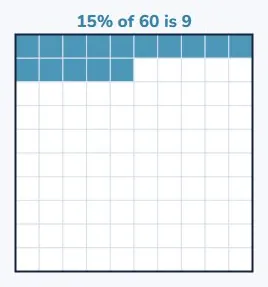
- 15% of 60. A tenth of 60 is 6.
- Half of that is 3, which is the 5%.
- 6 + 3 = 9. Faster than typing it.
Everything so far went one way
- You were given the whole and asked for a part.
- 2/5 of 42. 35% of 180. 15% of 60.
- Now we turn it round, and this is the hard bit.
| Given | Asked for | Direction |
|---|---|---|
| the whole | a part of it | forwards |
| a part | the whole | backwards |
One question before any method
- 8 is three fifths of a set. How big is the set?
- Do not work it out. Just answer this: bigger or smaller than 8?
- Bigger. Three fifths is not the whole thing.

Multiply by the fraction, upside down
- Going forwards you multiply by 3/5.
- Going backwards you multiply by 5/3.
- 8 × 5/3 is 40/3, which is 13 1/3.
| Step | Working | Gives |
|---|---|---|
| 8 is 3/5 of it | so multiply by the flip | 8 × 5/3 |
| Multiply | 8 × 5 over 3 | 40/3 |
| As a mixed number | 40 ÷ 3 is 13, r 1 | 13 1/3 |
Try it: divide by turning it over
And check it, in one line
- 13 1/3 is bigger than 8, as we said it had to be.
- Take three fifths of 40/3 and you get 8 back.
- Reverse problems always check themselves. Always do it.
| Step | Working | Gives |
|---|---|---|
| 8 is 3/5 of it | so multiply by the flip | 8 × 5/3 |
| Multiply | 8 × 5 over 3 | 40/3 |
| As a mixed number | 40 ÷ 3 is 13, r 1 | 13 1/3 |
| Check | 3/5 of 40/3 | 8 |
Why turning it over works
- 8 is three fifths, so one fifth is 8 ÷ 3.
- The whole is five of those: 8 ÷ 3 × 5.
- Which is exactly 8 × 5/3. Same thing, written shorter.
| Step | Working | Gives |
|---|---|---|
| Three fifths is | 8 | |
| So one fifth is | 8 ÷ 3 | 8/3 |
| Five fifths is | 8/3 × 5 | 40/3 |
And a word you will need next
- A ratio describes a split that is not equal.
- 3 : 2 means three for every two. Part against part.
- 3 out of 5 is the same split as a fraction. Part against whole.
| Written | Compares | Means |
|---|---|---|
| 3 : 2 | part to part | 3 for every 2 |
| 3 out of 5 | part to whole | a fraction |
| Same split | described two ways |
Common mistakes
- 0.4 × 0.2 = 0.8There are two decimal places in the question, so the answer needs two: 0.4 × 0.2 = 0.08.
- 2.3 × 45 = 103523 × 45 = 1035, but 2.3 is 23 ÷ 10, so divide by 10: 103.5, which fits between 90 and 135.
- 8 is 3/5 of a number, so the number is 3/5 × 8 = 24/5.The whole is bigger than the part, so divide by 3/5: 8 × 5/3 = 40/3 = 13 1/3.
- 5% of 180 is 36, because 10% is 18.5% is half of 10%, so halve 18 to get 9, not double it.
Your turn: eight questions
- Try all eight.
- Question 4 is the backwards one. Decide the direction first.
- Then check your answer by going forwards again.
Work out 1.4 × 25.
What is 3/8 of 20?
What is 20% of 85?
If 9 is 3/4 of a number, what is the number?
Work out 0.3 × 0.6.
Work out 45% of 160 without a calculator, building it from 10%.
In a class the ratio of girls to boys is 3 : 4. What fraction of the class are girls?
15 is 3/5 of a number. Which working finds the number, and is the number bigger or smaller than 15?
Show answer
1. 35. 14 × 25 = 350, and one decimal place in the question puts it at 35.0. 2. 7 1/2. 3/8 × 20/1 = 60/8, which is 7.5, or 7 1/2. 3. 17. A tenth of 85 is 8.5, so two tenths is 17. 4. 12. Multiply by the flip: 9 × 4/3 = 36/3 = 12. Check it, three quarters of 12 is 9. And 12 is bigger than 9, which it had to be. 5. 0.18. The digits give 3 × 6 = 18, and two decimal places in the question means two in the answer. 6. 72. 10% is 16, so 40% is 64, and 5% is half of 16, which is 8. Then 64 + 8 = 72. 7. 3/7. The ratio is part to part, so the whole is 3 + 4 = 7 parts, and girls are 3 of them. 8. 15 × 5/3, bigger than 15. Going backwards you multiply by the flip, and 3/5 is not the whole, so the number must be bigger. It is 25.
The answers
- 1.4 × 25 is 35. And 3/8 of 20 is 60/8, which is 7 1/2.
- 20% of 85 is 17, since a tenth is 8.5.
- 9 × 4/3 is 12. And three quarters of 12 is 9, so it checks.
| Answer | |
|---|---|
| 1 | 35 |
| 2 | 7 1/2 |
| 3 | 17 |
| 4 | 12 |
What to take away
- Estimate a decimal product before you place the point.
- Going backwards, multiply by the fraction turned over.
- And always ask whether the answer should grow or shrink.
| Remember | |
|---|---|
| Decimal products | estimate first, then count the places |
| Fraction of an amount | multiply, then tidy to a mixed number |
| Percentages | build from 10%, or multiply once |
| Going backwards | multiply by the fraction turned upside down |
| Always ask | should the answer be bigger or smaller? |
Challenge
Kiri was asked to find 35 of a number. By mistake she multiplied the number by 53 instead and got 75. Sam was asked to find 35% of the same number, but he multiplied it by 3.5 instead. (a) What answer should Kiri have got? (b) What answer did Sam get, what should he have got, and how many times too big is his answer?
Hint
Undo Kiri's mistake first to find the number: multiplying by 53 made it bigger, so to get back you multiply by the flip.
Answer
(a) The number is 45, so Kiri should have got 27. (b) Sam got 157.5 but should have got 15.75, so his answer is 10 times too big.
Step by step
- Kiri's wrong answer is 53 of the number, so the number is 75 × 35 = 45. That is smaller than 75, as it must be, since multiplying by 53 makes things bigger.
- 35 of 45 is 27, which is what Kiri should have got.
- Sam multiplied 45 by 3.5: 45 × 3 = 135 and 45 × 0.5 = 22.5, so 157.5.
- 35% of 45, built from 10%: 10% is 4.5, 30% is 13.5, 5% is 2.25, so 35% is 15.75.
- 35% is 0.35, and 3.5 is ten times 0.35, so Sam's answer is 10 times too big: 157.5 ÷ 15.75 = 10.
Full working
- number × 53 = 75, so number = 75 × 35 = 45undo Kiri's mistake with the flip
- 35 × 45 = 27(a) what Kiri should have got
- 45 × 3.5 = 135 + 22.5 = 157.5(b) Sam's answer
- 4.5 × 3 + 2.25 = 13.5 + 2.25 = 15.7535% of 45, built from 10%
- 3.5 = 10 × 0.35, so 157.5 = 10 × 15.75Sam is 10 times too big
- (a) 27 (b) Sam got 157.5, should be 15.75, 10 times too big
Aroha, Ben and Cara share a bag of lollies. Aroha takes 25 of the lollies. Ben takes 34 of what is left, then decides that is too greedy and puts 4 back. Cara gets everything now in the bag, and that is exactly 14 of the lollies that were in the bag at the start. How many lollies were in the bag at the start, and how many does each person end up with?
Hint
Write everything as a fraction of the starting bag. What fraction of the bag is left just before Ben puts the 4 back? Then compare that with 14.
Answer
40 lollies. Aroha 16, Ben 14, Cara 10.
Step by step
- After Aroha, 35 of the bag is left.
- Ben takes 34 of that, so 14 of 35 is left, which is 320 of the bag.
- Putting 4 back raises it to 14 of the bag, which is 520.
- So the 4 lollies are 520 − 320 = 220 = 110 of the bag, and the bag held 40.
- Aroha 25 of 40 = 16. Ben took 18 and gave 4 back, so 14. Cara has 10.
Full working
- 1 − 25 = 35left after Aroha
- 14 × 35 = 320left after Ben's first grab
- 14 − 320 = 520 − 320 = 110the 4 lollies he puts back
- 4 × 10 = 40whole bag from 110
- 25 × 40 = 16, 34 × 24 − 4 = 14, 40 − 16 − 14 = 10each share
- Check: 10 = 14 of 40Cara's share is right
- 40 lollies: Aroha 16, Ben 14, Cara 10
At a school gala, the food stall raised 0.45 of all the money. The sausage sizzle raised 23 of the food stall's money, and that was $1,215. The raffle raised 15% of all the money, and the book stall raised the rest. How much did the gala raise altogether? How much did the book stall raise, and what fraction of the total is that, in simplest form?
Hint
The $1,215 is a part of a part. What part of all the gala money is it? Then work backwards to the whole.
Answer
The gala raised $4,050. The book stall raised $1,620, which is 25 of the total.
Step by step
- The sausage sizzle is 23 of 0.45 of all the money: 23 × 0.45 = 0.3.
- So 0.3 (that is 310) of the total is $1,215. Work backwards: 1215 × 103 = $4,050.
- Food stall: 0.45 × 4050 = $1,822.50. Raffle: 10% is 405 and 5% is 202.50, so 15% is $607.50.
- Book stall: 4050 − 1822.50 − 607.50 = $1,620.
- Check: the book stall's share is 1 − 0.45 − 0.15 = 0.4 = 25, and 25 of 4050 is 1620.
Full working
- 23 × 0.45 = 0.3sausage sizzle's part of all the money
- 1215 × 103 = $4,050$1,215 is 310 of the total, so multiply by the flip
- 0.45 × 4050 = $1,822.50food stall
- 405 + 202.50 = $607.50raffle, 10% + 5%
- 4050 − 1822.50 − 607.50 = $1,620book stall
- 1 − 0.45 − 0.15 = 0.4 = 25book stall's fraction, and 25 × 4050 = 1620 checks
- Total $4,050; book stall $1,620, which is 25
Practise this
Report a mistake
More in Number
 Powers of ten, in both directions7 min
 Powers, roots and prime factors7 min
 Integers: below zero and back again7 min
 Order of operations, estimating and remainders8 min
 Fractions, decimals and percentages7 minDecimals, fractions of amounts, and working backwards7 min
 Ratios, and finding the whole from a part7 min
 Comparing money plans, and taking a discount off7 min
Is your child on track?
Take the free placement test