Powers, roots and prime factors
What this lesson covers
- Each composite number can be represented as a unique product of prime factors and summarised with exponent notation.
Break 36 apart, any way you like
- You could start with 6 × 6. Or with 4 × 9.
- Those are completely different first moves.
- Keep going and they end in exactly the same place. Every time.
First, the two words
- A prime has exactly two factors: itself and 1.
- 2, 3, 5, 7, 11, 13 and on for ever.
- Anything else with factors is composite. 36 is composite.
| Number | Factors | So |
|---|---|---|
| 7 | 1 and 7 | prime |
| 9 | 1, 3, 9 | composite |
| 13 | 1 and 13 | prime |
| 36 | nine of them | composite |
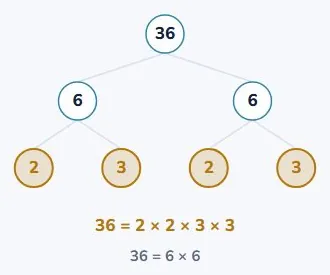
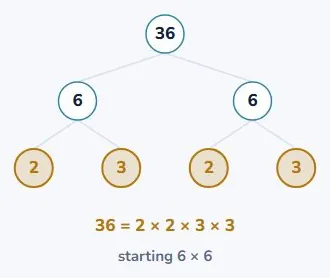
First tree: start with 6 × 6
- 36 splits into 6 and 6.
- Neither 6 is prime, so split again. 6 is 2 × 3.
- Now everything at the bottom is prime. Stop. 2, 2, 3, 3.
Try it: grow a factor tree
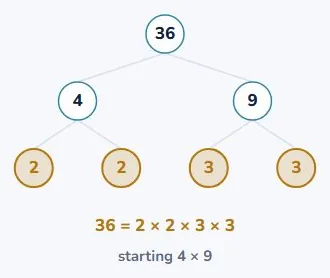
Second tree: start with 4 × 9
- A completely different first split.
- 4 is 2 × 2, and 9 is 3 × 3.
- Bottom row: 2, 2, 3, 3. The same four numbers.
That is not a coincidence
- Every route down gives the same primes.
- Not usually. Always, for every composite number there is.
- A number has one set of prime factors and no other.
| First split | Then | Leaves |
|---|---|---|
| Split as 6 × 6 | 6 = 2 × 3, twice | 2, 2, 3, 3 |
| Split as 4 × 9 | 4 = 2 × 2, 9 = 3 × 3 | 2, 2, 3, 3 |
| Same leaves | every time | 2² × 3² |
Tidying it with exponents
- 2 × 2 × 3 × 3 is correct but clumsy.
- Two 2s is 2². Two 3s is 3².
- So 36 = 2² × 3². Same fact, less writing.
| Number | Primes | Tidied |
|---|---|---|
| 36 | 2 × 2 × 3 × 3 | 2² × 3² |
Three more, same method
- 72 gives three 2s and two 3s: 2³ × 3².
- 60 gives two 2s, a 3 and a 5: 2² × 3 × 5.
- A prime appearing once needs no exponent at all.
| Number | Primes | Tidied |
|---|---|---|
| 36 | 2 × 2 × 3 × 3 | 2² × 3² |
| 72 | 2 × 2 × 2 × 3 × 3 | 2³ × 3² |
| 60 | 2 × 2 × 3 × 5 | 2² × 3 × 5 |
| 100 | 2 × 2 × 5 × 5 | 2² × 5² |
Why anyone does this
- The primes are a fingerprint for the number.
- Two numbers written this way show their shared factors at a glance.
- That is what makes simplifying fractions quick, next year.
| Number | Primes | Shared |
|---|---|---|
| 36 | 2² × 3² | |
| 60 | 2² × 3 × 5 | 2² and a 3 |
| So | both divide by 12 |
Now the other half: squares
- A square number is a number times itself.
- 5² is 25. 8² is 64. 12² is 144.
- Worth knowing on sight up to at least 12².
| Power | Meaning | Value |
|---|---|---|
| 5² | 5 × 5 | 25 |
| 8² | 8 × 8 | 64 |
| 11² | 11 × 11 | 121 |
| 12² | 12 × 12 | 144 |
The square root asks it backwards
- √49 does not mean "do something to 49".
- It asks: what number, times itself, gives 49?
- 7. So √49 = 7.
| Radical | The question | Answer |
|---|---|---|
| √49 | what times itself gives 49? | 7 |
Cubes: three of the same, multiplied
- 2³ is 2 × 2 × 2, which is 8.
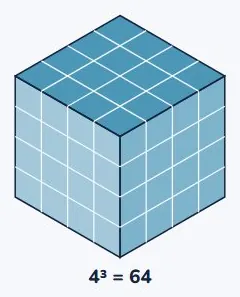
- 3³ is 27, 4³ is 64, 5³ is 125.
- Called cubes because that many unit cubes build a cube.
And the cube root asks that backwards
- ³√27 asks: what number, cubed, gives 27?
- 3, because 3 × 3 × 3 = 27.
- The small 3 on the sign is what makes it a cube root.
| Radical | The question | Answer |
|---|---|---|
| √49 | what times itself gives 49? | 7 |
| ³√27 | what cubed gives 27? | 3 |
| √144 | what times itself gives 144? | 12 |
| ³√125 | what cubed gives 125? | 5 |
64 answers both, differently
- √64 is 8, because 8 × 8 = 64.
- ³√64 is 4, because 4 × 4 × 4 = 64.
- Same number in, different question asked, different answer out.
| Radical | Because | Answer |
|---|---|---|
| √64 | because 8 × 8 = 64 | 8 |
| ³√64 | because 4 × 4 × 4 = 64 | 4 |
| Same number | different question | different answer |
When the root is not a whole number
- √50. Nothing times itself gives exactly 50.
- But 7² is 49 and 8² is 64, so it is between 7 and 8.
- 50 is barely past 49, so it is only just past 7.
| Known | Compared to 50 | Tells us |
|---|---|---|
| 7² = 49 | just under 50 | √50 is above 7 |
| 8² = 64 | well over 50 | √50 is below 8 |
| So | between 7 and 8 | and close to 7 |
Try it: trap a square root
Then let the calculator confirm it
- It says 7.0710 and onwards. About 7.07.
- Which is what we predicted: just above 7.
- Bracket first, key in second. Otherwise a slip goes unnoticed.
| Known | Compared to 50 | Tells us |
|---|---|---|
| 7² = 49 | just under 50 | √50 is above 7 |
| 8² = 64 | well over 50 | √50 is below 8 |
| So | between 7 and 8 | and close to 7 |
| Calculator | 7.0710... | 7.07 |
Common mistakes
- 36 = 6 × 6, so its prime factorisation is 6².6 is not prime, so keep splitting: 6 = 2 × 3, giving 36 = 2² × 3².
- ³√64 = 8, the same as √64.A cube root asks which number cubed gives 64: 4 × 4 × 4 = 64, so ³√64 = 4, while √64 = 8.
- √50 = 25, because 50 ÷ 2 = 25.√50 asks what number times itself gives 50; 7² = 49 and 8² = 64, so √50 is just over 7 (about 7.07).
- 2³ = 2 × 3 = 6.The exponent counts factors: 2³ = 2 × 2 × 2 = 8.
Your turn: eight questions
- Try all eight.
- For question 1, start the tree wherever you like.
- Question 4 wants no calculator. Use the squares you know.
Write 48 as a product of prime factors, using exponents.
What is ³√125?
What is √81?
Without a calculator, which two whole numbers is √20 between?
What number has the prime factorisation 2³ × 5?
Which one of these numbers is prime: 51, 53, 57 or 91?
Rua says 6³ = 18. What is 6³ really?
Mia writes 60 = 2 × 3 × 10 as her prime factorisation. What should she do next?
Show answer
1. 2⁴ × 3. Split it any way you like: 6 × 8 and 4 × 12 both end at four twos and a three. 2. 5, because 5 × 5 × 5 = 125. 3. 9. 4. Between 4 and 5, because 4² is 16 and 5² is 25, and 20 sits between those. It is nearer 4. 5. 40. 2³ is 2 × 2 × 2 = 8, and 8 × 5 = 40. 6. 53. Its only factors are 1 and 53; the others are composite, as 51 = 3 × 17, 57 = 3 × 19 and 91 = 7 × 13. 7. 216. 6³ means 6 × 6 × 6 = 216; Rua multiplied 6 by 3 instead. 8. 10 is not prime, so split it into 2 × 5: 60 = 2 × 2 × 3 × 5 = 2² × 3 × 5.
The answers
- 48 is 2⁴ × 3, whichever split you started from.
- ³√125 is 5, and √81 is 9.
- √20 is between 4 and 5, because 16 and 25 sit either side of 20.
| Answer | |
|---|---|
| 1 | 2⁴ × 3 |
| 2 | 5 |
| 3 | 9 |
| 4 | between 4 and 5 |
What to take away
- One number, one set of prime factors, however you split it.
- Exponents only tidy the writing. They add nothing new.
- Square root and cube root are different questions.
| Remember | |
|---|---|
| Prime factors | one set per number, no exceptions |
| Any first split | gives the same leaves |
| Exponents | tidy repeated factors, nothing more |
| √ and ³√ | two different questions |
| A root that is not whole | trap it between two you know |
Challenge
Without a calculator, use prime factors to find √7056 and ³√74088. Then explain how you can tell from a number's prime factors whether it is a square number.
Hint
Write each number as a product of primes with exponents. A square root splits the factors into two equal groups. A cube root splits them into three.
Answer
√7056 = 84 and ³√74088 = 42. A number is a square exactly when every exponent in its prime factorisation is even.
Step by step
- Keep dividing 7056 by primes: it is 2⁴ × 3² × 7².
- For the square root, split the factors into two equal groups: each group is 2² × 3 × 7 = 84.
- Keep dividing 74088 by primes: it is 2³ × 3³ × 7³.
- For the cube root, split into three equal groups: each group is 2 × 3 × 7 = 42.
- Splitting into two equal groups only works if every prime appears an even number of times, so a square has only even exponents.
Full working
- 7056 = 2 × 2 × 2 × 2 × 3 × 3 × 7 × 7 = 2⁴ × 3² × 7²divide by 2 four times, then 3 twice, leaving 49
- √7056 = 2² × 3 × 7 = 84half of each exponent; check 84 × 84 = 7056
- 74088 = 2³ × 3³ × 7³divide by 2 three times, then 3 three times, leaving 343 = 7³
- ³√74088 = 2 × 3 × 7 = 42a third of each exponent; check 42 × 42 × 42 = 74088
- √7056 = 84; ³√74088 = 42; squares have only even exponents
64 is a square number (8²) and also a cube number (4³). Find every whole number bigger than 1 and less than 5000 that is both a square number and a cube number. Use prime factors to explain why there are no others.
Hint
In a square number, each prime's exponent can be split into 2 equal groups. In a cube number, into 3 equal groups. Which exponents can do both?
Answer
64, 729 and 4096 (that is 2⁶, 3⁶ and 4⁶).
Step by step
- A square number has every prime exponent even. A cube number has every prime exponent a multiple of 3.
- To be both, every exponent must be a multiple of 2 and of 3, so a multiple of 6.
- That means the number is some whole number to the power 6.
- 2⁶ = 64, 3⁶ = 729 and 4⁶ = 4096. The next one is 5⁶ = 15 625, which is too big.
- Check one: 729 = 27² and also 9³.
Full working
- square: every exponent evensplits into 2 equal groups
- cube: every exponent a multiple of 3splits into 3 equal groups
- both: every exponent a multiple of 6so the number is k⁶
- 2⁶ = 64 = 8² = 4³first one
- 3⁶ = 729 = 27² = 9³second one
- 4⁶ = 4096 = 64² = 16³; 5⁶ = 15 625 > 5000stop here
- 64, 729 and 4096
(a) A whole number has exactly three factors, and those three factors add up to 183. What is the number? (b) Explain why any number with exactly three factors must be the square of a prime. (c) List every whole number less than 200 that has exactly three factors.
Hint
Factors come in pairs that multiply to the number, like 3 × 12 for 36. How can a number end up with an odd number of factors? And if one of the three factors had its own factors, what would happen?
Answer
(a) 169 (factors 1, 13 and 169). (c) 4, 9, 25, 49, 121 and 169.
Step by step
- Factors pair up: each factor has a partner that multiplies with it to give the number. The only way to get an odd count is a factor that is its own partner, so the number must be a square, n × n.
- So the three factors are 1, n and n × n, with nothing else.
- If n were not prime, it would have another factor, say f, and f would also be a factor of n × n. That makes four or more factors. So n must be prime.
- For (a): 1 + n + n² = 183, so n + n² = 182. Try primes: 13 + 169 = 182. So the number is 13² = 169.
- For (c): square the primes until you pass 200: 2² = 4, 3² = 9, 5² = 25, 7² = 49, 11² = 121, 13² = 169, and 17² = 289 is too big.
Full working
- factors pair up, odd count means a squareonly the middle factor pairs with itself
- factors: 1, p, p² with p primeanother factor of p would give a fourth factor
- 1 + p + p² = 183, so p + p² = 182take away the 1
- 13 + 169 = 182, so p = 1311 + 121 = 132 is too small, 17 + 289 too big
- p² < 200: 2², 3², 5², 7², 11², 13²17² = 289 > 200
- (a) 169; (c) 4, 9, 25, 49, 121, 169
Practise this
Report a mistake
More in Number
 Powers of ten, in both directions7 minPowers, roots and prime factors7 min
 Integers: below zero and back again7 min
 Order of operations, estimating and remainders8 min
 Fractions, decimals and percentages7 min
 Decimals, fractions of amounts, and working backwards7 min
 Ratios, and finding the whole from a part7 min
 Comparing money plans, and taking a discount off7 min
Is your child on track?
Take the free placement test