Integers: below zero and back again
What this lesson covers
- The number system extends infinitely, including into negative numbers, and can be represented with a number line.
- Integers are all the whole numbers, including positive whole numbers, negative whole numbers, and zero.
- Every number has an additive inverse, and their sum is zero (e.g. −5 and 5 are additive inverses; −5 + 5 = 0 and 5 + −5 = 0).
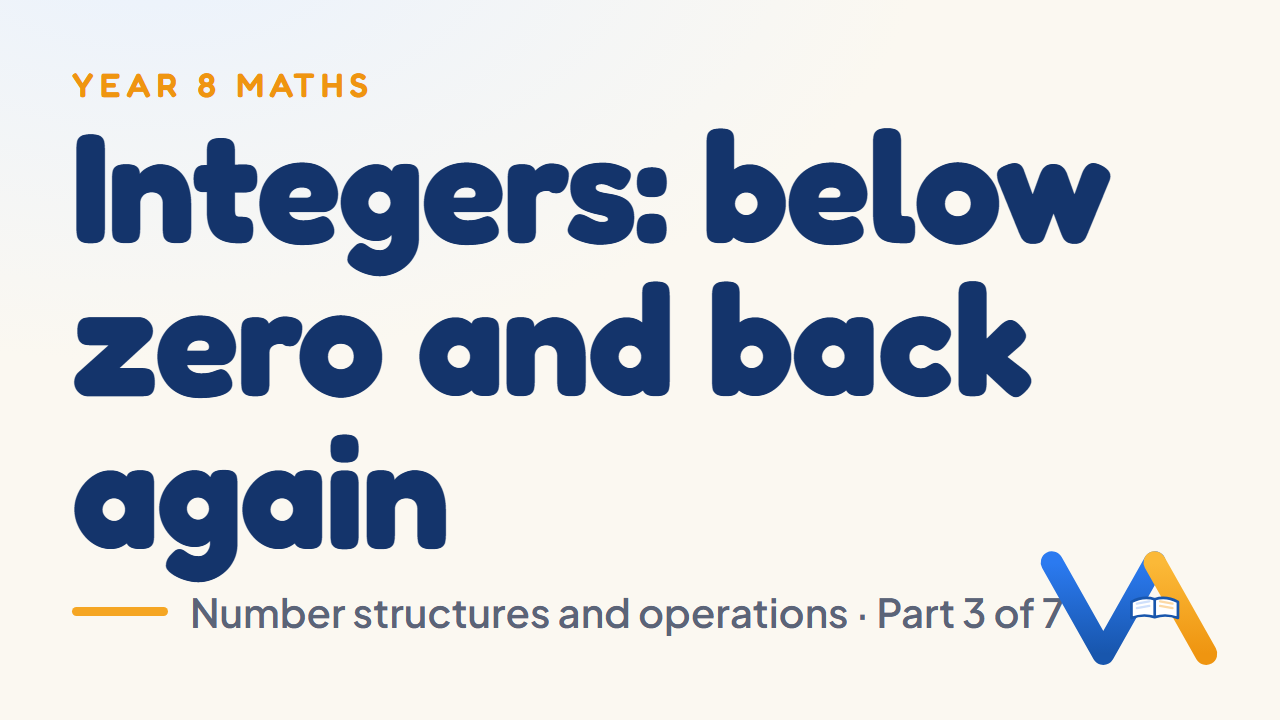
The line does not stop at zero
- Counting back: 3, 2, 1, 0.
- There is no reason to stop there, and we do not.
- The line carries on to the left, for ever.
What we mean by integers
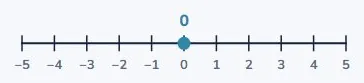
- The whole numbers going up: 1, 2, 3 and onwards.
- The whole numbers going down: −1, −2, −3 and onwards.
- And zero, which is an integer but is neither of the other two.
| Number | Why | Verdict |
|---|---|---|
| 4 | a whole number | integer |
| 0 | neither positive nor negative | integer |
| −17 | a whole number below zero | integer |
| 2.5 | not whole | not an integer |
Finding one on the line
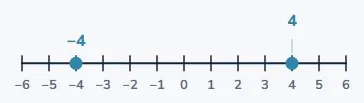
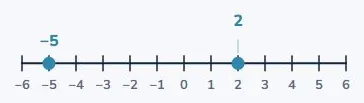
- −4 is four steps to the left of zero.
- Not four steps from somewhere else. Always from zero.
- The minus sign is an instruction about direction.
You already use these
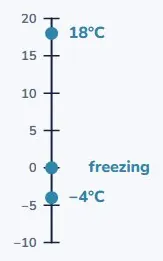
- Four degrees below freezing is −4.
- An overdrawn account, a basement floor, below sea level.
- In all of them, lower on the scale means less.
Which of two numbers is bigger
- Whichever is further right. That is the whole rule.
- It worked for positive numbers and it still works here.
- So every negative number is smaller than every positive one.
Where instinct goes wrong
- 3.4 is bigger than 3. Obviously.
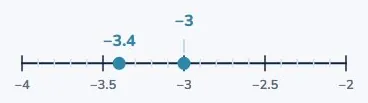
- So is −3.4 bigger than −3? It feels like it should be.
- It is not. −3.4 is further left, so it is smaller.
Why that happens
- Going further from zero on the right makes a number bigger.
- Going further from zero on the left makes it smaller.
- Same distance, opposite effect. Read the line, not the digits.
| Pair | On the line | So |
|---|---|---|
| 3.4 and 3 | 3.4 is further right | 3.4 is bigger |
| −3.4 and −3 | −3.4 is further left | −3.4 is smaller |
| The rule | further left is always smaller |
Putting five in order
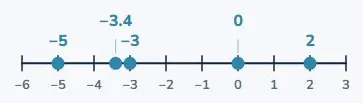
- −5, −3.4, −3, 0 and 2.
- Place them on the line, then read from left to right.
- No comparing needed. The line has already sorted them.
Every number has an opposite
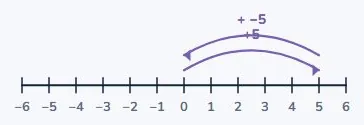
- 5 and −5 are the same distance from zero, opposite sides.
- Add them and you get zero. 5 + −5 = 0.
- That partner is called the additive inverse.
It works for every number there is
- The inverse of −12 is 12. The inverse of 0.5 is −0.5.
- Zero is its own, because 0 + 0 is 0.
- Two moves, same size, opposite ways. You end up where you began.
| Number | Its inverse | Sum |
|---|---|---|
| 5 | −5 | 0 |
| −12 | 12 | 0 |
| 0.5 | −0.5 | 0 |
| 0 | 0 | 0 |
Adding moves you right
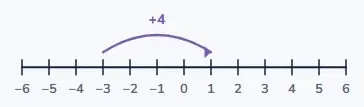
- Start anywhere. Adding 4 means going 4 to the right.
- That is true starting from 3, and from −3 as well.
- The starting point changes. The direction does not.
So what does adding −7 do?
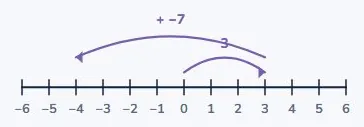
- 3 + −7. Start at 3.
- The negative turns you round, so travel 7 to the left.
- You pass zero and land on −4.
Try it: adding a negative
Which is exactly what subtracting does
- Now draw 3 − 7. Start at 3, travel 7 to the left.
- It is the same journey. Identical.
- Adding a negative and subtracting are one operation.
| Expression | The journey | Lands on |
|---|---|---|
| 3 + −7 | go 3 right, then 7 left | −4 |
| 3 − 7 | go 3 right, then 7 left | −4 |
| So | adding a negative is subtracting |
Subtracting past zero
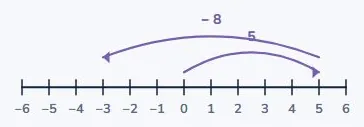
- 5 − 8. Start at 5 and go 8 left.
- After 5 steps you are at zero, with 3 still to travel.
- Those 3 take you to −3.
Starting below zero already
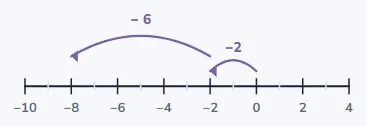
- −2 − 6. Start at −2, which is left of zero.
- Subtracting sends you further left, not back towards it.
- Six more to the left is −8.
A check you can always run
- Ask which way you finished travelling, and how far.
- Ended up left of zero? The answer is negative.
- Four jumps, four answers, no rules memorised.
| Expression | The journey | Lands on |
|---|---|---|
| 5 + −7 | right 5, left 7 | −2 |
| 5 − 8 | right 5, left 8 | −3 |
| −2 − 6 | left 2, left 6 more | −8 |
| −7 + 3 | left 7, right 3 | −4 |
Try it: below zero and back
Common mistakes
- −3.4 is bigger than −3, because 3.4 is bigger than 3.−3.4 is further left on the number line than −3, so it is smaller: −3.4 < −3.
- 3 + −7 = 10Adding −7 is the same as subtracting 7, so 3 + −7 = 3 − 7 = −4.
- −5 − 3 = −2Subtracting 3 moves you 3 further left from −5, so −5 − 3 = −8.
Your turn: eight questions
- Try all eight.
- Draw the line for the first two. It is faster than thinking.
- Question 3 is the one from earlier, in disguise.
What is 6 + −10?
What is −4 − 5?
Which is smaller, −2.5 or −2?
What is the additive inverse of −8?
At 6 am it is −3 °C in Queenstown. By noon it has risen 8 degrees. What is the temperature at noon?
Which expression has the same answer as 9 − 4?
On a number line you start at −2 and finish at 4. Which journey did you make?
Put these in order from smallest to largest: 1, −6, −1.5, 0, −2.
Show answer
1. −4. Start at 6, go 10 to the left, and you pass zero with 4 still to go. 2. −9. Start at −4 and go 5 further left. Both moves are leftward, so they pile up. 3. −2.5, because it sits further left than −2. The commonest wrong answer is −2, from comparing 2.5 and 2 instead. 4. 8. It is whatever cancels −8 to zero, and −8 + 8 = 0. 5. 5 °C. Start at −3 and go 8 to the right: 3 steps reach zero, and 5 more land on 5 °C. 6. 9 + −4. Adding a negative is subtracting: both start at 9 and go 4 left to 5. 7. 6 to the right. From −2 it is 2 steps right to zero, then 4 more to 4: 2 + 4 = 6. 8. −6, −2, −1.5, 0, 1. Place them on the line and read left to right; −6 is furthest left, and −2 is left of −1.5.
The answers
- 6 + −10 is −4. 10 left from 6 passes zero with 4 to spare.
- −4 − 5 is −9. Both moves go left, so they pile up.
- −2.5 is smaller. And the inverse of −8 is 8.
| Answer | |
|---|---|
| 1 | −4 |
| 2 | −9 |
| 3 | −2.5 |
| 4 | 8 |
Number Line: Integers
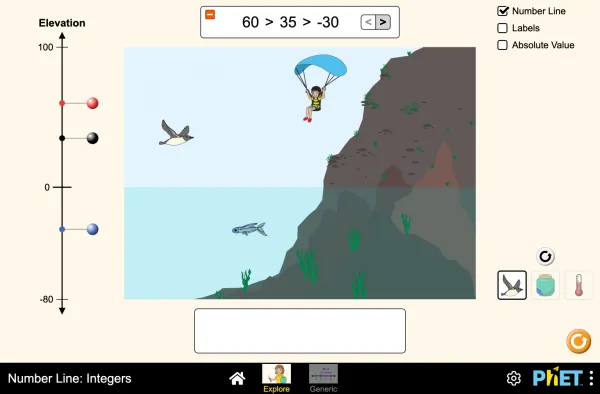
Full screen · PhET Interactive Simulations, University of Colorado Boulder, CC BY 4.0
What to take away
- Further left is always smaller, digits notwithstanding.
- A number and its inverse cancel to zero.
- Adding a negative is subtracting. One journey, two spellings.
| Remember | |
|---|---|
| Integers | whole numbers, negative, zero and positive |
| Further left | always means smaller |
| Additive inverse | the number that cancels it to zero |
| Adding a negative | is the same as subtracting |
| Every answer | is a journey along the line |
Challenge
A list of integers starts 5, −3. Every number after that is found by taking the number just before it and subtracting the one before that. So the third number is −3 − 5 = −8. (a) Write the first ten numbers. (b) What is the 100th number? (c) What do the first 100 numbers add up to?
Hint
Keep going for a while and watch for the start, 5, −3, to come back. Compare each number with the one three places before it.
Answer
(a) 5, −3, −8, −5, 3, 8, 5, −3, −8, −5. (b) −5. (c) −11.
Step by step
- Working along: −3 − 5 = −8, then −8 − (−3) = −5, then −5 − (−8) = 3, then 3 − (−5) = 8, then 8 − 3 = 5, then 5 − 8 = −3.
- Now 5, −3 has come back, so the list repeats every 6 numbers.
- Each number is the additive inverse of the one three places before it (5 and −5, −3 and 3, −8 and 8), so each block of 6 adds to 0.
- 100 = 16 × 6 + 4, so the 100th number is the 4th in the block, which is −5.
- The first 96 numbers are 16 full blocks that add to 0. The last 4 are 5 − 3 − 8 − 5 = −11.
Full working
- 5, −3, −8, −5, 3, 8, 5, −3, −8, −5subtract the one before last each time
- block of 6: 5, −3, −8, −5, 3, 8then it repeats
- 5 + (−3) + (−8) + (−5) + 3 + 8 = 0inverses cancel in pairs
- 100 = 16 × 6 + 44th place in a block is −5
- 16 × 0 + (5 − 3 − 8 − 5) = −11full blocks give 0
- (b) −5; (c) −11
Put a + or a − sign in each of the nine gaps: 1 □ 2 □ 3 □ 4 □ 5 □ 6 □ 7 □ 8 □ 9 □ 10, then work out the total. (a) Explain why the total can never be 0. (b) Give one way to make the total −1. (c) What is the smallest total possible? (d) Every total is an odd number from −53 up to 55, but two of those odd numbers can never be made. Which two?
Hint
Start with every sign a +, which gives 55. Changing one + to a − in front of a number takes that number away instead of adding it. How much does the total drop?
Answer
(a) Every total is odd. (b) For example 1 − 2 + 3 + 4 + 5 + 6 − 7 + 8 − 9 − 10 = −1. (c) −53. (d) 53 and −51.
Step by step
- With all + signs the total is 55. Turning +n into −n drops the total by n twice: once to cancel the n, and once more to take it away. So the total is 55 minus double the numbers you made negative.
- 55 take away an even number is always odd, so 0 is impossible.
- For −1, the numbers made negative must add to 28, since 55 − 2 × 28 = −1. For example 2, 7, 9 and 10.
- The smallest total makes 2 to 10 all negative: 1 − 54 = −53.
- The negative numbers can add to any amount from 0 to 54 except 1 (there is no 1 to choose) and 53 (that would leave out only 1). Those give 55 − 2 = 53 and 55 − 106 = −51.
Full working
- 1 + 2 + ... + 10 = 55all plus signs
- total = 55 − 2 × (sum of negated numbers)each −n costs 2n
- 55 − even = odd, never 0(a)
- negate 2, 7, 9, 10: they add to 28; 55 − 56 = −1(b)
- 1 − (2 + 3 + ... + 10) = 1 − 54 = −53(c)
- sums 1 and 53 impossible: 55 − 2 = 53 and 55 − 106 = −51only 2 to 10 can be negated
- (c) −53; (d) 53 and −51
Four different integers are added in pairs, in every possible way. The six totals are −11, −7, −4, −2, 1 and 5. Find the four integers. There are two possible answers: find both.
Hint
Each integer is in exactly three of the six pairs. Call the integers a < b < c < d. Which pair gives the smallest total, and which gives the largest?
Answer
−8, −3, 1, 4, or −7, −4, 0, 5.
Step by step
- Each integer appears in three of the pairs, so the six totals add to 3 times the sum of the four integers. They add to −18, so the four integers add to −6.
- Call them a < b < c < d. The smallest total is a + b = −11 and the largest is c + d = 5 (check: −11 + 5 = −6).
- The second smallest is a + c = −7 and the second largest is b + d = 1.
- The middle two, −4 and −2, are a + d and b + c, but we cannot tell which is which, so try both.
- If b + c = −2: a + b + c is half of −11 − 7 − 2, which is −10, so c = 1, b = −3, a = −8, d = 4. If b + c = −4: a + b + c = −11, so c = 0, b = −4, a = −7, d = 5. Both give exactly the six totals.
Full working
- −11 − 7 − 4 − 2 + 1 + 5 = −18sum of all six totals
- a + b + c + d = −18 ÷ 3 = −6each integer counted three times
- a + b = −11, a + c = −7, b + d = 1, c + d = 5smallest, second smallest, second largest, largest
- case b + c = −2: a + b + c = −10, so c = 1, b = −3, a = −8, d = 4pairs: −11, −7, −4, −2, 1, 5
- case b + c = −4: a + b + c = −11, so c = 0, b = −4, a = −7, d = 5pairs: −11, −7, −2, −4, 1, 5
- −8, −3, 1, 4 or −7, −4, 0, 5
Practise this
Report a mistake
More in Number
 Powers of ten, in both directions7 min
 Powers, roots and prime factors7 minIntegers: below zero and back again7 min
 Order of operations, estimating and remainders8 min
 Fractions, decimals and percentages7 min
 Decimals, fractions of amounts, and working backwards7 min
 Ratios, and finding the whole from a part7 min
 Comparing money plans, and taking a discount off7 min
Is your child on track?
Take the free placement test