Fractions, decimals and percentages
What this lesson covers
- The product of two fractions can be found by multiplying the numerators and multiplying the denominators.
- Percentages can be used to proportionally increase or decrease a quantity.
One amount, written three ways
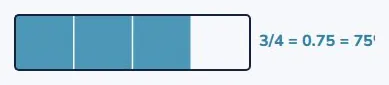
- Three quarters. Nought point seven five. Seventy-five percent.
- Those are not three related quantities.
- They are one quantity in three notations.
The ones to know on sight
- A half, a quarter, three quarters, a fifth, three fifths.
- These come up constantly, in all three forms.
- Knowing them saves you converting the same five all year.
| Fraction | Decimal | Percentage |
|---|---|---|
| 1/2 | 0.5 | 50% |
| 1/4 | 0.25 | 25% |
| 3/4 | 0.75 | 75% |
| 1/5 | 0.2 | 20% |
| 3/5 | 0.6 | 60% |
Fraction to decimal: just divide
- A fraction bar is a division sign. That is all it ever was.
- 7/8 means 7 ÷ 8.
- Which is 0.875. No rule to remember, just the division.
| Going from | Do this | Example |
|---|---|---|
| Fraction to decimal | divide top by bottom | 7 ÷ 8 = 0.875 |
Try it: change a percentage
Decimal to percentage: times 100
- Percent means "per hundred". Out of a hundred.
- So 0.875 becomes 87.5 percent.
- Going back the other way, divide by 100.
| Going from | Do this | Example |
|---|---|---|
| Fraction to decimal | divide top by bottom | 7 ÷ 8 = 0.875 |
| Decimal to percentage | multiply by 100 | 0.875 = 87.5% |
| Percentage to decimal | divide by 100 | 87.5% = 0.875 |
| Decimal to fraction | read the place value | 0.875 = 875/1000 |
Decimal to fraction: read the columns
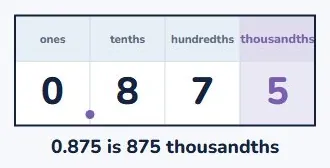
- 0.875 is 875 thousandths, because the last digit is thousandths.
- So it is 875/1000.
- Then simplify. Both divide by 125, giving 7/8.
When it does not come out evenly
- 2/3 means 2 ÷ 3, which never stops. 0.666 and on.
- So the decimal and the percentage are rounded.
- Only the fraction is exact. Sometimes it is the right form.
| Form | Note | Value |
|---|---|---|
| 2 ÷ 3 | never stops | 0.666... |
| As a decimal | rounded to 1 dp | 0.7 |
| As a percentage | rounded to 1 dp | 66.7% |
| Exactly | only the fraction is exact | 2/3 |
Comparing across the three
- Which is largest: 3/5, 0.56, or 58%?
- You cannot compare them as they stand. Pick one form.
- As decimals: 0.6, 0.56, 0.58. So 3/5 wins.
| Value | Converted | As a decimal |
|---|---|---|
| 3/5 | as a decimal | 0.6 |
| 0.56 | already one | 0.56 |
| 58% | as a decimal | 0.58 |
| Largest | 3/5 |
Multiplying by 10, 100, 1000
- 3.7 × 10 is 37. Every digit moves one column left.
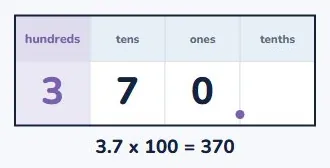
- × 100 moves them two columns. 3.7 becomes 370.
- The number of zeros tells you how many columns.
| Calculation | What happens | Answer |
|---|---|---|
| 3.7 × 10 | digits move 1 left | 37 |
| 3.7 × 100 | digits move 2 left | 370 |
| 3.7 × 1000 | digits move 3 left | 3700 |
And dividing goes the other way
- 45 ÷ 10 is 4.5. Digits move one column right.
- 45 ÷ 1000 moves them three. That gives 0.045.
- Zeros appear to fill the columns nothing landed in.
| Calculation | What happens | Answer |
|---|---|---|
| 45 ÷ 10 | digits move 1 right | 4.5 |
| 45 ÷ 100 | digits move 2 right | 0.45 |
| 45 ÷ 1000 | digits move 3 right | 0.045 |
The digits move, not the point
- You may have been told to move the decimal point.
- Same answers, but the columns are a fixed ladder.
- The digits slide along it. The point marks the ones, always.
Try it: slide the digits
Multiplying two fractions
- Tops times tops. Bottoms times bottoms. That is the whole rule.
- 2/3 × 3/4: the tops give 6, the bottoms give 12.
- So 6/12. No common denominator needed anywhere.
| Part | Working | Gives |
|---|---|---|
| Numerators | 2 × 3 | 6 |
| Denominators | 3 × 4 | 12 |
| So | 6/12 |
Try it: multiply two fractions
But 6/12 is not the answer yet
- 6/12 is correct and unfinished.
- Both numbers divide by 6, giving 1/2.
- Simplest form is part of the question, not an extra.
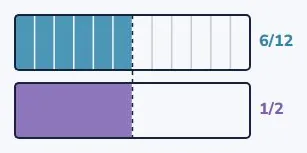
Why the answer got smaller
- Multiplying by 3/4 means taking three quarters of something.
- Three quarters of anything is less than you started with.
- Multiplying only makes things bigger when you multiply by more than 1.
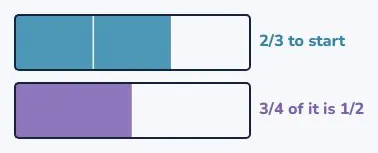
A fraction of a whole number
- 2/5 of 20. Write the 20 as 20/1.
- Then it is an ordinary fraction multiplication: 40/5.
- Which is 8. "Of" has always meant multiply.
| Step | Working | Gives |
|---|---|---|
| 2/5 of 20 | write 20 as 20/1 | 2/5 × 20/1 |
| Multiply | 2 × 20 over 5 × 1 | 40/5 |
| Simplify | 40 ÷ 5 | 8 |
Mixed numbers: convert first
- 1 1/2 × 8. Do not multiply the 1 and the half separately.
- Turn 1 1/2 into halves first: that is 3/2.
- Then 3/2 × 8/1 is 24/2, which is 12.
| Step | Working | Gives |
|---|---|---|
| 1 1/2 | two halves in the 1, plus 1 | 3/2 |
| 3/2 × 8 | as 3/2 × 8/1 | 24/2 |
| Simplify | 24 ÷ 2 | 12 |
Percentages that increase or decrease
- Increase 40 by 25%: you end up with 125% of it.
- So 40 × 1.25 = 50. One multiplication, not two steps.
- Decrease 80 by 15%: you keep 85%. 80 × 0.85 = 68.
| Change | What you end with | Working |
|---|---|---|
| Increase 40 by 25% | you end with 125% | 40 × 1.25 = 50 |
| Decrease 80 by 15% | you end with 85% | 80 × 0.85 = 68 |
| Either way | one multiplication, not two steps |
Common mistakes
- 0.56 is the largest of 3/5, 0.56 and 58%, because 56 is the biggest number.Convert to one form first: 3/5 = 0.6, 0.56 and 58% = 0.58, so 3/5 is the largest.
- 3.7 × 100 = 3.700Multiplying by 100 moves every digit two columns left, so 3.7 × 100 = 370; zeros after the decimal point change nothing.
- 0.875 = 875/100The last digit is in the thousandths column, so 0.875 = 875/1000, which simplifies to 7/8.
- 2/3 × 3/4 = 6/12, and that is the final answer.6/12 is not in simplest form; divide top and bottom by 6 to get 1/2.
Your turn: eight questions
- Try all eight.
- Questions 1 and 2 both want simplest form. Check before you stop.
- Question 4 has two good methods. Either is fine.
Work out 2/3 × 6/7, in simplest form.
Write 0.35 as a fraction in simplest form.
What is 2.4 × 1000?
What is 3/4 of 24?
Write 3/8 as a percentage.
Which is largest: 3/8, 0.4, 35% or 0.38?
Work out 2 1/3 × 6.
A $60 school jersey goes up in price by 15%. Which single multiplication gives the new price?
Show answer
1. 4/7. Multiplying gives 12/21, and both divide by 3. Stopping at 12/21 is the commonest lost mark in the topic. 2. 7/20. 0.35 is 35 hundredths, so 35/100, and both divide by 5. 3. 2400. The digits move three places left. 4. 18. Either 3/4 × 24/1 = 72/4 = 18, or find a quarter of 24 first, which is 6, and take three of them. 5. 37.5%. 3 ÷ 8 = 0.375, and multiplying by 100 moves the digits two places left. 6. 0.4. As decimals they are 0.375, 0.4, 0.35 and 0.38, and 0.4 is the biggest. 7. 14. Convert first: 2 1/3 is 7/3, and 7/3 × 6/1 = 42/3, which is 14. 8. $60 × 1.15. After a 15% increase you end with 115% of the price, which is 1.15 as a decimal.
The answers
- 2/3 × 6/7 gives 12/21, which simplifies to 4/7.
- 0.35 is 35/100, which is 7/20. And 2.4 × 1000 is 2400.
- 3/4 of 24 is 18.
| Answer | |
|---|---|
| 1 | 4/7 |
| 2 | 7/20 |
| 3 | 2400 |
| 4 | 18 |
What to take away
- One amount, three notations. Swap to whichever is easiest.
- Multiplying fractions: tops times tops, bottoms times bottoms.
- Then simplify, every time, before you call it done.
| Remember | |
|---|---|
| One amount | three notations, swap freely |
| Fraction to decimal | divide the top by the bottom |
| Times 100 | digits move two places left |
| Multiplying fractions | tops times tops, bottoms times bottoms |
| Always | simplify before you call it finished |
Challenge
Drink A is 38 fruit juice and the rest water. Drink B is 60% fruit juice. Moana mixes 2 L of drink A with 3 L of drink B. (a) What percentage of her mix is juice? (b) Her brother mixes the other way round: 3 L of A with 2 L of B. Is his mix stronger or weaker than Moana's, and by how many percentage points? (c) Write the juice in her brother's mix as a fraction of the mix, in simplest form.
Hint
Find the litres of juice in each part first. 38 of 2 L is a fraction times a whole number, and 60% of 3 L is 0.6 × 3.
Answer
(a) 51%. (b) Weaker, 46.5%, which is 4.5 percentage points less. (c) 93200.
Step by step
- Moana: 38 of 2 L is 68 = 0.75 L of juice, and 60% of 3 L is 1.8 L. That is 2.55 L of juice in 5 L.
- 2.55 out of 5 is 0.51, which is 51%.
- Her brother: 38 of 3 L is 98 = 1.125 L, and 60% of 2 L is 1.2 L. That is 2.325 L in 5 L, which is 0.465, or 46.5%.
- His mix is weaker because more of it is the weaker drink: 38 is only 37.5%. The gap is 51 − 46.5 = 4.5 percentage points.
- As a fraction, 0.465 is 4651000, and both divide by 5, giving 93200.
Full working
- 38 × 21 = 68 = 0.75 L; 0.6 × 3 = 1.8 Ljuice in each part of Moana's mix
- (0.75 + 1.8) ÷ 5 = 2.55 ÷ 5 = 0.51 = 51%5 L of mix in total
- 38 × 31 = 98 = 1.125 L; 0.6 × 2 = 1.2 Ljuice in her brother's mix
- 2.325 ÷ 5 = 0.465 = 46.5%51 − 46.5 = 4.5 points weaker
- 0.465 = 4651000 = 93200both divide by 5
- (a) 51%; (b) weaker by 4.5 percentage points; (c) 93200
A rectangular vegetable garden is made 20% longer and 20% narrower. (a) By what percentage does its area change, and does it go up or down? (b) A second garden is made 25% longer. By what percentage must its width be cut so that the area stays exactly the same? (c) A third garden is made 50% longer and 50% narrower. What fraction of its old area is left? Explain why making a rectangle the same percentage longer and narrower always loses area.
Hint
Area is length times width. Write each change as a single multiplier: 20% longer is × 65, 20% narrower is × 45. Multiply the two multipliers.
Answer
(a) Down by 4%. (b) 20%. (c) 34 is left, a 25% loss.
Step by step
- 20% longer means the length is multiplied by 120%, which is 65. 20% narrower means the width is multiplied by 80%, which is 45.
- The area is multiplied by 65 × 45 = 2425, which is 96%. So it goes down by 4%.
- 25% longer is × 54. To keep the area the same the width must be multiplied by 45, because 54 × 45 = 1. 45 is 80%, so the width is cut by 20%.
- 50% longer and narrower: 32 × 12 = 34, so a quarter of the area is lost.
- The two multipliers are always the same distance either side of 100%, like 120% and 80%. Two numbers the same distance either side of 100 always multiply to less than 100 × 100: 120 × 80 = 9600, 125 × 75 = 9375, 150 × 50 = 7500. So the area always shrinks.
Full working
- 20% longer: × 65; 20% narrower: × 45120% and 80% as fractions
- 65 × 45 = 2425 = 0.96 = 96%area goes down by 4%
- 54 × 45 = 2020 = 1width × 45 keeps the area the same
- 45 = 80%, so cut by 20%100% − 80%
- 32 × 12 = 34 = 75%a 25% loss
- (a) down 4%; (b) cut by 20%; (c) 34 is left
A predator-free sanctuary in the Waikato counts 64 kiwi. Each year the number of kiwi goes up by exactly 25%. (a) How many kiwi are there after 1, 2 and 3 years? (b) Explain why the count cannot go up by exactly 25% for a 4th year. (c) What is the smallest starting count that lets it go up by exactly 25% every year for 5 years, with a whole number of kiwi each year? How many kiwi would there be after the 5 years, and by roughly what percentage has the count grown altogether?
Hint
Going up by 25% is the same as multiplying by 54. What has to be true of a number so that 54 of it is a whole number? What if you need to do that five times in a row?
Answer
(a) 80, 100, 125. (b) 54 of 125 is 156 14, not a whole number. (c) Start with 1024; after 5 years there are 3125, an increase of about 205%.
Step by step
- Going up by 25% means multiplying by 125%, which is 54. 64 × 54 = 80, then 100, then 125.
- 125 × 54 = 6254 = 156 14. 125 is not a multiple of 4, so you cannot have a whole number of kiwi.
- Each year the count is divided by 4 and multiplied by 5. Multiplying by 5 never adds a factor of 4, so to divide by 4 five times in a row the start must have 4 × 4 × 4 × 4 × 4 = 1024 as a factor.
- Starting at 1024 gives 1280, 1600, 2000, 2500, 3125.
- 3125 ÷ 1024 is about 3.05, so the count is about 305% of the start, an increase of about 205%, not 5 × 25% = 125%.
Full working
- 25% increase: × 54100% + 25% = 125% = 54
- 64 → 80 → 100 → 12564 = 4³ gives three divisions by 4
- 125 × 54 = 6254 = 156 14125 has no factor 4
- start must be a multiple of 4⁵ = 1024five divisions by 4
- 1024 → 1280 → 1600 → 2000 → 2500 → 31251024 × 5⁵ ÷ 4⁵ = 5⁵
- 3125 ÷ 1024 ≈ 3.05, so up about 205%305% of the start
- (a) 80, 100, 125; (c) start 1024, end 3125, up about 205%
Where science uses this
Practise this
Report a mistake
More in Number
 Powers of ten, in both directions7 min
 Powers, roots and prime factors7 min
 Integers: below zero and back again7 min
 Order of operations, estimating and remainders8 minFractions, decimals and percentages7 min
 Decimals, fractions of amounts, and working backwards7 min
 Ratios, and finding the whole from a part7 min
 Comparing money plans, and taking a discount off7 min
Is your child on track?
Take the free placement test