Powers of ten, in both directions
What this lesson covers
- In our number system, each place value is a power of 10, and this continues infinitely to the left and right.
- Repeated division can be expressed using exponent notation with negative exponents.
- Decimals can be represented using negative exponents (i.e. negative powers of ten).
The pattern does not stop at the point
- You have met place value twice: whole numbers, then decimals.
- They are taught as if the decimal point is a border.
- It is not. There is one ladder, and it runs both ways.
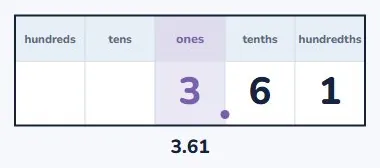
Every column is a power of ten
- A thousand is 10 × 10 × 10, which we write as 10³.
- A hundred is 10², and ten is 10¹.
- The exponent counts how many tens are multiplied together.
| Power | Value | Step |
|---|---|---|
| 10³ | 1000 | |
| 10² | 100 | ÷ 10 |
| 10¹ | 10 | ÷ 10 |
Going down a rung means dividing by ten
- 1000 ÷ 10 is 100. 100 ÷ 10 is 10.
- Every step to the right divides by ten.
- So what comes after 10¹?
| Power | Value | Step |
|---|---|---|
| 10³ | 1000 | |
| 10² | 100 | ÷ 10 |
| 10¹ | 10 | ÷ 10 |
| 10⁰ | 1 | ÷ 10 |
Which is why 10⁰ is 1
- 10 ÷ 10 is 1. The pattern gives us no choice.
- The next rung down from 10¹ is 10⁰, and it is worth 1.
- Not a rule to memorise. Just the pattern, carried on.
| Power | Value | Step |
|---|---|---|
| 10³ | 1000 | |
| 10² | 100 | ÷ 10 |
| 10¹ | 10 | ÷ 10 |
| 10⁰ | 1 | ÷ 10 |
And nothing stops us carrying on
- 1 ÷ 10 is 0.1. That is the next rung.
- The exponent has to keep dropping too, so it goes negative.
- 0.1 is 10⁻¹. Then 0.01 is 10⁻², and so on for ever.
| Power | Value | Step |
|---|---|---|
| 10⁰ | 1 | |
| 10⁻¹ | 0.1 | ÷ 10 |
| 10⁻² | 0.01 | ÷ 10 |
| 10⁻³ | 0.001 | ÷ 10 |
What a negative exponent actually means
- It does not mean a negative number. 10⁻² is not below zero.
- It counts divisions instead of multiplications.
- 10⁻³ means 1 divided by ten, three times over.
| Exponent | Counts | So |
|---|---|---|
| Positive | how many tens multiplied | 10³ = 10 × 10 × 10 |
| Zero | no tens at all | 10⁰ = 1 |
| Negative | how many tens divided by | 10⁻³ = 1 ÷ 10 ÷ 10 ÷ 10 |
Try it: go below 10⁰
Three ways to write the same rung
- 10⁻² is one hundredth.
- One hundredth is the fraction 1/100.
- And 1/100 is the decimal 0.01. Three names, one number.
| Power | Fraction | Decimal |
|---|---|---|
| 10⁻¹ | 1/10 | 0.1 |
| 10⁻² | 1/100 | 0.01 |
| 10⁻³ | 1/1000 | 0.001 |
So the columns have proper names
- The ones column is the 10⁰ column.
- First past the point is tenths, which is 10⁻¹.
- Then hundredths, 10⁻². The point marks where the ones are.
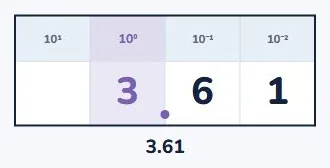
Writing 3.61 the long way
- Take each digit with the column it sits in.
- 3 ones, 6 tenths, 1 hundredth.
- So 3.61 = 3 × 10⁰ + 6 × 10⁻¹ + 1 × 10⁻².
| Digit | Column | Written | Worth |
|---|---|---|---|
| 3 | ones | 3 × 10⁰ | 3 |
| 6 | tenths | 6 × 10⁻¹ | 0.6 |
| 1 | hundredths | 1 × 10⁻² | 0.01 |
Check it by adding it back up
- 3 + 0.6 + 0.01.
- That is 3.61, which is what we started with.
- Expanded form is never a guess. It always adds back.
| Digit | Column | Written | Worth |
|---|---|---|---|
| 3 | ones | 3 × 10⁰ | 3 |
| 6 | tenths | 6 × 10⁻¹ | 0.6 |
| 1 | hundredths | 1 × 10⁻² | 0.01 |
A longer one: 2405.07
- Start at the left. 2 is in the thousands, so 2 × 10³.
- Work right one column at a time, dropping the exponent by one.
- Past the point the exponents go negative. 7 is 7 × 10⁻².
| Digit | Written | Worth |
|---|---|---|
| 2 | 2 × 10³ | 2000 |
| 4 | 4 × 10² | 400 |
| 0 | 0 × 10¹ | 0 |
| 5 | 5 × 10⁰ | 5 |
| 0 | 0 × 10⁻¹ | 0 |
| 7 | 7 × 10⁻² | 0.07 |
Try it: 2405.07 the long way
The zeros are not optional
- Two columns here hold a zero, and contribute nothing.
- But they hold the other digits in their places.
- Drop them and 2405.07 becomes 245.7, a different number.
| Digit | Written | Worth |
|---|---|---|
| 2 | 2 × 10³ | 2000 |
| 4 | 4 × 10² | 400 |
| 0 | 0 × 10¹ | 0 |
| 5 | 5 × 10⁰ | 5 |
| 0 | 0 × 10⁻¹ | 0 |
| 7 | 7 × 10⁻² | 0.07 |
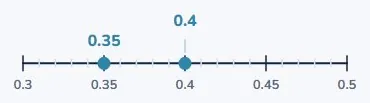
Now: which is bigger, 0.4 or 0.35?
- Plenty of people say 0.35, because 35 is bigger than 4.
- Put them on a line and you can see it is not.
- 0.4 sits to the right of 0.35.
Why more digits does not mean bigger
- After the point, the digits are not a whole number.
- The first one is tenths, and tenths outrank everything after.
- 4 tenths beats 3 tenths. The hundredths never get a say.
| Number | Tenths | Hundredths |
|---|---|---|
| 0.4 | 4 tenths | 0 hundredths |
| 0.35 | 3 tenths | 5 hundredths |
| Bigger? | 4 beats 3 | 0.4 |
Ordering four of them
- Compare the tenths first. Only if they tie, move right.
- 0.405 and 0.45 both have 4 tenths, so go to the hundredths.
- 0 beats nothing, 5 beats 0. Smallest to largest, left to right.
| Number | Reading it | |
|---|---|---|
| 0.405 | 4 tenths, 0 hundredths | smallest |
| 0.45 | 4 tenths, 5 hundredths | |
| 0.5 | 5 tenths | |
| 0.54 | 5 tenths, 4 hundredths | largest |
Common mistakes
- 10⁻² = −100.A negative exponent counts divisions, not a negative number: 10⁻² = 1/100 = 0.01.
- 0.35 is bigger than 0.4, because 35 is bigger than 4.Compare the tenths first: 4 tenths beats 3 tenths, so 0.4 is bigger.
- 3.61 = 3 × 10¹ + 6 × 10⁻¹ + 1 × 10⁻².The ones column is 10⁰, not 10¹, so 3.61 = 3 × 10⁰ + 6 × 10⁻¹ + 1 × 10⁻².
- 2405.07 = 2 × 10³ + 4 × 10² + 5 × 10⁰ + 7 × 10⁻¹.The 7 is in the hundredths column after a zero tenth, so it is 7 × 10⁻²; skipping zero columns moves digits.
Your turn: eight questions
- Try all eight.
- Question 2 wants powers of ten, not just 4 + 0.5 + 0.02.
- Question 3 is the one to slow down on.
Write 0.001 as a power of ten.
Write 4.52 in expanded form using powers of ten.
Which is bigger, 0.7 or 0.65?
Write 10⁻¹ as a fraction and as a decimal.
Which is true about 10⁰?
What number is 5 × 10² + 3 × 10⁰ + 8 × 10⁻²?
Tama writes 2.07 = 2 × 10⁰ + 7 × 10⁻¹. What is his mistake?
Put these in order from smallest to largest: 0.6, 0.06, 0.66, 0.606.
Show answer
1. 10⁻³. Three divisions by ten below the ones. 2. 4 × 10⁰ + 5 × 10⁻¹ + 2 × 10⁻². 3. 0.7. It has 7 tenths against 6 tenths, and the comparison is settled there. The extra digit in 0.65 never gets a say. 4. 1/10 and 0.1. 5. It equals 1. Each column down divides by ten, and 10¹ ÷ 10 = 1, so 10⁰ is the ones column. 6. 503.08. That is 5 hundreds, 0 tens, 3 ones, 0 tenths and 8 hundredths: 500 + 3 + 0.08 = 503.08. 7. The 7 is in the hundredths column, so it should be 7 × 10⁻²; as written it adds back to 2.7, not 2.07. 8. 0.06, 0.6, 0.606, 0.66. Compare tenths first: 0.06 has none; the rest have 6, so go to the hundredths, where 0.66 has the most.
The answers
- 0.001 is three divisions below the ones, so 10⁻³.
- 4.52 is 4 × 10⁰ + 5 × 10⁻¹ + 2 × 10⁻².
- 0.7 is bigger. And 10⁻¹ is 1/10, which is 0.1.
| Answer | |
|---|---|
| 1 | 10⁻³ |
| 2 | 4 × 10⁰ + 5 × 10⁻¹ + 2 × 10⁻² |
| 3 | 0.7 |
| 4 | 1/10 and 0.1 |
What to take away
- One ladder of powers of ten, running both ways for ever.
- A negative exponent counts divisions, not subtractions.
- To compare, start at the left and stop at the first difference.
| Remember | |
|---|---|
| One ladder | each rung is ten times the one below |
| 10⁰ | is 1, because the pattern says so |
| Negative exponent | counts divisions, not subtractions |
| 10⁻² | is 1/100, which is 0.01 |
| Comparing | start at the left and stop at the first difference |
Challenge
Think about the numbers that lie strictly between 0.4 and 0.45. (a) How many of them have exactly two decimal places? (b) How many have exactly three decimal places, so the thousandths digit is not 0? (c) Of the numbers in (b), how many have an expanded form with exactly three terms, like 4 × 10⁻¹ + 3 × 10⁻² + 7 × 10⁻³, with no zero digit anywhere?
Hint
Write 0.4 as 0.400 and 0.45 as 0.450. Now you are counting thousandths from 400 to 450, not including the ends. Which of those end in a 0?
Answer
(a) 4 (0.41, 0.42, 0.43, 0.44). (b) 45. (c) 36.
Step by step
- With two decimal places, the numbers after 0.40 and before 0.45 are 0.41, 0.42, 0.43 and 0.44.
- With three places, write the ends as 0.400 and 0.450. The numbers in between run from 0.401 to 0.449, which is 49 numbers.
- Four of those end in 0 (0.410, 0.420, 0.430, 0.440). They really only have two decimal places, so 49 − 4 = 45 are left.
- For exactly three terms, the hundredths digit must not be 0 either. It can only be 1, 2, 3 or 4, because 0.45 is the limit.
- The thousandths digit can be any of 1 to 9, so there are 4 × 9 = 36 numbers.
Full working
- 0.41, 0.42, 0.43, 0.44strictly between 0.40 and 0.45
- 0.401 to 0.449: 449 − 401 + 1 = 49count the thousandths
- 49 − 4 = 45remove 0.410, 0.420, 0.430, 0.440
- hundredths digit 1, 2, 3 or 40 would drop a term, 5 or more reaches 0.45
- 4 × 9 = 36thousandths digit 1 to 9
- (a) 4; (b) 45; (c) 36
(a) Mere slides every digit of a number two columns to the left. Her number goes up by 316.8. What was her number? Write it in expanded form using powers of ten. (b) Rawiri slides every digit of a different number three columns to the right. His number goes down by 25.2747. What was his number? Write it in expanded form using powers of ten.
Hint
Sliding two columns left makes the number 100 times as big. So the increase is 100 lots of the number take away 1 lot. How many lots of the number is that?
Answer
(a) 3.2 = 3 × 10⁰ + 2 × 10⁻¹. (b) 25.3 = 2 × 10¹ + 5 × 10⁰ + 3 × 10⁻¹.
Step by step
- Two columns left means multiplying by 10², which is 100.
- The new number is 100 lots of the old one, so it has gone up by 99 lots. 99 lots make 316.8, so one lot is 316.8 ÷ 99 = 3.2.
- Three columns right means multiplying by 10⁻³, so the new number is one thousandth of the old one.
- Losing all but one thousandth means losing 999 thousandths of the number, which is 0.999 of it.
- 0.999 of the number is 25.2747, so the number is 25.2747 ÷ 0.999 = 25.3. Check: 25.3 − 0.0253 = 25.2747.
Full working
- new = old × 10² = 100 × oldtwo columns left
- increase = 99 × old = 316.8100 lots minus 1 lot
- old = 316.8 ÷ 99 = 3.2check: 320 − 3.2 = 316.8
- new = old × 10⁻³three columns right
- decrease = 0.999 × old = 25.2747, so old = 25.3check: 25.3 − 0.0253 = 25.2747
- (a) 3.2 = 3 × 10⁰ + 2 × 10⁻¹; (b) 25.3 = 2 × 10¹ + 5 × 10⁰ + 3 × 10⁻¹
A calculator shows 1000. It has only two buttons: one multiplies the number on screen by 10, the other divides it by 10. Tia presses buttons exactly 11 times, in some order, and the screen ends on 0.01. (a) How many times did she press the divide button? (b) Hemi says that after exactly 11 presses the screen could show 0.1. Explain why he is wrong. (c) How many different numbers could the screen show after exactly 11 presses? Give the smallest and largest as powers of ten.
Hint
Write 1000 and 0.01 as powers of ten. Each press moves the exponent up 1 or down 1. Think about what 11 moves of 1 can add up to.
Answer
(a) 8 times (and 3 multiplies). (b) 0.1 needs an even number of presses. (c) 12 numbers, from 10⁻⁸ to 10¹⁴.
Step by step
- 1000 is 10³ and 0.01 is 10⁻². Each press changes the exponent by 1, up or down. Overall it must drop by 5.
- 11 presses that drop the exponent by 5 overall: 8 down and 3 up works, because 3 − 8 = −5.
- 0.1 is 10⁻¹, a drop of 4. If there are m multiplies and d divides with m + d = 11, then one of m and d is odd and one is even, so m − d is always odd. A drop of 4 is even, so it cannot happen.
- The change in the exponent can be any odd number from −11 to 11. That is 12 choices, so the final exponent is any even number from 3 − 11 = −8 up to 3 + 11 = 14.
- So there are 12 possible numbers, from 10⁻⁸ (0.00000001) to 10¹⁴.
Full working
- 1000 = 10³, 0.01 = 10⁻²change of −5 in the exponent
- m + d = 11 and m − d = −5m multiplies, d divides
- d = 8, m = 3check: 3 + 3 − 8 = −2
- 0.1 = 10⁻¹ needs m − d = −4but 11 = odd + even, so m − d is odd
- m − d ∈ {−11, −9, ..., 9, 11}12 odd values
- exponent from 3 − 11 = −8 to 3 + 11 = 14, even only12 numbers
- (a) 8 divides; (b) impossible; (c) 12 numbers, 10⁻⁸ to 10¹⁴
Practise this
Report a mistake
More in Number
Powers of ten, in both directions7 min Powers, roots and prime factors7 min
 Integers: below zero and back again7 min
 Order of operations, estimating and remainders8 min
 Fractions, decimals and percentages7 min
 Decimals, fractions of amounts, and working backwards7 min
 Ratios, and finding the whole from a part7 min
 Comparing money plans, and taking a discount off7 min
Is your child on track?
Take the free placement test