Adding fractions and decimals, and fractions of amounts
What this lesson covers
- Fractions should have the same denominator before using them in addition or subtraction.
- Multiplication, division, fractions, decimals, and percentages can be used to solve problems involving relative quantities and measures.
Pieces have to be the same size
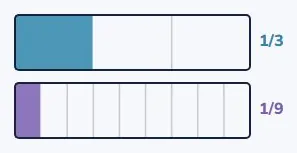
- You cannot add thirds to ninths as they stand.
- The pieces are different sizes, so counting them means nothing.
- Make them match, and then it is only counting.
Match the bottom number first
- Fractions need the same denominator before you add them.
- The bottom says how big the pieces are.
- Same bottom, same size pieces, and the tops can be added.
| this | not this |
|---|---|
| 6/9 + 1/9 | 2/3 + 1/9 |
| add the tops | nothing to add yet |
Rewrite one of them
- 2/3 + 1/9. Nine is a multiple of three.
- So multiply top and bottom of the thirds by 3.
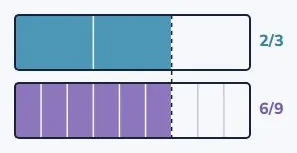
- 2/3 becomes 6/9. Same amount, new name.
Now add the tops
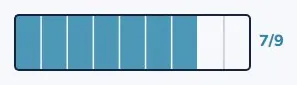
- 6/9 + 1/9. Six ninths and one more ninth.
- That is 7/9.
- The bottom never changes. You are counting pieces, not making them.
Try it: match the pieces, then add
Subtraction is the same job
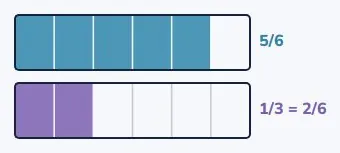
- 5/6 − 1/3. Sixths and thirds.
- 6 is a multiple of 3, so 1/3 becomes 2/6.
- 5/6 − 2/6 = 3/6, which is a half.
Decimals need exactly the same thing
- You cannot add tenths to hundredths as they stand either.
- Lining up the decimal points lines up the places.
- It is not a second rule. It is the same rule.
| fractions | decimals |
|---|---|
| match the denominators | line up the points |
| then add the tops | then add each column |
Adding to two places
- 1.31 + 0.22. Points under points.
- Hundredths: 1 + 2 = 3. Tenths: 3 + 2 = 5.
- Ones: 1 + 0 = 1. So 1.53.
| ones | tenths | hundredths | |
|---|---|---|---|
| 1.31 | 1 | 3 | 1 |
| 0.22 | 0 | 2 | 2 |
| 1.53 | 1 | 5 | 3 |
When the lengths do not match
- 4.6 − 1.25. One has a hundredths digit, one does not.
- Write 4.6 as 4.60. That free zero again.
- Now every column subtracts: 3.35.
| ones | tenths | hundredths | |
|---|---|---|---|
| 4.60 | 4 | 6 | 0 |
| 1.25 | 1 | 2 | 5 |
| 3.35 | 3 | 3 | 5 |
A fraction of an amount
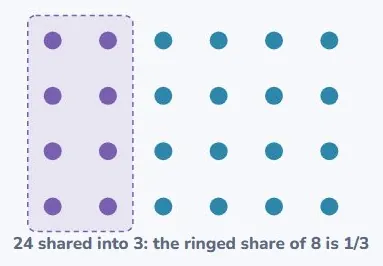
- 2/3 of 24. The bottom tells you to share into 3.
- 24 shared into 3 is 8. That is one third.
- The top tells you how many of those you want.
Divide by the bottom, times by the top
- One third of 24 is 8.
- Two thirds is two lots of that, so 16.
- Down to one piece, then up to as many as you need.
| step | working | result |
|---|---|---|
| share into 3 | 24 ÷ 3 | 8 |
| take 2 of them | 8 × 2 | 16 |
Backwards: the part is given
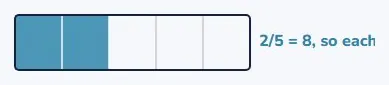
- 8 is 2/5 of a set. How big is the set?
- Two fifths is 8, so one fifth is 4.
- Five fifths is five lots of 4, so the set is 20.
Percentages of a number
- 10% of 340: move the digits one place right, so 34.
- 50% is just half, so 170.
- 25% is half of that half, so 85. No written working needed.
| find | of 340 | how |
|---|---|---|
| 10% | 34 | digits one place right |
| 50% | 170 | halve it |
| 25% | 85 | halve it twice |
Try it: change a percentage
Backwards again: finding 100%
- If 25% is 15, then 100% is four lots of 15, so 60.
- If 50% is 15, then 100% is two lots of 15, so 30.
- Same move as the fractions. Get to one piece, then build up.
| given | reasoning | 100% |
|---|---|---|
| 25% is 15 | so 100% is 4 lots of 15 | 60 |
| 50% is 15 | so 100% is 2 lots of 15 | 30 |
Common mistakes
- 2/3 + 1/9 = 3/12Make the bottoms match first: 2/3 = 6/9, so 6/9 + 1/9 = 7/9. The bottom is the size of the piece, so it is never added.
- 2.45 + 1.3 = 2.58Line up the points, not the last digits: 2.45 + 1.30 = 3.75.
- 2/3 of 24: 24 ÷ 2 = 12, then 12 × 3 = 36.Divide by the bottom, then times by the top: 24 ÷ 3 = 8, and 8 × 2 = 16.
- 8 is 2/5 of a set, so the set is 8 × 5 = 40.8 is two fifths, so one fifth is 4. Five fifths is 5 × 4 = 20.
Your turn
3/4 + 1/8, and then 7/10 − 1/5.
2.45 + 1.3, and then 5.2 − 0.86.
3/5 of 45.
If 12 is 3/4 of a set, how big is the set? And 25% of 80?
Mere wrote 2/5 + 1/10 = 3/15. What is the right answer?
Aroha ran 2.75 km on Monday and 1.4 km on Tuesday. How far did she run altogether?
25% of a number is 18. What is 50% of the number, and what is 100% of it?
Hemi has read 15 pages, which is 3/8 of his book. How many pages does he still have to read?
Show answer
1. 6/8 + 1/8 = 7/8, and 7/10 − 2/10 = 5/10 which is a half. 2. 2.45 + 1.30 = 3.75, and 5.20 − 0.86 = 4.34. 3. 45 ÷ 5 = 9, and 9 × 3 = 27. 4. One quarter is 4, so the set is 16. And 25% of 80 is 20. 5. 5/10, which is a half. Ten is a multiple of five, so 2/5 becomes 4/10, and 4/10 + 1/10 = 5/10. Mere added the bottoms, which you never do. 6. 4.15 km. Write 1.4 as 1.40 and line up the points: 2.75 + 1.40 = 4.15. 7. 36 and 72. 50% is two lots of 25%, so 2 × 18 = 36, and 100% is four lots, so 4 × 18 = 72. 8. 25 pages. One eighth is 15 ÷ 3 = 5, so the book is 8 × 5 = 40 pages, and 40 − 15 = 25 are left.
Fractions: Equality
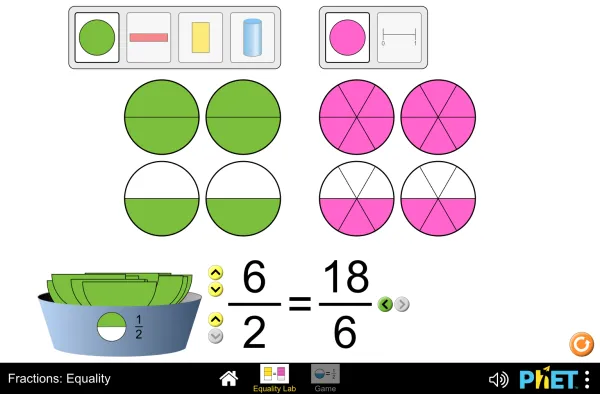
Full screen · PhET Interactive Simulations, University of Colorado Boulder, CC BY 4.0
What to take away
- Same size pieces before you add. Fractions and decimals both.
- For a fraction of an amount: divide by the bottom, times the top.
- Working backwards, get to one piece first, then build up.
| job | the move |
|---|---|
| add fractions | match the bottoms, add the tops |
| add decimals | line up the points, pad with a zero |
| fraction of an amount | divide by the bottom, times the top |
| find the whole | down to one piece, then up to all |
Challenge
A farm water tank starts empty. On Monday it is filled to 12 of the way. On Tuesday another 16 of the tank is added, and on Wednesday another 112. It still needs 45 L more to be full. How much water does the full tank hold?
Hint
Make all three fractions twelfths. How much of the tank is still empty?
Answer
180 L
Step by step
- Twelfths fit all three: 12 = 612 and 16 = 212.
- 612 + 212 + 112 = 912 of the tank is full.
- So 312 is empty, and 312 = 14.
- One quarter is 45 L, so the whole tank is 4 lots of 45 L = 180 L.
- Check: 90 + 30 + 15 = 135 L, and 135 + 45 = 180.
Full working
- 12 = 612, 16 = 212same size pieces
- 612 + 212 + 112 = 912full so far
- 1212 − 912 = 312 = 14still empty
- 14 = 45 L, so 4 × 45 = 180down to one piece, then up
- 180 L
A jar holds some marbles. Kahu takes 13 of them. Then Rua takes 14 of the marbles that are left. Now there are 18 marbles in the jar. How many were there at the start?
Hint
Work backwards. After Kahu, Rua took a quarter, so the 18 is how many quarters of what Kahu left?
Answer
36 marbles
Step by step
- Rua took 14 of what was there, so 18 is the other 34.
- 3 quarters is 18, so one quarter is 6, and what Kahu left was 4 × 6 = 24.
- Kahu took 13, so 24 is the other 23 of the start.
- 2 thirds is 24, so one third is 12, and the start was 3 × 12 = 36.
- Check: Kahu takes 12 of 36, leaving 24. Rua takes 6, leaving 18.
Full working
- 34 of the rest = 18Rua left three quarters
- 18 ÷ 3 = 6, 6 × 4 = 24marbles after Kahu
- 23 of the start = 24Kahu left two thirds
- 24 ÷ 2 = 12, 12 × 3 = 36marbles at the start
- 36 − 12 = 24, 24 − 6 = 18check
- 36 marbles
In a sale, a jacket has 25% taken off its price, and it now costs $48. Mere says: "25% of $48 is $12, so the old price was $48 + $12 = $60." Show that Mere is wrong, and find the real old price.
Hint
Take 25% off Mere's $60 and see what you get. Then think about what percentage of the old price $48 is.
Answer
Mere is wrong: 25% off $60 gives $45, not $48. The real old price was $64.
Step by step
- Test Mere's answer: 25% of $60 is $15, and $60 − $15 = $45, not $48.
- Her mistake: the 25% is a quarter of the old price, not of the new one.
- Taking off 25% leaves 75% of the old price, so $48 is 75%.
- 75% is three quarters. So one quarter (25%) is $48 ÷ 3 = $16.
- 100% is four quarters: 4 × $16 = $64. Check: 25% of $64 is $16, and $64 − $16 = $48.
Full working
- 25% of 60 = 15, 60 − 15 = 45Mere's price fails
- 100% − 25% = 75%what is left after the sale
- 75% = $48three quarters
- 25% = 48 ÷ 3 = $16one quarter
- 100% = 4 × 16 = $64four quarters
- 64 − 16 = 48check
- the old price was $64
Practise this
Report a mistake
More in Number
 Big numbers, factors and rounding5 min
 Negative numbers and counting on5 min
 Adding and subtracting big numbers5 min
 Multiplying and dividing bigger numbers6 min
 Tenths, hundredths and comparing decimals6 min
 Multiplying and dividing by 10 and 1006 minAdding fractions and decimals, and fractions of amounts5 min
 Money: totals, change and rounding5 min
Is your child on track?
Take the free placement test