Money: totals, change and rounding
What this lesson covers
- Money uses our decimal place-value system to two decimal places.
You already know this one
- A cent is one hundredth of a dollar. Exactly one hundredth.
- So money is decimals to two places, with a $ in front.
- Everything from the last three lessons was money all along.
| money | is really |
|---|---|
| $4.75 + $12.30 | adding decimals to 2 places |
| change from $30 | subtracting across zeros |
| about $5 | rounding |
The two places are cents
- 100 cents make a dollar, so 1c is 1/100 of a dollar.
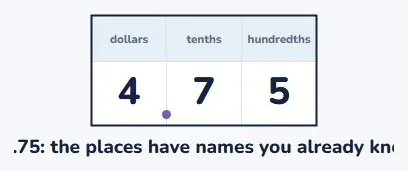
- First place after the point: ten-cent pieces.
- Second place: single cents. $4.75 is 4 dollars, 7 tens, 5 ones.
Always two places
- Money never gets written with one decimal place.
- $4.7 is not wrong by a little. It is unreadable.
- Fill the second place, even when it is a zero.
| not this | this | why |
|---|---|---|
| $4.7 | $4.70 | that is 70c, not 7c |
| $4.5 | $4.50 | fifty cents needs both places |
| $.05 | $0.05 | five cents, and keep the 0 |
| $4.75c | $4.75 | a dollar sign or a c, never both |
Read the place, not the digit
- If you did write $4.7, the 7 sits in the tenths place.
- Tenths of a dollar are ten-cent pieces. So that is 70c.
- Seven cents is $0.07. One place apart, ten times apart.
| written | the 7 is in | means |
|---|---|---|
| $4.70 | tenths | 70 cents |
| $4.07 | hundredths | 7 cents |
Cents into dollars
- Going from cents to dollars is dividing by 100.
- Which means the digits move two places right.
- So 475c is $4.75, and 8c is $0.08.
| cents | dollars |
|---|---|
| 475c | $4.75 |
| 60c | $0.60 |
| 8c | $0.08 |
So why two places, with no 1c coin?
- New Zealand dropped 1c and 2c in 1990, and 5c in 2006.
- The smallest coin is 10c, so cash rounds to the nearest 10c.
- But prices and card payments are still exact to the cent.
| paying | what happens to $4.78 |
|---|---|
| by card | exactly $4.78 |
| with cash | rounded to $4.80 |
Totalling a basket
- Three things: a book, a drink and a sandwich.
- Write the prices with the points underneath each other.
- That lines up dollars with dollars and cents with cents.
| item | price |
|---|---|
| book | $12.30 |
| drink | $4.75 |
| sandwich | $6.35 |
Try it: pay the exact amount
Add the columns
- Cents: 0 + 5 + 5 = 10. Write 0, carry 1.
- Ten-cents: 3 + 7 + 3 + 1 = 14. Write 4, carry 1.
- Dollars: 12 + 4 + 6 + 1 = 23. So $23.40.
| column | add | write | carry |
|---|---|---|---|
| cents | 0 + 5 + 5 = 10 | 0 | 1 |
| ten-cents | 3 + 7 + 3 + 1 = 14 | 4 | 1 |
| dollars | 12 + 4 + 6 + 1 | 23 | 0 |
Check it before you believe it
- Round each price to the nearest dollar first.
- $12 and $5 and $6 is $23.
- We got $23.40. Close enough to trust.
| price | to the nearest dollar |
|---|---|
| $12.30 | $12 |
| $4.75 | $5 |
| $6.35 | $6 |
Rounding to the nearest dollar
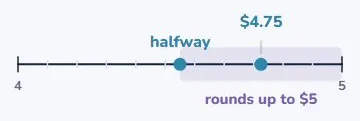
- Look only at the cents. Under 50c rounds down.
- 50c or more rounds up. Exactly 50c goes up.
- So $4.75 is about $5, and $12.30 is about $12.
Change from the nearest ten dollars
- The basket is $23.40. The next ten dollars up is $30.00.
- So you hand over thirty dollars.
- The change is $30.00 take away $23.40.
| amount | |
|---|---|
| to pay | $23.40 |
| handed over | $30.00 |
| change | ? |
Two ways, one answer
- In columns: $30.00 − $23.40 needs borrowing across both zeros.
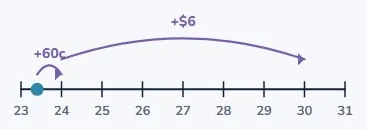
- Or count up: 60c gets you to $24, then $6 more to $30.
- Either way the change is $6.60.
Try it: count on to give change
Common mistakes
- $4.7 is four dollars and seven cents.The 7 is in the tenths place, so it is 70 cents: write $4.70. Seven cents is $0.07.
- $30.00 − $23.40 = $7.60Count up instead: 60c gets to $24, then $6 more gets to $30, so the change is $6.60.
- 475c = $47.5Cents into dollars divides by 100, so the digits move two places: 475c is $4.75.
- $12.30 + $4.75 + $6.35 = $22.40Carry the extra 1 from each column: the total is $23.40, and rounding to $12 + $5 + $6 = $23 checks it.
Your turn
Write 6c, then 60c, then 615c, in dollars.
Total $8.45, $3.20 and $11.90.
Round each of those three to the nearest dollar.
Find the change from $30 for your total in question 2.
Which is the right way to write seven dollars and five cents?
Round $14.50 and $9.49 to the nearest dollar.
A pie at a Rotorua dairy costs $6.43. You pay with cash. How much do you pay?
Lunch in Wellington is $13.85 for a wrap and $4.60 for a juice. You pay with the next ten dollars up. What is your change?
Show answer
1. $0.06, $0.60, $6.15. 2. $23.55. 3. $8, $3, $12, which totals $23, so question 2 looks right. 4. $30.00 − $23.55 = $6.45. 5. $7.05. Five cents is five hundredths, so the 5 goes in the second place and the tenths place gets a 0. 6. $15 and $9. Look only at the cents: 50c or more rounds up, so $14.50 is $15, and 49c is under 50c, so $9.49 is $9. 7. $6.40. The smallest coin is 10c, so cash rounds to the nearest 10c, and 43c is nearer 40c than 50c. 8. $1.55. The total is $13.85 + $4.60 = $18.45, so you hand over $20.00. Count up: 55c to $19, then $1 more, so $1.55.
What to take away
- A cent is a hundredth, so money is just two-place decimals.
- Write both places, and line the points up before adding.
- For change, count up to the next ten dollars.
| job | the move |
|---|---|
| write money | two decimal places, always |
| total a basket | points under points, then add |
| check a total | round each price and add those |
| find change | count up to the next $10 |
Challenge
Pens cost $1.27 each. When you pay cash, each payment is rounded to the nearest 10c. Ana buys 3 pens in one cash payment. Ben buys 3 pens one at a time, paying cash each time. Who pays more, and by how much? If they had both paid by card, how much would each have paid?
Hint
Round each payment, not each pen. Ana makes one payment and Ben makes three.
Answer
Ben pays 10c more: Ana pays $3.80 and Ben pays $3.90. By card, both would pay exactly $3.81.
Step by step
- 3 pens cost $1.27 + $1.27 + $1.27 = $3.81 exactly.
- Ana pays once in cash: $3.81 rounds to the nearest 10c, which is $3.80.
- Ben pays three times in cash: each $1.27 rounds to $1.30.
- Three lots of $1.30 is $3.90.
- So Ben pays $3.90 − $3.80 = 10c more. A card pays to the exact cent, $3.81, for both.
Full working
- $1.27 + $1.27 + $1.27 = $3.81exact cost of 3 pens
- $3.81 rounds to $3.801c is under halfway to the next 10c
- $1.27 rounds to $1.307c is past halfway
- $1.30 + $1.30 + $1.30 = $3.90Ben's three payments
- $3.90 − $3.80 = $0.10the difference
- Ben pays 10c more ($3.90 against $3.80); by card both pay $3.81
A café sells muffins for $3.45 and coffees for $4.80. A group buys some of each, and the card bill is exactly $37.80. How many muffins and how many coffees did they buy?
Hint
Look at the cents digit. Every coffee total ends in 0 cents. What happens to the last digit when you add muffins one at a time?
Answer
4 muffins and 5 coffees.
Step by step
- Any number of coffees costs a whole number of 10c pieces, because $4.80 ends in 0.
- One muffin ends in 5c, two end in 0c, three in 5c, and so on. The bill ends in 0c, so there is an even number of muffins.
- 11 muffins would already cost $37.95, more than the bill, so try 2, 4, 6, 8 and 10 muffins.
- 4 muffins cost $13.80, leaving $24.00, which is exactly 5 coffees.
- No other even number of muffins leaves an amount that is an exact number of coffees.
Full working
- $3.45 × 2 = $6.90leaves $30.90, not a number of coffees
- $3.45 × 4 = $13.80leaves $37.80 − $13.80 = $24.00
- $24.00 ÷ $4.80 = 5exactly 5 coffees
- $3.45 × 6 = $20.70leaves $17.10, not a number of coffees
- $3.45 × 8 = $27.60leaves $10.20, not a number of coffees
- $3.45 × 10 = $34.50leaves $3.30, less than one coffee
- 4 muffins and 5 coffees
Hemi copies four prices from a receipt: $6.40, $2.05, $13.70 and $4.82. He adds them up and gets more than the receipt total, which is $26.43. He realises that in exactly one price he swapped the two digits after the point (so, for example, $1.23 would become $1.32). Which price did he copy wrongly, and what was the real price?
Hint
Find how far out his total is. Then work out how much each price would change if its two cents digits were swapped back.
Answer
$4.82 was copied wrongly. The real price was $4.28.
Step by step
- Hemi's four prices add to $26.97.
- That is $26.97 − $26.43 = 54c too much, so the true price is 54c less than the one he wrote.
- Swap back each price in turn: $6.40 becomes $6.04 (36c less), $2.05 becomes $2.50 (more, not less), $13.70 becomes $13.07 (63c less), $4.82 becomes $4.28 (54c less).
- Only $4.82 changes by exactly 54c, so that is the wrong one, and the real price is $4.28.
- Check: $6.40 + $2.05 + $13.70 + $4.28 = $26.43.
Full working
- $6.40 + $2.05 + $13.70 + $4.82 = $26.97Hemi's total
- $26.97 − $26.43 = $0.54how much too much
- $6.40 − $6.04 = $0.36not 54c
- $13.70 − $13.07 = $0.63not 54c
- $4.82 − $4.28 = $0.54matches
- $6.40 + $2.05 + $13.70 + $4.28 = $26.43check
- $4.82 was wrong; the real price was $4.28
Practise this
Report a mistake
More in Number
 Big numbers, factors and rounding5 min
 Negative numbers and counting on5 min
 Adding and subtracting big numbers5 min
 Multiplying and dividing bigger numbers6 min
 Tenths, hundredths and comparing decimals6 min
 Multiplying and dividing by 10 and 1006 min
 Adding fractions and decimals, and fractions of amounts5 minMoney: totals, change and rounding5 min
Is your child on track?
Take the free placement test